“Is it too late in the year to get this done?” is a question I hear from about August onward, every single season. Here’s the honest answer: the best time of year for stucco work in the GTA is roughly April through November, with the strongest finish-coat window sitting from May to September — and the calendar for that window fills up a lot earlier than most homeowners expect. After 25+ years scheduling crews around this climate, I can tell you almost exactly why that window exists, and what you can still get done outside it.
When’s the best time of year to get stucco work done in the GTA?
The best window runs April through November, with May to September being the safest stretch for finish coats. Outside that window the temperature itself becomes the obstacle — not the crew, not the material, the weather. Booking early inside that window matters just as much as the season, because the good slots go first.
That window isn’t a marketing line — it’s chemistry. Cement stucco and acrylic finish coats both cure through a reaction that needs sustained above-freezing temperatures to complete properly. Push a finish coat into a cold snap and the surface can look fine the day we leave and still be structurally weak underneath, a problem that doesn’t show up until the following winter. I’d rather push your start date than gamble your wall on a warm afternoon in a cold week.
Why does temperature actually matter for stucco and EIFS?
Both systems need the coating to stay above freezing, day and night, for long enough to properly hydrate and set. A warm daytime high doesn’t save a finish coat if the overnight low drops below zero — that’s the number that actually decides whether a cure completes or gets interrupted halfway through.
| System | Minimum cure temperature | What goes wrong if it’s rushed |
|---|
| Traditional cement stucco | Above 0°C, sustained | Weak, chalky surface; freeze damage before full strength |
| Acrylic/EIFS finish coat | Above ~5°C, sustained | Film never fully forms; early cracking and poor bond |
| Both systems, overnight | Low must stay above freezing | A cold night mid-cure can undo a warm afternoon’s work |
This isn’t unique to us — it’s the same reason concrete crews watch the overnight forecast every fall. Environment and Climate Change Canada’s climate normals for the Toronto region show overnight lows dropping below freezing regularly from November through March, which is exactly why that stretch is off the table for finishing — see the official climate normals at climate.weather.gc.ca if you want the raw numbers for your neighbourhood.
Month-by-month: what the GTA stucco calendar actually looks like
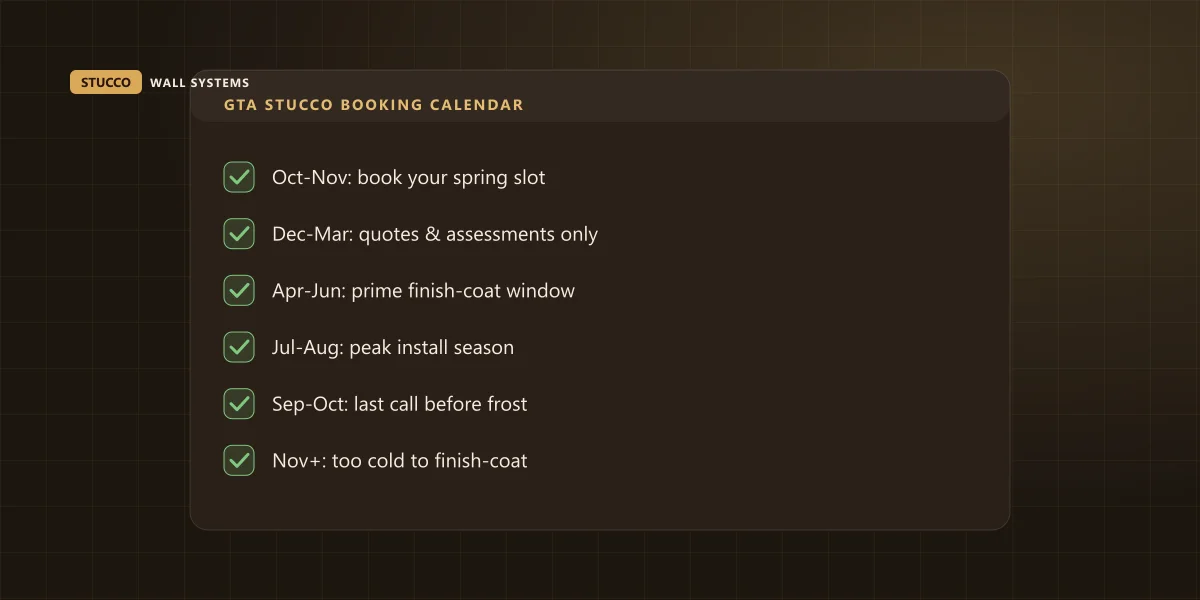
April and October are the shoulder months — workable but weather-dependent. May through September is the reliable core of the season. November through March is assessment-and-planning season only, not finishing season, no matter how mild a particular week feels.
| Months | Status | What’s realistic |
|---|
| April | Shoulder — opens up mid-to-late | Spring starts once overnight lows hold above freezing |
| May – June | Prime window | Full installs, repairs, colour changes — the calendar is booked hardest here |
| July – August | Peak season | Long cure days, but also the busiest — book ahead or wait |
| September | Prime window, cooling | Still excellent; a good time for repairs before the fall rush ends |
| October | Shoulder — closes mid-to-late | Last call for finish coats; first frost ends the season |
| November – March | Off-season for finishing | Assessments, written quotes, material ordering, urgent stabilization |
Lakeshore properties in Port Credit and Bronte sometimes squeeze a few extra mild days out of either end of that window because the water moderates the air temperature — and sometimes they lose a few days the other way when the lake wind picks up. Inland neighbourhoods in Kleinburg and Vaughan tend to see earlier frost in the fall than the lakefront does. Either way, the shoulder months are a judgment call we make on site, not a date on a calendar.
When should you actually call to book?
Call in October or November if you want a spring start — that’s when the best crews and the best weeks in April and May get claimed, often months before the snow melts. Call by late winter for a summer slot. For a fall repair, call as soon as you notice the problem; there’s often still room if the weather holds.
I know that sounds early to a homeowner staring at a crack in July, but the math is simple: everyone else with a stucco problem also wants a spring or early-summer start, because that’s objectively the best time to do it. The good weeks fill from the middle of the season outward. I go through the same booking logic from the cost side in our GTA stucco cost guide — scheduling pressure is one of the few things that genuinely moves a quote.
What can still happen in the off-season?
Plenty, just not the finish coat itself. Winter is exactly the right time for a free assessment, a written quote with the full scope locked in, ordering materials and colour matching ahead of the rush, and — if there’s active water intrusion — stabilizing and tarping the area until a proper repair can be finished in warm weather.
Using the off-season this way is how you land the early-spring slot instead of getting stuck waiting until July. A homeowner who calls in January with a scoped, written quote already in hand is first in line the day the weather turns. A homeowner who calls in April is starting from the back of that same line.
What happens when a crew rushes a finish coat into the cold?
The wall usually looks fine the day the crew packs up — that’s the trap. A finish coat applied in marginal temperatures can cure unevenly, bond poorly to the base coat, and develop hairline cracking within a season or two, sometimes sooner. It’s one of the quiet causes I cover in more detail in why stucco cracks in GTA winters — and it’s almost always traceable to a job pushed too late in the calendar to hit a deadline that had nothing to do with the weather.
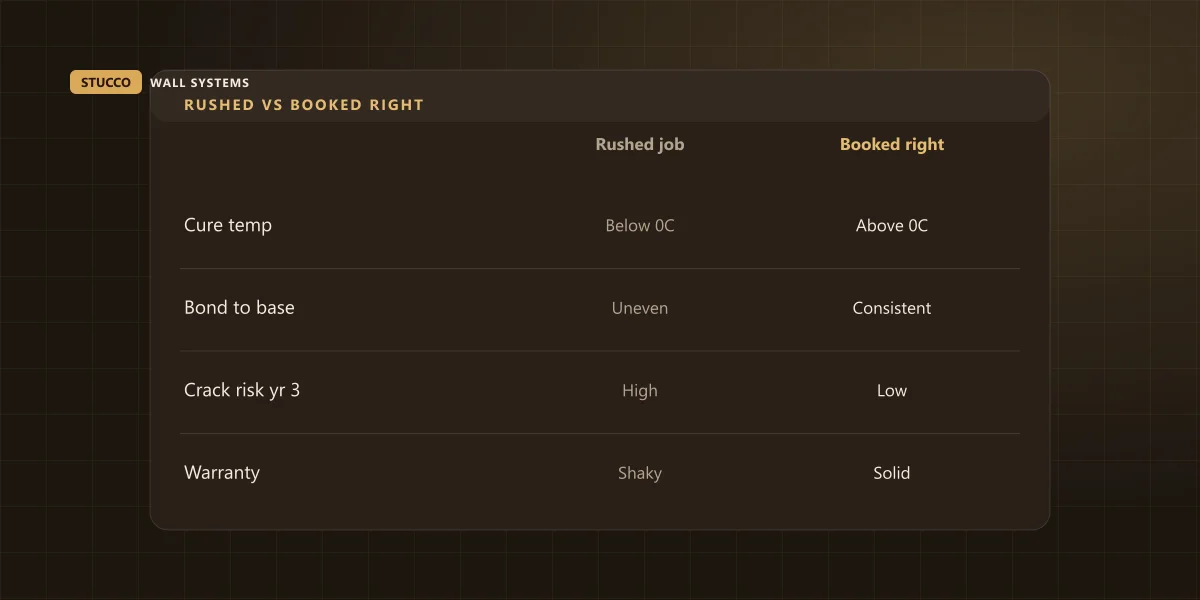
| Rushed into a cold snap | Properly timed |
|---|
| Cure conditions | Risked below the minimum | Sustained above-freezing cure |
| Bond to base coat | Often uneven | Consistent, full strength |
| Cracking by year 2–3 | Elevated risk | Baseline risk only |
| Warranty confidence | Shaky — hard to prove conditions | Solid — documented cure window |
I’d rather tell a client honestly that we can’t hit their October deadline and offer them the first slot in April than take the job, watch the forecast turn, and hand them a wall that fails on someone else’s timeline two winters later. That’s not caution for its own sake — it’s the same reason a good commercial contractor won’t pour concrete into a frost either.
So when should you actually book your project?
If you’re thinking about stucco or EIFS work for next season, the smart move is calling now — whatever month “now” happens to be — and getting a written, scoped quote locked in before the weather cooperates. That way you’re ready to move the moment the calendar allows, instead of joining the queue after everyone else already has.
We assess year-round across the GTA, for both residential and commercial walls, and every quote is free, written and fixed regardless of what month you call. Send us your address and a few photos and we’ll tell you honestly where your project fits on this year’s calendar — you can see the kind of work that calendar produces in our project portfolio.