“Just give me a price” is usually the first thing I hear before I’ve even parked the truck. Fair question — but a stucco quote that’s only a number is missing the parts that actually protect you. After 25+ years pricing walls across the GTA, and about as many years rebuilding walls that someone else quoted cheap and thin, I can tell you the red flags show up in almost the same order every time. Here are the seven I watch for, and what a quote you can actually trust says instead.
What should a legitimate stucco quote include?
A real stucco quote is written, not verbal, and breaks the wall into layers — prep, base coat, mesh, control joints, flashing, finish coat, colour and texture — with one fixed price and payment staged to progress. If a quote can’t tell you what’s under the finish coat, it isn’t a scope. It’s a guess with a number attached.
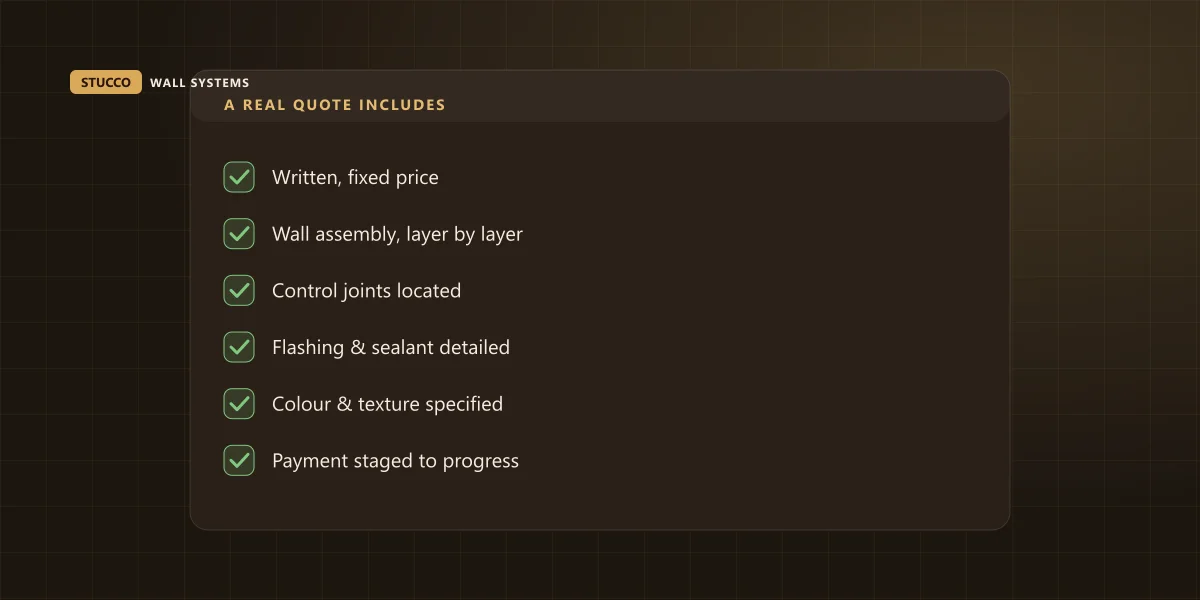
That list isn’t me being fussy. Every one of those items is something that can go wrong on your wall in ten years if it’s skipped now, and every one of them costs the contractor real time to work out — which is exactly why the quotes that skip them tend to come in lower. You’re not comparing two prices for the same wall. You’re comparing a full scope against a placeholder.
What are the 7 red flags in a stucco quote?
Watch for a verbal-only price, no wall assembly described, no control joints marked, a price far below every other quote, most of the money demanded upfront, no firm timeline, and no insurance or WSIB coverage on the paperwork. One of these is worth a question. Two or more, and I’d get a second opinion before signing.
| Red flag | What it looks like | Why it matters |
|---|
| Verbal price only | A number on the phone or from the truck window, nothing in writing | No scope means no accountability if it changes once the wall is open |
| No wall assembly described | “We’ll stucco it” with no layers named | You can’t tell mesh from no mesh, or one coat from three, after the fact |
| No control joints marked | Long walls with no joint locations on the quote or drawing | Missing joints are one of the top causes of cracking — I cover this in why stucco cracks in GTA winters |
| Price far below every other quote | 30–50% under the pack with no explanation | Something in prep, layers or flashing is almost always missing, not discounted |
| Most of the money upfront | Full or near-full payment demanded before work starts | You carry all the risk; a legitimate crew doesn’t need your whole job paid before they show up |
| No firm timeline | “We’ll get to it sometime this summer” | Vague scheduling is often a sign of a crew juggling too many jobs to detail any of them properly |
| No insurance, WSIB or business address | A name and a cell number, nothing else | If someone falls off your wall, you want to know who’s covering it — and it shouldn’t be you |
The one I’d put at the top of that list is the verbal price, because it’s the one that opens the door to every other flag. I’ve seen quotes literally written on the back of a business card, leaning on a car window in a driveway in Mississauga, no mention of what’s actually going on the wall. That’s not a quote. That’s a guess with a handshake attached, and handshakes don’t hold up when the wall cracks in year three and nobody remembers what was promised.
The lowball number is the one that costs homeowners the most, because it’s the hardest to say no to. I get it — stucco isn’t cheap, and a quote that comes in well under the others feels like a win. But I’ve opened up enough of those walls afterward to tell you what’s usually missing: no mesh, one thin coat instead of a proper build-up, no control joints, flashing skipped at the windows. The savings are real on day one and gone by year five, and by then it’s a repair bill on top of the original price, not instead of it.
The vague timeline and the missing insurance usually travel together, and they’re the two flags homeowners wave off most often. “We’ll get to it sometime this summer” sounds harmless until you realize a crew that can’t commit to a start date is probably juggling six other jobs and will squeeze yours in whenever it fits — including, sometimes, a cold snap that finish coats shouldn’t be applied in at all. And a contractor with no WSIB coverage or liability insurance isn’t a bargain, they’re a risk sitting on your property. If someone falls off scaffolding on your driveway in Oakville and there’s no coverage behind them, that liability doesn’t disappear — it lands on your homeowner’s policy. Ask for the WSIB clearance certificate before anyone sets foot on a ladder. It takes them thirty seconds to produce if it’s real.
How do you compare two stucco quotes fairly?
Line up the scopes, not the totals. Compare wall assembly, control joint locations, flashing details, warranty and payment terms side by side before you look at the price. If two quotes describe the same wall in the same detail and one is cheaper, that’s a fair comparison. If one is a paragraph and the other a page, you’re comparing a scope to a hope.
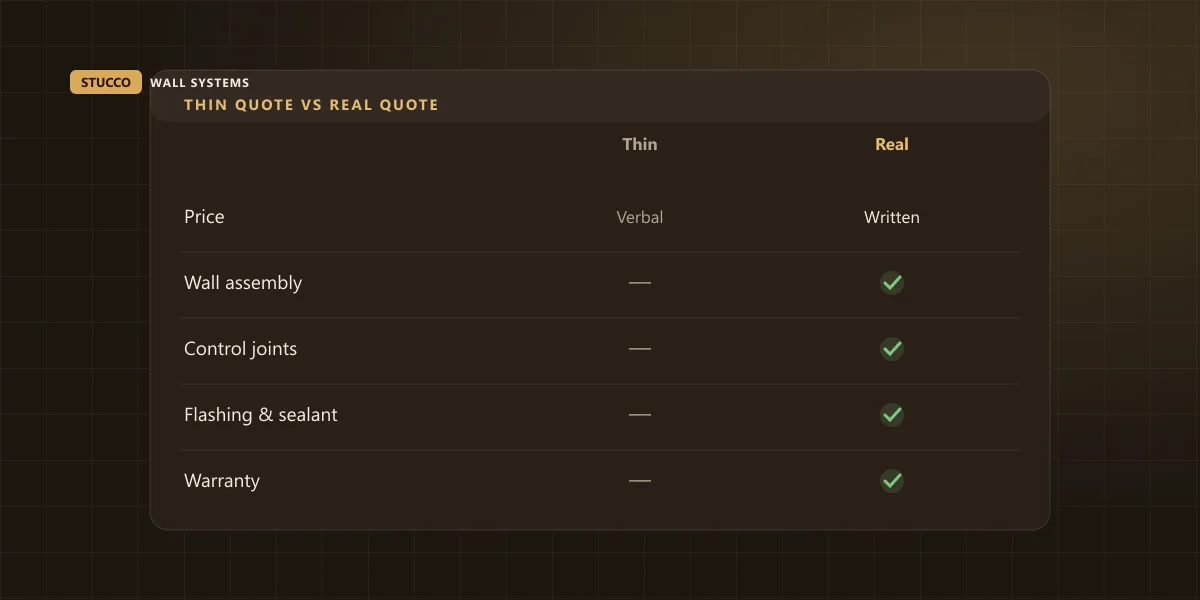
| What to check | Thin quote | Real quote |
|---|
| Price | Verbal or one line | Written and fixed |
| Wall assembly | Not mentioned | Layer by layer |
| Control joints | No | Yes, located |
| Flashing & sealant | No | Yes, detailed |
| Warranty | No | Yes |
This is also where you should be reading the fine print on the total itself. Our own numbers run $8–$16 per square foot installed for residential work and $10–$18 for commercial, and I break down exactly what moves you up or down that range in our GTA stucco cost guide. If a quote lands well outside those ranges — high or low — ask why, specifically. A good contractor can answer that in one sentence. A thin quote usually can’t.
What should you ask before you sign a stucco quote?
Ask what’s under the finish coat, where the control joints go, how water is flashed at windows and penetrations, what the payment schedule is, and whether the price is fixed in writing. Ask for the business’s WSIB clearance and insurance certificate too — a legitimate contractor hands both over without hesitation, because they already have them on file.
Ontario’s consumer protection guidance on home renovations makes the same point from the other side of the table: get everything in writing before work starts, and don’t pay for a job that hasn’t been scoped. It’s worth a read before you sign anything — see Ontario’s Building Code page on ontario.ca. It applies just as much to a $2,000 repair as a $35,000 re-clad.
None of this is complicated once you know what to look for — the same way I’d check a wall before I ever picked up a trowel. If you’ve got a quote sitting on your kitchen table right now and something about it doesn’t sit right, send it to us and we’ll tell you honestly what’s missing. We quote the same way for a bungalow in Bronte or a custom build in Kleinburg: free, written, and in enough detail that you know exactly what’s going on your wall. You can see the finished result of quotes built this way in our project portfolio, on homes and commercial buildings across the GTA.