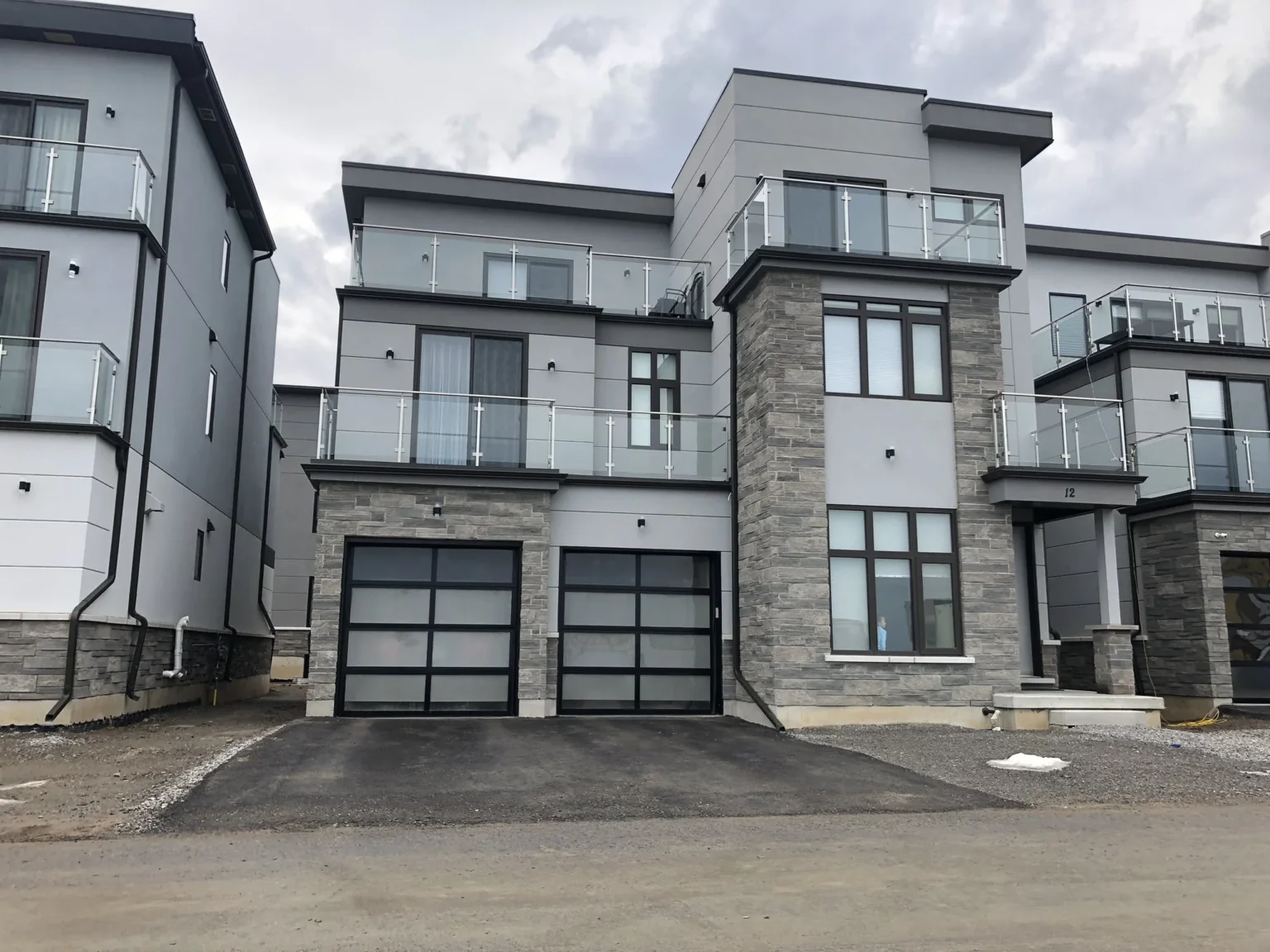
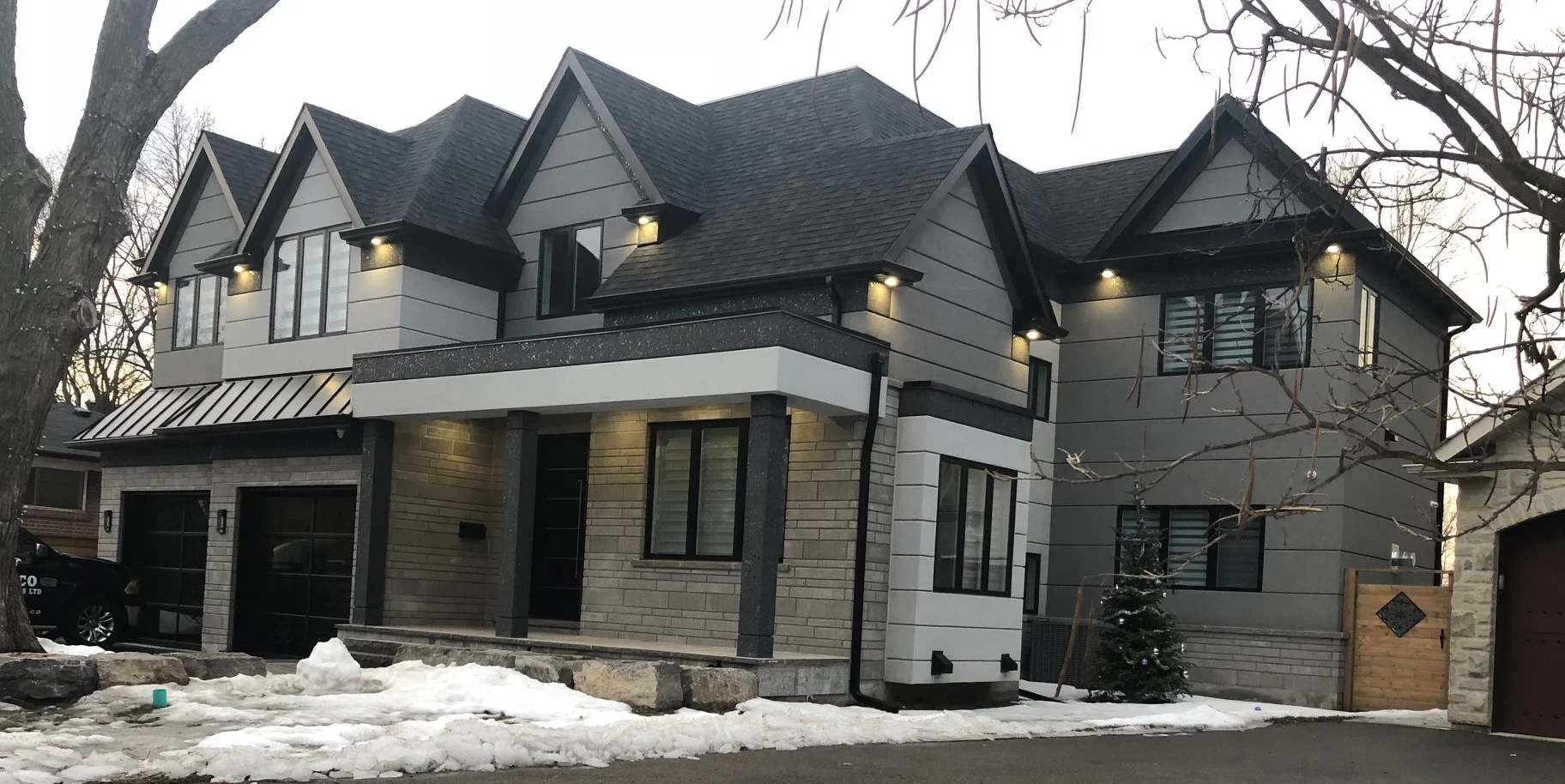
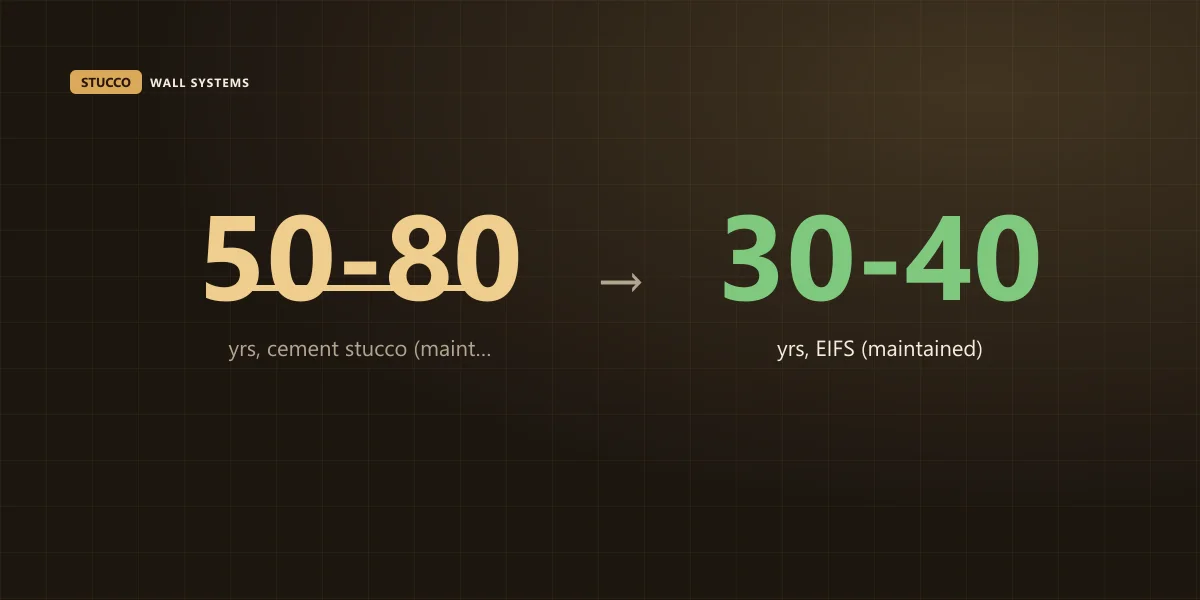
“How long is this actually going to last?” comes up on almost every assessment, right after the cost question. Here’s the honest number: a properly built and maintained traditional cement stucco wall in Ontario runs 50 to 80 years, and a well-detailed modern EIFS wall runs 30 to 40-plus. Neither is a guarantee — it’s a range, and after 25+ years quoting and repairing walls across the GTA, I can tell you almost exactly where your wall lands in it depends on installation quality and upkeep, not luck.
How long does traditional cement stucco last?
Traditional cement stucco, installed properly over a sound substrate, typically lasts 50 to 80 years. It’s essentially a masonry skin — the cement itself doesn’t wear out the way a lot of homeowners assume. What ends its life early is water getting behind it through unrepaired cracks, missing flashing, or sealant nobody renewed, not the material aging.
That’s not a sales pitch — walk through Riverdale, Roncesvalles or Cabbagetown and you’ll find century-old cement stucco still doing its job, sometimes on the original lath. What ages out first is almost never the stucco itself — it’s the paint finish on top, which chalks and fades on an 8-to-12-year cycle. The wall underneath keeps going long after that first repaint, provided water’s been kept out of it.
How long does EIFS (synthetic stucco) last?
Modern drained EIFS — installed with a proper water-resistive barrier and a drainage plane behind the foam — typically lasts 30 to 40-plus years. Older “barrier” EIFS built before the mid-2000s trapped any water that got in with nowhere for it to go, and could fail in as little as 10 to 15 years. That gap is where EIFS earned its bad reputation, and it’s a detailing problem, not a technology problem.
The distinction matters because the two systems get lumped together constantly. A drained EIFS wall has a designed exit path for moisture; a barrier wall has none. I cover the practical difference between the systems in more depth in EIFS vs traditional stucco — the short version here is that the foam insulation itself doesn’t degrade on any real timeline. What limits EIFS lifespan is almost always a detail: a missed sealant joint, a control joint that was never cut, flashing that was skipped to save an afternoon.
| System | Typical lifespan (maintained) | What usually ends it early |
|---|
| Traditional cement stucco | 50–80 years | Water through unrepaired cracks or failed flashing |
| Modern drained EIFS (2000s+) | 30–40+ years | Sealant failure at penetrations, missing control joints |
| Older barrier EIFS (pre-2000s) | 10–20 years | Trapped moisture, no drainage path out |
| Acrylic/paint finish coat | 8–12 years to re-coat | UV fading and chalking — cosmetic, not structural |
One thing worth saying plainly: a lifespan number is not a warranty. It’s an average across walls that were detailed correctly and maintained. A wall built with the right control joint spacing — roughly every 10 to 12 feet, or wherever a panel gets past about 144 square feet — sheds the same freeze-thaw movement that cracks a wall with none. Two houses on the same Vaughan street, same crew year, same stucco order, can be 25 years apart in remaining life because one had joints cut where the drawings called for them and the other didn’t. That’s a workmanship gap, not a materials one.
What shortens stucco's lifespan in Ontario?
Four things end a stucco wall early here: water finding a way behind the finish, missing or too-few control joints on long walls, sealant nobody renewed, and an installation that skipped proper flashing to save time. Our freeze-thaw winters don’t damage sound stucco directly — they punish existing gaps, which is why almost every early failure I open up traces back to one of these four.
Water that finds a crack freezes and expands roughly 9%, working like a wedge every cycle — I go through the mechanics of that in why stucco cracks in GTA winters. Shaded north walls and lakeshore properties in Etobicoke, Port Credit and Bronte hold moisture longer and age faster for the same reason. Landscaping that buries the weep screed at grade, downspouts that dump right against the foundation, and shrubs pressed against the wall all quietly shorten a wall’s life the same way — none of it looks dramatic until year fifteen. Canada’s housing agency, CMHC, has documented moisture management as the single biggest factor in how long a wall assembly lasts, and that holds true for every stucco wall I’ve opened up.
Two more quiet killers I see constantly: power washing and the wrong caulking product. A homeowner blasting a wall with a pressure washer to clean it can drive water past the finish faster than any rainstorm would, especially at hairline cracks. And not every sealant is compatible with every finish — the wrong tube from a big-box shelf can pull away from the substrate within a season, leaving a gap that looks sealed but isn’t. Small decisions, real consequences on a 50-year timeline.
What actually extends stucco's lifespan?
The wall that hits 80 years instead of 30 almost always has three things going for it: control joints placed correctly at build time, flashing detailed at every penetration, and an owner who reseals and repairs small damage instead of ignoring it. None of that costs much next to a full re-clad — it’s the cheapest insurance a stucco wall ever gets.
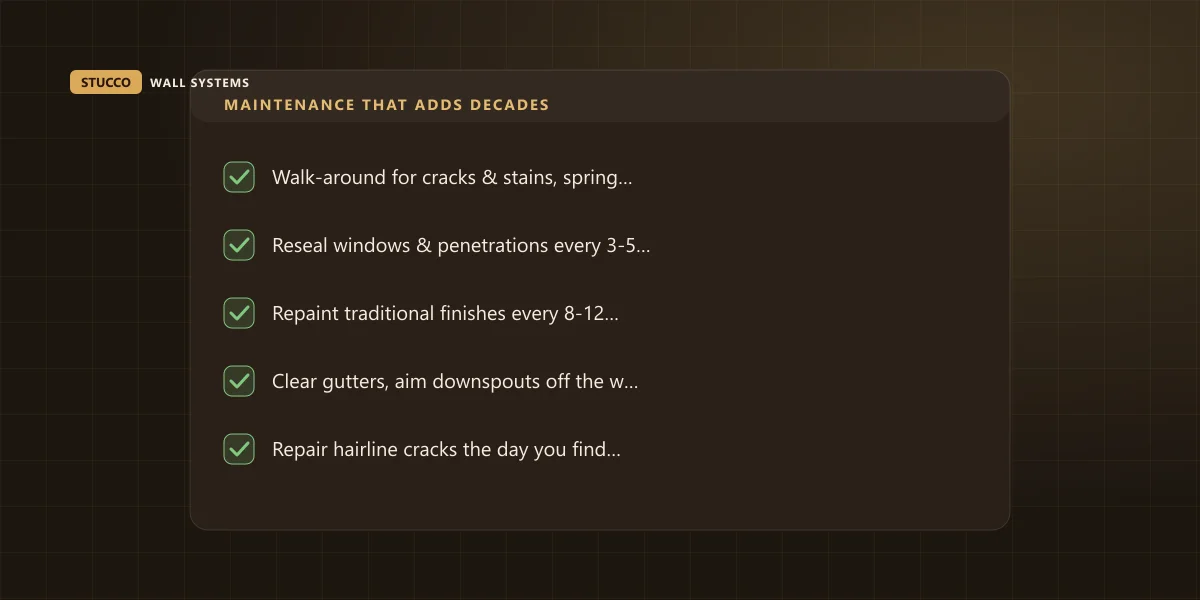
| Maintenance task | Frequency | Why it matters |
|---|
| Visual walk-around for cracks, stains, soft spots | Every spring & fall | Catches small damage before freeze-thaw widens it |
| Reseal windows, doors and penetrations | Every 3–5 years | Sealant fails long before the stucco underneath does |
| Repaint traditional (painted) finishes | Every 8–12 years | UV breaks down paint film well before the cement ages |
| Clean gutters, redirect downspouts off the wall | Annually | Keeps bulk water off the wall face entirely |
| Repair hairline cracks | As soon as you find one | A fingernail-width crack today is a wet wall in two winters |
None of this is complicated, and none of it needs a contractor for most of it — a homeowner with a ladder and a caulking gun can do half this list. It’s the same logic behind the one-hour fall routine I’d recommend to anyone with stucco, regardless of the system or the age of the wall.
Does a 20-year-old stucco wall need repair or replacement?
Age alone doesn’t answer that — condition does. A 25-year-old wall with sound cement and a few repairable cracks just needs targeted repair. A wall of any age with widespread soft substrate, bulging, or cracking that keeps returning in the same spot after being patched usually means the underlying system has failed, and a re-clad is the honest answer.
We check this with a moisture meter and by probing suspect areas, not by guessing off a photo. If the assembly’s sound, targeted repair gets you another decade or two for a fraction of replacement cost — you can see what a properly matched repair looks like in our Mississauga repair & restoration project. If it isn’t sound, we’ll tell you that too, in writing, before you spend a dollar on a patch that won’t hold.
What does this mean for your wall?
If your stucco is 15, 30 or 60 years old and you’re not sure which bucket it’s in, that’s exactly what a free assessment is for. We’ll tell you honestly whether you’re looking at maintenance, repair, or replacement — for a home or a commercial building anywhere across the GTA. Send us the address and a few photos and we’ll give you a straight answer, not an upsell.