The payment schedule is the least interesting paragraph in a stucco contract and the one that decides how much trouble you can get into. Every line of a stucco payment schedule — the deposit, the draws, the last ten per cent — exists to keep the money level with the work that has actually been done. When those two drift apart, one of us is quietly carrying the other’s risk. Here is what a fair schedule looks like on a real number, and what Ontario law already does for you whether or not your contractor mentions it.
What does a fair stucco payment schedule look like?
Money should follow finished stages, not calendar days. A modest deposit on signing, then draws when the lath and flashing are done, when the base coat has cured, and when the finish coat is complete — with the final ten per cent held back until the lien period has passed. Never the whole balance before the scaffold comes down.
Take a full re-clad with about 1,800 square feet of actual wall area at $12 a square foot installed, mid-range for the $8–$16 we quote on residential stucco. That is a $21,600 contract, and it should be paid out like this.
| Stage | What has to be finished before it’s owed | Share | On a $21,600 job |
|---|
| On signing | Contract signed, finish colour and material ordered, dates booked in | 10% | $2,160 |
| Draw 1 | Old cladding off, sheathing repaired, lath, mesh and all flashing installed — and inspected before anything covers it | 30% | $6,480 |
| Draw 2 | Base coat on the whole elevation and cured, no bare patches left for later | 30% | $6,480 |
| Draw 3 | Finish coat complete, joints sealed, scaffold down, site cleaned | 20% | $4,320 |
| Holdback | The lien period has run out and nobody has claimed against your property | 10% | $2,160 |
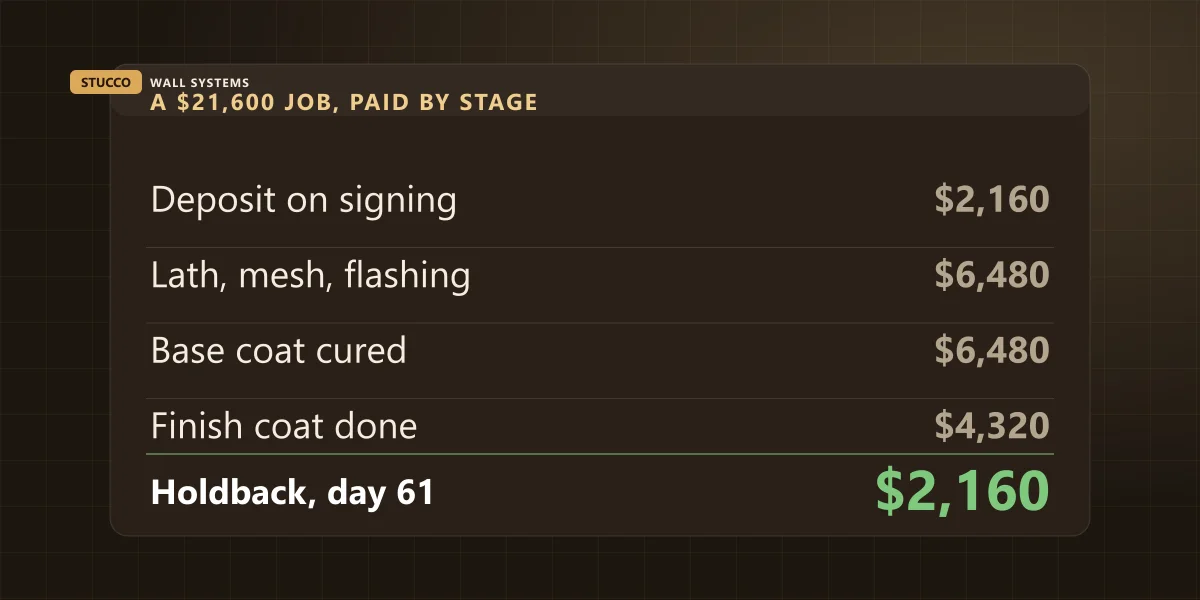
Notice what the middle draws have in common. Not “week two”, not “materials delivered” — a stage that is either finished or it isn’t.
How big should the deposit be on a stucco job?
Small. Ontario’s consumer guidance says a down payment on a home renovation should be no more than ten per cent, and that you should never pay the full contract before the work is done. On a stucco job that ten per cent covers ordering material and holding your slot. It does not fund somebody else’s payroll.
There is a real reason for a deposit, and it sets the size. Acrylic finish is batch-tinted to your colour, so once it is mixed it is yours — nobody takes back six pails of a custom sand-float. Mesh, board, corner bead and joint material get ordered against a start date, and scaffold gets booked for a window. On a $21,600 job none of that comes close to half the contract, because most of a stucco price is labour and equipment.
So fifty per cent before a sheet of board arrives is not a materials request. It is a request to finance the company, sometimes because the last customer’s money already went somewhere else. The province sets out what your contract and down payment should look like in your rights when starting home renovations or repairs — worth four minutes before you sign.
Why should draws be tied to stages instead of dates?
Because weather runs a stucco job and a calendar doesn’t. A wet week in October moves every date on the page and none of the work. Tie money to finished stages and a rain delay costs everyone a little patience. Tie it to dates and you are paying for scaffold to stand in the rain.
Draw 1 is the one that matters, and not for the money. It lands at the only moment in the whole job when the parts that keep water out are finished and still visible — lath, mesh laps, corner reinforcement, and every piece of flashing at windows, at the roof line, at the deck ledger. Once base coat goes on, all of it is buried for thirty years. A draw sitting right there gives both of us a reason to stand and look — the cheapest inspection you will ever get.
The last draw works in reverse. The balance is due when the scaffold is down and the site is clean, because scaffold is the only inexpensive way back up a wall: once it is on the truck, a twenty-minute touch-up needs a whole mobilisation. Wanting that invoice settled while the pipes are still standing is asking you to give up your leverage at the moment you need it.
| What | The version I’d walk away from | The version that works |
|---|
| Deposit | 50% cash before anything arrives on site | 10% on signing, on a proper invoice |
| What triggers a draw | A date on the calendar | A finished stage you can stand and look at |
| Extras | Explained to you at the end | Priced and signed before the work happens |
| Final 10% | Asked for on day one, with the deposit | Paid out after the lien period closes |
| Paperwork | A number written on a business card | Written contract, HST number, insurance and WSIB on file |
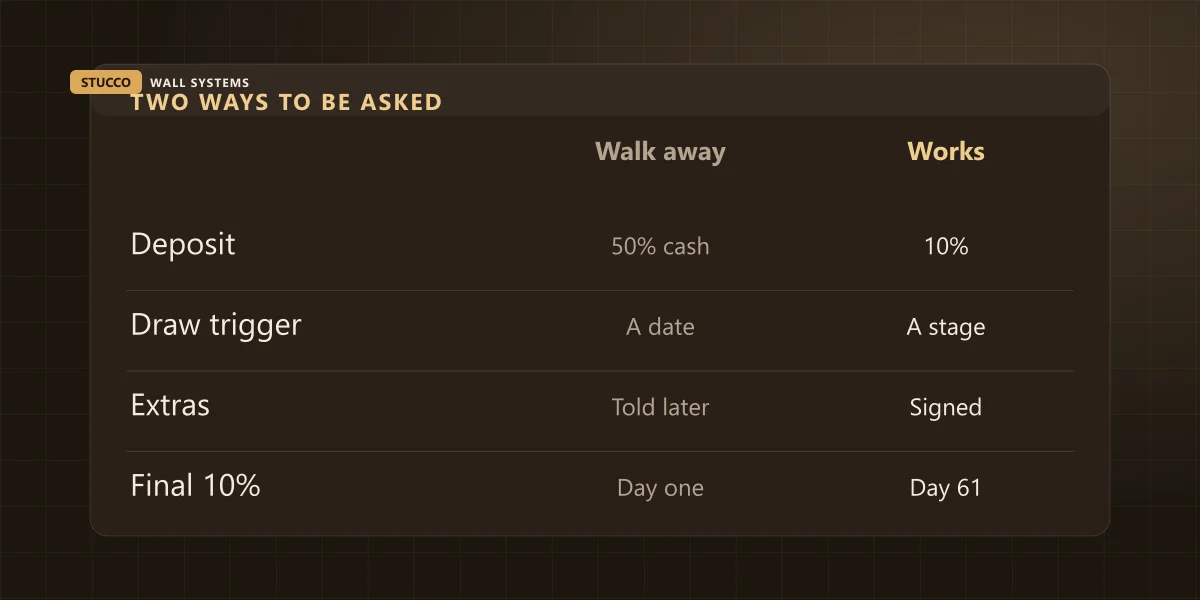
Half of that right-hand column is paper, and paper is the part people skip. Ontario requires a home renovation contract over fifty dollars to be in writing, with the work, the total price, the payment schedule and the deposit in it. A company that will not write down how it wants to be paid has answered several questions you were saving for later — more of those are in the red flags I look for in a stucco quote.
What is the 10% holdback, and does it apply to my house?
It applies to your house. Ontario’s Construction Act requires whoever is paying for construction work — a homeowner included — to hold back ten per cent of every payment until the lien period has expired. It is what caps your exposure if the contractor takes your money and never pays his supplier or his subtrade.
The situation it exists for, in plain words: say I buy $4,000 of board, mesh and finish on account to do your house. You pay me every cent you owe, on time, and I never pay the supplier. That claim is not only against me — it can attach to your property, because your property is where the material went.
The holdback is the ceiling on what that costs you — but only if you actually retained it. Pay the whole contract out on the last day of work and the obligation does not vanish with it; you can end up paying the same ten per cent twice, once to your contractor and once to somebody you have never met. The window is sixty days from the day the contract is completed, abandoned or terminated. Nothing claimed by the time it closes, you release the holdback and you are done.
Setting it up takes one sentence in the contract: ten per cent holdback retained under the Construction Act, released sixty days after completion. Anyone who works commercially writes that line every week — it is ordinary on the commercial facade work we do for property managers, where a current insurance and WSIB clearance also gets checked before each progress payment. A contractor who reacts badly to seeing it on a house contract has never worked where it was enforced. The Act is published by the province as the Construction Act on Ontario’s e-Laws site. This is the plain-language version and not legal advice — if real money is already in dispute, you want an hour with a lawyer, not a blog post from a stucco guy.
When can a stucco price legitimately go up?
When the work changes, and only with your agreement first. In Ontario the final price on a home renovation cannot exceed the estimate by more than ten per cent unless you agreed to new work or a new price. On stucco there are two honest reasons a number moves, both of which arrive as a change order.
The first is what is behind the old cladding. Strip vinyl or failing stucco off a wall in Bronte or Port Credit and you occasionally find sheathing that has been wet for years, or framing that needs a carpenter before anything can be fastened to it. That is not optional, and it gets priced as its own line the day it is found — the kind of hidden-water work on our stucco repair page. The second is area: a wall measured off drawings and the same wall measured with a tape can differ by a couple of hundred square feet, which at $12 a foot is real money in either direction. How that take-off is done is in how stucco square footage gets measured.
A change order is one page — what changed, what it costs, both signatures, before the work. If somebody says the number went up but cannot produce that page, what changed was not the job.
What if I signed at the kitchen table and changed my mind?
You get ten calendar days. A home renovation contract worth more than fifty dollars, signed somewhere other than the business’s own address — your kitchen, your driveway, your front step — carries a ten day cooling-off period, and inside it you can cancel for any reason with no fee.
| How the contract was signed | Can you cancel? | What you still owe |
|---|
| At your home, no work started yet | Yes, within 10 calendar days | Nothing |
| At your home, crew already started | Yes, within 10 calendar days | Reasonable value of work and materials supplied |
| At the contractor’s own office or shop | Cooling-off period does not apply | Whatever the contract says |
Send the cancellation by email or registered mail rather than saying it on the phone, and keep the copy — afterwards, the only thing that matters is a date you can prove. This is also the quiet reason a good contractor is not in a hurry for your signature: anyone pushing you to sign tonight because the crew is “in the area this week” is running down a clock you never agreed to.
The payment terms I would walk away from
- Cash only, no HST on anything. That is not a discount, it means there is no invoice — and the invoice is what your warranty, your insurance claim and any future dispute all hang from.
- Most of the money up front “for materials”. On a whole-house job the material package is a fraction of the price. Ask what exactly is being ordered for that amount, and watch what happens.
- The deposit goes to a personal name. If the quote is on company letterhead and the e-transfer is going to an individual, those two should match.
- The final invoice before the scaffold comes down. Fine to invoice it. Not fine to be paid it.
- Nothing in writing. Over fifty dollars, Ontario wants the scope, the price and the payment schedule on paper.
- A flat refusal to put the holdback in the contract. It costs an honest contractor nothing, because he expects to be paid it sixty days later.
The short version
Keep the deposit around ten per cent, tie every draw to a stage you can stand in the driveway and look at, hold the last ten per cent for sixty days after completion, and get extras priced on paper before they happen. Do that and a bad month costs you a delay instead of a deposit.
We quote this way as a matter of course, from single-wall repairs to full re-clads across Oakville, Mississauga and the GTA, and the schedule goes on the contract before anybody books a start date. If you are holding a quote and the payment terms are the part making you uneasy, send it over with a couple of photos of the wall and I will tell you straight what I would change — including the times the honest answer is that the terms are fine and the price is fair.