Almost every mould call I get starts the same way: “it’s only on one side of the house.” That detail is the whole story. Mould on stucco — or mold, if you spell it the American way — isn’t random. It shows up exactly where a wall stays wet longer than it should, and after 25+ years working stucco across the GTA, I can usually guess which wall has it before I’ve seen the house. Here’s what actually causes it, how to clean it without wrecking the finish, and how to tell a cosmetic problem from a much bigger one.
What actually causes mould and mildew to grow on stucco?
Mould and mildew are living organisms feeding on moisture, dust, pollen and organic film on the wall — they need the surface to stay damp for hours at a stretch, which is why they show up on shaded, poorly-drained or constantly-sprinkled walls first and never on the sun-baked ones. Stucco’s texture makes it worse, since the peaks and valleys in the finish hold more of that dust and moisture than a flat surface would.
It’s not a sign the stucco is failing. A perfectly sound wall grows mould just as easily as a damaged one — sometimes more easily, because a rougher texture holds more of the food source. The wall’s condition and the wall’s mould problem are two separate questions, and mixing them up is how homeowners either panic over nothing or ignore something they shouldn’t.
| What causes it | Why it happens on stucco | What actually helps |
|---|
| Shade & tree cover | North-facing or tree-shaded walls stay damp for hours after every rain instead of drying by midday | Trim branches and thin shrubs back 12–18 in. off the wall |
| Sprinkler heads hitting the wall | Daily wetting keeps the surface damp far longer than rain alone | Re-aim heads so spray lands on the lawn, not the finish |
| Downspouts discharging at the base | Water sheets up the wall every time it rains | Extend downspouts 4–6 ft from the foundation |
| Rough or deep-texture finish | Dash and heavy-aggregate textures hold more dust and moisture in their valleys than a smooth finish | Clean it more often — see our texture comparison |
| Negative grading at the foundation | Water pools against the wall and wicks up from the base | Regrade so soil slopes away from the house |
Is mould on stucco actually dangerous, or is it just ugly?
Most of the time it’s cosmetic: a surface film on top of a sound wall, and cleaning it off is the whole fix. It becomes a real problem when growth keeps returning within days no matter how well you clean it, or when it’s paired with a soft spot or a stain that follows a window or crack instead of a shade line — that combination means water is behind the finish, not sitting on it.
The two look almost identical from the driveway and get treated completely differently on the wall, which is exactly why I want you able to tell them apart before you call anyone — a cleaning quote and a repair quote are not the same conversation.
| Sign | Usually just cosmetic | Usually water behind the wall |
|---|
| Staining pattern | Follows the shade line, tree canopy or sprinkler spray | Follows a window head, sill or a specific crack |
| After cleaning | Comes off and stays off for a season or more | Comes back within days or weeks |
| Wall feel | Solid and hard when pressed | Soft or springy near the stain |
| Smell | None noticeable indoors | Musty smell from inside near that wall |
If that second column sounds like your wall, stop cleaning it and go read 6 signs water is behind your stucco — the musty-smell sign in particular gets missed because it shows up inside the house, not on the wall itself.
Why does mould always show up on the same wall of the house?
Because that one wall stays wet longer than the others — almost always shade, sprinkler spray, a downspout dumping at the base, or all three together. I see it constantly on the north and northwest walls in leafy neighbourhoods like The Kingsway and Port Credit, where mature tree canopy keeps the same stretch of wall out of direct sun most of the day. Down along the water in Bronte, it’s the lake humidity doing the same job even on walls that do get sun.
None of that means those neighbourhoods have worse stucco — it means physics doesn’t care how nice the street is. Any wall that stays damp longer than a few hours after rain is going to grow something eventually. The fix usually isn’t on the wall at all; it’s the landscaping, the sprinkler head or the downspout aimed at it.
Can you clean mould off stucco yourself without damaging it?
Light, shade-side staining usually comes off with a garden hose, a soft brush and a cleaner labelled safe for masonry or stucco — the mistake almost everyone makes is reaching for a rental power washer instead. Every satisfying pressure-washer video on the internet is filmed on a driveway, not a stucco wall, and high pressure on stucco doesn’t just clean the surface; it can force water past hairline cracks and behind the finish, which is the opposite of what you want on a wall that’s already been holding moisture.
A wire brush or heavy scrubbing causes a quieter version of the same problem: it polishes and glazes the texture, which actually holds dirt and moisture worse afterward than the rough finish did. Straight bleach with no dilution or rinse plan streaks the finish and kills the shrub bed underneath, without cleaning any better than a proper diluted product would.
| Method | Safe on stucco? | Why |
|---|
| Garden hose + soft brush + labelled masonry cleaner | Yes | Lifts the growth without forcing water into the wall |
| Professional low-pressure soft wash | Yes | Chemical solution does the work; minimal pressure |
| Rental power washer | No | Forces water past hairline cracks and behind the finish |
| Wire brush or heavy scrubbing | No | Polishes and glazes the texture, holding moisture worse after |
| Straight bleach, no dilution or rinse | No | Streaks the finish and kills nearby plants without cleaning better |

For a wall you can reach with a garden hose, that’s a Saturday-morning job. For a full elevation, a second-storey wall, or growth that keeps coming back after you’ve cleaned it twice, that’s when I’d call a pro for a proper low-pressure soft wash instead of renting more machine than the wall can take.
When does mould mean you need a repair, not just another cleaning?
If the same spot returns within a few weeks of a proper cleaning, or the wall feels soft when you press it near the stain, the problem isn’t on the surface anymore — it’s moisture trapped behind the finish, and no cleaning solution fixes that. At that point you’re looking at opening the wall to find where water is getting in, not scheduling another wash.
I’ll be straight with you: most of the mould calls I get are the cosmetic kind, and I’d rather tell a homeowner “that’s a bottle of cleaner and an hour with the hose” than invent a repair that isn’t there. But when it is the other kind, repair costs run the same range as any other water-behind-the-wall job — typically $1,500–$5,000+ depending on how far it’s spread, which is exactly why catching it at the “musty smell” stage instead of the “soft drywall” stage matters.
How do you actually stop mould from coming back for good?
You fix the thing keeping the wall wet, not the wall itself. That means trimming branches and thinning shrubs back 12–18 inches off the stucco so air and sun actually reach it, re-aiming any sprinkler head spraying the wall instead of the lawn, and extending downspouts at least 4–6 feet from the foundation so water doesn’t sheet straight up the base every time it rains.
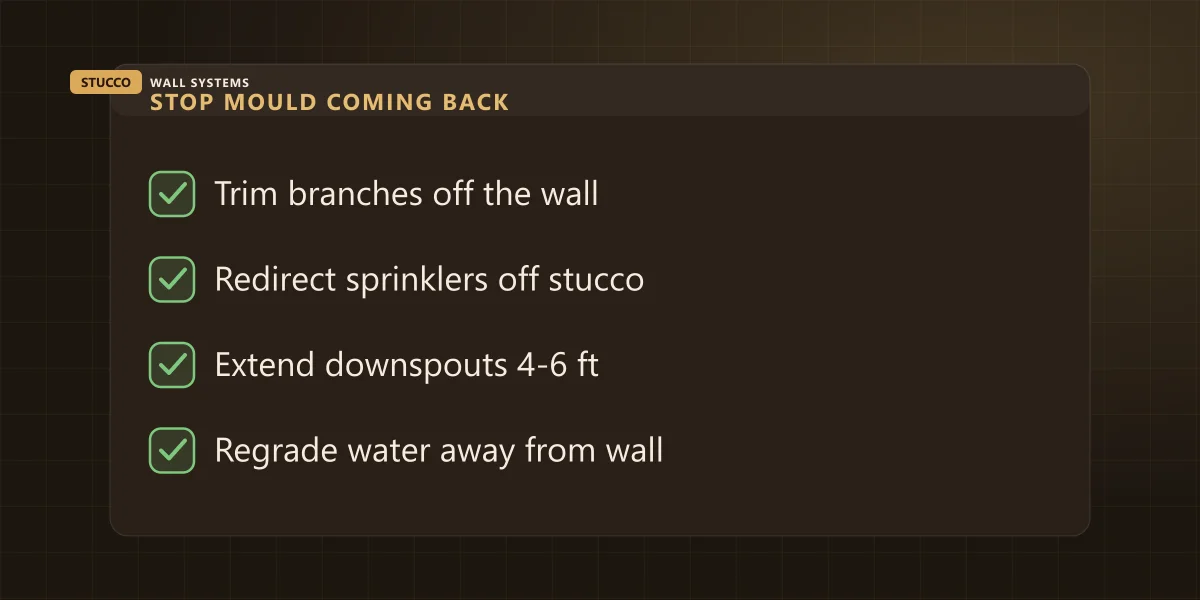
If the soil around the foundation slopes toward the house instead of away from it, regrading is the fix — water pooling at the base wicks straight up into the wall regardless of what you do to the finish above it. Canada Mortgage and Housing Corporation covers this same principle from the whole-house side: controlling moisture around the foundation and keeping walls able to dry out is what actually prevents mould, indoors or out, not the cleaning product you reach for once it’s already there. Worth a read: CMHC on moisture control in the home.
One more thing worth saying plainly: recoating or painting over active mould without fixing the moisture source just seals a damp wall shut. It’ll look clean for a season and come back through the new coat, because you painted over the food source instead of removing what was feeding it.
Mould on a shaded or poorly-drained stucco wall is one of the more common calls we get across Oakville, Mississauga and the rest of the GTA, and it’s rarely the emergency it looks like. If you’ve cleaned a spot twice and it keeps coming back, or the wall feels soft under your hand, that’s worth an actual look rather than another bottle of cleaner — we quote stucco repair and full residential stucco work the same way for every wall: free, on-site, honest about which one you actually have. Send us a few photos and we’ll tell you straight whether it’s a cleaning job or something more.