Nearly every chimney call I take starts the same way: the chimney looks twenty years older than the house it is attached to. Cracked at the corners, dark down one face, maybe a rust streak running from the top. The walls below it are fine. That gap is normal, and stucco chimney repair is one of the most common jobs I quote on houses where nothing else needs touching.
Homeowners read a cracked chimney as a stucco problem. It almost never is. The finish up there is the same product that has been sitting quietly on the garage wall for eighteen years. What is different is the exposure, the movement, and four small pieces of metal and mortar at the top and the bottom of that little tower. Those are what fail, and those are what a real repair addresses.
This post is the diagnosis — what goes wrong up there and how to read it from the ground. If you already know the chimney needs doing and want the scope, the access, the order the trades go up in and the price, that is on our chimney stucco page.
Why does a chimney fail before the rest of the stucco?
Because it is the only part of the house weathered on four sides and a top, with no heated space behind it and a roof draining into it. It wets faster, dries slower on the north face, freezes harder, and moves on its own rather than with the house. Same stucco, several times the workload.
Take the exposure first. A wall on the side of your house sees weather from roughly one direction, and the overhang above keeps most of the rain off. A chimney has no overhang and no sheltered side, so whatever the wind is doing, one face is taking it straight on. In the GTA the driving rain comes from the west and southwest often enough that the west face of a chimney is almost always the worst-looking one.
Then drying. Stucco is a porous cladding that gets wet and dries out again, and drying needs sun, air and ideally some warmth behind. Your house wall has a heated room behind it half the year. A chimney has cold masonry or an unheated wood chase, and its north face may see no direct sun between November and February. Water that goes in during December is often still in there in March, freezing and thawing every time the temperature crosses zero — which in Toronto it does dozens of times a winter.
And movement. A chimney is a slender tower with a lot of thermal mass, heated by sun on one side and chilled on the other. It expands and contracts on a different schedule from the wall below, which is why cracks show up at the chimney corners and at the roofline first: those are the two places where a moving object meets a less-moving one.
| A typical wall | The chimney |
|---|
| Weather exposure | One face | Four faces plus the top |
| Behind the cladding | A heated room most of the year | Cold masonry or an unheated chase |
| Wind | Sheltered by the roofline | The highest, most exposed point on the house |
| Water from above | Roof and eaves shed it away | Roof planes drain toward it |
| Movement | Moves with the house | Moves on its own, in two directions |
| Freeze-thaw cycles | One or two faces cycle a day | Every face cycles, every day |
None of that is a defect. It is the job description. A chimney finish that needs attention at year twelve while the walls are fine at year twenty-five is a chimney behaving exactly as expected.
Is it a masonry chimney or a framed chase?
Look at the top. A poured concrete crown with clay flue tiles standing proud of it is a masonry chimney — brick or block underneath, parged or stuccoed outside. A flat sheet-metal cover with a rain cap and one or two round pipes through it is a framed wood chase with cladding on the outside. The repair and the price are completely different.
This is the most useful thing a homeowner can work out before phoning anybody, because it changes what a leak means. Water in a masonry chimney soaks into brick and mortar; that eventually spalls brick and rusts anything steel in there, but masonry can be wet for a while without anything structural happening. Water in a framed chase lands on wood. Wood rots quietly for years, and the first outside sign is usually the stucco starting to move because the sheathing behind it has gone soft.
If the top is not visible from the ground, the basement tells you. A masonry chimney lands on a footing, so you see a solid brick or block base, often with a small cleanout door. A framed chase is a hollow stud box where it passes through the house. Vintage helps too. On the older Toronto streets — The Kingsway, Port Credit, the pre-war parts of Etobicoke — it is nearly always a masonry chimney. On the newer subdivisions in Vaughan, Kleinburg and north Mississauga, the framed chase around a gas fireplace has been the default since about the mid-nineties.
| Masonry chimney | Framed chase |
|---|
| Under the finish | Solid brick or block | Wood studs and sheathing |
| Closed at the top by | A poured concrete crown | A sheet-metal chase cover |
| Typical GTA vintage | Pre-1990 brick homes | Mid-1990s onward, gas fireplace |
| How a leak announces itself | Damp brick, white staining, spalling faces | Nothing outside until the sheathing is already soft |
| Worst-case repair | Rebuild the top courses and re-pour the crown | Replace rotten framing and sheathing before any finish goes on |
| Can it come off above the roof | Yes, with a structural look first | Yes, usually the simpler of the two |
What actually leaks on a stucco chimney?
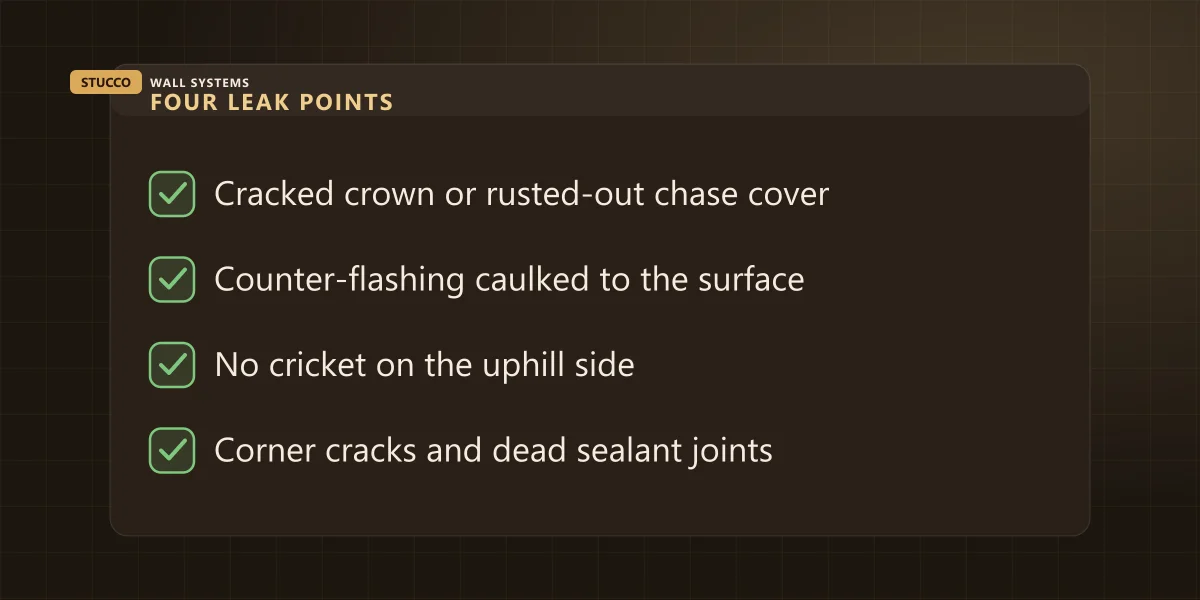
Four things, in this order of frequency: the top, the flashing at the roofline, the missing cricket on the uphill side, and the finish itself at the corners and sealant joints. Three of those four are metal-and-mortar details, not stucco. That is why a re-coat on its own so often fails to stop the leak.
1. The top: the crown or the chase cover
This is the number one leak on both types of chimney, and nobody looks at it because you cannot see it from the driveway. On a masonry chimney the crown is the sloped concrete cap that sheds water off the top course and holds the flue tiles. Crowns crack because they are a thin slab of concrete on top of a moving tower, and once cracked they let water straight down inside the masonry, where it works from the inside out all winter.
On a framed chase the equivalent is the sheet-metal chase cover. A good one is stainless or heavy galvanized, sloped, with cross-breaks and a drip edge that stands off the cladding. A cheap one is flat light-gauge steel that ponds, rusts through at the low spot in ten to fifteen years, and drains straight into the wood box. The tell from the ground is the same for both: rust staining below the top, a dark band that never dries, or finish flaking off the top eighteen inches while the rest of the chimney looks fine.
2. The counter-flashing at the roofline
Where the chimney passes through the roof, two layers of metal do one job. Step flashing runs up the sides under the shingles; counter-flashing laps over it and tucks into the chimney so the joint is covered. On masonry it is let into a saw cut in a mortar joint and sealed. On a stuccoed chimney it goes behind the finish — and that word, behind, is the whole detail.
What I find on failed chimneys is counter-flashing surface-mounted and caulked to the outside of the stucco. Surface caulk gets about five years in GTA sun; the detail it was standing in for is supposed to last as long as the wall. When it lets go, water runs behind the metal into the roof deck, and the homeowner replaces shingles that were never the problem. Same principle as everywhere else the roof meets a wall, laid out in full in our guide to the stucco roof-wall junction.
3. The cricket nobody built
A cricket, or saddle, is a small peaked roof built on the uphill side of a chimney to split water and snow and steer them around it. Without one, the uphill side is a dam. Snow sits there until March, leaves and grit collect, and that back face stays wet for weeks at a time — exactly the condition that pops stucco off a wall.
The rule I work to: anything wider than about thirty inches measured across the slope gets a cricket, and on a steep roof I want one on narrower chimneys too. If your chimney is wide, sits partway down a slope, and the back of it is the face that looks worst, you have your answer without going up a ladder. Chimney construction and roof flashing are both covered by Ontario's Building Code — a cricket is not an upgrade, it is part of building the roof properly.
4. The finish, the corners and the sealant joints
Last, and least often the real culprit: the stucco itself. Cracks concentrate at the corners, where a tower that moves in two directions concentrates its stress, and around penetrations — a gas line, an old antenna bracket, the holes left behind when one came off. Sealant joints at the top edge and at the roofline are a wear item with a life of five to ten years in GTA sun, not a permanent part of the building.
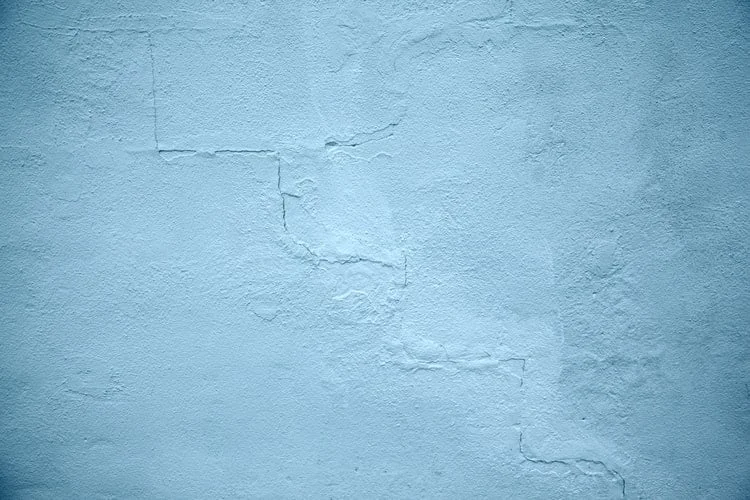
Hairline crazing across the face is cosmetic and can wait. Anything you can slide a business card into, anything opened at a corner in a straight vertical line, or anything that sounds hollow when you tap it needs a look, on the same logic as any other stucco repair on the house — the crack-by-crack breakdown is in our guide to stucco crack repair costs.
What does stucco chimney repair cost in the GTA?
Most chimney work lands between about $1,800 and $4,800, and the surprise for most homeowners is that the stucco is the small half of it. A chimney above the roofline is only 60 to 120 square feet of wall. Access, metal and the crown or chase cover carry the price, and a job that includes none of those is usually a patch, not a repair.
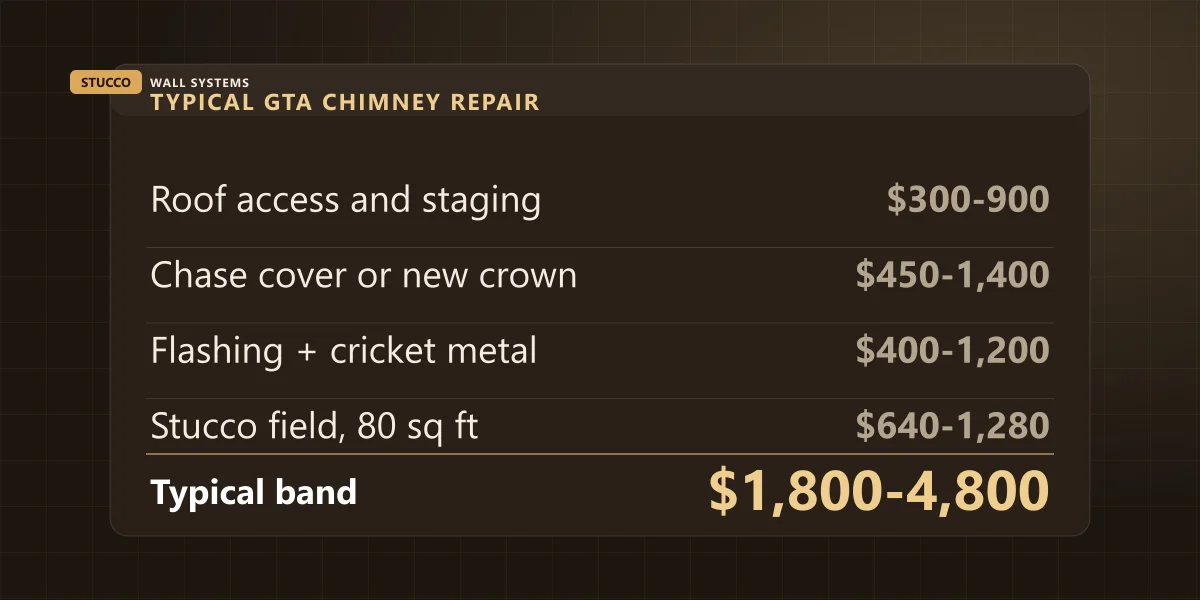
Run the arithmetic yourself. Our residential rate is $8–$16 per square foot installed, so 80 square feet of chimney finish is roughly $640 to $1,280 of actual stucco work — less than it costs to get a crew safely onto a steep two-storey roof with staging and materials. The stucco cost calculator will price the area for you, but treat a chimney number from it as a floor, not a quote: it prices wall, not access.
That is also why a small chimney repair reads expensive per square foot next to a whole elevation: the setup is nearly identical whether we finish 80 square feet or 800. If a crew is already going to be on that roof, or already staged for other residential stucco work on the house, chimney details get dramatically cheaper. Bundle it. That is the best scheduling advice on this page.
What pushes a chimney past the band: rotten framing inside a chase that has to come out before any finish goes on, top courses of brick spalled badly enough to need rebuilding, or a third-storey chimney that needs real scaffolding rather than roof jacks. None of those are common, none are rare, and none can be seen from the ground — which is why I do not price chimneys over the phone.
Repair it, rebuild the top, or take it down?
Three honest options. Repair the finish and the metal if the chimney is sound and still in use. Rebuild the top and re-finish if the crown or chase top is gone but the structure is fine. Or remove it above the roofline entirely — which is often the cheapest answer of the three, and the one almost nobody mentions.
That third option deserves a paragraph, because a lot of GTA chimneys are no longer doing anything. When a house gets a high-efficiency furnace or a tankless water heater, the new appliance vents sideways through a plastic pipe in the wall and the old flue is abandoned. The chimney stays up out of habit. If nothing vents into it and there is no working fireplace, you are maintaining a decorative tower in the worst weather position on the building, forever.
| Option | When it is the right call | What you own afterwards |
|---|
| Repair the finish and metal | Chimney is sound and in use; crown or flashing has aged out | Normal upkeep: sealant every five to ten years, a look each spring |
| Rebuild the top and re-finish | Cracked crown, spalled top courses, or a rusted-through chase cover | Fifteen-plus years of service, but you still own a chimney |
| Remove above the roofline | Nothing vents into the flue and there is no working fireplace | Nothing. There is no chimney left to maintain |
Removal is not free — demolition, new roof deck and shingles across the hole, sometimes framing and an interior patch. But it is a one-time cost with no maintenance behind it, against a lifetime of five-to-ten-year sealant cycles and a re-finish every fifteen. Before going that way, confirm with your heating contractor that the flue really is out of service, and check whether your municipality wants a permit; Toronto publishes the rules on when a building permit is required, and other GTA municipalities publish their own.
The part of a chimney I do not touch
My scope is the outside: the cladding, the crown or chase cover, the flashing, the sealant. What happens inside the flue — liners, caps that serve venting, clearances to combustibles, whether an appliance is safely vented at all — is fuel-safety work and belongs to a licensed heating contractor. If I open a chimney and find a liner problem, I stop and tell you to call one.
The two get muddled on quotes. A rain cap that keeps water off a crown is exterior work. A cap that forms part of an appliance's venting is not, and swapping it out because it looked rusty is how a well-meant repair becomes a safety problem. If someone offers to handle the whole chimney, inside and out, with no mention of who does the fuel-side work, that tells you something about how they scope jobs.
A ten-minute chimney check from the ground
You do not need a ladder. Take a pair of binoculars, stand back far enough to see the whole chimney against the sky, and look at four things.
- The top. Can you see a cracked concrete crown, or a metal cover that is dished, rusty or ponding? That is the leak, nine times in ten.
- Rust streaks. Orange staining running down from the top means the chase cover or something steel above is rusting through and washing down the face.
- The uphill side. Is the back face darker, greener or flakier than the others? That is standing water, and it usually means no cricket.
- The corners at the roofline. Straight vertical cracks at the corners, or a lifted, caulked strip of metal at the roof, mean the flashing detail is working on borrowed time.
If two or more of those are true, get it looked at before winter rather than after. Water that gets into a chimney in November has five months to work on it before a crew can do anything, and one winter is usually what separates a $2,000 repair from a $5,000 one.
Chimneys get looked at as part of any exterior assessment we do as a stucco contractor in Toronto and the surrounding cities. If you want a straight answer on which of the three options above yours actually needs, book an assessment — including when the answer is “leave it alone for another few years”, which it often is.