“What’s it going to cost to fix this crack?” is a different question from “what does stucco repair cost” — and I get both, back to back, most weeks. Here’s the honest answer: stucco crack repair in the GTA runs $120 to $400 per crack for a properly routed, meshed and texture-matched fix, and most repair calls total $450 to $2,500 once you add sealant renewal or a patch. But that range hides a lot, because not every crack is the same job wearing a different face. After 25+ years opening up walls from Oakville to Toronto, here’s exactly what drives the number, crack by crack.
How much does stucco crack repair cost in the GTA?
A properly repaired crack — cut out, reinforced with mesh, base-coated and texture-matched — runs $120 to $400 per crack. Sealant renewal around windows and joints is priced separately at $6 to $12 per linear foot. Most repair visits, once you add a few cracks and some resealing, land between $450 and $2,500 total.
| Work | Typical range | What it covers |
|---|
| Caulking & sealant renewal | $6–$12 / linear ft | Windows, doors, trims and control joints |
| Crack repair (per crack, routed & meshed) | $120–$400 each | Cut out, mesh, base coat, texture match |
| Patch & texture match (small area) | $450–$1,200 | Impact holes, failed sections up to ~20 sq ft |
| Section rebuild (water damage) | $18–$34 / sq ft | Remove to substrate, dry, rebuild base + finish |
| Full elevation refinish | $9–$16 / sq ft | New base coat, mesh and finish over one wall |
Those are the same real numbers I quote off our stucco repair page, not a separate blog-post estimate. What changes call to call isn’t the price list — it’s which line item your wall actually needs, and that’s decided by the crack type, not the crack’s owner.
What does the cost look like by crack type?
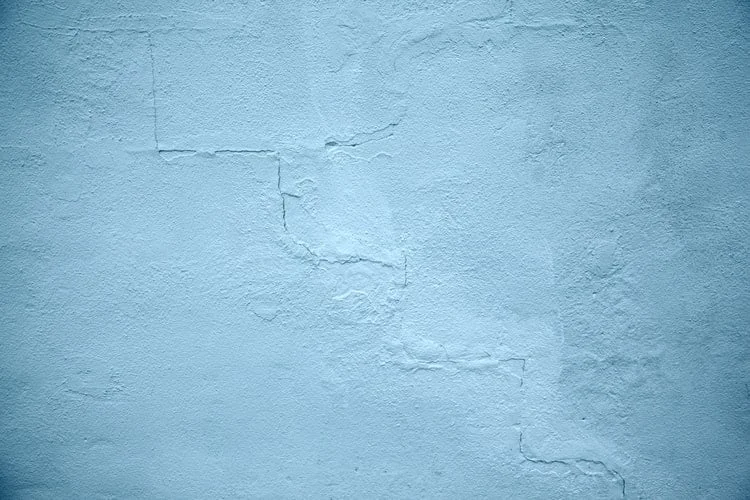
Hairline cracks often need nothing at all. Corner cracks and missing-joint cracks are the standard $120–$400 routed repair. Stair-step cracking on block or brick isn’t priced as a crack — it’s a substrate problem we assess first. Bulging or soft areas jump straight to a section rebuild, because by then water’s already behind the wall.
| Crack type | What it usually means | Typical repair cost |
|---|
| Hairline / map cracking | Finish-coat shrinkage — cosmetic | Often none; if closed, $120–$400 |
| Diagonal crack at window/door corner | Stress concentration, no corner mesh | $120–$400 per crack |
| Long straight crack, no control joint | Wall has nowhere to move | $120–$400 per joint cut in |
| Stair-step crack on block/brick | Movement in the substrate itself | Priced after assessment — not a flat fee |
| Bulging, hollow or soft area | Water behind the system, debonded | $18–$34 / sq ft (section rebuild) |
| Rust stains, streaks, efflorescence | Water moving in and out — failed caulking or flashing | $450–$1,200 (trace, flash, seal, patch) |
I walk through why each of these cracks actually forms — freeze-thaw, missing joints, rushed cold-weather finishes — in why stucco cracks in GTA winters. This post is the other half: once you know what you’re looking at, here’s what fixing it actually costs.
What decides where you land in that range?
Four things move the number more than the crack’s length ever does: how many cracks there are, how hard the wall is to reach, whether the finish match has to be invisible, and whether the cause gets fixed before we close it up. Two houses with the “same” crack can be $800 apart because of these four, not the crack itself.
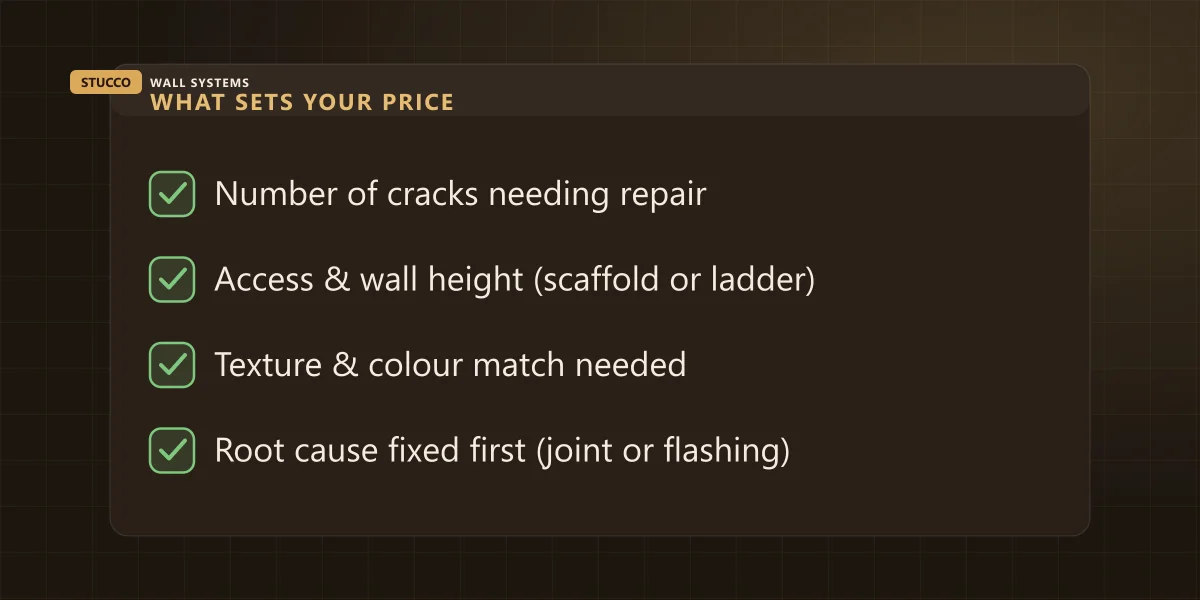
Number of cracks. One crack is a service call; six cracks across an elevation is a job with its own logistics — setup, mixing, a bigger tarp zone — and usually a small per-crack discount once we’re already on site.
Access and height. A ground-floor crack in Mississauga is a ladder job. The same crack on the third storey of a Kleinburg custom home needs scaffold or a lift, and that setup cost gets spread across however many cracks we’re fixing that day — which is why booking all your cracks together instead of one at a time saves real money.
Texture and colour match. Integral-colour acrylic (EIFS) matches almost invisibly because the colour runs all the way through the finish. Painted cement stucco is trickier — sun-faded paint on an older wall in Port Credit or Bronte rarely matches a small patch, and we’ll usually recommend repainting to the nearest corner or control joint so the repair actually disappears, which adds to the bill.
Root cause first. A crack from a missing control joint isn’t fixed by filling the crack — it reopens next winter in the exact same spot. The honest repair cuts in the joint the wall was always missing, which is still inside that $120–$400 band, but it’s more work than a straight patch, and it’s the difference between a repair that holds and one you’re paying for twice.
What does a typical repair call actually total?
Most calls aren’t one crack — they’re a small cluster plus some tired sealant. A common visit: three window-corner cracks on one elevation, plus resealing around two window rows. Priced against the real numbers above, that’s roughly $480 to $1,440 — squarely inside the $450–$2,500 range most repairs fall into.
| Line item | Cost |
|---|
| 3 window-corner cracks (routed, meshed, matched) | $360–$1,200 |
| Reseal 2 window rows (∼20 linear ft) | $120–$240 |
| Typical total | $480–$1,440 |
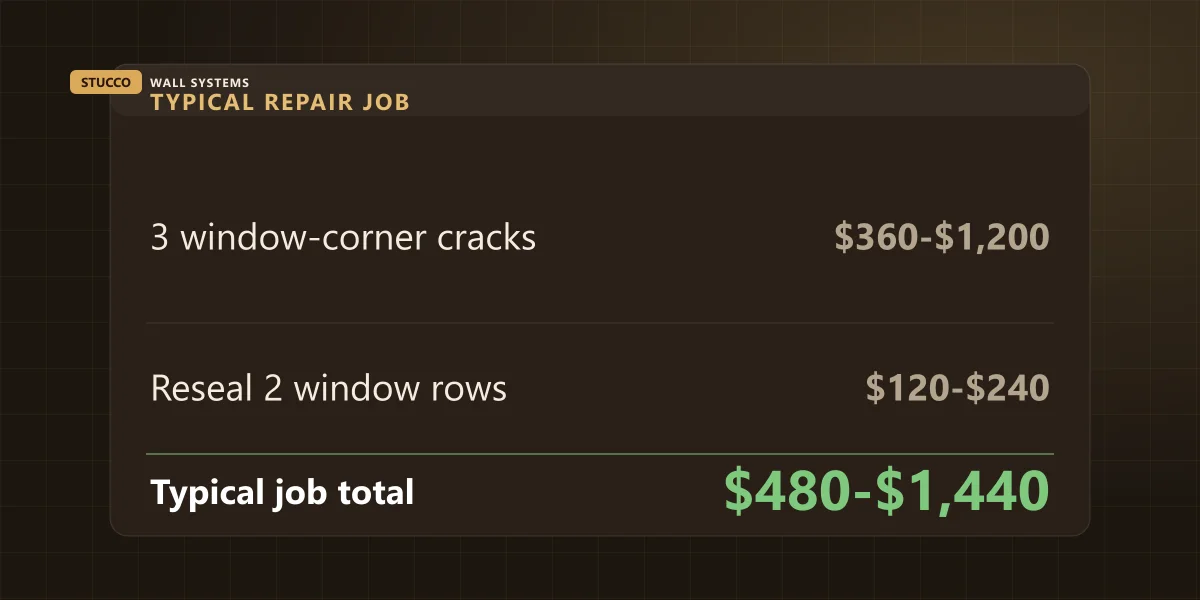
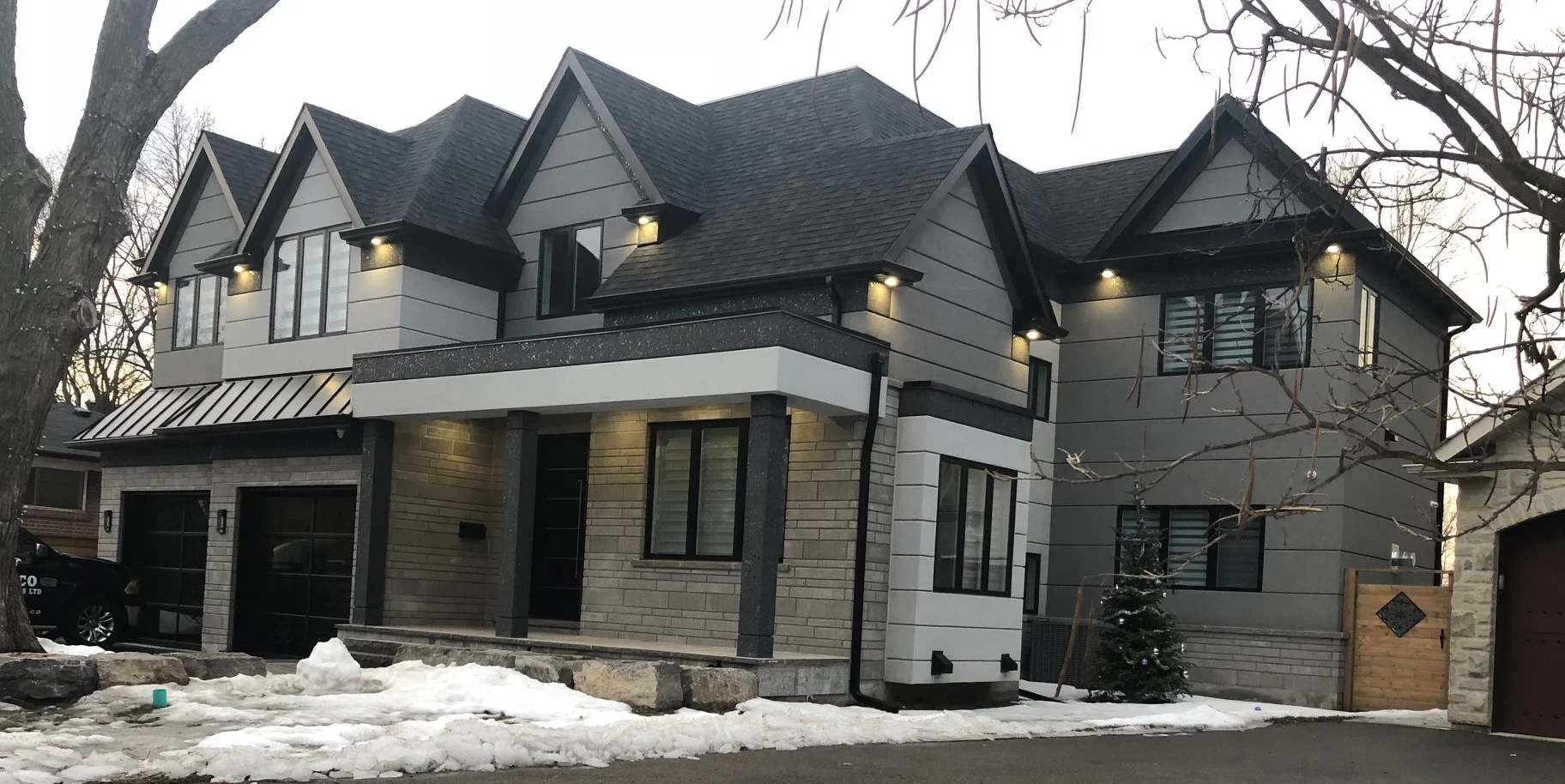
That’s a real job, not a worst case or a teaser number. You can see what a finished, matched repair looks like on an actual wall in our Mississauga repair & restoration project — the goal on every one of these is that you can’t find the repair afterward.
When does “just a crack” turn into a bigger job?
The moment a crack is wet, stained, or the wall sounds hollow when you tap it, you’re past crack-repair pricing and into section-rebuild territory at $18–$34 per square foot. That’s not us upselling — it’s that water behind the finish has already debonded the assembly from the substrate, and mesh over a soft area doesn’t hold.
I cover how to tell the difference — stains, soft spots, the sound a wall makes when you knock on it — in 6 signs water is behind your stucco. The short version: a crack you can catch with a fingernail is a $120–$400 repair; a crack with a rust streak or a soft patch below it is a phone call, not a wait-and-see.
How do you avoid paying for the same crack twice?
Insist the quote names the cause, not just the symptom. “Repair crack” on a one-line invoice tells you nothing about whether anyone diagnosed why it opened. A proper scope says what caused it — missing joint, failed flashing, settlement — and what’s being done about that cause, not just the visible line. I go through exactly what a thin scope looks like versus a real one in 7 red flags in a stucco quote.
Canada’s housing agency backs this up from the other direction: CMHC has written for decades that moisture management — not the visible crack itself — is what actually determines how long a wall assembly lasts. Fix the water path, and the crack repair holds. Fill the crack and skip the cause, and you’re back on the schedule next spring.
What does this mean for your wall?
If you’ve got one crack or six, the fastest way to a real number is a photo, not a guess off this article. Text a photo to (905) 973-6470 or send it through our contact page, and I’ll tell you honestly which line item your wall needs — and if it’s nothing at all, I’ll say that too. Free, written, anywhere across the GTA, for a home or a commercial building.