Every November somebody on a stucco house climbs a ladder with a bag of clips and a glue gun, and every spring some of those walls have a row of small holes or torn patches under the eaves. Hanging Christmas lights on stucco without damage comes down to two things: run the string off the roofline and the trim instead of the wall, and take it down in January without pulling anything off a frozen finish. Which wall you have changes the rest, so that comes first.
Can you hang Christmas lights on a stucco wall?
Yes, and on most GTA houses you barely need to touch the wall. The eavestrough, the aluminum fascia and the window frames carry most strings. Where a light has to sit on the stucco itself, use something that comes off without force, and only after you know whether the wall is cement stucco or EIFS, because they fail in different ways.
From the street the two look the same. They often have the same acrylic finish coat, the same colours and the same textures. Behind that finish they are different walls. Cement stucco is a hard render, roughly 7/8 of an inch over metal lath in a three-coat system, and it shrugs off a clip but cracks around a nail. EIFS is a few millimetres of mesh-reinforced base coat and finish over foam board, so it takes a light clip fine but dents, melts and leaks where a hard fastener or a hot tool goes in. If you want the longer version of that difference, the guide to drilling into a stucco wall walks through what a fastener actually grips in each one.
Which kind of stucco wall do you have?
Two checks take five minutes and tell you most of the time. Do them on a wall you will actually hang lights on, at shoulder height, away from window corners where both systems are reinforced.
The knuckle test
Knock firmly with one knuckle, then walk a few feet and knock again. Cement stucco feels and sounds like knocking on a concrete step. EIFS gives a duller, slightly hollow sound, and on an older wall you can sometimes feel the coat flex a little under a firm press.
The cut-edge look
Find where the wall was opened for something: a dryer vent, a hose bib, an electrical box, the bottom edge near grade. On EIFS you may see white or grey foam, or a thin coat wrapped around a foam edge. On cement stucco you see a solid grey render with a metal screed at the bottom.
Houses built in the GTA from the 1990s on, especially in the newer parts of Vaughan, Oakville and Milton, are often EIFS. Older houses in areas like The Kingsway or Port Credit are more often cement. That is a pattern, not a rule, and a lot of houses mix the two, with EIFS on the upper storey and cement on the lower. If the tests disagree, treat the wall as EIFS. It is the more forgiving guess for the wall.
What is the safest way to attach lights to each type?
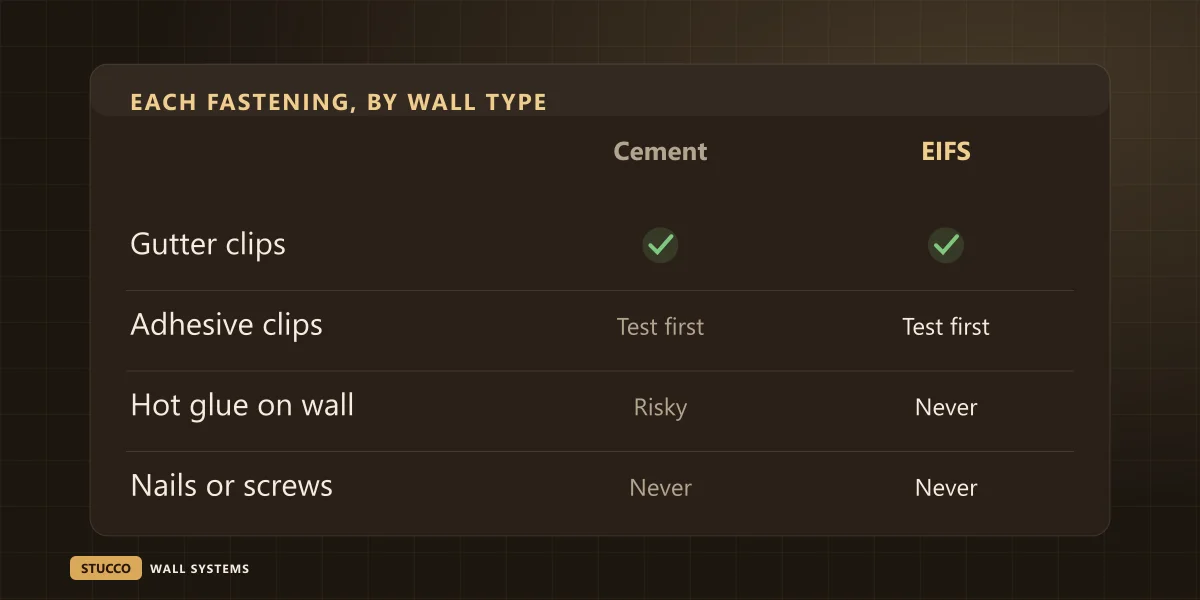
On both walls the safest attachment is no attachment to the stucco at all: clips on the eavestrough, hooks over the fascia, clips on the window frame. Where you must touch the finish, cement stucco tolerates tested adhesive clips and, with care, hot glue on a test spot. EIFS gets adhesive clips at most, and nothing hot or driven into it.
Cement stucco
- Run the main strings on eavestrough clips and fascia hooks.
- For lights along a wall, stick one outdoor-rated adhesive clip in an out-of-the-way spot in early October and pull on it a week later.
- If it held, clean each clip spot with a dry brush, not a wet rag, and press the pad for the full time on the package.
- Hot glue only on a tested spot, and only if you can live with the finish coming off under the blob in January.
- No nails, staples or screws. They crack the render around the hole and let water in for the whole winter.
EIFS
- Keep as much as possible on the roofline and the window frames.
- Adhesive clips only, tested the same way, and spaced closer because the textured coat gives them less to hold.
- No hot glue. Polystyrene foam starts to soften at roughly 100 °C, and a glue gun runs well above that.
- Nothing pushed into the wall, not a nail, a screw or a hook with a point. A hole through a few millimetres of coat goes straight to the foam.
- No heavy displays hanging from the wall field. A wreath or a lit sign goes on a stand or on the door.
| Fastening | On cement stucco | On EIFS | What goes wrong |
|---|
| Clips on the eavestrough | Yes | Yes | Nothing, if the trough is solidly hung |
| Hooks over aluminum fascia | Yes | Yes | A bent fascia edge if pulled sideways |
| Clips on window frames | Yes | Yes | Sealant torn if a clip is wedged into the joint |
| Outdoor adhesive clips on the finish | Test first | Test first | Drops in the cold; can lift finish when pried off |
| Hot glue on the finish | Risky | Never | Pulls the acrylic finish; melts foam on EIFS |
| Tape on the finish | Poor hold | Poor hold | Lets go in wet weather; leaves residue in the texture |
| Nails, staples, screws | Never | Never | Cracked render, a wet hole, a spring repair |
One more word on glue, since every how-to online recommends it. The usual advice is to use hot glue on "unpainted stucco". Very little stucco in the GTA is unpainted in that sense. Most finish coats put on in the last thirty years are acrylic, which grips a glue blob the way paint does, and when the blob comes off, the finish comes with it. Then you are not removing glue, you are patching a finish, and a patch on a coloured wall shows. The piece on stucco patch matching explains why a small spot is harder to hide than a whole wall.
Where should the string run on a stucco house?
Along the roofline first, then around windows and doors on their frames, and on the wall itself only where nothing else reaches. That order keeps almost every clip off the stucco and puts the load on parts built to take a bit of pulling: the eavestrough, the fascia and the window frame.
- Eavestrough. Clips that hook over the front lip of the trough are the backbone on most GTA houses, and they come down in seconds. The article on the roofline as a water system is worth a read before you lean a ladder on a trough that is already pulling away.
- Aluminum fascia. Hooks that sit over the bottom edge of the fascia carry a string where there is no trough, such as along a gable.
- Window and door frames. Clip to the frame, not into the sealant joint between the frame and the stucco. That bead keeps water out of the wall all year.
- Foam trim and sills. Leave them alone. The bands, sills and keystones on most stucco houses are foam with a thin coat, and tape or glue there pulls the coat off. The foam trim repair guide shows what is under that coat.
- The wall field. Last resort, with tested adhesive clips only, and spaced closely enough that one failing clip does not drop the whole run onto the next one.
How do you take lights off stucco in January without damage?
Wait for a day above zero, take the roofline down first, and never pry. A frozen finish is brittle and an adhesive pad frozen to it holds harder than it did in November. Cut tape at the cord, soften glue before lifting it, and pull adhesive clips by their release tab slowly and straight down along the wall.
- Early JanuaryLights off and unplugged. Leave them on the house until a mild spell is in the forecast.
- The thaw dayAbove zero, dry wall, afternoon sun on that face. Roofline clips come off first.
- Wall clips and glueRelease tabs pulled straight down. Glue softened with warm air on cement stucco, never a heat gun on EIFS.
- April walk-aroundLook along every line you used for holes, pale spots and lifted finish before the spring rain gets in.
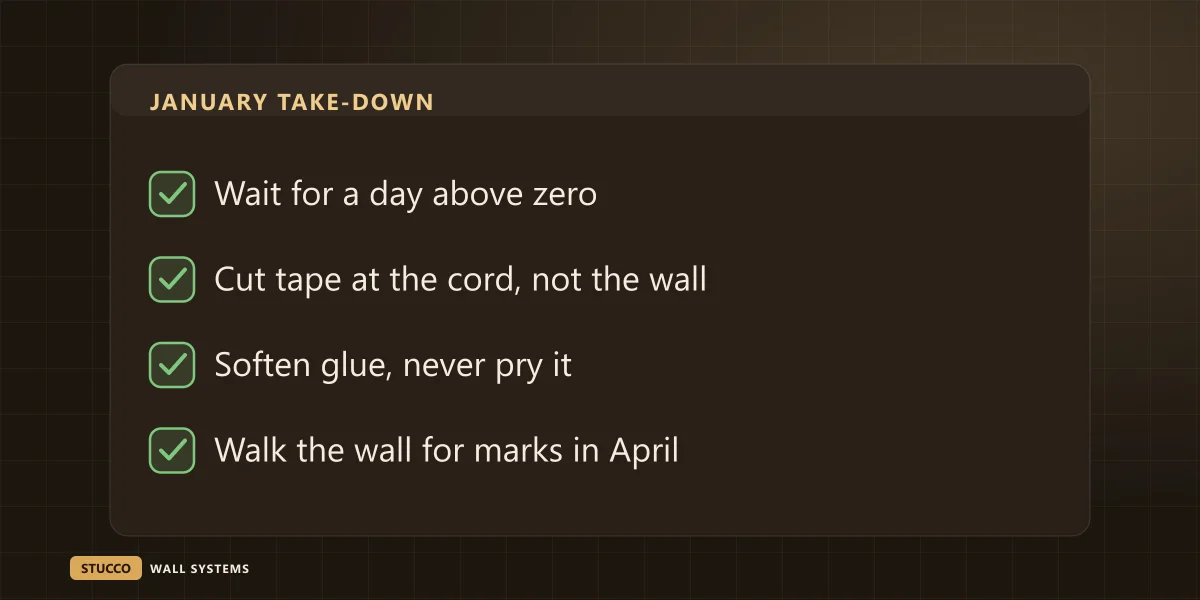
The January thaw is the part people skip. It is minus twelve, the lights look wrong after New Year, and the clips get yanked off in the dark. That is the evening most of the damage happens, not the evening they went up. If a clip will not let go, leave it until the next mild day. A clip on the wall in February costs nothing. A torn finish costs a repair.
What if the wall is already damaged from old lights?
Fix it before the freeze-thaw season, not after. An open nail hole or a torn spot lets water into the wall, where it freezes and widens the damage every cold night. A small repair is a few hundred dollars. The same spot after two winters can mean wet sheathing behind EIFS and a much bigger job.
Do not seal an old hook hole with a dab of caulk and leave it. On cement stucco the hole is filled and the finish re-applied. On EIFS a hole that reached the foam is cut back, filled with foam, meshed and coated, because the mesh is what stops the edge cracking again. The stucco repair page lists the kinds of damage we fix and how the work is done. If you are not sure what you are looking at, send me a photo of the spot and the address, and I usually call back within a day.
Are holiday lights safe on a stucco house?
The wall is not what catches fire. The cord and the plug are. Buy lights rated for outdoor use, check the cords each year, and keep connections off the ground where meltwater collects along the bottom of a stucco wall. Plug outdoor strings into a GFCI-protected outlet, and do not run cords through a window that then gets closed on them.
Ontario's Electrical Safety Authority puts out the same reminders every season, and its holiday safety tips say to look for a recognized Canadian certification mark on the package and to check that each product is approved for outdoor use. Those two checks take ten seconds in the store. For the wall, the rule is simpler: if a fastener needs a hammer, a drill or heat, it does not go into the stucco.