Homeowners call me about stucco and end up talking about their gutters — almost every time. That’s not a coincidence. Your soffit and eavestrough are the first water system a house has, and the stucco wall is downstream of every decision made up there. After 25+ years repairing walls across the GTA, I’d guess the roofline before I even look at the crack — because more often than not, that’s where the real problem started.
What do soffit, fascia and eavestrough actually do for a stucco wall?
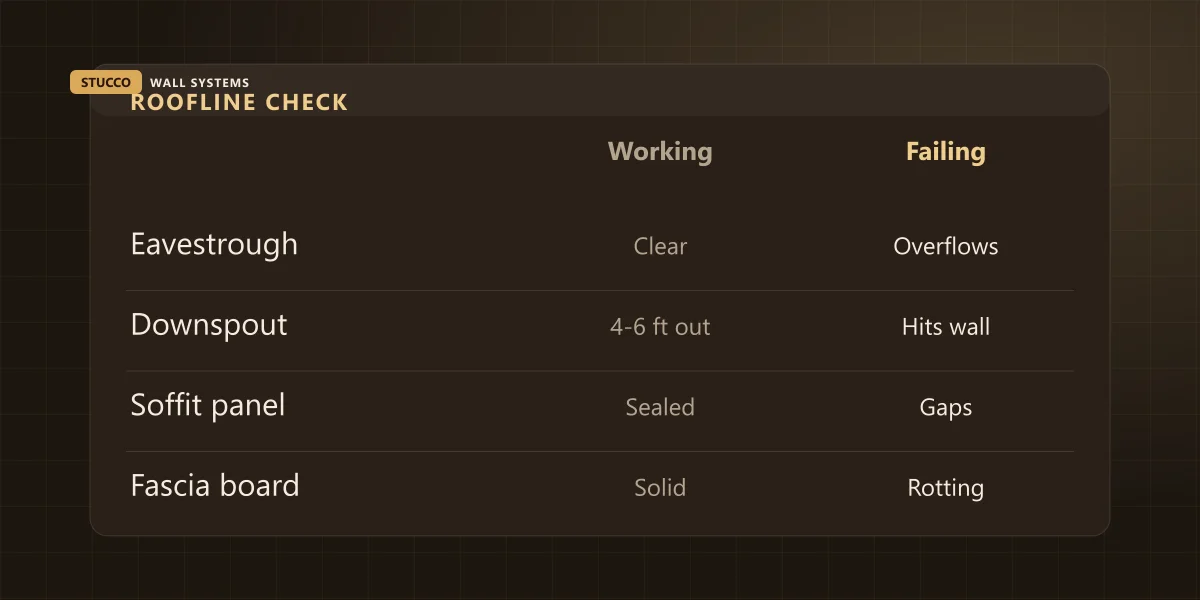
Together they decide how much water ever reaches your wall face. The fascia anchors the eavestrough at the roof edge, the eavestrough catches shingle runoff, the downspout carries it clear of the foundation, and soffit closes the overhang while venting the attic above. When all three hold pitch and seal, most rain never touches the stucco at all.
It’s easy to think of a wall as the thing that keeps water out, and forget that most of the water heading for that wall never has to be dealt with by the wall itself — it’s supposed to be intercepted first. A roof edge that’s doing its job diverts the bulk of a rainstorm sideways and down a downspout before a single drop runs down the finish coat. That’s the whole point of the system, and it’s why I look at the eaves before I look at the crack on almost every call.
| Component | Working | Failing |
|---|
| Eavestrough | Clear, pitched to downspout | Sagging, overflowing at seams |
| Downspout | Discharges 4–6 ft away | Dumps right at foundation |
| Soffit panel | Solid, vented, sealed | Gaps, sag, pest holes |
| Fascia board | Straight, sound, painted | Rot, pulling from wall |
On a lot of the 1980s and ’90s builds I still work on in Erin Mills and Meadowvale, the eavestrough is original equipment — somebody eyeballed the pitch from a stepladder back in 1987, and gravity has been quietly winning that argument ever since. The stucco on those houses isn’t failing because the stucco is bad. It’s failing because the water system above it quietly stopped doing its job a decade ago.
What happens when an eavestrough overflows or a downspout dumps at the foundation?
The wall gets a dose of water it was never built to shed on its own. An overflowing eavestrough sheets straight down the face in a curtain, and a downspout aimed at the foundation soaks the exact strip where stucco meets grade — the hardest spot to inspect and the easiest spot to damage quietly.
That strip is usually the last place a homeowner looks, because it’s hidden behind mulch or a shrub and nobody crouches down to check it.
That base strip matters more than it looks like it should. It’s where the weep screed sits — the drainage detail at the bottom of the wall system that’s supposed to let any moisture inside the assembly drain back out. Constant splashback from a bad downspout keeps that strip wet far longer than a normal rain ever would, and a wall that never fully dries at the bottom is a wall that’s slowly losing the fight, season after season, long before anyone notices a stain. I go through what that looks like once it shows up on the surface in 6 signs water is behind your stucco.
The fix is almost never expensive. A downspout extension is a five-minute job. The wall damage that comes from skipping it is not.
Does soffit venting have anything to do with stucco wall moisture?
Only indirectly. Soffit vents feed the attic, not the wall cavity behind your stucco — they manage roof moisture and ice damming, not wall drainage. The link is real but one step removed: a poorly vented attic melts roof snow unevenly, that meltwater refreezes at the cold eave as an ice dam, and the dam overflows the eavestrough onto the wall.
So a soffit problem doesn’t crack your stucco directly, but it can absolutely be the reason your eavestrough is overflowing every February even though nobody’s touched it since fall. Natural Resources Canada’s own energy-efficiency guidance backs this up directly: a well-sealed, well-vented attic runs cool enough that it generally won’t produce ice dams at all, and the department specifically recommends soffit vents make up about half of an attic’s total ventilation (see NRCan on roofs, attics and ice dams). If you get ice damming at the same spot every winter and the eavestrough there looks fine on a dry day, the attic ventilation above it is worth a look before you blame the gutter.
There’s a second, more physical connection too: overhang depth. A deep soffit overhang keeps wind-driven rain off the top few feet of wall almost regardless of what the eavestrough is doing. A shallow overhang, or one that’s been shortened during a reno, leaves more wall exposed directly to weather — which is one more reason older custom builds with generous eaves in neighbourhoods like Kleinburg tend to show less weathering on their upper walls than newer builds with tight, minimal rooflines.
What are the warning signs your roofline is already hurting your stucco?
Look for vertical staining below a gutter seam, a wet strip at the wall base that never quite dries, sagging or pooling sections of eavestrough, and gaps or sagging soffit panels. Any one of these means water is already reaching the wall somewhere it shouldn’t — the only open question is how long it’s been happening.
| What you’re seeing | What’s actually happening | Urgency |
|---|
| Vertical streaks below a seam | Eavestrough is overflowing at a joint or hanger | Fix this season |
| Wet strip at the wall base | Splashback is keeping the weep screed area saturated | Fix now, before freeze-thaw |
| Sagging or pooling eavestrough run | Lost pitch — water sits instead of draining | Fix this season |
| Gaps or sagging soffit panels | Pests, wind-driven rain and ice-dam risk all rise | Fix before winter |
None of these are emergencies the way a hollow, soft wall is — but every one of them is a countdown, not a static problem. The one-hour fall stucco checklist covers the wall-side half of this walk-around; treat the roofline as the other half of the same hour.
What does it cost to fix the roofline versus fix the wall damage it causes?
Seamless eavestrough runs $12–$20 per linear foot, soffit and fascia run $18–$30 per linear foot — a full roofline package lands around $4,000–$9,000. Ignore the problem and let it soak the wall instead, and you’re adding a stucco repair on top, from a few hundred dollars up to $5,000 or more.
| Roofline problem | Typical fix (roofline) | Wall repair cost if ignored |
|---|
| Sagging, un-pitched eavestrough run | $12–$20 / linear ft to replace | $300–$800 for a stained finish, more if it spreads |
| Downspout dumping at foundation | A downspout extension, often under $100 | $1,500–$5,000+ if the base has been saturating for years |
| Rotten or gapped soffit & fascia | $18–$30 / linear ft to replace | $1,500–$5,000+ if ice damming has been soaking the eave wall |
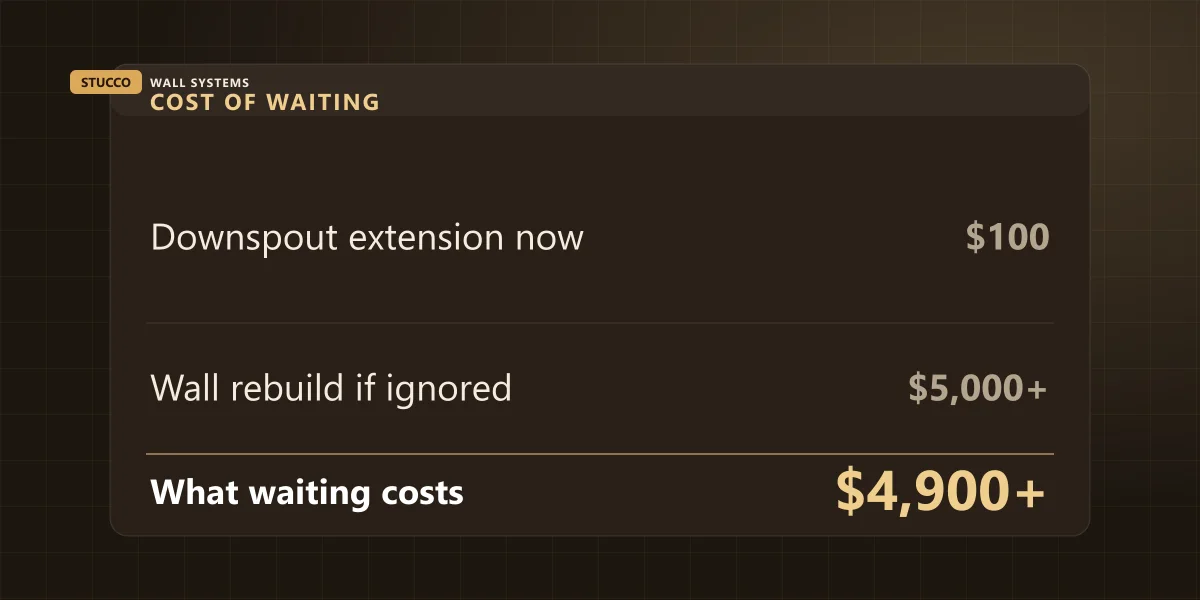
I know a $4,000–$9,000 roofline package doesn’t sound like the cheap option next to a $100 downspout extension — and it isn’t, if all you need is that one extension. But when the whole system is original to a 30-year-old house, the comparison that actually matters isn’t roofline cost against nothing, it’s roofline cost against the wall repair bill you’re otherwise financing on the instalment plan, one soaked section at a time. You can see a full package done right in our Burlington soffit and eavestrough project.
How often should soffit, fascia and eavestrough be inspected on a stucco home?
Twice a year covers it for most GTA houses — once in spring after the snow’s gone, once in fall before it comes back. Add an extra look any time you notice water somewhere new on the wall, since that’s usually the roofline telling you something changed before the stucco does.
The spring check is about winter damage: ice-dam evidence at the eave, hangers pulled loose by snow load, and any soffit panel that shifted or cracked in the cold. The fall check is about getting ready for the next one — clean gutters, confirm pitch, and make sure every downspout still throws water where it’s supposed to before the leaves come down and clog the whole system. Neither check takes long if you’re already doing the wall-side walk-around at the same time.
If you’d rather have someone who does this daily take the look instead of squinting up from the lawn, send us a few photos of your eaves and gutters and we’ll tell you straight whether it’s a clean bill, a small fix, or the start of a bigger conversation. Full soffit and eavestrough service is priced the same way every stucco job on our site is — a real number after a real look, not a quote from the driveway.