Every spring someone in Erin Mills or Bronte rents a pressure washer for the driveway, finishes the driveway, looks at the house, and thinks: why not. The repairs that follow are some of the most avoidable ones I see. So before you do anything, here is the short version of how to clean stucco: work out what the stain actually is, wash with a garden hose, a soft brush and a mild cleaner on a dry day, and leave the pressure washer on the driveway where it belongs.
Stucco is not hard to clean. It is easy to damage while cleaning, and a lot of what looks like dirt is the wall telling you something. This guide covers both: the method, and how to tell a dirty wall from a wall with a problem.
How do you clean stucco without damaging it?
Wet the wall and the plants below it, apply a mild detergent or a cleaner labelled for stucco or masonry from the bottom up, work it in with a soft nylon brush, and rinse from the top down with a garden hose. Do it on a dry day with no frost coming. No pressure washer, no wire brush, no acid.
The bottom-up, top-down order is not superstition. If you soap a dry wall from the top, the dirty run-off streaks down over dry stucco and leaves clean stripes in a dirty wall, which looks worse than where you started. Wet it first, soap from the bottom, rinse from the top, and the dirt leaves in one sheet.
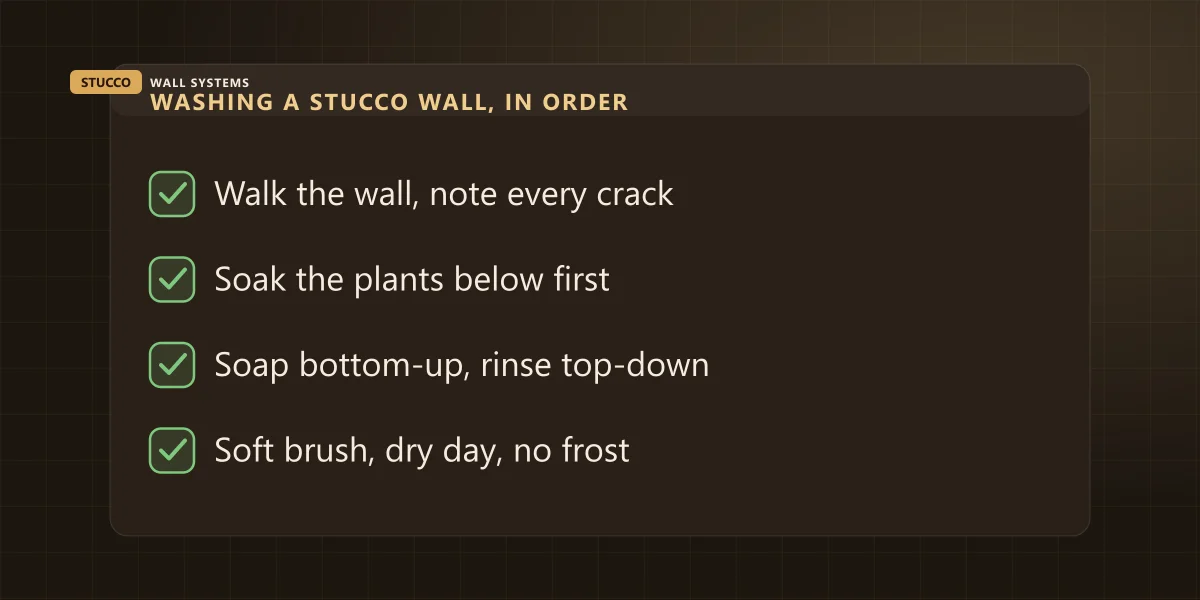
Before any water touches the wall, walk it. Look for hairline cracks, open sealant around windows and gaps at hose bibs and vents. Those are the places a hose, never mind a pressure washer, pushes water into the wall. You do not skip them, but you rinse them gently and from above, not by aiming straight in. Close windows, and tape a bag over a dryer vent if you will be rinsing near it.
Then the weather. In the GTA I only wash stucco when there are a couple of dry days ahead and no overnight frost in the forecast. A wet wall that freezes that night puts water inside every crack right when it expands. Late spring through early fall is the window, which also happens to be when the wall is dirtiest.
What is that stain on my stucco?
The colour and the location tell you most of it. Green or black on a shaded wall is growth. White and chalky is salt from water moving through the wall. Orange is rust. Grey streaks under windows and eaves are dirt carried by water. Reddish-brown along the bottom is soil splash. Some need a cleaner; some need a repair.
| What you see | What it usually is | How to clean it | When it means repair |
|---|
| Green or black film, shaded or north wall | Algae, mildew, mould growth | Diluted mildew cleaner, soft brush, rinse | Back within weeks, or wall feels soft |
| White, chalky bloom | Efflorescence: salts left by water leaving the wall | Dry brush first, then light rinse | Keeps returning to the same spot |
| Orange spots or spray pattern low on the wall | Iron from fertilizer or well water, thrown by a sprinkler | Masonry rust remover, test patch, rinse well | Rarely; re-aim the sprinkler |
| Orange streak from a line or corner | Rusting metal: lath, corner bead, fasteners | Do not just clean it | Almost always; metal inside is corroding |
| Grey or black streaks under sills and eaves | Dirt carried down by water off a ledge | Detergent and soft brush | Streaks return fast: sill or drip edge sheds water onto the wall |
| Reddish-brown band at the bottom | Soil and mulch splash from rain | Hose and brush once dry | Stucco is buried or touching soil |
Two of those rows already have their own guides here. Green and black growth is covered properly in mould on stucco, including why it always picks the same wall. White bloom is covered in white stains on stucco, and the key point bears repeating: dry-brush efflorescence before you wet it, or you dissolve the salt and send it back into the wall.
The one I want every homeowner to learn is the difference between the two orange rows. Rust in a spray pattern, low on the wall, next to the lawn is a sprinkler throwing fertilizer or iron-rich water. It is a cleaning job and a sprinkler adjustment. Rust in a line is different. A vertical orange streak down an outside corner, or a row of orange dots on a flat wall, is metal inside the stucco rusting: the corner bead, the lath, the fasteners that hold it. That means water has been reaching the metal for a while. Cleaning it off just hides the evidence.
Can you pressure wash stucco?
I would not. A rental or big-box pressure washer runs roughly 1,500 to 3,000 psi. On an EIFS wall that strips the acrylic finish, which is only about an eighth of an inch thick. On cement stucco it drives water through hairline cracks and can erode the texture. A hose and brush get the same wall clean.

The problem is not only the surface. Stucco is a weather skin, and it works by shedding water that runs down it. It was never designed to have water fired at it from eighteen inches away. A pressure washer finds the hairline crack you did not notice, the sealant joint that has started to let go, the gap around the hose bib, and it pushes water into every one of them at a pressure no rainstorm ever will. On an older barrier EIFS wall with no drainage behind the foam, that water has no way back out.
Then there is what it does to the finish. On EIFS, a tight tip at close range can cut through the finish into the base coat in one pass, and what was a cleaning job becomes a patch and a colour match. On cement stucco the damage is slower but real: the sharp edges of a dash or float texture wear down, and the wall ends up patchy, smoother where the wand lingered. Neither can be undone with more cleaning.
And yes, I have seen the "stucco restoration" flyers. If the restoration turns out to be one man, one gas pressure washer and an afternoon, that is not restoration. That is sandblasting with water, and you are paying for it twice: once for the wash, and again when someone like me has to repair what it did. Repairs after a bad wash run from a few hundred dollars for a small patch to $5,000 and up when water has gotten behind the wall.
If a whole house genuinely needs cleaning, or the dirty part is two storeys up, hire a proper low-pressure soft wash, where the cleaning solution does the work and the water is only there to rinse it off. Ask the company what pressure they run on stucco. If they do not understand the question, keep calling.
Which cleaners are safe on stucco?
Water, a mild detergent, and cleaners labelled for stucco or masonry, used diluted and rinsed off well. Diluted mildew cleaner for growth, and a masonry rust remover for surface rust, both tested on a hidden spot first. Keep muriatic acid, undiluted bleach and strong solvents off a finished wall, especially an acrylic EIFS finish.
| Cleaner | Cement stucco | EIFS / acrylic finish | Notes |
|---|
| Water, soft nylon brush | Yes | Yes | Start here; it handles most dirt |
| Mild detergent | Yes | Yes | Rinse completely; leftover soap attracts dirt |
| Cleaner labelled for stucco or masonry | Yes | Check the label says acrylic finishes | Follow dilution exactly |
| Diluted mildew cleaner or bleach solution | Yes, diluted | Yes, diluted | For growth only; wet plants before and rinse after |
| Masonry rust remover | Spot use, test first | Spot use, test first | Can lighten coloured finishes |
| Muriatic acid | No | No | Etches cement and can pull out integral colour |
| Paint thinner, strong solvents | Spot use only | No | Can soften an acrylic finish |
| Wire brush | No | No | Leaves steel bits that turn into rust spots |
Two things about chemicals and the yard. First, whatever runs off the wall lands in your garden bed, so soak the plants with plain water before you start and rinse them again after. Second, do not let a bucket of bleach solution run down the driveway into the storm drain. In most of the GTA storm drains run to creeks and the lake, not to a treatment plant.
Is cleaning EIFS different from cleaning cement stucco?
Yes. Cement stucco is about seven eighths of an inch of hard cement and tolerates a firmer brush and a stronger rinse. EIFS has a thin acrylic finish over a meshed base coat and foam, so it bruises and gouges easily and reacts to solvents. Both want low pressure and soft brushes. EIFS just forgives less.
| Cement stucco | EIFS |
|---|
| Surface | Hard, porous cement or a painted coat | Soft acrylic finish, about 1/8 inch |
| Brush | Soft to medium nylon | Soft nylon only |
| Rinse | Garden hose | Garden hose, never close up |
| Solvents | Spot use, tested | Avoid; can soften the finish |
| Most common cleaning damage | Worn texture, water into cracks | Finish stripped to base coat or foam |
| Tell by knocking | Solid, hard | Hollow, slightly soft |
If you do not know which one you have, knock on it. Cement stucco sounds and feels like a sidewalk. EIFS sounds hollow and gives a little under a firm thumb. Plenty of newer builds around the GTA are EIFS, and plenty of older Toronto houses are cement. Clean the gentle way until you know.
How do you get graffiti off stucco?
Carefully, and fast. Stucco texture holds spray paint, and scrubbing with solvent can soften an acrylic finish or push the paint deeper. Try a graffiti remover labelled for textured masonry on a hidden patch first. When it will not lift cleanly, the honest fix is to repaint that section with a matching coating rather than scrub the wall bare.
This one comes up mostly on commercial buildings and on side walls facing laneways. In Toronto it is not optional either: the city's Municipal Code Chapter 485 on graffiti requires owners and occupants to keep their property free of graffiti vandalism, lets an officer give at least 72 hours' notice to remove it, and lets the city remove it and add the cost to the tax roll if the owner does not. On a plaza or a mixed-use building, speed matters for another reason too: tags that stay up tend to attract more. If a facade keeps getting hit, talk to us about commercial stucco finishes and coatings that are easier to clean.
When is a dirty wall really a repair job?
When the same spot keeps coming back after a proper cleaning, when the stain follows a line, crack or corner, when rust comes from inside the wall, or when the stucco feels soft or sounds hollow where it should be solid. Those are water problems wearing a dirt costume. Cleaning them only buys a clean-looking wall for a few months.
Here is the pattern I look for. Dirt is even: it builds up all over a wall at roughly the same rate, heavier where it is shaded. A problem is specific. A streak that starts at the corner of one window. A dark patch that is always wetter than the wall around it. A bloom under one sill and not the others. That specificity is the wall pointing at exactly where the water gets in, usually at a window, a roof-to-wall junction, or a spot where the stucco runs down into the soil (clearance at grade covers that last one).
If you have washed a spot twice and it keeps coming back, stop washing it. Take a photo, note the date, and have someone look at the wall behind it. That is exactly what our stucco repair visits start with, and if you are in the city, our Toronto stucco crew can usually tell you on the first visit whether it is a cleaning problem or a water problem. Better to hear "it's just dirt" from me than to find out the other way. You can send us photos first if you would rather start there.
The short version
Name the stain before you clean it. Wash with a hose, a soft nylon brush and a mild cleaner, soap from the bottom and rinse from the top, on a dry day with no frost coming. Leave the pressure washer, the acid and the wire brush for other jobs. And if one spot keeps coming back, it is not dirty. It is wet.