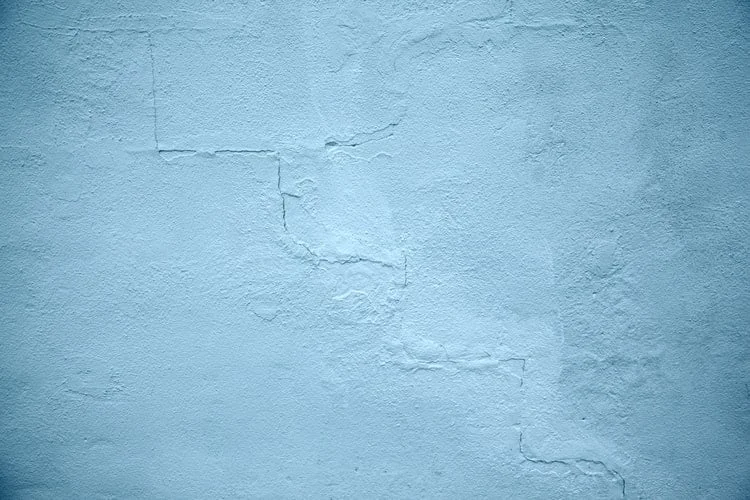
Somebody sends me a photo of a white, chalky bloom across the bottom of a wall about once a week, and the message usually contains the word “mould”. It almost never is. White stains on stucco are nearly always efflorescence — mineral salt left behind after water moved through the wall and evaporated off the face.
Which makes the stain a receipt rather than the problem: a record that water went somewhere. Whether you need to do anything depends on where that water came from, and that is the part nobody reads off a photo.
What are the white stains on my stucco?
They are efflorescence: water-soluble salts that were sitting inside the wall materials, dissolved by water, carried to the surface, and left there as a powder when the water evaporated. It is mineral, not biological. It is not mould, it is not a health issue, and it does not spread on its own.
It needs three things at once, and taking away any one of them stops it. First, salts — and they are everywhere in a wall: cement, sand, mortar, concrete block, the soil sitting against a foundation. Second, water to dissolve them and move them. Third, a path out and a face to dry on.
That is why it shows up in the same handful of places on every house. Those are the places where all three line up.
In this city there is a fourth salt source the textbook diagrams leave out: the road. We put down so much de-icing salt every winter that Environment and Climate Change Canada manages road salts as a pollutant under a national code of practice for road salts. A share of it gets splashed and ploughed against the bottom foot of your wall every January, and comes back out in April, white and powdery.
Is efflorescence on stucco something to worry about?
By itself, no. It is cosmetic, and it will not damage a sound wall in a season. What it tells you can matter a great deal. A one-time bloom on a new wall is ordinary curing. The same bloom, in the same spot, every spring for three years is a water source nobody has found yet.
There are really two kinds and they behave completely differently. The first shows up on new cementitious work in its first months: the mix water carries free salts out to the face as the material cures, you get a haze, and rain weathers it off over a season or two. Nothing to do. Leave it.
The second kind arrives months or years after the wall was finished, which means the water is coming from outside now — rain, snowmelt, ground moisture, a leak, a sprinkler. This is the one that repeats. You can clean it every spring for a decade and it will meet you every spring for a decade, because the source is still there.
Salt itself only turns destructive when it crystallises inside the pores instead of on the face, which can push a finish apart over years. On a GTA wall that is not the risk I would lose sleep over. Whatever is delivering the water is doing more damage than the salt is.
How do I tell efflorescence from mould, paint failure, or run-off?
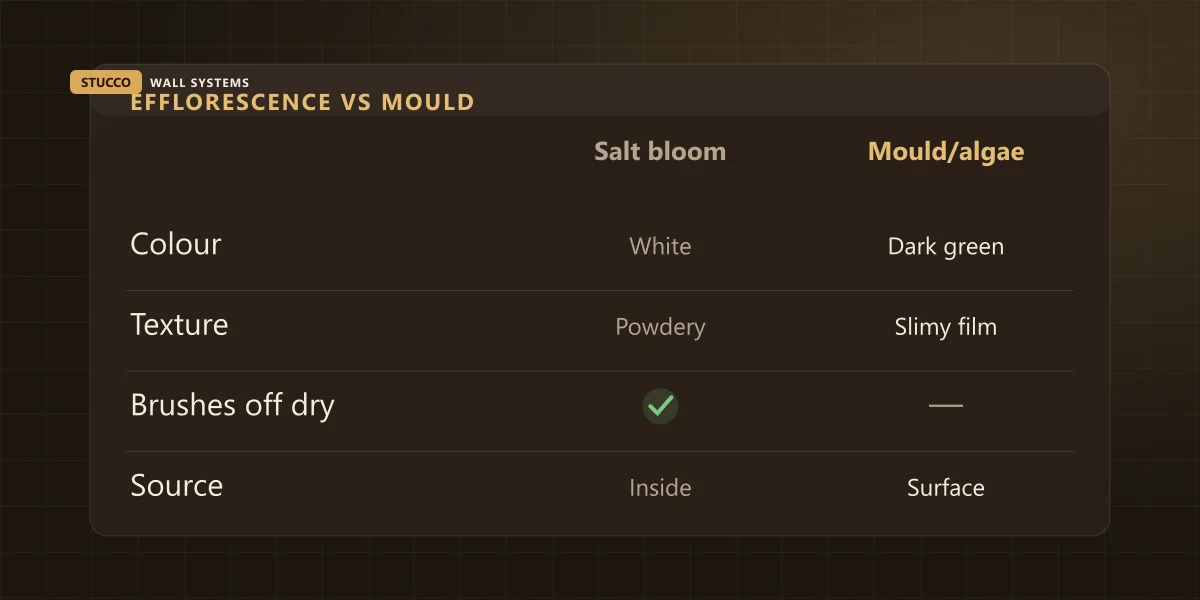
Four things separate them: colour, texture, whether it brushes off dry, and whether it came out of the wall or ran down it. Efflorescence is white to grey, dry and gritty, brushes off on a dry day, and emerges from the wall. Growth is green or black and smears. Run-off streaks downward from something above.
| Tell | Efflorescence | Mould / algae | Paint or finish failure |
|---|
| Colour | White to light grey | Green, grey-green or black | Same colour as the finish |
| Texture | Dry, powdery, gritty | Damp film, slimy when wet | Flaking, curling, lifts at an edge |
| Brushes off dry | Yes, on a dry day | No — it smears | No — it comes off in pieces |
| Where it shows | Out of the wall: bases, joints, cracks | Shaded north and east walls, behind shrubs | Often a whole elevation at once |
| What it means | Water moved through, then evaporated | A surface that stays damp and cannot dry | Wrong coating, or moisture pushing it off |
If it turns out to be growth rather than salt, that is a different job with a different fix, and the reason it is on that particular wall is usually shade and airflow — the full picture is in mould and mildew on GTA stucco. If it is the finish itself lifting, the culprit is very often a coating that was put on a wall that needed to breathe, which is the rule people break when they paint stucco.
There is one more test worth knowing, and it takes thirty seconds. Wet a small patch and watch it. Most efflorescence salts dissolve, so the white vanishes while the wall is wet and reappears as it dries. Lime bloom — the hard calcium carbonate version — will not dissolve and will not budge. If wetting it changes nothing, stop scrubbing: a brush is not going to win that one, and you are just wetting your wall for no reason.
Where do white stains show up, and what does each spot mean?
Six locations cover nearly everything I get sent. The bottom foot of wall, under a window or sill, below a control joint or crack, a fan-shaped patch mid-wall, under anything screwed to the wall, and the whole field of a first-year wall. Each one points at a different water source.
| Where the white is | What is almost certainly feeding it | What to do about it |
|---|
| The bottom foot, and foundation parging | Ground moisture wicking up, plus road salt off the walk | Usually normal here — check nothing is buried against the base |
| Under a window or a concrete sill | Either a leak at the opening, or lime washing down off the sill | Look above the stain: run-off streaks down, a leak blooms outward |
| Below a control joint or a crack | Water getting in higher up and leaving at the first opening it finds | Worth acting on — seal it, then watch that spot for a season |
| A fan-shaped patch mid-wall | An irrigation head soaking the wall every morning | Turn the head. Cheapest fix on this page by a distance |
| Below a light, vent or bracket | Water entering at the top edge of a hole through the wall | Reseal the fixture properly, not with a smear of caulk over it |
| The whole field of a new wall | Curing bloom on cementitious work in its first year | Leave it alone. Rain takes it off |
The sill row is the one that fools experienced people. White streaking under a concrete or precast sill is frequently lime washing down off the sill itself, and it has nothing to do with your stucco — the wall is just the thing it landed on. The direction gives it away: run-off runs in vertical streaks from a defined source above, while efflorescence blooms outward from the wall in a soft patch. Get that backwards and you can spend real money repairing a wall that was never leaking.
The mid-wall fan is my favourite, because a sprinkler head that has drifted a few degrees paints the same section of wall every morning from May to September, and nobody is up at six to see it. They just see the mark.
And if it is showing up along a straight line, that line is probably doing its job. Water arriving from above will exit at the first weakness it reaches, and on a properly built wall that is a control joint — which is exactly what those lines on your wall are there for. The joint is not the fault. It is the exit.
How do I remove efflorescence from stucco?
Let the wall dry, brush the deposit off with a stiff nylon brush, rinse at low pressure, and dry again. That handles most of it. What matters more is what not to do: start with water, use a pressure washer, or put acid on a finished wall. All three feed the process or wreck the finish.
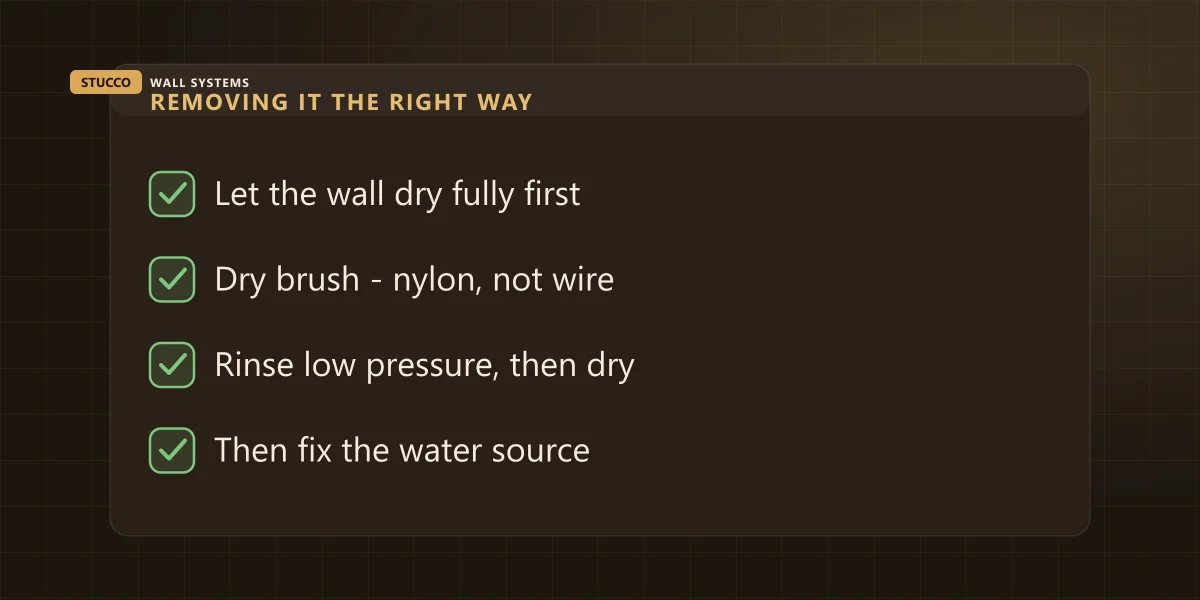
Dry first, always. The whole mechanism is water going in and coming out, so soaking the wall before you brush dissolves the salts and sends a good share of them straight back inside. Dry, brush, then rinse — that order is the trick.
Use nylon, not wire. A wire brush leaves steel fragments in the texture, and by next spring you have swapped a white stain for orange rust freckles that are considerably harder to remove.
On the pressure washer: it is a machine for driving water into a wall that has spent years keeping water out. On an acrylic finish a tight wand takes the texture off faster than you can move your arm, and once it is off it is a patch and a colour match, not a clean. If a quoted stucco “restoration” turns out to be one man with a 3,000 psi wand and an afternoon, that is not restoration. That is erosion, invoiced.
And acid. Masons use dilute acid on brick, and somebody always suggests it. I do not put it on a finished stucco wall. It etches cement finishes, it can pull integral colour out of a coloured coat, and on an acrylic EIFS finish it has no business being there. Bleach is no better — bleach is for growth, and it does nothing to a mineral salt except add water.
Then, when the wall is clean, comes the part people skip: find the water. Cleaning efflorescence without dealing with the source is dusting. It is not repair, and the wall will file the same complaint next April.
When does white staining actually mean a leak?
Three signals move it from cosmetic to worth a phone call. It returns to the same spot after you have properly cleaned it. It arrives with company — a stain, a soft area, or a patch that sounds different when you tap it. Or it appears somewhere with no business being wet, like mid-wall with nothing above it.
The repeat test is the one to actually run, and it costs nothing. Clean the spot, photograph it, and let your phone date the photo. Look again after the next serious rain, and again in spring. A wall that stays clean has answered you. A wall that blooms in the identical outline has answered you too, rather more clearly.
The company it keeps is what escalates it. Salt on its own is a note. Salt plus a brown stain, or a soft spot, or a hollow-sounding area, means water has been sitting in the assembly long enough to change it — and that is the list in 6 signs water is behind your stucco. Do not wait out a winter on that combination. Water parked in a wall through a GTA freeze-thaw cycle expands every night it drops below zero, which is how our winters open cracks that were hairlines in October.
One wrinkle worth knowing, because it changes the reading. Acrylic EIFS finishes are not especially porous, so classic salt bloom pushing through the finish is uncommon on them. When I see white staining on an EIFS wall it is usually water exiting at a joint, a failed sealant line, or run-off from something above — not the wall sweating salt. Knock on the wall: hard-coat answers solid, EIFS answers hollow and slightly soft. Five seconds, and you know which conversation you are having. That is worth a proper look from somebody who does stucco repair for a living rather than a guess from the driveway.
What does it cost to deal with?
The cleaning is a Saturday and a brush. The cost lives in whatever put the water there. Renewing failed sealant at joints and openings runs $500–$1,500. A crack repair with a texture match is $300–$800. If water has reached the substrate you are into $1,500–$5,000+, and that number follows what turns up behind the finish.
| What it turned out to be | Typical range | Do it when |
|---|
| A curing bloom on new work | $0 | First-year wall — brush it and forget about it |
| An irrigation head hitting the wall | $0 | Today. Go and turn it |
| Failed sealant at joints and openings | $500–$1,500 | It returns each spring along the same line |
| Crack repair with a texture match | $300–$800 | A crack is visibly feeding the stain |
| Water in the substrate | $1,500–$5,000+ | The salt comes with a stain, a soft spot or a hollow patch |
The two most common answers on that list cost nothing, which is not me being generous — most white staining I get called out to is either a first-year wall doing what first-year walls do, or something soaking a wall that should not be. The middle rows are ordinary maintenance: sealant at joints and openings is a wear item with a service life, and renewing it on schedule is the cheap thing that prevents the expensive thing. The bottom row is the one to move on, because a visible stain is always smaller than the wet area behind it — and nobody, including me, can price a closed wall from a photograph.
The short version
White stains on stucco are salt, not mould, and salt is a record of water. Work out which spot it is in, whether it came out of the wall or ran down it, and whether it returns after a proper clean. A one-time bloom on a new wall is nothing. The same outline every spring is a wall telling you where the water gets in.
If it has come back twice, or it turned up with a stain or a soft spot, send me the address and a couple of photos of that elevation or call (905) 973-6470. The assessment is free and the quote is written, whether the answer is sealant and a brush, a proper repair, or eventually a full residential refinish. We work across Mississauga, Oakville, Toronto and the rest of our service area, insured and WSIB covered, with 25+ years behind us — the finished work sits in our project portfolio.