Every quote in this province says the same two words somewhere near the bottom: fully insured. Mine says it too. Stucco contractor insurance is the easiest claim in the trade to make and one of the least-checked, and in 25+ years of walls across the GTA hardly anyone has ever asked me to prove it before the scaffold went up.
That is not a complaint about homeowners. Nobody ever explains what to ask for. So here it is: two certificates, two free public lookups, roughly ten minutes at your kitchen table — including the part almost nobody writes honestly, which is that a contractor telling you he has no WSIB coverage can be completely above board.
What does “fully insured and WSIB covered” actually mean?
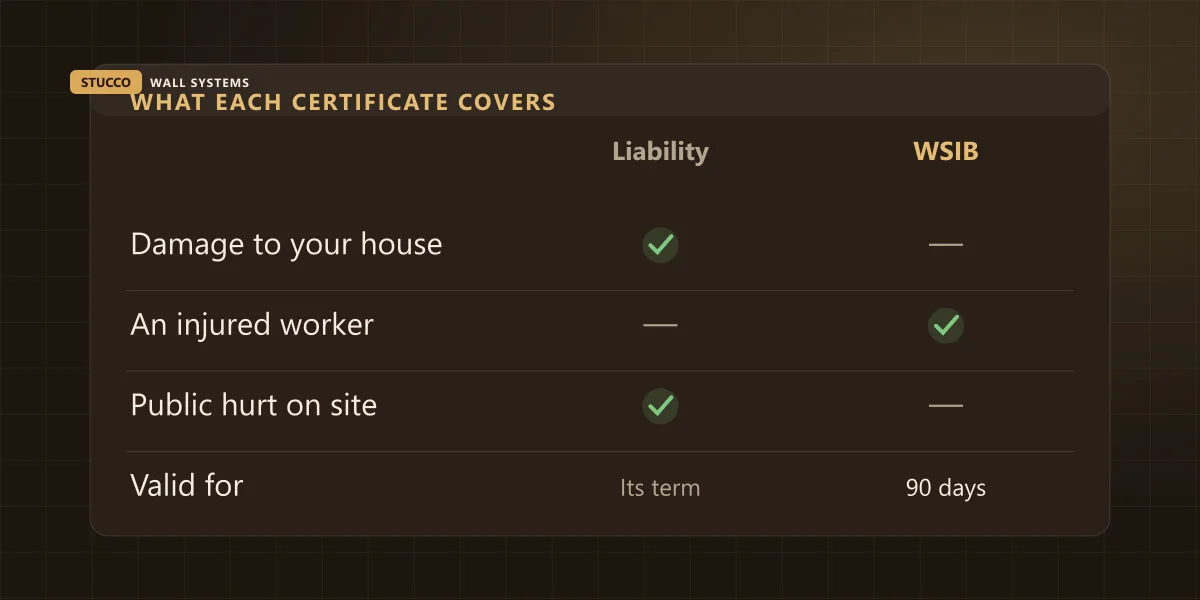
It is two separate things said as one phrase. Liability insurance is a private policy that pays when a contractor damages your property or injures a member of the public. WSIB is Ontario’s workplace insurance, and it pays when a worker is hurt on the job. Neither one covers the other’s claim.
Sit with that for a second, because the rest of this article comes off it. If a labourer swings a scaffold frame through your bay window, that is the liability policy. If the same labourer falls off that scaffold onto your driveway, that is WSIB. A contractor can hold one and not the other and still say “we are fully covered” at your kitchen table without technically lying to you.
| The paper | What it proves | What it does not touch |
|---|
| Liability insurance certificate | A live policy covering damage to your property or injury to the public | Anyone on the contractor’s payroll who gets hurt |
| WSIB clearance certificate | The business is registered and current with WSIB on the date printed | Your window, your car, your neighbour’s fence |
| Certificate of Qualification | That an individual passed the provincial trade exam | Anything financial — it is a skills credential, not coverage |
The third row is the one that surprises people. There is no financial protection in a trade certificate at all — it says somebody passed an exam, not that anybody will pay for your window. It is still worth checking, and I will come back to it at the end, because it is the only part of a contractor’s actual skill that Ontario puts on a public list.
How do I check a WSIB clearance certificate myself?
Ask for the clearance, then verify it without the contractor in the room. WSIB runs a free online clearance lookup that needs no account and no login, and a clearance is valid for up to 90 days. If the paper you were handed is older than that, it is a document about last spring, not about your job.
A clearance means one specific thing: that the business is registered with WSIB and current on its premiums and reporting as of the date printed on it. That date is the entire value of the document. A clearance from March tells you nothing about August, which is exactly why on commercial work the property manager asks for a fresh one before each progress payment — a rhythm I walk through in how a commercial facade job actually runs. On a house, one dated close to your start is plenty.
The trap is whose clearance you are holding. It covers the business named on it and nobody else. If two company names end up in your driveway — the contractor plus a scaffold company, say, or a separate crew doing the parging — that is two clearances, not one. Ask how many separate businesses will set foot on the property, then get a certificate for each and check them at WSIB’s clearance page. It takes about a minute per company.
What should I read on a liability insurance certificate?
Four lines: the named insured, the policy number, the expiry date, and the limit. The named insured has to match the legal business name on your quote exactly — not the name on the truck, not the website, not the first name of the man in your driveway. Then ask for the certificate to come from the broker rather than from the contractor.
That last point does more work than the other three put together. A certificate of insurance is a printout, and a printout is only as honest as whoever printed it. Any real broker will email one straight to a client on request, and arranging it costs a contractor a phone call. When I say ours sits with a broker and here is the number, that is not generosity — it is the cheapest way I have of proving something I would otherwise just be asserting at a kitchen table like everybody else.
Read the expiry date against your finish date, not your start date. Exterior work in the GTA slides with the weather; a policy that lapses in week four of a six-week re-clad in Oakville is a policy you do not have for the second half of the job. And ask out loud whether there is a height restriction on it. Three storeys is not two, and the answer to that question is either immediate or very interesting.
| On the certificate | What it looks like when it is real | What to do about it |
|---|
| Named insured | The legal company name, matching your quote and your invoice | Read the two documents side by side before signing |
| Expiry date | Falls after your job finishes, not partway through it | If it lapses mid-job, ask for the renewal in writing |
| Who sent it | The broker, direct to your inbox | Ask for it that way rather than forwarded on |
| Certificate holder vs additional insured | Holder means you were sent a copy; additional insured extends the policy to you | Raise it at quote stage — the broker handles it, not the contractor |
That last row is the one worth understanding, because the two phrases sound identical and are not. Being the certificate holder means somebody put your name in a box so you would receive the paperwork. Being named as an additional insured is a change to the policy itself. On commercial jobs the building owner is named as a matter of course; on a big residential re-clad it is a fair thing to ask about, and asking tells you quickly whether the contractor has a broker relationship or a PDF.
Can a stucco contractor legally have no WSIB coverage?
Yes, and it is more common than people expect. Ontario exempts individuals doing home renovation work only who are hired and paid directly by the homeowner or resident. A one-man operator working straight for you can be genuinely, lawfully exempt. What the exemption never stretches to is his employees, or any subcontractor he brings along.
These rules are worth knowing rather than guessing at, because “I am exempt” is both a legitimate answer and an extremely easy sentence to say. WSIB sets three conditions together: the work is home renovation only, the contractor is hired and paid directly by the homeowner or resident, and no non-renovation construction contracts are taken on at all. One commercial job and the exemption is gone across the board. The full wording sits in WSIB’s questions and answers on compulsory coverage in construction, and it is short enough to read while you are waiting for a quote.
Then the parts that decide whether it matters on your job. A home renovation business with employees still has to be registered so those employees are insured — the owner can be exempt for himself while every other person on your scaffold must be covered. Subcontractors are never exempt, because they are retained by the contractor rather than by you. And home renovation means an existing home occupied by the person doing the hiring or their family, so a new build does not qualify, and if you are a landlord hiring for a unit you do not live in, do not lean on the exemption — ask for a clearance instead.
| Who is on your property | Is “exempt” legitimate? | What to ask for |
|---|
| One tradesman, hired by you, on the home you live in | Yes — this is exactly what the exemption is for | It in writing, plus his liability certificate |
| A crew of four on the scaffold | No — employees have to be insured | A clearance certificate for the business |
| Your contractor brings in another company | No — subcontractors are never exempt | A separate clearance for each company on site |
| A rental unit you own but do not occupy | Do not assume it — the rule is written around the occupant | A clearance, and treat the exemption as unavailable |
Here is how I read it standing in a driveway. One tradesman, no crew, no subs, working directly for the homeowner, who says he is exempt — that is a man who has read the rules that apply to him, and I have no problem with him at all. Four guys already on the scaffold and the same sentence is a different sentence entirely.
What happens if somebody gets hurt on my property?
I am a plasterer, not a broker or a lawyer, so take this as what I have watched happen rather than as advice. An injury with no workplace coverage behind it does not evaporate. It goes looking for the nearest policy, and on a residential job the nearest policy is very often the homeowner’s own.
Which is why the useful two-minute phone call is not to me — it is to your own insurer, before anybody is on a ladder. Tell them what work is happening and ask what your policy expects of you when you hire a contractor. Some homeowners find out their coverage makes assumptions about the trades they hire that nobody had ever mentioned to them. That is a much better conversation to have in February than during a claim.
Missing paperwork also rarely travels alone. In the seven red flags in a stucco quote, the absent insurance line and the vague start date are the two homeowners wave off most often, and in my experience they turn up on the same quote nearly every time. A crew that cannot produce a certificate usually cannot produce a wall assembly description either.
Is there such a thing as a licensed stucco contractor in Ontario?
Not in the way the word gets used on trucks. Ontario has compulsory trades — electrician, plumber and others — where working without certification is illegal. Plastering is not one of them. Drywall Finisher and Plasterer, trade code 453A, is a non-compulsory trade, which means anyone may legally stucco your house tomorrow morning.
So “licensed and insured” on a magnetic door sign means the insured half. There is no stucco licence in this province to hold, and nobody can be stripped of one. What does exist is a Certificate of Qualification held by an individual tradesperson, and Skilled Trades Ontario keeps a free public register you can search by name in about thirty seconds.
I am not going to pretend a certificate makes a good plasterer. Some of the best hands I have worked beside never sat the exam, and a finish coat has never once cared what is in a filing cabinet. But in a trade where nearly every claim on a quote is unverifiable, it is one more thing that can actually be checked — and checkable beats impressive. It is the same reasoning behind what makes a stucco warranty worth anything: the promise means nothing until the business behind it is real.
The ten-minute check, in order
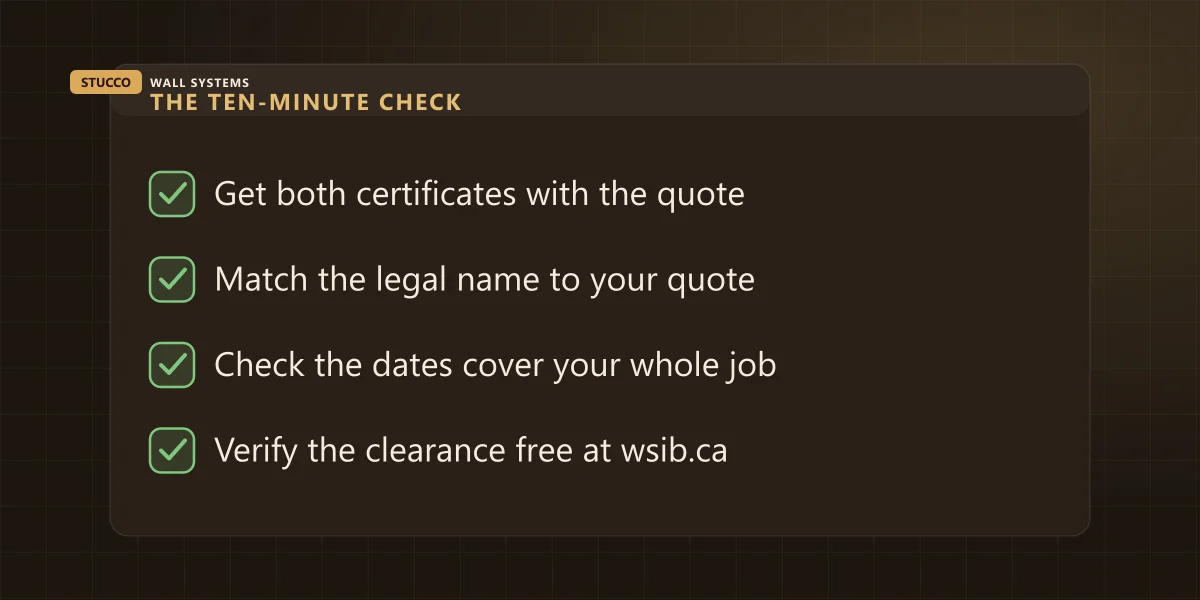
Do it once, before you sign, and never again for that contractor. Ask for both certificates with the quote, match the legal names against the quote, read the dates against your finish date, verify the clearance free at WSIB, and ask how many separate businesses will be on site. Anyone legitimate has all of it on file already.
Timing matters more here than thoroughness does. Ask at quote stage, while three contractors want your job and producing a certificate is a way to win it. Ask after you have signed and it becomes a favour. Ask after the crew has arrived and you are the difficult customer with a scaffold already standing in your side yard.
Notice what is not on that list: a long conversation. I can hand both documents over at the tailgate while I am still measuring an elevation, because they live in the same folder as everything else a job needs. The crews worth filtering out are not the ones who take a day to email it — they are the ones who ask you why you want it.
Where the paperwork stops and the wall starts
None of this tells you whether a contractor can hold a straight line on a control joint. Certificates are a floor, not a recommendation. They get you a shortlist of businesses that are real, insured and answerable, and from there you are back to looking at finished walls and asking what goes on under the finish coat.
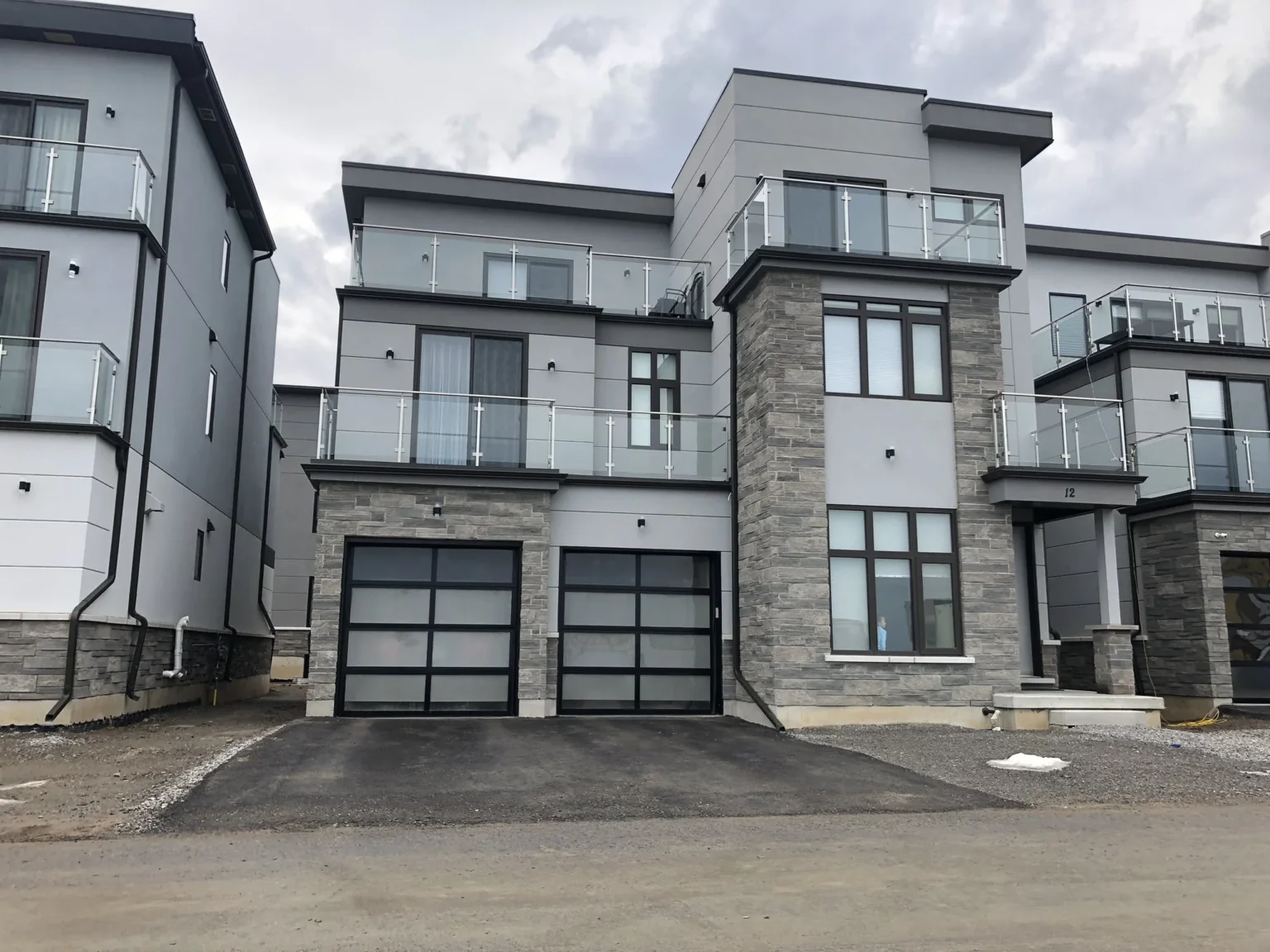
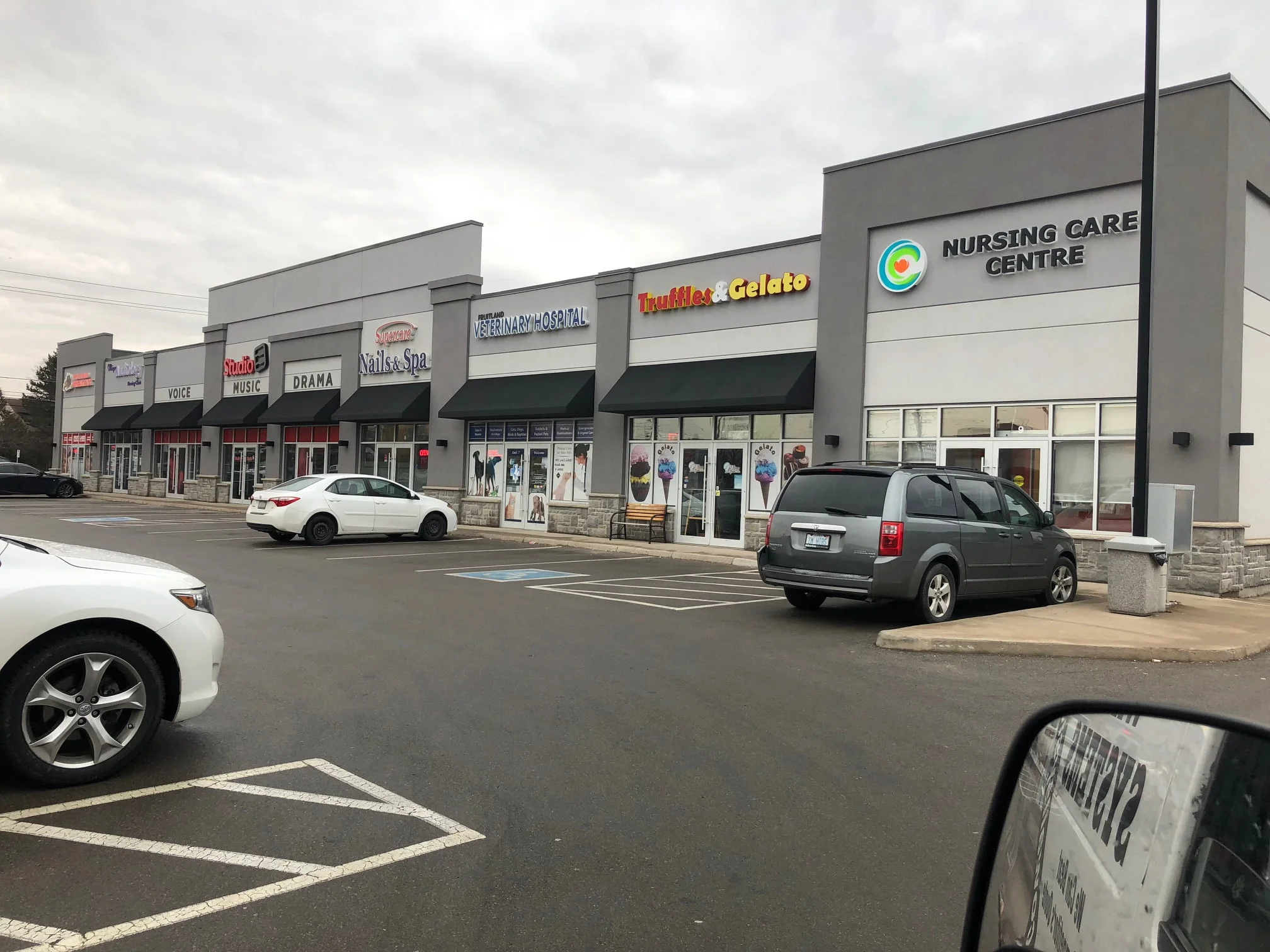
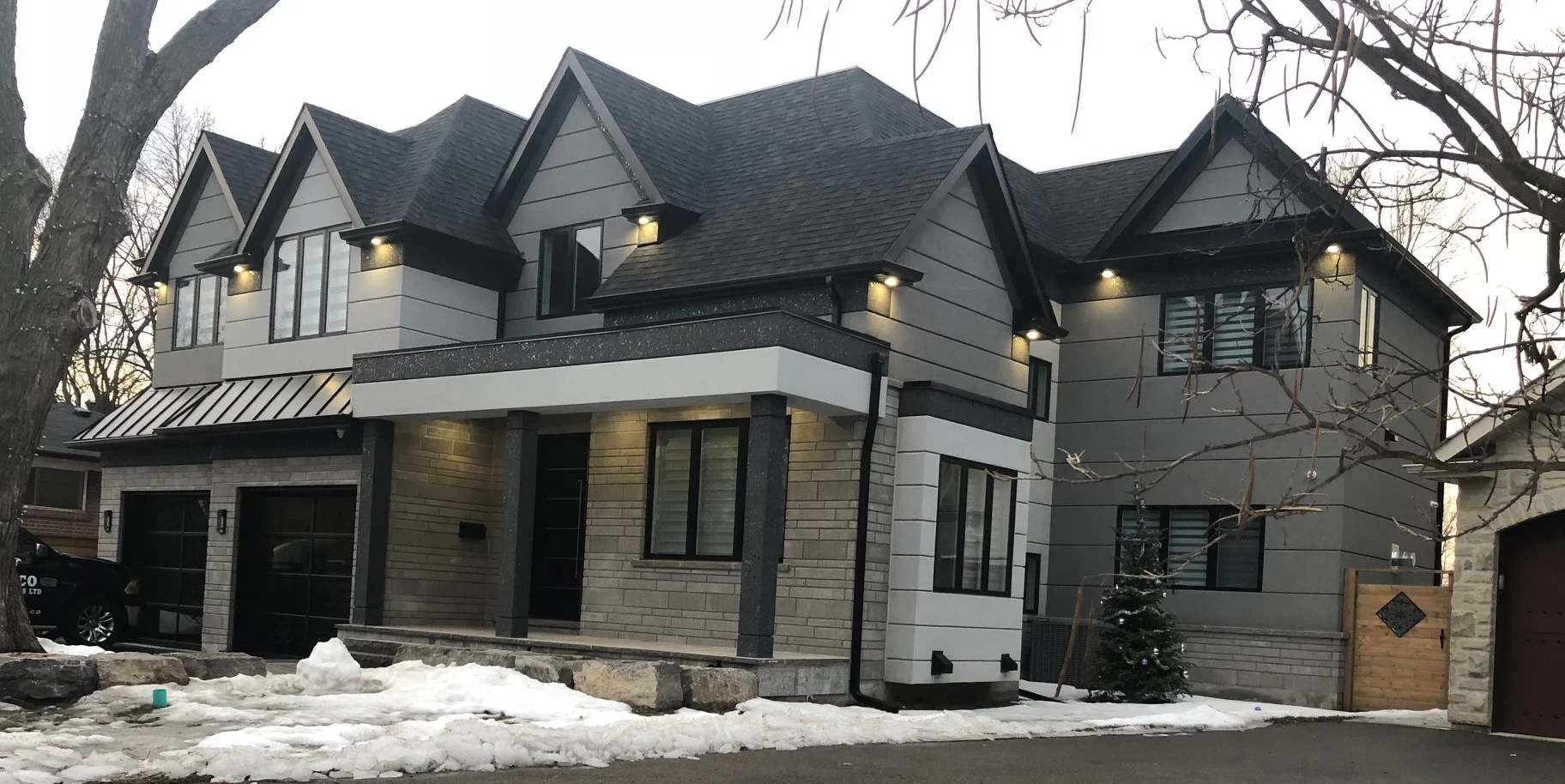
For what it is worth, ours goes out with the quote instead of after being chased: Stucco Wall Systems Ltd., an Oakville company with 25+ years on the tools, insured and WSIB covered, five years on workmanship alongside a ten-year drainage warranty, and Google reviews you can go and read yourself. The finished work across Oakville, Mississauga and the rest of our service area sits in our project portfolio — on homes, commercial buildings and repairs.
Send me the address and a few photos of the wall or call (905) 973-6470. The assessment is free and written, and the certificates come with it whether or not you remember to ask.