There is a warranty line on every quote I hand over, and I would bet most people read it about as closely as they read the back of a parking ticket. I understand why. It is the boring paragraph at the end, after the price. But when a wall goes wrong three years later, that boring paragraph is the entire conversation. The uncomfortable truth about a stucco warranty is that the number of years printed on it tells you almost nothing useful — what matters is which of two completely different warranties you actually have, and what the exclusion list quietly takes back.
What does a stucco warranty actually cover?
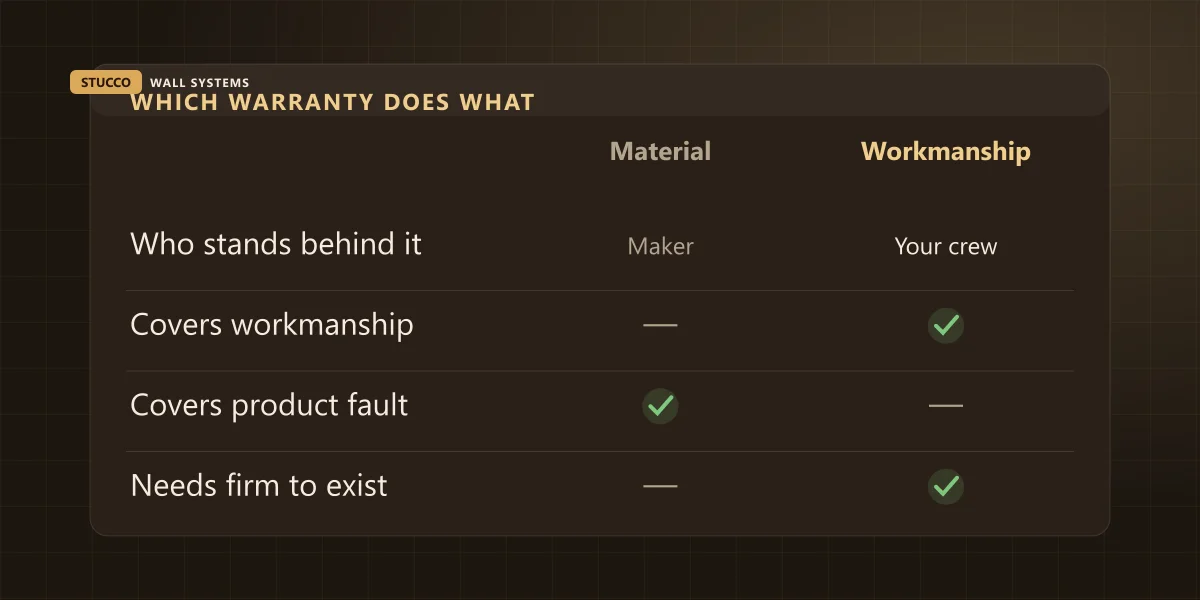
Two separate warranties, routinely mistaken for one. The workmanship warranty comes from the contractor and covers how the wall was built — joints, flashing, mesh laps, bond, cracking traced back to the install. The material warranty comes from the manufacturer and covers the product itself. Neither one covers the other’s failure.
That distinction is the whole article, so it is worth sitting on for a second. When a salesperson says “this system carries a fifteen-year warranty,” they are almost always talking about the manufacturer’s product warranty. That is a real thing, and it is not nothing — but it is a promise about a bag of base coat and a pail of finish, not a promise about the person spreading them on your house.
| | Workmanship warranty | Material / system warranty |
|---|
| Who issues it | The contractor who did the work | The manufacturer of the finish or EIFS system |
| What it covers | How the wall was built — joints, flashing, mesh laps, bond, install-related cracking | The product as manufactured — adhesion or coating failure that is not an install error |
| Who actually does the repair | The crew comes back out | You still need a crew, and someone has to pay them |
| What kills it | The company closing, or moving on to a new numbered corporation | Mixing components across brands, or an installer the maker never certified |
Which of the two warranties actually matters?
The workmanship one, nearly every time. In twenty-five years of being called out to walls that failed, I can count on one hand the times the material itself was the problem. It is the detailing that fails: a missing head flashing over a window, a control joint that never got cut in, mesh that was butted instead of lapped, a base coat rushed on in a cold snap.
None of that is covered by a manufacturer. The product performed exactly as designed; it was installed wrong. And here is the part people find out too late — most limited material warranties I have read supply replacement material, not the labour to strip a wall down and rebuild it. On a re-clad at $8–$16 per square foot installed, the material is the small half of that number. Read your own document and see which half it is actually promising you.
This is the same reason the cheapest quote so often turns out to be the most expensive one. I walked through the layer-by-layer version of that in why the cheapest stucco quote costs the most — every corner that gets cut there is a corner no manufacturer warranty will ever pay for.
What does a stucco warranty not cover?
Every honest warranty has exclusions, and most of them are legitimate. Normal hairline shrinkage cracking, impact damage, water arriving from a failed roof or a downspout, damage caused by another trade opening the wall, and gradual colour fade are all standard carve-outs. The problem is not that exclusions exist — it is when they are vague enough to swallow the coverage.
| Commonly excluded | Why it is excluded | Is that fair? |
|---|
| Fine hairline cracking | Cement shrinks as it cures — some fine cracking is physics, not workmanship | Fair, but the document should define what counts as hairline |
| Impact damage | A ladder, a stone off the mower or a hockey puck has nothing to do with the install | Fair — that is a repair, not a claim |
| Another trade cutting the wall | A window, A/C line or vent installer opens the assembly after we leave | Fair — photograph the wall before and after any other trade works on it |
| Water from the roof, eaves or grading | The wall was not the source of the water | Fair, and it is exactly why the roofline is worth an hour of your year |
| Colour fade over many years | UV works on every exterior colour eventually | Fair on painted walls; integral colour holds much longer |
That fourth row causes more arguments than the rest combined, and usually unfairly. Water coming over a blocked eavestrough and running down a wall for two winters is not a stucco defect, but it will absolutely look like one by the time anyone opens the wall up. I laid out how the whole roofline works as one water system in your roofline is a water system — keeping it working is the cheapest warranty protection there is, and it costs nothing but an afternoon.
What voids a stucco warranty?
Mostly things homeowners do with good intentions. Sealing the wall with a non-breathable coating, pressure washing it at car-wash pressure, DIY patching with the wrong mix, letting a downspout discharge against the wall, and sitting on a known problem for two years instead of reporting it — each of those can end your coverage.
Painting it with the wrong coating. This is the big one. A wall assembly is designed to let moisture out; a heavy sealing coating changes that, and after it goes on nobody can honestly separate an install fault from a coating fault. I set out which coatings are safe over stucco and when not to paint at all in the rules most crews break when painting stucco.
Power washing. A soft wash with a brush is fine and I recommend it. A pressure washer held close enough to strip the texture is not, and the damage it does looks a lot like a manufacturing defect from ten feet away.
Patching it yourself. Not because I want the work — there is a genuine list of things you can safely do yourself, and I wrote it out in what stucco work you can DIY. But once someone else’s material is in the wall, the original installer cannot tell what failed, and no fair warranty asks them to guess.
Waiting. Almost every warranty document has a clause requiring reasonably prompt notice. A hairline crack reported in year two is a callback. The same crack reported in year five, after two winters of freeze-thaw driving water through it, is a section rebuild in the $1,500–$5,000+ range, and by then it is genuinely hard to argue it started as a workmanship issue. If you are unsure what you are looking at, the six signs water is behind your stucco is the list I would work through first.
How long should a stucco warranty run?
Long enough to cover a few real GTA winters, which is when install faults show themselves. Ours is a five-year workmanship warranty and a ten-year drainage warranty — the numbers on our homepage. But term length is the least informative part of any warranty document, and a long number on a weak clause is worth less than a short number on a specific one.
Freeze-thaw is the honest reason a few winters matter more than a long number. A wall that was detailed properly and a wall that was not can look identical the day the scaffold comes down. It takes a couple of January thaws, water getting into a missed joint and freezing overnight, before the difference shows on the surface. Any workmanship warranty that survives three or four GTA winters has told you what you needed to know.
Which brings me to the lifetime warranty. I have seen it printed on quotes handed over through a car window, from crews with a cell number and no address, and it is the cheapest thing in the world to print. A workmanship warranty lasts exactly as long as the company that wrote it. Before the length means anything, check that the business behind it is real: fully insured, WSIB covered, and reachable at the same address in five years. Ours is an Oakville company with 25+ years on the tools behind it and a 4.3-star rating from 12 Google reviews — a smallish number, and a real one you can go read. That is the check that makes a warranty worth something, and it is the same instinct behind the seven red flags in a stucco quote.
Does Ontario’s new home warranty cover stucco?
If your house is newly built, partly yes. New homes in Ontario carry 1-year, 2-year and 7-year warranties administered by Tarion, covering bad workmanship, water penetration and major structural defects. Envelope water penetration sits in that early window, so a new-build stucco problem is worth reporting immediately rather than living with it.
That is a builder’s warranty, not your stucco contractor’s, and it is worth knowing the difference: your claim goes through the builder, and it runs on the province’s clock rather than a private contract’s. The details and the claim routes are published by the province (see Ontario on what to know before buying a home). Worth noting from the province’s own review of the program: water penetration is one of four claim types that, together, made up more than 80% of all claims paid out in each year from 2012 to 2015. Water is where the money goes, which is why flashing details are worth arguing about before the wall goes on.
If you are taking possession of a new build, the pre-delivery inspection is your one free chance to put a date on anything you can see. I went through exactly what to look at, and what is normal versus what to flag, in what builders should spec for stucco on new builds.
And keep warranty and insurance separate in your head — they answer different questions. A warranty covers a defect in how something was built or made. Insurance covers sudden, accidental damage to a wall that was fine. I wrote up which is which, and what tends to be covered either way, in stucco damage and home insurance in Ontario.
What should I ask before I sign?
Five questions, and you can ask all of them in under two minutes at your kitchen table. Is it written into the contract with a start date? Does it cover labour as well as material? What exactly voids it? Does it transfer if I sell? Are you insured and WSIB covered? The answers tell you more about a contractor than the price does.
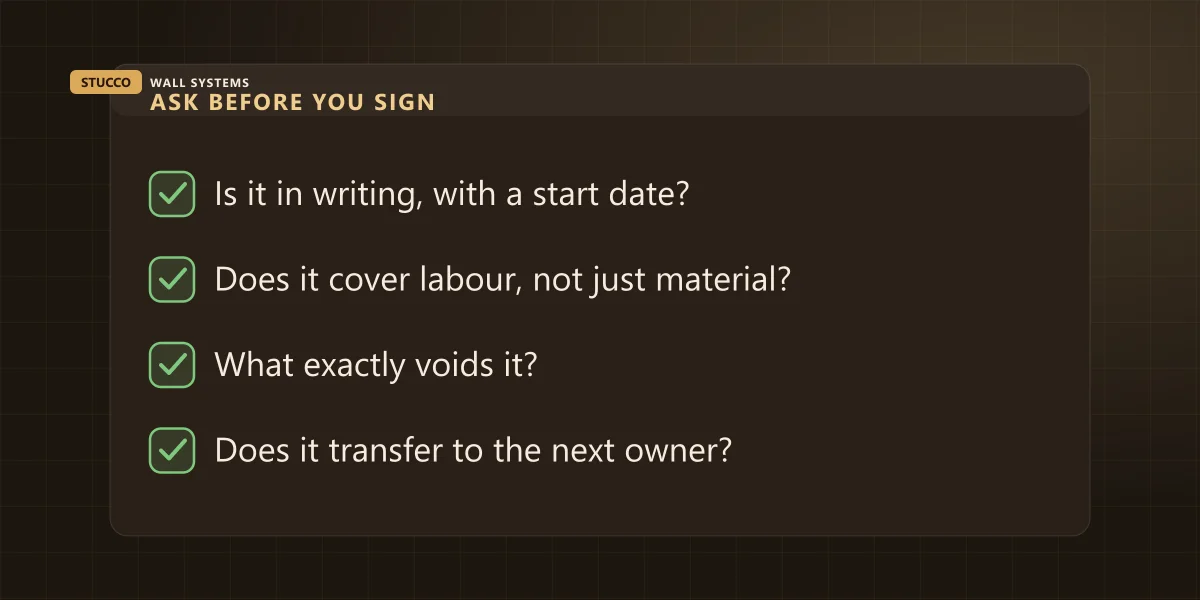
| Ask this | A real answer sounds like | The answer to walk away from |
|---|
| Is the warranty written into the contract, with a start date? | Yes — it is clause 8, and it starts the day we finish | “Don’t worry, we always look after our customers” |
| Does it cover labour as well as material? | Both. If it is our detailing, we come back at no charge | “The manufacturer covers the material” — and nothing about labour |
| What exactly voids it? | A short, specific list you can read on the spot | “Nothing really”, or a shrug |
| Does it transfer if I sell the house? | A straight yes or no, written into the document | “That has never come up” |
| Are you insured and WSIB covered? | Certificates produced without being chased | “Everyone on site is a sub, so it is fine” |
None of those questions are hostile, and none of them will offend a contractor who has answered them a hundred times. The reaction you get to question three is usually the most informative thing in the whole meeting.
How does a stucco warranty claim actually work?
You call the contractor who did the work, they come and look, and if it is their detailing they fix it. There is no adjuster and no claim number. What makes it go smoothly is paperwork you gathered years earlier: the signed contract with the warranty clause, dated photos from the day the job finished, and the product name and colour code.
Keep all of that with your house papers, not in an email folder you will lose to a new phone. Dated handover photos are the single most useful thing in the file — they establish what the wall looked like when we left, which settles most of the honest disagreements before they start. And call early. A callback for one crack is a morning’s work; the same wall left two years is a stucco repair job with scaffolding on it.
The honest bottom line
A warranty is not a safety net that lets you skip due diligence — it is the written version of due diligence you already did. Ask who issues it, what it names, what voids it, and whether the company will still exist to honour it. If the answers are specific and in writing, the years matter less than you think. If the answers are vague, no number of years fixes that.
If you want to see what those clauses look like written down, get in touch and ask for a quote — the warranty terms are on the same page as the price, in plain language, before you commit to anything. That goes for a single crack, a full residential re-clad or a commercial facade, and for every city we cover from Oakville out through the rest of the GTA. Finished walls from all of it are in our project portfolio.