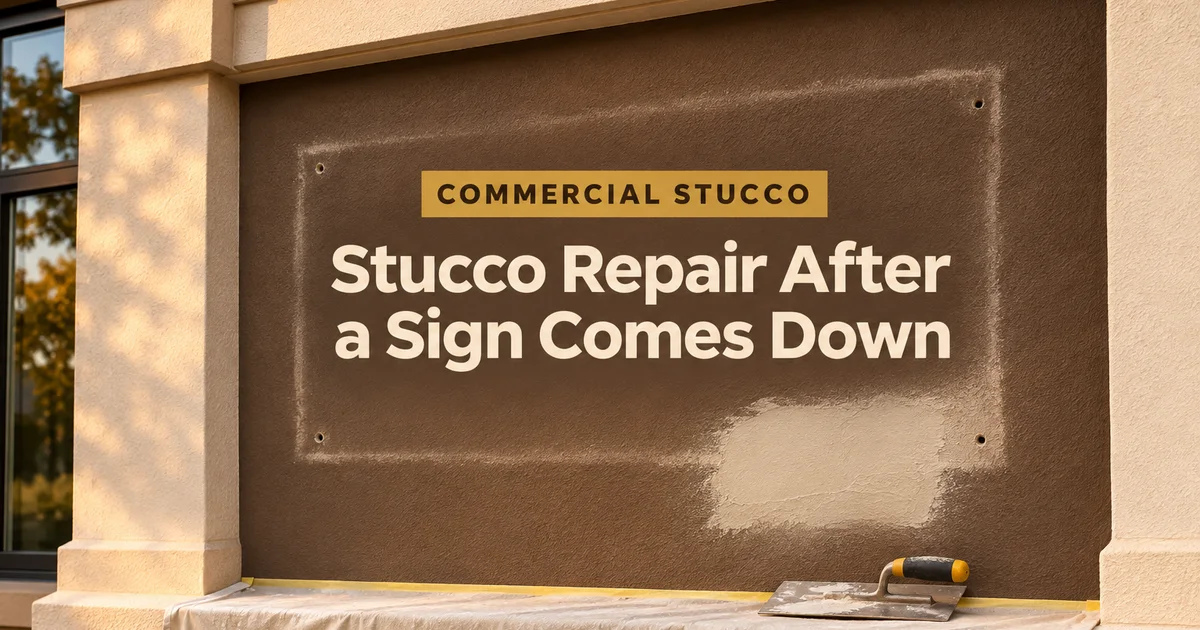
A tenant moves out, a sign crew shows up with a bucket truck, and by four o'clock the letters are gone. What's left is the job nobody priced: a row of bolt holes, a bigger hole where the wire went in, and a crisp rectangle of the wall's old colour that you can read from across the parking lot. Stucco repair after sign removal is a small job, but it's the one that decides whether the next tenant's storefront looks new or looks patched.
I'm Musa Kastrati. I've worked on stucco and EIFS walls for 25+ years across Halton, Peel, Toronto and York region, plazas and shopfronts included. Each mark a sign leaves has its own fix, the order of the removal decides how big the holes get, and the outline can be handled three ways at three prices from our list.
What does a sign leave behind on a stucco wall?
Usually five things: anchor holes, one larger hole for the power feed, a clean outline where the finish was shaded for years, dark drip lines running down from the top edge of the old sign, and smears of sealant or rust around the fixings. The holes are the quick part. The outline is what people notice.
- Anchor holes
- Lag bolts, sleeve anchors or screws, often a dozen or more for a row of channel letters. Each one went through the finish and the base coat into whatever is behind it. Left open, it lets water straight in behind the coat, and on our winters water in a hole turns into ice that pushes the edges apart.
- The wire hole
- Lit signs need power, so somewhere behind the old sign there is a hole of an inch or more where the conduit or cable came through the wall. It's the biggest opening of the lot and the one most often left with a wad of foam or tape in it.
- The outline
- The finish under the sign sat in shade and stayed dry, so it kept its original colour. The wall around it has been in sun, rain and road dust for as long as the sign was up. The result is a sharp rectangle or the ghost of each letter, and no amount of washing makes the two match.
- Drip lines
- The top edge of a sign collects dirt, and every rain washes some of it down the wall below. You'll see dark streaks under each end of the old sign box, sometimes with a stain from birds that liked the warm top of a lit sign.
- Sealant smears and rust
- Installers seal around each fixing, and the old bead of sealant usually stays stuck to the wall when the sign comes off. Steel fixings that rusted leave orange rings. Both have to come off before anything new goes on, or they show through.
Cement stucco or EIFS behind the sign
The two walls look alike from the parking lot, and they behave very differently once the bolts are out. Knock on the wall next to a hole. A hard, solid sound means cement stucco on metal lath. A hollow, light sound and a peek of white or grey foam in the hole means EIFS, a thin finish over foam board. Many GTA plazas have EIFS on the upper fascia where the signs go and something harder at the storefront level.
| When the fixing comes out | Cement stucco | EIFS |
|---|
| What the hole looks like | A clean round hole, sometimes with a chipped edge | A hole in a thin skin, often with the foam crushed around it |
| What is behind it | Lath and sheathing, about an inch back | One to several inches of foam, then the sheathing |
| What a careless pull does | Pops out a cone of stucco around the hole | Tears the skin and leaves a dent or a soft spot |
| How it is patched | Cut back to sound coat, fill in coats, mesh, texture | Replace damaged foam, new base coat with mesh lapped onto the old, finish |
On EIFS the foam is the reason holes are worth fixing properly. A sign is heavy, and if the installer did not sleeve the bolts, tightening them crushed the foam behind the finish. When the sign comes off, that crushed ring stays, and filling just the hole leaves a dish in the wall that shows in low sun. Our commercial stucco page covers the difference between a finish-only wall and full EIFS if you don't know which one your building has.
Taking the sign down without wrecking the wall
Most of the damage I see around old sign locations happened in the last hour of the sign's life, not the ten years before it. A pry bar behind a letter turns a bolt hole into a fist-sized hole. If you're the landlord, you can ask for the order below before the sign company starts.
The sign crew
- An electrician disconnects the power and makes the supply safe before anyone touches the sign.
- Cut the sealant around each fixing with a knife, so it lets go of the sign instead of pulling the finish off with it.
- Back the bolts out. A bolt that won't turn gets cut flush, not pried.
- Lift the sign straight off the wall. Nothing gets levered against the stucco.
- Leave the wire hole capped and taped, and photograph the wall before driving away.
The stucco crew
- Map every hole, the wire opening, rust and drip lines on a photo of the wall.
- Knock around each hole to find hollow or crushed areas; those get cut back to sound edges.
- Seal everything against water that same week, whatever the season.
- Find out where the new tenant's sign and its fixings will go before the final finish.
- Patch, mesh and texture, then refinish as far as the option you picked.
Step four of the stucco crew is the one that saves money. If the next sign's bolts land in a spot you just patched and finished, the new installer drills straight through your fresh work. Better to know the layout first.
Can you just fill the holes and paint over them?
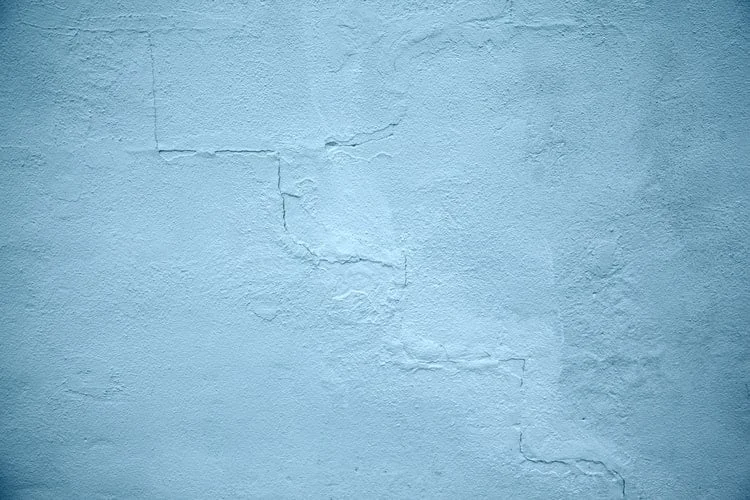
You can, and the holes will be closed, but the outline of the old sign will still be there with dabs of paint inside it. The protected rectangle is a different colour from the faded wall, so a repair that stops at the holes leaves the old tenant's name readable. The fix is to refinish out to a line.
That line is a control joint, a reveal, a corner or the edge of the fascia band. A finish that stops at one of those edges disappears, because the eye reads the joint, not the colour change. It's the same rule I use on houses, explained in more detail in my post on why stucco patches show and how to hide them. Many plazas have a vertical reveal between tenant units, and it's there for exactly this.
Here are the three choices worked on one storefront. The sizes are my example: a 20 ft wide unit, a sign band 4 ft high across its full width, and 14 ft of stucco from the canopy to the top of the parapet.
Holes only
Every bolt hole and the wire hole cut back, filled, meshed and textured. Around 20 sq ft of patching in total.
The outline stays. Fine if the next sign is the same size and goes in the same place.
$450 to $1,200
The sign band to the joints
The same patching, then a new finish over the whole band, 4 ft by 20 ft, from one reveal to the next.
80 sq ft at $9 to $16 is $720 to $1,280. The outline is gone.
$1,170 to $2,480
The whole frontage
Patching plus a new finish over the full face of the unit, 20 ft by 14 ft, 280 sq ft at $9 to $16.
Worth it when the rest of the face is faded, stained or cracked anyway.
$2,970 to $5,680
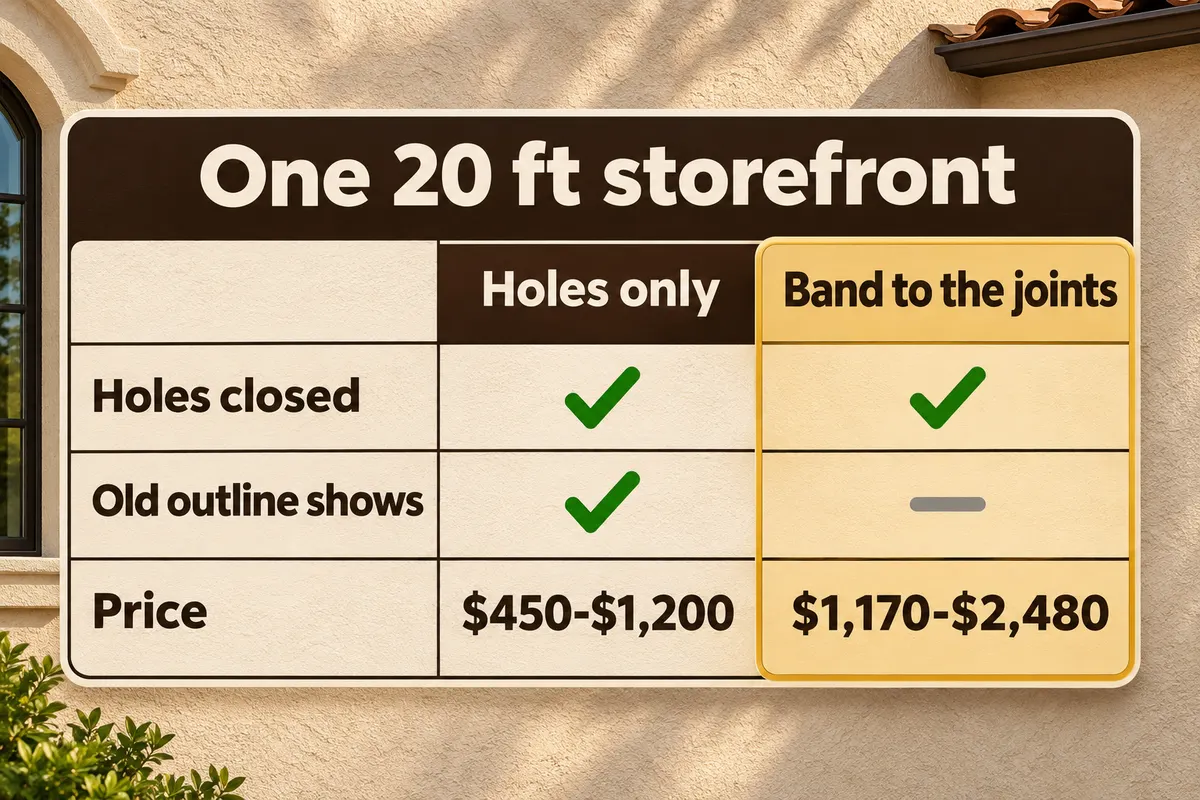
The middle option is the one I recommend most often for a single unit in a row. The whole frontage makes sense when the building is getting a colour change anyway, or when the landlord wants every unit to match before leasing. The $99 patch-and-pray answer, a tube of caulk and a can of spray paint, costs less than all three and is the reason so many plazas have a row of dotted letters above an empty unit.
Fix the wall while the new sign is in review
The next tenant can't hang a new sign the day they get the keys. In Mississauga, the city's page on permanent sign permits says a sign attached to a building needs a sign permit, that it usually takes about six to eight weeks to get one, and that the drawings show the wall construction and how the sign is fastened to it. That wait is your window to fix the wall.
- Application inThe city pre-screens it, usually in three to five business days.Stucco: seal the old holes, map the wall, confirm whether it is EIFS or cement.
- ReviewAbout two weeks for a complete application; a resubmission can add two more.Stucco: patch and mesh, keeping clear of the new sign's fixing points.
- Permit issuedAbout six to eight weeks from the start in a usual case.Stucco: finish coat and refinish to the joints, with time to cure.
- Sign installedThe fascia sign inspection is booked after the sign is up.Stucco: nothing left to do. The new bolts go into a finished wall.
The drawings for the permit have to say what the wall is made of and how the sign attaches, so the sign designer will ask anyway. If your stucco contractor has already opened a hole and knows whether it's foam, wood sheathing or block behind the finish, give the sign company that answer. Fixings on an EIFS wall have to reach something solid behind the foam, a point I cover from the homeowner side in drilling into a stucco wall.
Other cities in our area run their own sign permits with their own forms and timelines, so check with the city where the plaza sits. The idea is the same everywhere: the weeks of waiting for a sign permit are weeks the wall can use.
Signs coming down in December
A lot of leases end with the year, which means a lot of signs come off in the coldest weeks. The holes don't care. Water gets into an open bolt hole in January just as easily as in July, and the freeze makes it worse. Seal every hole and the wire opening the week the sign comes off. Our crews can do that at any time of year.
The proper patch and the new finish are different. Base coats and acrylic finishes need temperatures above about 5 C to cure, so the finished repair is booked from roughly April to November. If the new tenant opens in February, they open under a wall with sealed holes and an outline, and the band gets refinished in spring. It's better to say that in the lease talks than to have someone trowel finish onto a frozen wall to make an opening date.
A handover checklist for the landlord and the outgoing tenant
Who pays for what is set by the lease, not by me. Most commercial leases have a clause about restoring the premises at the end. Read it, and then agree the scope in writing while both of you are still answering the phone.
- Photos of the sign and the wall around it before the sign comes down, with the date on them.
- An electrician named for the disconnect, and the wire hole capped the same day.
- A sign crew told in writing: cut the sealant, back the bolts out, no pry bars on the wall.
- Photos of the bare wall right after removal, close up on every hole.
- One written stucco quote that lists the holes, the wire opening and how far the refinish goes.
- Who books the stucco work and by when, especially if the next tenant's sign is waiting.
- If it is winter, who pays for sealing now and who pays for the finish in spring.
A written quote broken down line by line makes that last conversation short. Ours are fixed and free, and they list each item separately, so a landlord and a tenant can split a quote without arguing about what's in it.
What does stucco repair after sign removal cost?
On our price list, patching holes and small damaged areas up to about 20 sq ft costs $450 to $1,200. Refinishing a band or a whole elevation runs $9 to $16 per sq ft. A section that got wet behind the sign and has to be rebuilt to the substrate is $18 to $34 per sq ft.
| The work | Price on our list | When it applies |
|---|
| Holes and small damaged areas patched and textured | $450 to $1,200, up to about 20 sq ft | Every sign removal |
| A crack running from a fixing, routed and meshed | $120 to $400 per crack | Where a bolt was overtightened or pried |
| Sealant renewed at the canopy, trim or joints | $6 to $12 per linear ft | When the old beads came off with the sign |
| Sign band or elevation refinished | $9 to $16 per sq ft | To hide the outline and drip lines |
| Wet section rebuilt to the substrate | $18 to $34 per sq ft | Where water got in behind the sign for years |
The prices come from our stucco repair price list, so they match what you would see on a written quote. The refinish rate is the same one shown for recoating an aged commercial exterior.
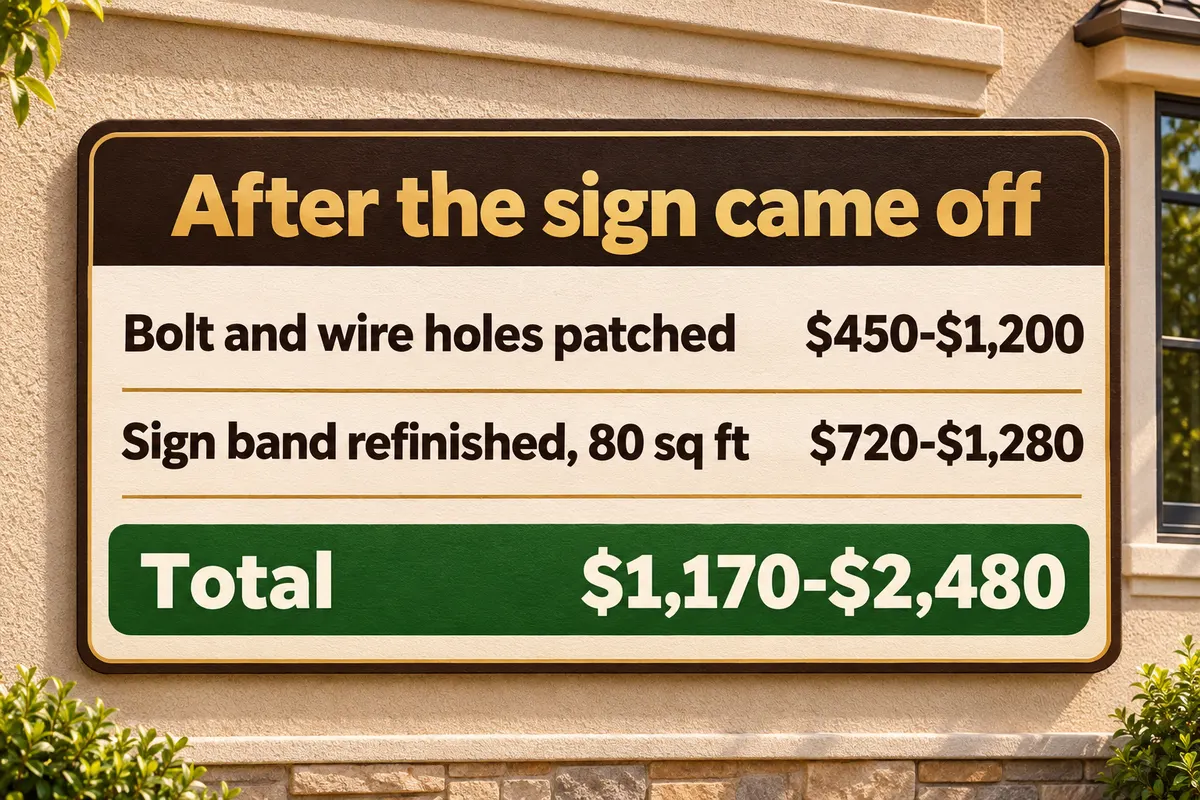
The last row is the one to watch for. A sign that sat on a wall for ten years with a cracked seal around its wire hole can leave wet sheathing behind it. If the stucco around the old wire opening sounds hollow or soft, I open it up before quoting the finish, because a new finish over wet board is money thrown away.
Getting a price for your wall
Send a photo of the wall without the sign, one close-up of a hole and the width of the unit through the contact page, or text them to (905) 973-6470. I call back usually within a day, and the quote is written and fixed. We are insured and WSIB covered for commercial work. For plazas in Peel, start with the Mississauga stucco page.