By the third week of October, my phone starts ringing with a different question than the rest of the year: not “what does this cost” but “is there still time?” Getting stucco or EIFS work done before winter in the GTA isn’t a yes-or-no answer — it’s math, and the math is completely different for a single crack than it is for a full re-clad. After 25+ years scheduling crews around this climate from Oakville to Toronto, here’s exactly how I work out whether a job still fits — and what to do if it doesn’t.
Can you still get stucco or EIFS work done before winter?
Sometimes — it depends entirely on the size of the job and how many mild, dry days are realistically left before a hard frost. A single crack or small patch can often still be booked into late October or even early November. A full elevation refinish or a new install needs a longer uninterrupted stretch of weather, which is why we stop booking those jobs weeks earlier than the smaller ones.
That’s the part homeowners don’t expect: there isn’t one cutoff date for “stucco season.” There’s a different cutoff for every job size, and it’s driven by how many consecutive above-freezing days that job actually needs, not by what the calendar says.
How do you actually work out how much time is left?
Count backward from the first realistic hard frost using the job’s own timeline, not the date on your phone: a crack repair needs roughly 2–3 mild days total; a small patch, 3–5; a full elevation refinish, 7–10; a full re-clad or new install, several uninterrupted weeks. Weigh whatever’s left in the forecast against that number, honestly, before you assume either “plenty of time” or “too late.”
| Job type | Mild days actually needed | Realistic booking cutoff |
|---|
| Single crack repair | 2–3 days | Often still bookable into late October or early November |
| Small patch or section | 3–5 days | Usually fine through mid-to-late October |
| Full elevation refinish | 7–10 days | Needs booking by mid-September to finish before frost |
| Full re-clad / new EIFS install | Several weeks | Realistically needs a September start, or it moves to spring |
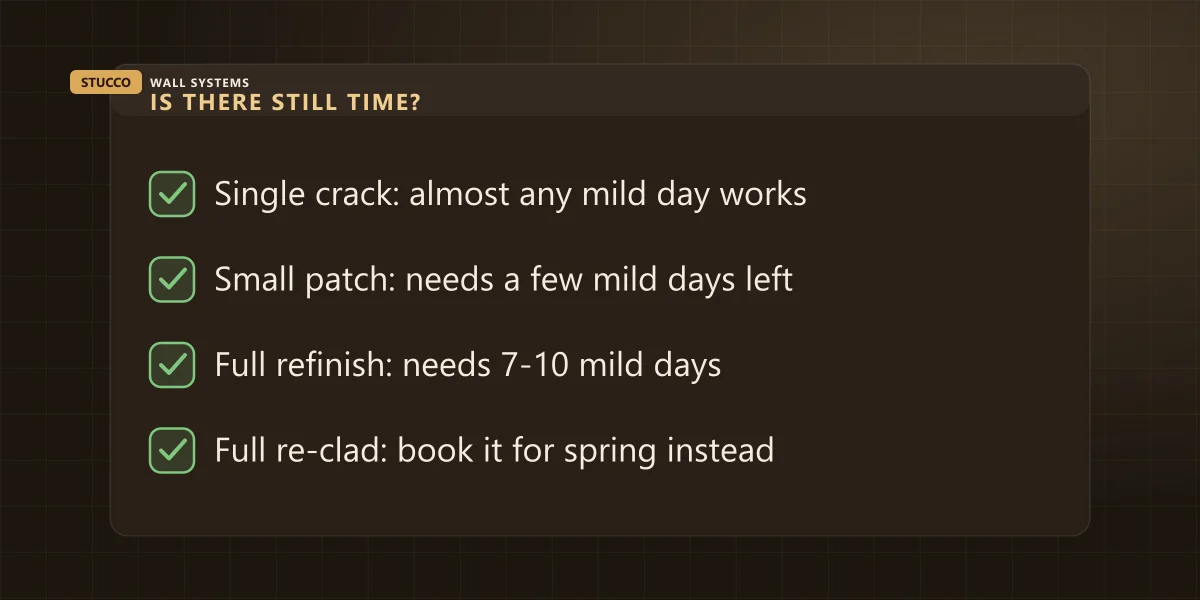
Those numbers are how we plan a crew’s schedule, not a guarantee written in stone — a stretch of unseasonably warm November days can buy a small job an extra week, and an early cold snap can cost a big job one it was counting on. I go through why lakeshore properties in Port Credit and Bronte sometimes buy an extra few days at either end of the season in our full stucco calendar guide — worth a read if your job is sitting right on the edge of one of these cutoffs.
What can actually still be done in true cold weather?
Plenty — just not the finish coat itself. A full assessment, a written and priced quote, ordering materials and colour-matching ahead of the spring rush, and, if water is actively getting in, stabilizing and tarping the area so it doesn’t get worse over winter — none of that needs above-freezing temperatures to happen properly.
| Cold-weather task | Can it happen now? | Why |
|---|
| Assessment & written quote | Yes | No cure involved — just eyes on the wall and a number in writing |
| Material order & colour match | Yes | Ordering ahead avoids the spring rush on popular finishes |
| Emergency tarping / stabilization | Yes | Keeps active water intrusion from getting worse until spring |
| Finish coat (cement or acrylic) | No | Needs a sustained above-freezing cure — the chemistry doesn’t negotiate |
| Full EIFS install | Not without extraordinary measures | Multiple coats, each needing its own cure window |
Using the off-season this way is how a homeowner who calls in November ends up first in line the moment spring weather actually arrives, instead of starting from the back of the queue in April. Environment and Climate Change Canada’s climate normals for the Toronto region show overnight lows dropping below freezing regularly from November on — which is exactly why the finish-coat window closes even on a mild-feeling afternoon.
Is tenting and heating a wall worth it to beat the frost?
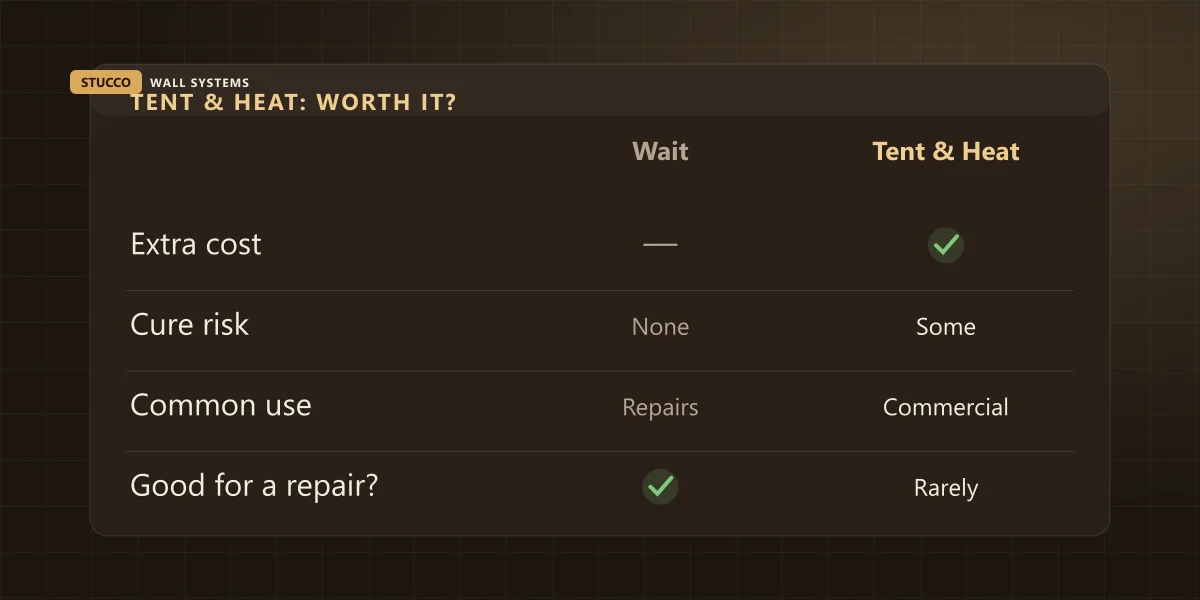
For most homeowner jobs, no. Tenting and ground-heating a section of wall to force a cure through cold weather is a real technique — commercial crews use it to protect a contractual deadline — but the rental, fuel and round-the-clock monitoring cost usually exceeds what you’d save by simply waiting, and the cure it produces still carries more risk than a properly timed one in May.
| Wait for spring | Tent & heat now |
|---|
| Extra equipment cost | None | $$ — rental, fuel, monitoring |
| Cure reliability | Full sustained cure, no gamble | Better than raw cold, still not ideal |
| Typical use case | Almost every homeowner repair | Commercial jobs on a contractual deadline |
| Worth it for a house? | Yes, in almost every case | Rarely — the math almost never favours it |
I’ll say the honest thing out loud: if a contractor is offering to tent and heat your house wall in December to save you three months, ask what that setup costs before you say yes. Nine times out of ten, tarping the trouble spot and doing the job properly in April costs less and produces a better wall — the same logic I cover from the other direction in why the cheapest stucco quote costs the most: a shortcut that skips the chemistry a wall needs almost always shows up again later, one way or another.
What should you actually do this fall if you spot stucco damage?
Call for an assessment regardless of how small the problem looks — it costs nothing to find out where you stand. From there it’s one of two honest answers: either there’s enough season left to fix it now, or there isn’t, and we tell you plainly what to watch for until spring instead of taking a job the weather won’t support.
A dry hairline crack with no staining can usually just be monitored. Anything with a rust streak, a soft or hollow spot, or a wall that’s visibly damp is a different conversation — that’s water already behind the finish, and freeze-thaw cycling over a whole winter can turn a small problem into a much bigger one. I cover exactly which signs mean “wait” and which mean “call today” in 6 signs water is behind your stucco — five minutes well spent before you decide to sit tight until April.
What happens if a crack just gets left until spring?
For most dry, cosmetic cracks, not much — a little more freeze-thaw widening, nothing that changes the repair. For a crack that’s already letting water in, an entire winter of freeze-thaw cycling is the worst possible thing to leave unaddressed, because every cycle works the opening a little wider, the same mechanism I go through in why stucco cracks in GTA winters. That’s the real reason we’ll stabilize and tarp an active leak in December rather than tell every caller to simply wait.
What does this mean for your wall right now?
If you’re staring at stucco damage wondering whether you’ve missed the window, the fastest way to a real answer is a photo, not a guess off this article. Send us your address and a couple of photos, or text one to (905) 973-6470, and I’ll tell you honestly whether your job still fits this season or whether we’re booking it for the first good week of spring — free, written, for a home or a commercial building anywhere across the GTA. You can see the kind of finished work that comes out of a properly timed job in our project portfolio.