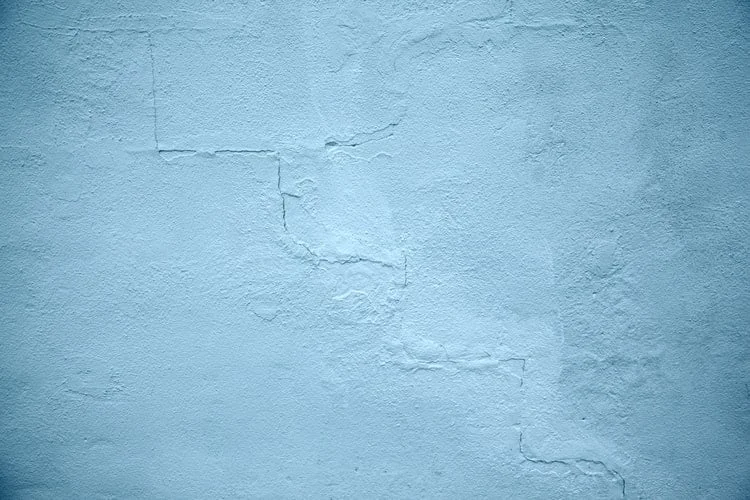
About once a season someone sends me a photo of a pencil-thin brown line running up the parging at the bottom of their wall, and asks whether it is a crack. Sometimes it is a crack. Sometimes it is a termite tube, and that is a very different phone call. So here is the plain answer on termites in stucco walls, and their more common cousin in the GTA, the carpenter ant: neither one eats stucco, both can live behind it, and a finished wall is very good at hiding them.
I plaster walls for a living. I am not an exterminator and I will not pretend to be one. What I can tell you is where these insects get into a stucco or EIFS wall, what they leave behind that you can see from the lawn, and the order the repair has to happen in so you do not pay for it twice.
Do termites eat stucco or EIFS foam?
No. Termites eat cellulose, which means wood, paper and cardboard. Cement stucco gives them nothing, and EPS foam has no food value either. The trouble is that foam is soft enough to tunnel through, and a stucco face is opaque. So the wall becomes a covered road from the soil to the wood framing, with no window to see it.
Subterranean termites need contact with moist soil, and they move between the ground and their food inside mud tubes they build to stay damp and hidden. On a bare concrete foundation you can usually see those tubes. On a house where the foundation is insulated, parged over, or wrapped by EIFS foam that runs down toward the grade, the tubes can run behind the finish instead of on top of it. Nobody sees anything until the wood above, usually the sill plate and the rim joist, has already been eaten from the inside.
That is the whole reason this topic belongs on a stucco site. The wall does not cause termites. It removes the evidence.
How do carpenter ants differ, and which one do I have?
Carpenter ants do not eat wood. They dig nest galleries in it, preferring wood that is already damp, and they push the debris out as fine sawdust. Termites eat the wood and leave mud tubes and mud-packed galleries. Ants have elbowed antennae and a pinched waist; termite swarmers have straight antennae and a thick waist.
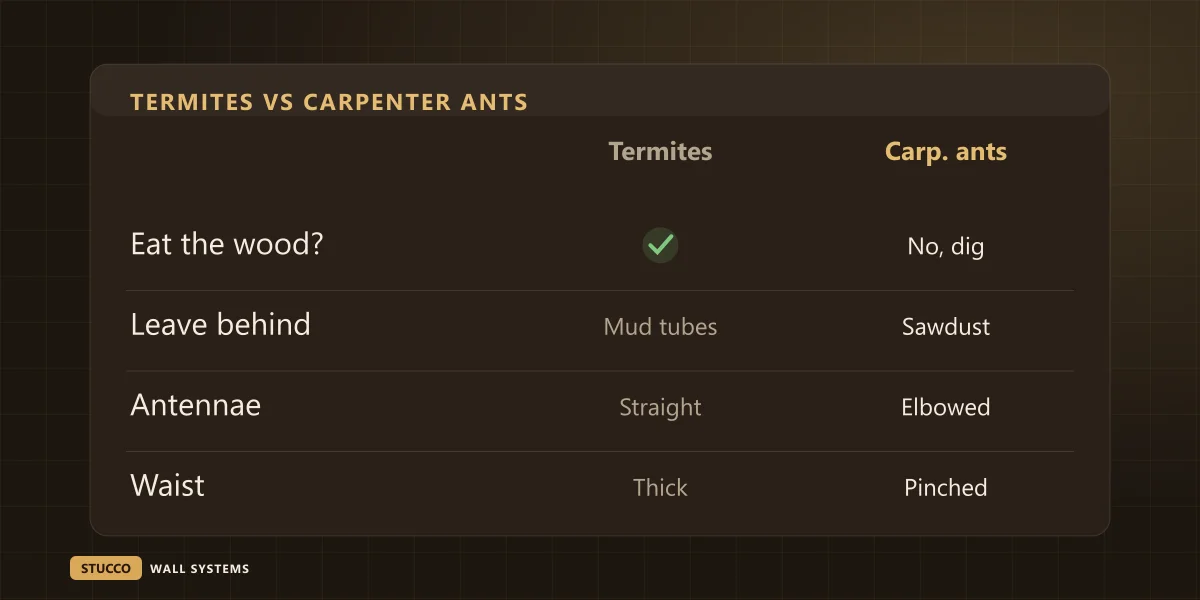
Across most of the GTA, carpenter ants are the one I actually run into. They like exactly what a neglected stucco wall offers: wet wood behind a leak, and soft foam they can dig through without effort. EIFS foam that sits in damp soil or mulch is an open invitation, which I mentioned in passing in the clearance-at-grade guide. Here is the fuller list of what each one leaves behind.
| What you find | Points to | Where on a stucco house |
|---|
| Pencil-width brown tubes running up concrete or parging | Subterranean termites | Foundation wall, the base of the finish, inside the garage along the slab |
| Fine pale sawdust, sometimes with insect parts in it | Carpenter ants | Below a crack, a vent, a hose bib or the weep screed |
| Winged insects indoors in late winter or spring | Either one; check antennae and waist | Near basement windows, rim joist, sliding doors |
| Wood that sounds hollow, with galleries packed with soil | Termites | Sill plate, rim joist, door frames near grade |
| Wood with clean, smooth galleries and no soil | Carpenter ants | Wet framing behind a leak, often under a window |
| Small holes through the finish near the ground with debris below | Ants excavating foam | EIFS walls with foam at or near the soil |
If you can catch a winged one, put it in a jar and take a photo through a magnifying glass. The antennae and the waist settle it, and the exterminator will ask anyway.
What does the Ontario Building Code say about termites?
In localities where termites are known to occur, the Code requires structural wood to sit at least 450 mm above finished ground with every side visible for inspection, or to be pressure-treated against termites. Where a foundation is insulated or finished in a way that could hide termites, a metal or plastic barrier has to go through it.
That second rule is the one that touches my trade directly. It is in Ontario Regulation 332/12, the Building Code, under termite and decay protection in Part 9:
“a metal or plastic barrier shall be installed through the insulation and any other separation or finish materials above finished ground level to control the passage of termites behind or through the insulation”
Read that slowly and it describes an insulated foundation or an EIFS wall that runs close to the ground. The Code knows foam hides termites, so in a termite locality it asks for a physical break that forces any tube out onto the face of the wall, where somebody can see it. Whether your street counts as such a locality is a question for your municipal building department, not for me or for a website.
How real is the risk locally? The City of Toronto has been dealing with eastern subterranean termites for decades. A 1999 council report on a neighbourhood termite program noted that 18 percent of blocks in the former City of Toronto had properties treated, and that provincial treatment grants ran from 1978 to 1990. It is not every street, and it is not a myth either.
Where do insects get into a stucco or EIFS wall?
Almost always at the bottom, and almost always where water is already a problem. The four entry points I see are buried weep screeds, foam carried down into the soil, open penetrations near grade, and wet wood behind an old leak. Fix the moisture and ground contact, and you remove most of what draws them in.
The buried base of the wall
The weep screed at the bottom of a stucco wall is supposed to sit about six inches above soil and two above paving. Every bag of mulch and every new garden bed creeps it closer to the dirt. Once soil is touching or covering the screed, termites have a hidden way in and the bottom of the wall stays wet enough for ants. This is the same detail that causes most of the water damage I fix at grade.
Foam that runs into the ground
On some EIFS installs the foam is carried right down past the finished grade, sometimes to make the foundation look neat. Below ground, foam is a soft, damp, insulated tunnel. In a termite locality that is exactly what the Code barrier is meant to interrupt. If I am re-cladding a house and the old foam goes into the soil, I stop the new system above grade and finish the foundation separately.
Penetrations near the ground
Hose bibs, dryer vents, gas lines, cable entries and old abandoned holes. Each one is a gap through the finish, and the ones within a foot or two of the soil are the ones ants find. The woodpecker post covers how wasps move into the same kind of opening higher up the wall.
Wet framing behind an old leak
Carpenter ants follow moisture. A window that has leaked into the wall for a few winters leaves soft, damp wood behind the stucco, and that is prime nesting material even well above the ground. If ants keep turning up under one window, the ants are the second problem. The first is the leak. Our moisture testing guide explains how to find out how wet that wall really is.
What should I check from the ground?
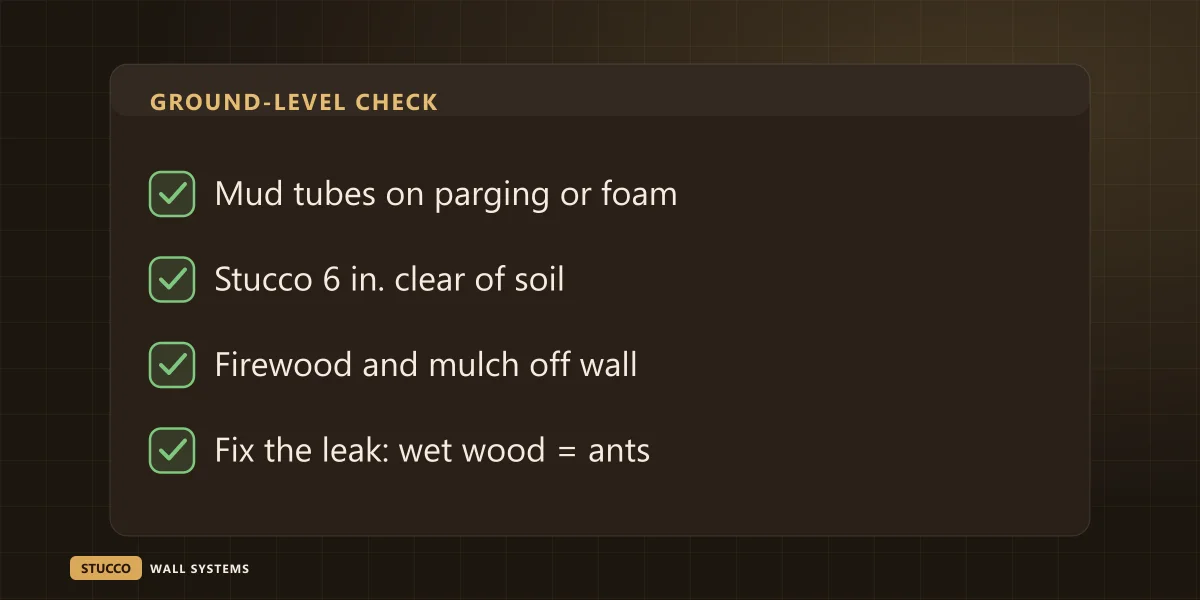
Walk the house slowly with a flashlight, once in spring and once in fall. Look for mud tubes on the parging, sawdust below cracks and vents, soil or mulch touching the bottom of the finish, firewood stacked against the wall, and any soft or hollow spot near grade. None of this needs a ladder.
- Start at the garage. Inside, look along the joint between the slab and the wall. Termite tubes often show up there before anywhere else, because the garage is the one place the foundation is bare.
- Walk the outside at grade. Look at the parging and the bottom few inches of stucco for brown tubes, and break one open with a screwdriver if you find it. If it is rebuilt within a few days, something is still using it.
- Check the screed line. If you cannot see the metal edge at the bottom of the stucco, soil or mulch has buried it. Pull it back to six inches of clearance.
- Look under every opening. Below each hose bib, vent and cable entry, look for little piles of sawdust or foam crumbs on the ground or the sill below.
- Move the firewood. A woodpile against the wall is a food source and a bridge in one. Stack it on a rack, off the ground and away from the house.
- Press the base of the wall. Firm thumb pressure along the bottom foot of an EIFS wall. If it feels soft or crumbly, the foam behind it has been dug out or soaked.
Anything on that list, write down where it is and photograph it with something for scale. It saves a lot of time when the exterminator and I each come out.
Who do I call first, and what does the repair cost?
A licensed exterminator first, always. The insects have to be treated and confirmed gone before anyone closes up the wall, or the repair seals a live colony inside. Then the wall: fix the moisture and ground contact that invited them, replace damaged substrate, and rebuild the finish with the base kept above grade.
I have had homeowners ask me to just patch the holes and be done with it. I will not, and any crew that will is selling you the same repair twice. Cover a live ant nest and they dig a new exit a foot away. Cover a termite route and you have hidden the evidence the next inspector needed to see. Pest control is not my trade and I do not quote it. Here is what the stucco side tends to run, on the same bands we use everywhere on this site:
| What the wall needs after treatment | Typical stucco cost | What drives it |
|---|
| Seal a few small holes and penetrations near grade | $120–$400 | Number of spots and colour matching |
| Rebuild a section of base with new foam or lath and finish | $450–$1,200 | Length of wall and whether the screed is replaced |
| Open the wall, replace wet or damaged sheathing, rebuild | $1,500–$5,000+ | How far the damage runs and what the framing needs |
| Larger repair area, measured | $18–$34 per sq ft | Access, texture match and system type |
| Re-clad an elevation with the base stopped above grade | $8–$16 per sq ft installed | System, height and detailing |
Two things are not in that table. Structural framing repair, if termites or ants have eaten into the sill plate or rim joist, is carpentry and sometimes engineering, and gets priced by whoever does that work. And the exterminator’s bill is separate and theirs to quote.
How do I keep them out after the repair?
- Keep the bottom of the stucco six inches above soil and two above paving, every spring, after every new bag of mulch.
- On EIFS, stop the foam above grade and finish the foundation with parging or another non-foam finish.
- Seal penetrations near the ground properly, at the sheathing, not with a bead on the surface.
- Fix leaks when you find them. Dry wood does not interest carpenter ants nearly as much.
- Keep firewood, lumber and cardboard off the wall and off the ground.
- In a known termite area, ask your exterminator about ongoing monitoring rather than one treatment.
If you are planning a new stucco or EIFS installation, or a re-clad on an older house, tell us if you have had termites or ants before. It changes how we finish the bottom of the wall, and it is far cheaper to detail on day one. For damage that is already there, our stucco repair work starts with finding where the water and the insects came in. Homeowners in the city can reach our Toronto stucco team directly, or send us photos of the base of the wall and we will tell you honestly whether it is a stucco job, a pest job, or both.