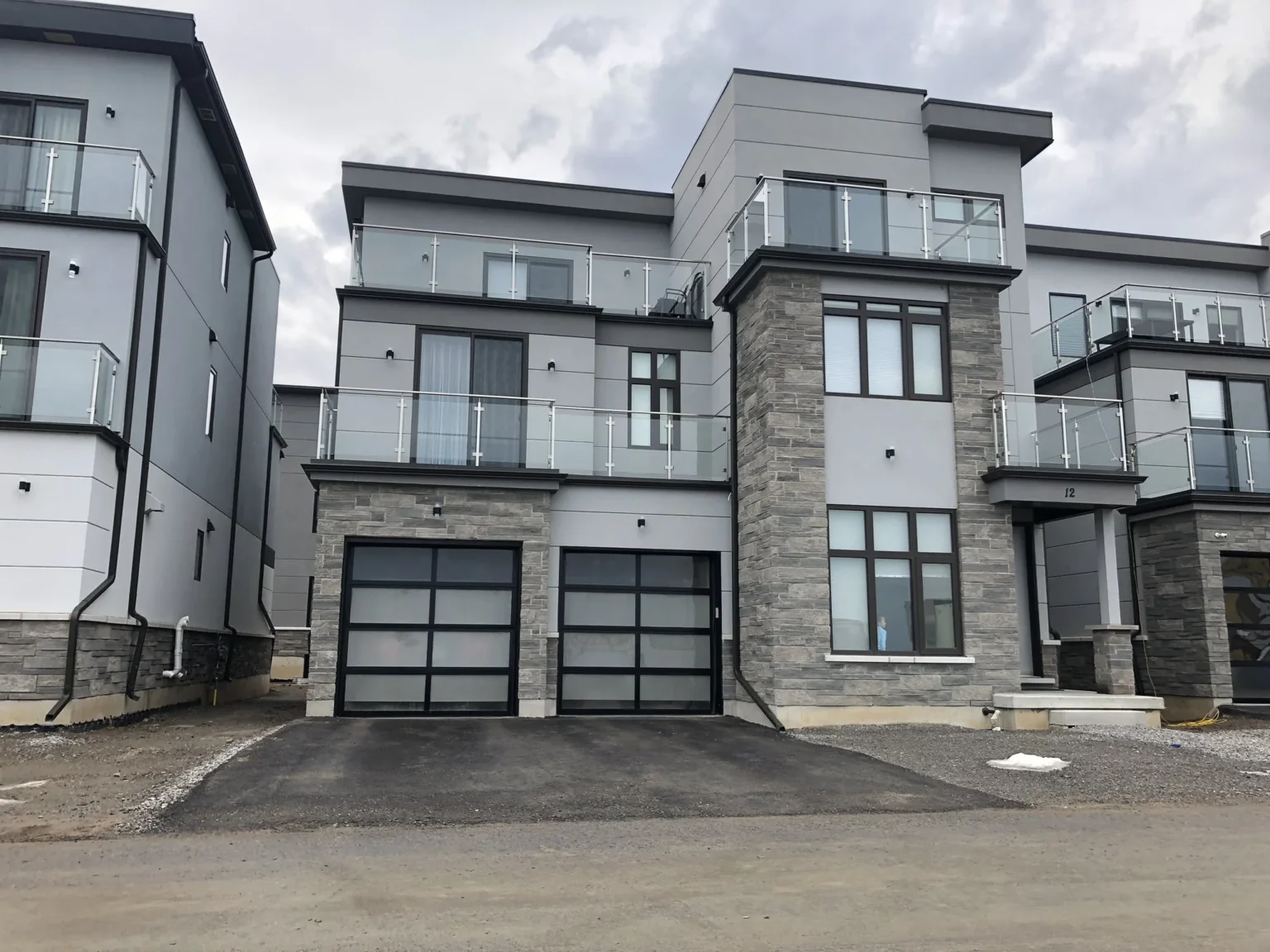
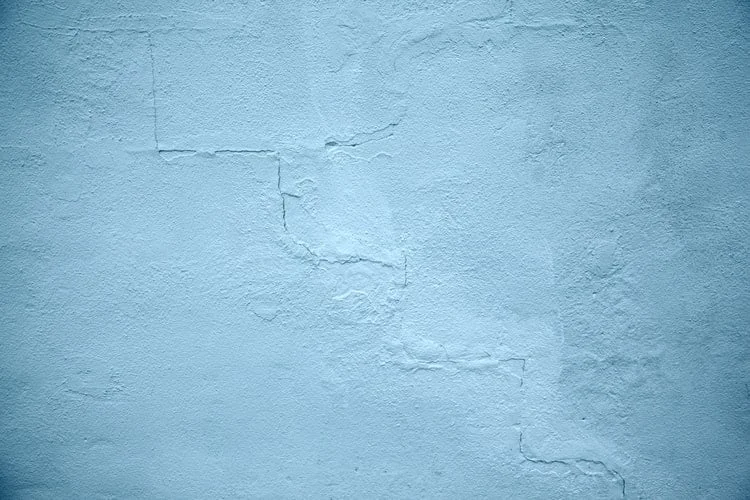
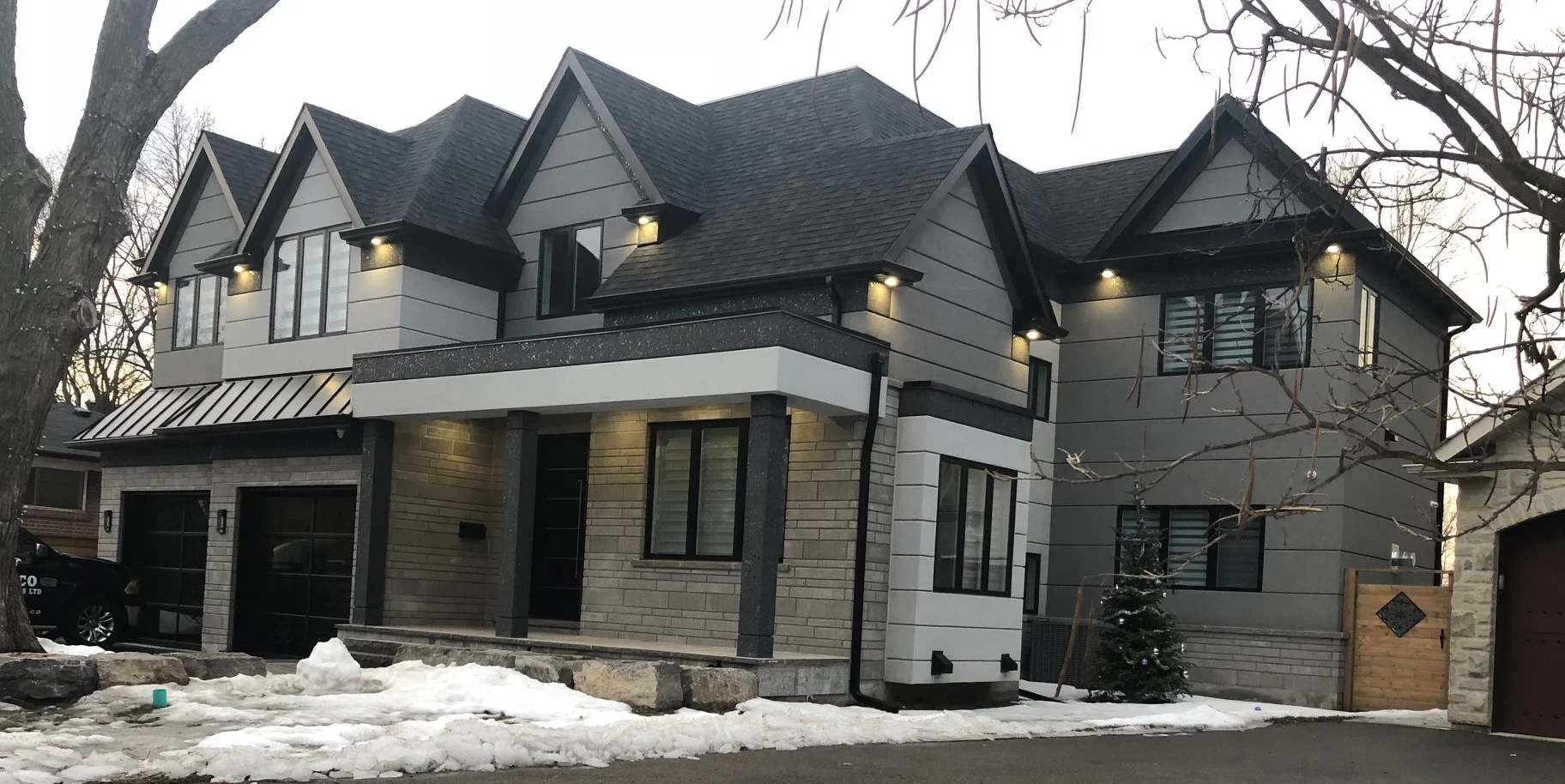
Every spring somebody sends me the same photograph: a clean round hole punched through a gable, twenty feet up, on a house built in the last thirty years. Woodpecker holes in stucco are not freak damage and they are not bad luck — they are one specific wall type meeting a bird that is very good at its job.
Nearly every one of those calls turns out to be an EIFS wall, acrylic finish over foam board, and to a woodpecker that assembly reads like a standing dead tree. So: why it happens, whether the hole matters, and what a real repair involves. The fix most people reach for first is the one that guarantees the bird comes back.
Why do woodpeckers drill into stucco?
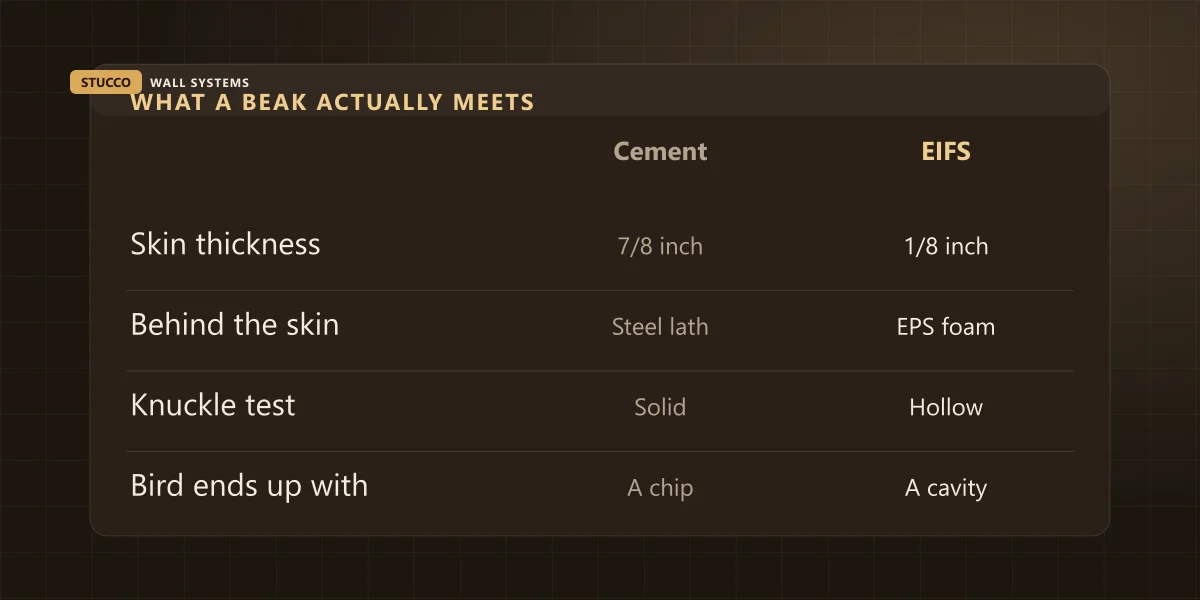
Because on an EIFS wall there is almost nothing there to stop them. The finish is an acrylic skin about an eighth of an inch thick, and directly behind it is expanded polystyrene foam. A beak is through that in seconds, and then it is excavating soft foam in exactly the way it would excavate a rotten trunk.
The other half of the answer is sound. Woodpeckers use resonance the way we use a stud finder — they are listening for a void. Foam over a cavity over sheathing rings hollow, and hollow is the signal that says this one is worth opening. It is why the damage so rarely lands in a solid, well-bonded field of wall, and so often at a gable peak, a top corner under the soffit, a band detail where the foam thickness steps, or directly over a window header. Most of it sits fifteen to twenty-five feet up, which is the single biggest reason the bill is never just a patch bill.
Traditional cement stucco is a completely different proposition, and you can tell the two apart with a knuckle: cement over lath feels dense and dead, EIFS over foam sounds hollow and gives very slightly under a fingernail. Age is a fair first guess as well. Cement over lath was the default here for a long time; acrylic EIFS went onto GTA subdivisions and custom builds in volume from the 1990s onward.
| What the bird meets | Cement stucco over lath | EIFS over foam |
|---|
| Thickness of the skin | About 7/8 in., three coats | About 1/8 in.: base coat plus finish |
| Reinforcement in it | Metal lath through the full thickness | Fibreglass mesh in the base coat only |
| What sits directly behind | More cement, then lath, paper and sheathing | Expanded polystyrene board |
| Knuckle test | Dense, dead, no give | Hollow, slight give |
| Realistic worst case | A chipped finish coat | A cavity you can put a fist into |
| Repair that follows | Refinish the damaged area | Cut back, replace foam, re-mesh, re-coat |
What is the bird actually doing up there?
Three different behaviours, and they need three different responses. Drumming is a spring territorial broadcast and it wants noise, not depth. Foraging is a search for insects and leaves small scattered punctures. Nest or roost excavation is one deep round hole with a chamber behind it, and that is the one that costs real money.
| Behaviour | When it happens | What it looks like on the wall | What it means for you |
|---|
| Drumming | Late winter into spring, often at first light | Fast repeated bursts on one resonant spot; scuffs and pockmarks, frequently not all the way through | A signal, not a search. Cosmetic if you catch it in the same season |
| Foraging | Any time of year, more often on shaded elevations | Several small irregular punctures through the finish, an inch or two into the foam | The wall sounded like an insect gallery. Occasionally the bird is right |
| Nesting or roosting | Spring for nesting, again in late autumn for a winter roost | One large round entry with foam hollowed out behind it, wider inside than the hole in front | The expensive one. Water gets a path in, and the cavity gets a tenant |
That distinction is worth money. Drumming damage is often finish-deep, and dealt with in the same season you are refinishing an area rather than rebuilding an assembly. Once there is a chamber behind the wall, the price is set by what is in it and what is behind it. Drumming season is also short, which makes it the only window where a deterrent has much chance of doing anything.
Does a woodpecker hole in stucco actually matter?
Yes, because on an EIFS wall the thin finish is the weather barrier. The foam is insulation, not waterproofing. Once that lamina is punctured, rain has a direct route into the assembly, and through a GTA winter the water that gets in freezes and thaws inside the opening over and over.
A modern drained EIFS has a drainage plane behind the foam to take incidental water back out, and that change is most of the reason the system stopped deserving its old reputation — I went through that history in why EIFS got a bad name in the 90s. But a drainage plane is engineered for small amounts sneaking past a joint, not for a two-inch hole aimed straight into the board. On an older barrier system there is no drainage path at all, and the water simply sits against the sheathing.
Freeze-thaw then grows the problem without further help. Water sits in the ragged edge of the lamina, freezes, and levers it outward a fraction at a time, so a hole that opened in September is often wider and crumbling around the rim by April with no bird touching it again. If a stain or a soft patch has appeared below it by then, you are past patching and into stucco repair with the substrate in scope.
What moves in after the bird moves out?
Wasps, most often. A cavity in EPS foam is dry, insulated, sheltered from wind and has one small defensible entrance, which is close to ideal for paper wasps and yellowjackets. Assume any hole that has stood open through a summer may have something living in it, and look from a distance before anyone puts a hand or a trowel near it. A hole a bird made and a hole a person made behave identically once they are open, which is why I am just as fussy about the box left when a light fixture came down or the capped vent nobody removed — all of those are in how to put a hole in a stucco wall without causing a leak.
One warning that is not negotiable: do not seal a live nest inside the wall. Wasps that find their exit closed go looking for another, and chewing sideways through polystyrene is no obstacle to them, so you end up with a second hole in a spot you did not choose. Nest first, wall second — and the first half of that is a pest-control call, not a stucco call.
Can I just fill a woodpecker hole in stucco?
Not with caulk or canned foam, no. Both leave the wall hollow, unreinforced and the wrong colour, so you still have a water path and the bird still has a reason to come back. As a cover before a weekend of rain they are sensible. As the finished repair they are what I get called out to undo.
Sealant is made to flex in a joint between two surfaces, not to span an opening. Squeezed into a hole it bonds to a thin acrylic edge, shrinks as it cures, reads as a grey thumbprint from the driveway, and traps whatever moisture is already in the foam behind it.
Canned foam keeps expanding after you have gone inside, pushing the lamina outward so that edge telegraphs through any finish put over it later. There is no mesh in it, so nothing ties it to the wall, and it cures to a skin softer than the original board — leaving the wall marginally easier to open than before you started.
A plug of finish coat, painted over, is the near miss, and the one a hurried crew leaves behind. Finish coat is a decorative layer; with no base coat and mesh under it the plug has no continuity with the wall around it, and a ring crack shows up around the perimeter within a freeze-thaw cycle or two.
How is a woodpecker hole in stucco properly repaired?
Cut the damaged finish back to sound material on a square edge, remove the wrecked foam, fit new board of the same thickness, lap fresh mesh at least two and a half inches onto sound base coat, then base coat it, let it cure, and match the finish. The mesh lap is what makes it a repair instead of a plug.
Square the opening up and take all the wrecked foam out. Round holes patch badly because there is no straight edge to blend off, so I cut back to a rectangle and keep cutting until the base coat at the perimeter is genuinely bonded — if it lifts when you pick at it, stopping there only moves the failure line an inch outward. A nesting chamber is almost always wider inside than its entry hole, so the foam damage behind the finish is bigger than the hole in front of it.
Look at what is behind the foam before you close it up. This step decides whether it is a patch or a repair, and it is why I will not quote one of these blind off a photograph. Dark, soft or crumbling sheathing means water has been getting in for a while, and finding that with the wall open is the cheap version of finding it.
Fit new foam at the same thickness, and lap the mesh properly. A board sitting proud or shy by a few millimetres shows as a flat spot in raking evening light for as long as the wall stands. New mesh needs at least two and a half inches onto sound base coat right around the perimeter, because continuity of reinforcement across the old-to-new joint is the whole reason a patch does not crack out in its first winter.
Base coat, cure, then finish. Base coat needs above-freezing temperatures to cure, which puts a real deadline on autumn damage: a hole that opens in October gets closed in October, not left for spring. Where the geometry allows, stop the new finish at a control joint or a corner instead of feathering it out mid-wall — matching a patch is a subject of its own, and I laid it out in why stucco repairs still show.
What does it cost to fix woodpecker damage?
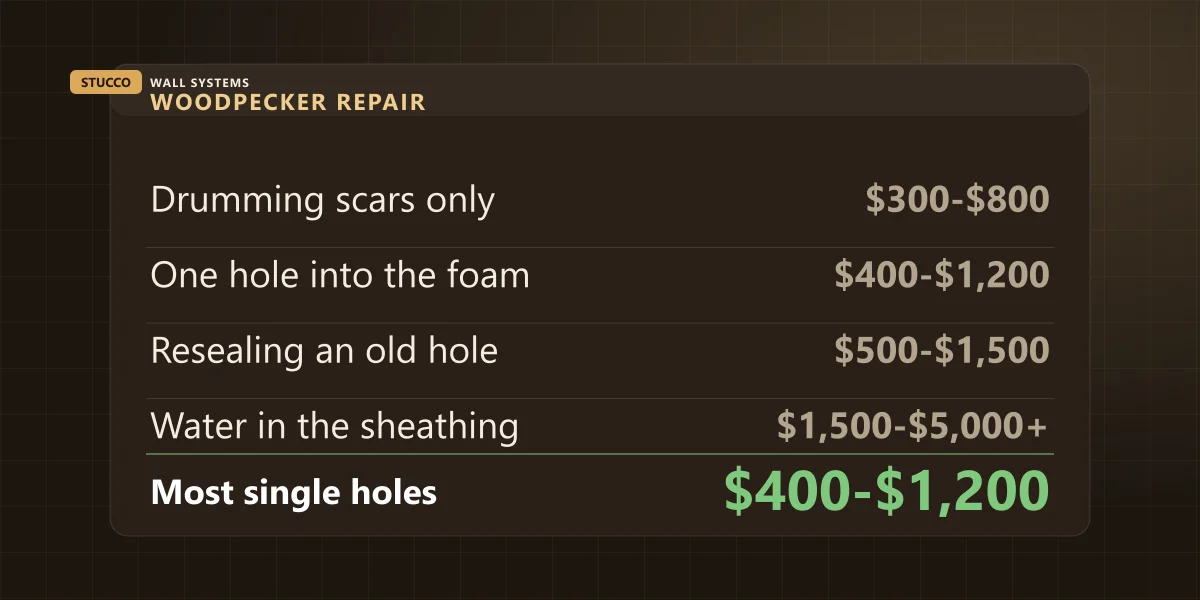
A single hole at ladder height sits in the same band as any other impact damage: $400–$1,200. Drumming scars that never breached the finish run $300–$800. If water reached the sheathing behind the foam, you are into $1,500–$5,000 and up, because at that point the substrate is the job and the finish is an afterthought.
| What we found | Typical range | What you are paying for |
|---|
| Drumming scars, finish not breached | $300–$800 | Refinishing an area and matching texture — no foam work |
| One hole through into the foam | $400–$1,200 | Cut back, new board, re-mesh, base coat, finish match |
| An abandoned hole or old penetration to reseal | $500–$1,500 | Same work as renewing failed sealant at a joint or opening |
| Water reached the sheathing | $1,500–$5,000+ | Substrate repair — the finish is the last part of it |
Access is the multiplier nobody puts on a quote. A hole in a gable peak at twenty-two feet is not a ladder job, and on elevated stucco work generally, height and access move a price by roughly 10–25%. The treed ravine lots in Vaughan and Kleinburg get hit by this most often — the birds are already next door — and they are also the lots where a lift cannot get around to the back elevation, so the answer becomes scaffold. It is also why several holes on one elevation cost far less than the same number spread over four: the setup moves once. Have it all looked at in a single visit rather than fixing the one you can see from the kitchen window.
How do you stop them coming back?
Repair properly and repair fast. The cavity is the attraction, so a patch that fills the void with the right foam and restores a continuous skin takes away the reason the bird stopped. An open hole does the opposite — it is a working demonstration that this wall opens, and it is letting water in the whole time it waits.
Deterrents work while they are still novel. Mylar strips and spinners do something for a few weeks because they are unpredictable, then the birds habituate. Hang them at the start of drumming season and take them down after and they earn their keep. A stationary plastic owl bolted to a gable in November is a lawn ornament that happens to be twenty feet up.
Two measures for a wall that keeps getting hit. Netting stood off the wall is the only physical barrier I would call reliable, and almost nobody wants it on the front of the house — on a back elevation hit two years running it is worth considering. The other is high-impact reinforcing mesh, a standard EIFS component normally specified at ground level where carts and shovels hit a wall. Nothing stops it going into the base coat higher up, and the time to do it is while that elevation is being refinished anyway. It buys a wall that is harder to open, not a guarantee — raise it at the quote stage if you are planning work on a residential stucco elevation with this history.
Close every abandoned penetration while you are up there, too. The old light box and the disused vent are not woodpecker damage, but they are the same cavity, and they are how wasps get in with no bird involved at all.
One last thing, before anybody proposes a solution involving a pellet gun. Ontario’s Fish and Wildlife Conservation Act, 1997 says at section 7 that a person shall not destroy, take or possess the nest or eggs of a bird that belongs to a species that is wild by nature, and the six species it excepts — crow, cowbird, grackle, house sparrow, red-winged blackbird, starling — include no woodpecker. Section 31 lets you deter wildlife damaging your own property, but it does not lift that nest protection. I am a contractor, not a lawyer; both sections are short and worth reading.
The short version
A woodpecker on your wall is telling you the wall sounds hollow, which almost always means EIFS foam under a thin acrylic skin. Work out which of the three behaviours it is, because a drummer caught in season is a few hundred dollars and a nesting cavity ignored over a winter is a substrate repair. Do not fill it with foam or caulk and call it done, do not seal a live nest inside the wall, and do not leave it open through a summer.
If there is a hole in a gable and you would rather somebody looked at it before the next freeze, send me the address and a couple of photos of that elevation or call (905) 973-6470. We work across Oakville, Mississauga, Toronto and up through Vaughan and Kleinburg, where the treed lots are and where most of this lands.