Somebody taps your wall, frowns, and says the sentence that ruins a week: there is moisture in there. Maybe it was a home inspector with a little yellow meter. Maybe it was a contractor with a thermal camera and a tablet full of orange blotches. Either way you are now standing in your own driveway deciding whether to spend real money opening a wall that looks perfectly fine from the sidewalk. Stucco moisture testing is one of the few things in this trade where the tool matters more than the opinion, so here is what each one physically measures, what it can prove, and what it absolutely cannot.
Twenty-five years of opening walls across the GTA has taught me two things about this. The wall is usually not as bad as the first reading suggests. And the wet part is almost never where the stain is.
What does stucco moisture testing actually measure?
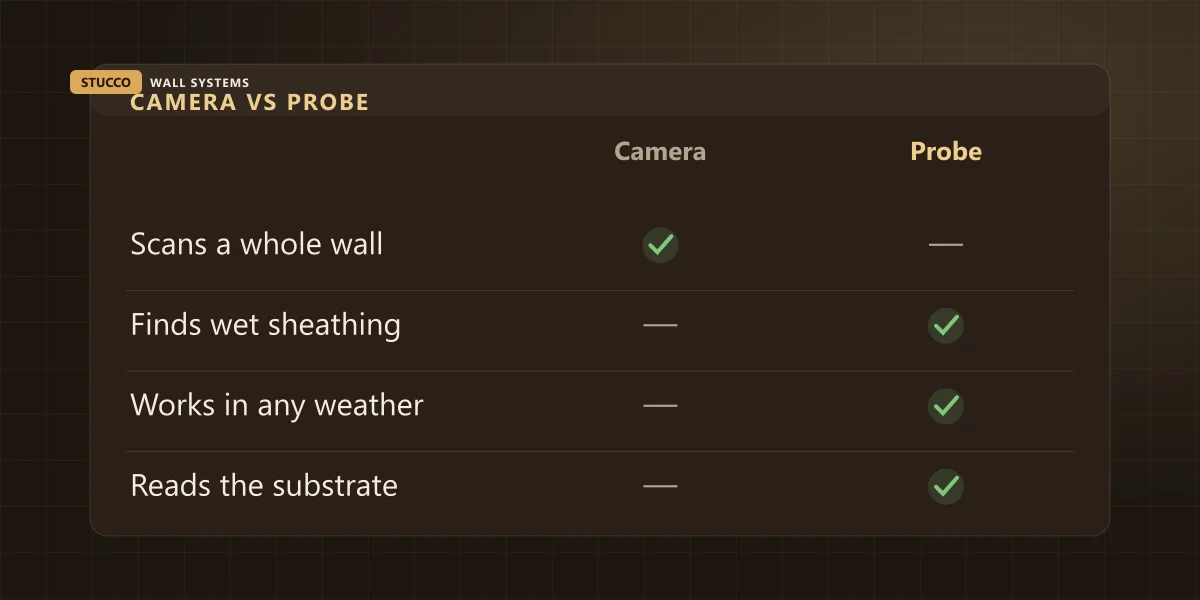
Nothing measures water directly. A pin meter measures electrical resistance between two points. A pinless scanner measures how a radio-frequency field is disturbed a fixed depth into the wall. A thermal camera measures surface temperature. All three infer moisture from something else, and that inference is exactly where the false alarms come from.
That matters more on stucco than on any other cladding, because a stucco wall is hostile to every indirect method at once. The surface is a mineral, full of alkaline cement and soluble salts that conduct beautifully. On traditional three-coat work there is a sheet of galvanized lath stapled up behind it, and metal reads as a dead short to anything electrical. And the material you actually care about — the sheathing that rots — is not the material you can touch. It is behind the finish, behind the drainage plane, and on an EIFS wall behind two or three inches of foam.
| The tool | What it physically measures | Where it fools people |
|---|
| Pin meter (two prongs) | Electrical resistance between the pins, converted to a wood-moisture scale | Salts and galvanized lath conduct like water. On stucco it reports the surface, not the wall |
| Pinless scanner (flat pad) | How a radio-frequency field is disturbed roughly 19–25 mm in | Three-coat stucco is most of that depth on its own, so it often never reaches the sheathing at all |
| Thermal camera | Surface temperature, to a fraction of a degree | Reads anything that changes temperature differently — studs, patches, missing insulation — not only water |
| Probe (pins through a drilled hole) | Resistance at the sheathing itself, behind everything else | Only tells you about the one spot you drilled, so a single hole is close to meaningless |
Why does a hardware-store moisture meter read high on a dry wall?
Because it is calibrated for wood and you are holding it against cement. Set two pins into stucco and you are measuring surface salts, the alkalinity of the mix and often galvanized lath a quarter inch behind. A 99 on a forty-dollar meter is a real measurement of the wrong thing, and it proves nothing about your sheathing.
Every one of those meters reports in what the trade calls wood moisture equivalent. The scale was built by drying wood samples in an oven and mapping electrical resistance against the weight they lost. Point the same meter at anything that is not wood and the number still appears, confidently, in per cent — it just stops being per cent of anything.
Three things then push it higher on a perfectly sound wall. Metal lath, as above. Salts, which is the same chemistry behind the white bloom I wrote about in efflorescence on stucco — dissolved salt is what makes water conductive in the first place, so a wall that has ever been wet keeps reading as though it still is. And plain surface wetness: dew, an overnight shower, a sprinkler that clips the wall every morning at six.
None of that makes the meter junk. Turn around and use it inside — on the drywall under the window, on a bottom plate, on the return where the stain is — and it becomes genuinely informative, because now it is reading the material it was designed for. Outside it is a screening device at best. I have never once opened a wall on the strength of an exterior surface reading alone.
What a thermal camera can and cannot see
A camera sees temperature, not water. Wet material holds more heat and gives it up more slowly than dry material, so damp areas only stand out while the wall is moving through a temperature change. On a mild, overcast, windless afternoon nothing is driving that change, and the wall photographs as a beautiful, uniform, completely uninformative rectangle.
So a scan needs what building science people call a thermal driver, and in the GTA there are two easy ones. A wall that has taken direct sun and is now cooling in late afternoon: the damp patches lag behind and read cool. Or a cold January night with the heat on inside, pushing warmth outward through anything that conducts — and wet material conducts far better than dry. Book a scan for a still, grey October lunchtime and you have paid for a picture of nothing.
Two more honest limits. First, on an EIFS wall the continuous foam is doing exactly the job you are trying to see through — it thermally decouples the outside from the inside, which is the entire reason to install it and a real handicap for the camera. Second, a camera finds anomalies, not water. A stud, a chase, an old patch of a different density, a batt that slumped in 1996: every one of them reads as a shape on the screen, and every one of them can be described as moisture by somebody in a hurry.
Used properly it is the best money on this page. It covers a whole elevation in minutes and turns a guess into a short list of five or six places worth investigating. That is a map. It is not a verdict, and nobody should be pricing a wall opening off a thermal image alone.
Probe testing: the only method that confirms
A probe test drills a small hole through the finish and puts two pins into the sheathing itself, so the reading comes from the material that actually rots rather than the one you can see. It is the only test here that answers the question you are really asking, and the only one that leaves a mark.
The hole is about the diameter of a pencil lead. The pins go through the finish, through the drainage plane and into the substrate, and the number is taken there. On EIFS this is not some aggressive last resort — it is how the whole argument from the nineties got settled, one wall at a time, and it is why we can now say plainly which of those systems failed and which never did. I went through that history in the post on why EIFS got a bad name.
What separates a survey from a poke is the pattern. Water collects where the wall is interrupted, so the holes go where the interruptions are: under window sills at the two bottom corners, at the base of the wall just above the weep screed, at every penetration, and where a roof dies into a wall. Those are not random choices — they are the same four places I keep writing about, because they are where the leaks are. A wall with no interruptions almost never rots in the middle of a blank elevation.
Then the step a cheap survey skips: control readings. Somebody has to take the same measurement on an elevation with no symptoms at all, the same day, in the same weather. Without controls you have a page of numbers with nothing to compare them to, and every number taken off a GTA wall in November looks alarming out of context.
| Reading at the sheathing | What it means | What I would do |
|---|
| Under 16% | Dry. Normal for wood sheathing in a GTA wall, summer or winter | Nothing. Note it as a control and move on |
| 16–19% | Elevated. Not decay territory, but wetter than its neighbours for a reason | Find the reason outside — a joint, a sill, a flashing. Re-read in a month |
| 20% and above | Active. The band where decay fungi get to work in wood | Open it. Monitoring a wall in this range is watching it get worse politely |
| Above 28% | Saturated. Water is standing against the sheathing, not passing through it | Open it now, and expect the wet area to be larger than the stain |
| Any reading with no control | Unproven in either direction | Ask for a control reading before you spend a dollar on the strength of it |
Those bands are a trade convention read on a wood scale, not a line out of a code book. What makes them useful is the comparison, not the digit: sixteen per cent under one window and six per cent under the identical window ten feet away is a finding, even though sixteen sits inside the safe band.
Now the holes. They get sealed the same day with a sealant matched as closely as the finish allows. On a float or dash texture they genuinely disappear. On a smooth trowel finish or a wall painted last summer you will be able to find them if you go looking — and anybody who does not tell you that before drilling is managing you rather than informing you.
When is testing worth paying for?
Four situations, honestly. You are buying the house and need to know before a condition comes off. You have a stain with no crack above it. You are about to spend serious money painting or re-cladding. Or you need documentation for a warranty or insurance claim. One hairline crack on an otherwise dry wall is not on that list.
Buying. The strongest case of the four, because you are making a six-figure decision about a wall you have looked at twice. What an inspection can and cannot reach is the whole subject of buying a stucco house in the GTA, and probe readings are the one thing that turns a worry into a number you can negotiate with.
A stain with no crack above it. A crack explains itself. A stain with nothing above it means the water arrived from somewhere you cannot see, and that is exactly the case where guessing costs more than testing. The visible symptoms are catalogued in six signs water is behind your stucco.
Before you spend real money on the outside. Painting a wall with wet sheathing behind it is the most expensive way to hide a problem, and it makes the next diagnosis harder. If you are already booked for a full re-clad the calculus changes — the wall is coming off anyway and we will see everything — but for a repaint or a partial repair, test first.
Documentation. Readings on a dated, weather-noted sheet are evidence. A conversation is not. That matters for a builder warranty claim, and it matters more still for an insurance claim, where the question is always when the water started and nobody can answer it after the fact.
The money argument underneath all four is simple. Crack repair and patching on a dry wall runs $450–$1,200 on the stucco repair rates we publish everywhere else on this site. The same wall opened two winters later with wet sheathing behind it runs $1,500 to $5,000 and up, because by then the price follows the rot rather than the crack. Testing earns its keep exactly when it can move you from the second number to the first.
And when it is not worth it: a single hairline crack, a dry basement, no interior symptoms, no stain. Seal it, watch it through one freeze-thaw season and keep your money. Ontario’s Building Code requires an exterior wall to have a way of shedding and dissipating the water that inevitably gets past the cladding — a modern wall is built expecting some water and designed to get rid of it. Not every damp reading is a failure of that system.
What a real moisture report looks like
It has locations, not adjectives. Every reading tied to a marked-up elevation so you can find that exact spot again in two years. Control readings from a dry area taken the same day. The date, the weather, and how long since the last rain. A photo at each probe. And the recommendation kept separate from the price of the work.
That last one deserves saying out loud, and it applies to me as much as to anyone. If the person testing your wall is also the person quoting the repair, ask for the raw numbers and the locations, not just the conclusion. I test walls I hope to be hired to fix. The numbers are the part you can check, so the numbers are the part you should be handed.
- Ask when it last rained. A reading taken in a downpour and a reading after ten dry days are two different documents, and only one of them is worth arguing over.
- Ask for the control. If nobody measured a dry wall the same day, the findings have no baseline.
- Ask how deep the pins went. Surface or substrate — that is the whole difference between a screening number and a finding.
- Ask what happens to the holes. Sealed the same day, or left open over a weekend of rain, which I have genuinely walked up to more than once.

The short version
No instrument on a stucco wall measures water. The hardware-store meter reads salts and metal lath, and will happily report a dry wall as soaked. The thermal camera reads temperature, and only works when the weather is giving it something to read — which makes it an excellent map and a poor verdict. Only a probe into the sheathing answers the question, and only against a control reading from a dry part of the same house. If somebody wants to open your wall, ask what the number was, where it was taken, and what the dry wall read that same morning.
We assess and repair stucco and EIFS on houses across the GTA — from older three-coat work through Etobicoke and Toronto to the foam re-clads in Kleinburg and Erin Mills — and there are finished elevations in the project gallery. If you have been told there is moisture in your wall and you are not sure what to do with that, send us the address and the reading or call (905) 973-6470. Sometimes the honest answer is that the wall needs opening. Often enough it is that somebody measured the weather.