Stucco on ICF Houses
Acrylic, EIFS or cement stucco over insulated concrete forms, planned around the pour date and the other trades, with a fixed quote in writing after a free visit.
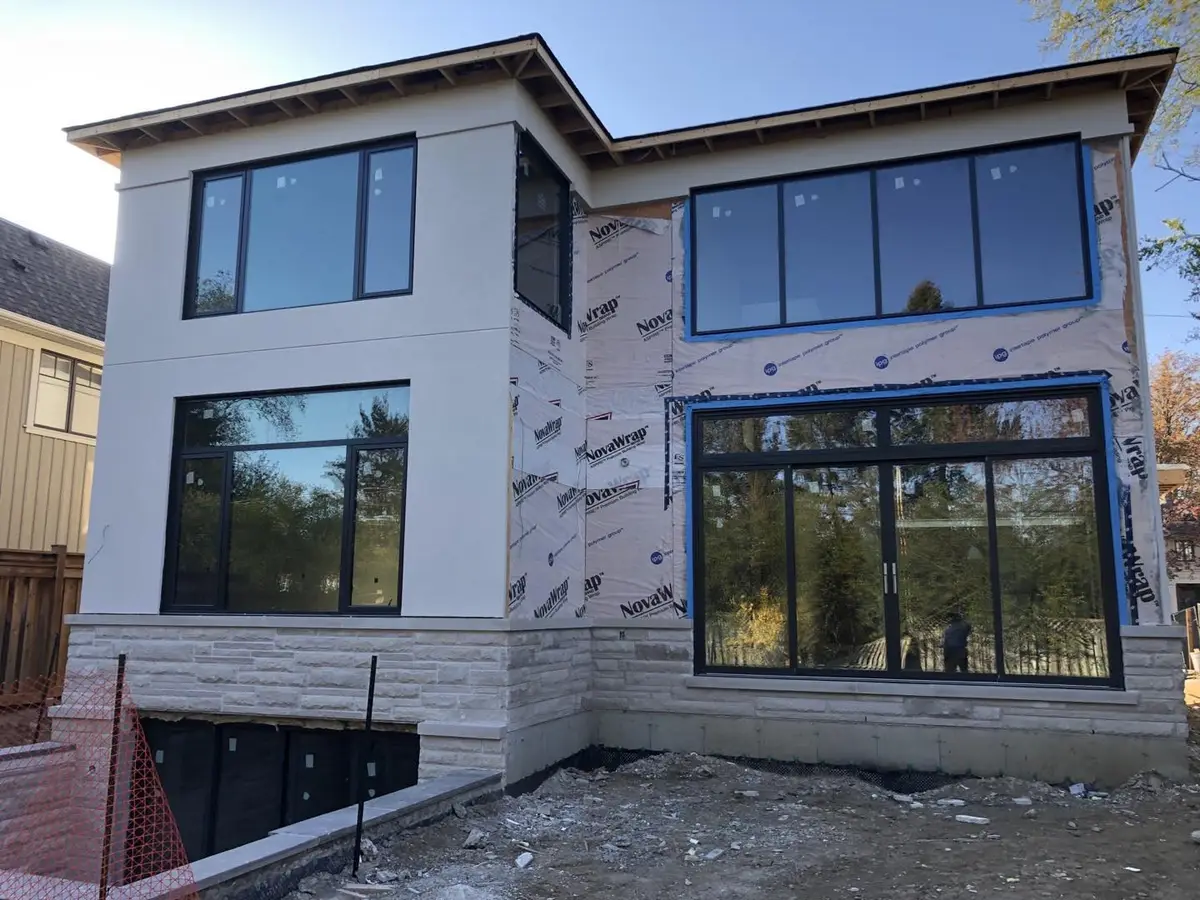
Who has worked on the wall before we get there
An ICF house is built from hollow foam blocks filled with concrete, and the foam stays on for good. By the time we're called, two other crews have already been on that wall. Knowing where their work ends tells you where ours starts, and it's the first thing we sort out with the builder.
The ICF crew
- Stacks the blocks and pours the concrete.
- Sets the window and door bucks, the frames cast into the wall.
- Leaves the outside face as bare white foam with plastic strips inside it.
The waterproofing crew
- Covers the foam below the soil line.
- Stops at grade, because that's where their job ends.
Our crew
- Preps the foam from the roof line down.
- Puts on the finish system you picked.
- Seals the finish to every window and door.
- Covers the strip of foam just above the soil.
Between the end of the waterproofing and the start of the wall finish there's usually a band of bare foam, about 6 to 12 inches high, right where the trimmer and the snow shovel hit. On our ICF jobs that band is in the quote, done by the same people who do our foundation parging.
Three ways we finish the foam, and what each one costs
All three look much the same the week the scaffold comes down. They differ in what holds the finish on and in how well they hide an uneven wall. The rates are the same ones we publish for every house.
Thin acrylic coat on the foam
We rasp the face of the blocks, bed fibreglass mesh in a base coat, and trowel an acrylic finish over it. The finish sticks to the foam itself.
It's the lightest and quickest option. It also copies the wall exactly, so the blocks have to be flat.
- Holds on by
- its bond to clean, rasped foam
- Best for
- walls poured straight, and finished before the foam weathers
Full EIFS over the forms
A water barrier goes on the blocks, then at least one inch of new foam board, then the same mesh and acrylic coats. The new board is rasped flat, so steps and bellies in the forms disappear.
It's the same system as on our EIFS installation page, laid over the blocks instead of plywood.
- Holds on by
- adhesive or screws into the forms, then the bond
- Best for
- uneven forms, block lines you never want to see, or extra insulation
Cement stucco on metal lath
Metal lath is screwed into the plastic strips inside the blocks, and traditional cement coats go on top. The finish hangs on the screws, not on the foam.
If you're weighing this against acrylic, our acrylic vs traditional stucco page sets the two side by side.
- Holds on by
- screws into the strips, never nails
- Best for
- owners who want the feel and weight of a cement wall
From the pour date to our first coat
Concrete inside foam dries slowly, because the foam on both faces holds the water in. While it dries, moisture comes out through the joints between blocks, and a finish put on too early can mark along those lines.
- Pour dayThe concrete goes in. We'd like to know this date before anything else.
- Day 28The usual cure for concrete. On an ICF wall it's the minimum, not the start date.
- Well past 28 daysSto, one of the big finish makers, tells crews to wait well beyond 28 days before its materials go on foam over concrete.
- Our startThe ICF elevations go last, after every other wall on the house is done, so they get the most drying time the schedule allows.
So the first thing we ask a builder for is the pour date in writing, and the second is the latest date the finish can go on without holding up the trades inside. Between those two dates we pick the start, and the quote says when it is.
Five jobs we do on the foam before any base coat
Take the sun off it
Foam left out through a summer goes yellow and chalky, and coatings won't grip chalk. We rasp the whole face back to bright foam, the north side as well.
Look for the ties
On some blocks, rasping uncovers the plastic or metal ties. Base coat won't bond to them. A wall full of exposed ties is a wall for added foam board, and we'll tell you that before the price is final.
Check it with a straightedge
Forms push out a little during a pour. Small steps rasp off. A belly can't be hidden by a thin coat and changes the method.
Fill the gaps with foam
Open joints and broken corners get foam slivers or low-expansion spray foam, cut flush. Packing them with base coat leaves a hard line that shows through.
Decide the edges
Where the finish stops at the bottom, around each opening and at the roof is set now, with the mesh wrapped round the foam edge.
Three spots where an ICF wall still lets water in
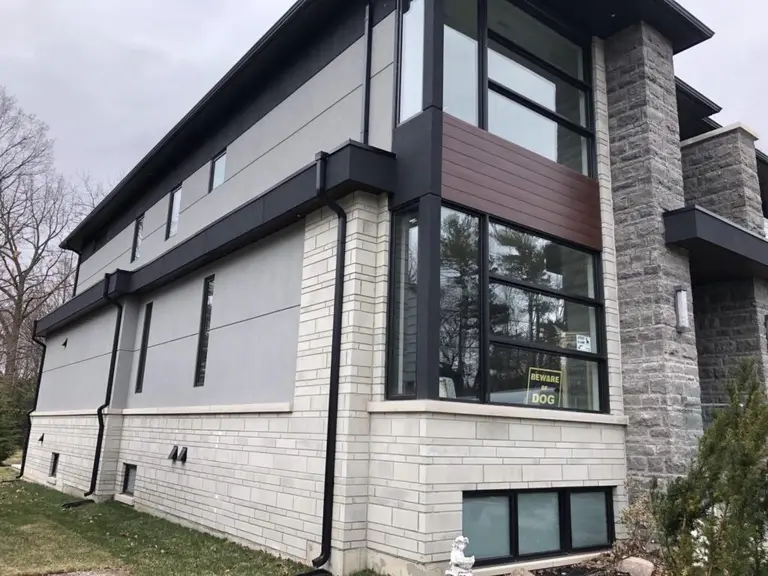
Concrete doesn't rot, so people relax about the details. The windows, the wood bucks and everything inside the house still care about water, and a coat bonded to foam has no drainage gap behind it to carry a leak out.
Windows on wood bucks
The buck is often the only lumber in the wall, and it sits where water collects. The sill gets a pan or membrane, the head gets flashing, and our finish stops at a proper sealant joint against the frame. We trim and band openings the same way on our window trim work.
The bottom strip
Bare foam above the soil is soft and gets chewed by sun and trimmers. It gets an acrylic parge coat from the end of the waterproofing up to the wall finish, with the right gap left to the soil or paving.
Where ICF meets a framed storey
Plenty of houses have ICF below and wood framing above. Concrete and lumber move differently through a year, so the finish gets a real joint at that floor line instead of running straight across it.
The longer version, with the manufacturer guidance behind it, is in Musa's post on stucco over ICF walls.

What to send us for an ICF quote
Most of the price is decided before we visit, by these few things. Text them to (905) 973-6470 or attach them to the quote form. The line is open 24 hours, 7 days a week, and Musa usually calls back within a day.
- Visit and quote
- Free, in writing, with a fixed price.
- Cover
- Fully insured and WSIB covered.
- After the job
- Our workmanship warranty.
- Behind it
- 25+ years of hands-on experience with acrylic and cement systems.
Five things to send
- The pour date, or the planned one.
- The block brand, if you know it.
- Photos of each side of the house, plus one close-up of the foam.
- The elevation drawings, or the wall area in square feet.
- Which finish you have in mind, or "not sure yet".
ICF stucco questions
Can stucco go straight onto ICF foam?
How much does stucco on an ICF house cost?
How long after the pour can the finish go on?
Why do I see block lines through the finish?
Ready to upgrade your exterior?
Tell us about your project and get a free, fixed written quote. Oakville-based, serving the whole GTA. Open 24 hours.
Want a price for your own wall?
Send your name, a phone number and what the wall is doing. Musa calls you back to book a free site visit, usually within a day, and the written quote after the visit is fixed. Would rather talk now? Call (905) 973-6470.