Somebody asks me this on a driveway two or three times a year, usually while I am measuring a wall for something else entirely. Does stucco reduce noise? They are on a busy stretch of Dundas, or backing onto the 403, or under the Pearson approach in south Etobicoke, and they are hoping the re-clad they are already half-decided on will buy them a quieter bedroom as a bonus.
The honest answer is worth more to you than the sales answer, so here it is up front. A bit, if it is hard-coat cement. Almost none, if it is EIFS. And on nearly every house I have stood in front of, the wall was not the thing letting the noise in.
Does stucco reduce noise?
A little. Traditional hard-coat stucco adds real weight to the outside of a wall, and weight is what blocks sound, so a cement re-clad does better than a light cladding. EIFS adds almost none. But in most GTA houses the windows, the vents and the gaps are letting in far more than the wall ever will.
That is the whole article in four sentences, and I could stop there. The reason I do not is that "a little" is where people hear what they want to hear. Stucco does get sold as something that will cut the road right out, usually by whoever is quoting the wall anyway, and it was never going to do that — on most houses the field of the wall is the part of the elevation already doing its job.
What actually stops sound coming through a wall?
Three things, in this order: mass, sealing and decoupling. A stucco job adds mass and it can help you seal. It cannot decouple anything, because a cladding is bonded to the very wall it would need to be separated from. That is two of the three levers, and only one of them is a strong one.
| The lever | What it means | What a stucco job does about it |
|---|
| Mass | Heavy surfaces move less when sound pushes on them, so less gets through to the other side. Each doubling of weight buys you a few decibels — that is the rule of thumb the whole trade runs on | Adds it. A lot with hard-coat cement, very little with foam |
| Sealing | Sound follows air. A gap does far more damage to a sound barrier than its size suggests, which is why a wall with a dozen open penetrations behaves like a wall with a hole in it | Can help — but only if the penetrations get detailed at the sheathing rather than caulked on the surface |
| Decoupling | Two separate layers with a gap or a resilient break between them, so vibration cannot walk straight across. This is where the big numbers in acoustics come from | Nothing at all. Cladding is glued to the wall. It is not a spring |
The decoupling row is the one worth sitting with, because it is where the intuition goes wrong. Foam looks like it should be a sound blanket. It is soft, it is thick, it is the same stuff people line studios with in the movies. But EIFS foam is stuck flat to the sheathing with adhesive, and something bonded to a surface does not isolate that surface from anything — it just rides along with it. Real decoupling is an interior job: a second layer of drywall on resilient channel, a staggered stud wall, a room built inside a room. All of that is on the other side of the wall from me.
Hard-coat stucco versus EIFS for noise
Hard-coat wins, and not by a small amount. Three-coat cement stucco at the standard seven-eighths of an inch weighs roughly ten pounds per square foot. EIFS — foam with a thin reinforced skin over it — weighs a little over one. On the mass lever, that is about three doublings of difference between the two systems.
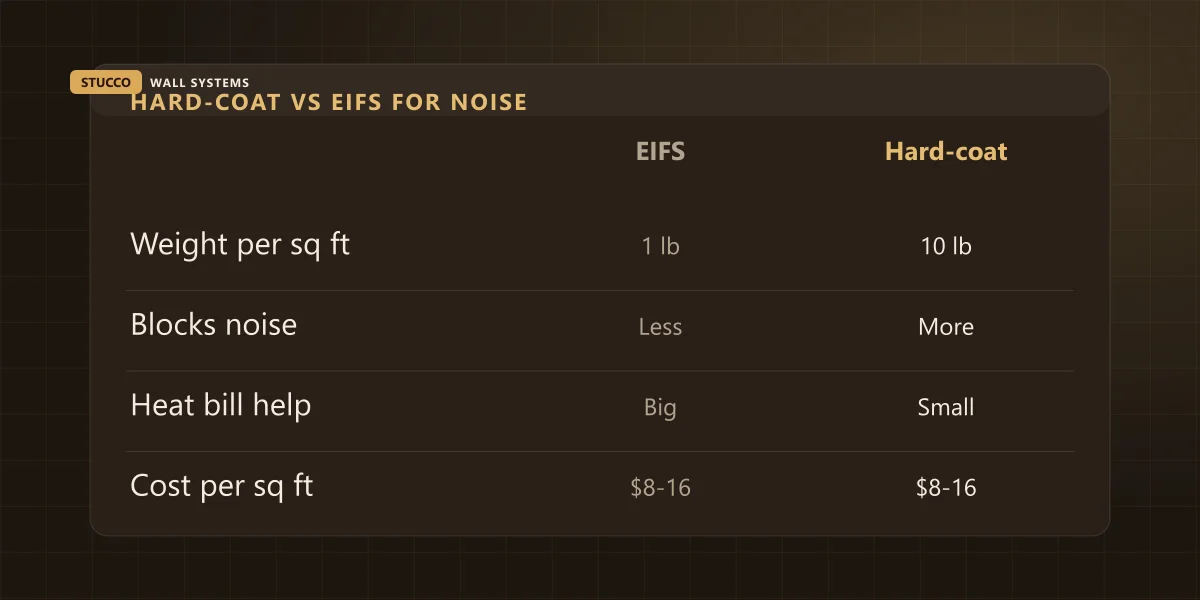
Those weights are not a sales figure, they are the numbers that decide what a tear-off costs — I worked through them properly in what is under the wall and what removal costs, where the same ten-to-one ratio is the difference between eight tons of debris and about one. It happens to be the cleanest way to compare the two systems for sound, because surface weight is the only wall property that reliably moves the needle.
Which produces the line nobody puts in a brochure: the system that does the most for your heating bill does the least for your noise. EIFS is the better envelope by a distance — it is continuous insulation, it moves the cold surface outboard, and I have never argued otherwise. It is also foam, and foam is light. I put the two systems side by side on every count in EIFS versus traditional stucco; sound is the one line where hard-coat is straightforwardly ahead.
Now the caveat that keeps this honest. Choose your system on water management, insulation, the house you have and the budget you have. Do not choose it on noise. The gap between the two systems is smaller than the gap a single tired patio slider makes on the same elevation, and you can replace a slider without touching the cladding.
So where is the noise actually getting in?
Through the openings, almost every time. Windows and patio doors first, then vents and hoods, then gaps at doors, then the roof for anything arriving from above. The field of the wall — the part a re-clad actually changes — is usually the best-performing surface on the elevation before I show up.
| The path | Why it beats the wall | What dealing with it involves |
|---|
| Windows and patio doors | Glass is light next to a stucco wall, and there is far more of it on a typical elevation than people picture. One old slider can set the noise level for a whole room on its own | Window work. The single biggest improvement available on most houses — and not a stucco job |
| Vents, hoods and air intakes | A dryer vent or a range hood duct is a straight metal tube from outside to inside with no mass in it anywhere along its length | Proper hoods with working dampers, and sealing the sleeve where it passes the sheathing. Cheap |
| Doors, sweeps and the attached garage | Hardened weatherstrip, a worn sweep, a man door into a garage that faces the road, an old mail slot | Weatherstrip and sweeps. A Saturday morning and a trip to the hardware store |
| The roof and ceiling plane | Anything from above — aircraft most obviously — arrives through the roof and the ceiling. No exterior wall on the house touches that path | Attic insulation depth and sealing the ceiling. Nothing to do with cladding at all |
There is a diagnostic in that table you can run tonight for free. Stand in the loud room with the window shut and listen to what actually bothers you. If it is the hiss of tires and the top end of engine noise, you are hearing the windows and the gaps, and that is the good news — those are the cheap fixes. If it is a low rumble you feel more than hear, no wall is going to help you and I will get to why in a minute. If you can hear the road through the bathroom fan while it is switched off, you have found your worst path, and a hood with a damper that actually closes is the cheapest fix on this page.
What Ontario itself does about road noise
The province has a published guideline for exactly this, and it is instructive for what it does not put first. NPC-300 governs how new housing near roads and rail gets assessed and mitigated, and its list of remedies puts the wall a long way down.
The guideline's own words: “Where the noise impact exceeds the applicable sound level limits, mitigation measures such as site planning, architectural design, noise barriers, building envelope elements (windows, exterior walls, doors) with upgraded sound isolation performance and/or central air conditioning may be required.” You can read the whole thing on ontario.ca.
Read that list again and notice two things. Exterior walls are on it — but as one item inside an envelope package specified by an acoustics consultant on a new build, alongside the windows and the doors, not on their own. And central air conditioning is on it, which sounds bizarre until you realise why: the cheapest reliable way to make a house beside a highway quieter is to make it possible to keep the windows shut through July. Nothing on the province's list reads "re-clad the house".
The same guideline is also why a newer house near a 400-series highway often has a noise warning clause registered against it — a notice to a purchaser or tenant about an existing source of noise, written into the offer or the condominium declaration. If you bought a subdivision house near the 407 or the 401 and you have never gone looking for that clause, it is probably in your paperwork, and it will tell you the noise was assessed and mitigated at design stage rather than left for a future cladding decision.
If you are re-cladding anyway, ask for these four things
This is where a stucco job genuinely can help, because the wall is only open once. None of these four cost real money at the right moment, and three of them are things I would do anyway to keep water out. Ask for them by name and get them written into the scope.
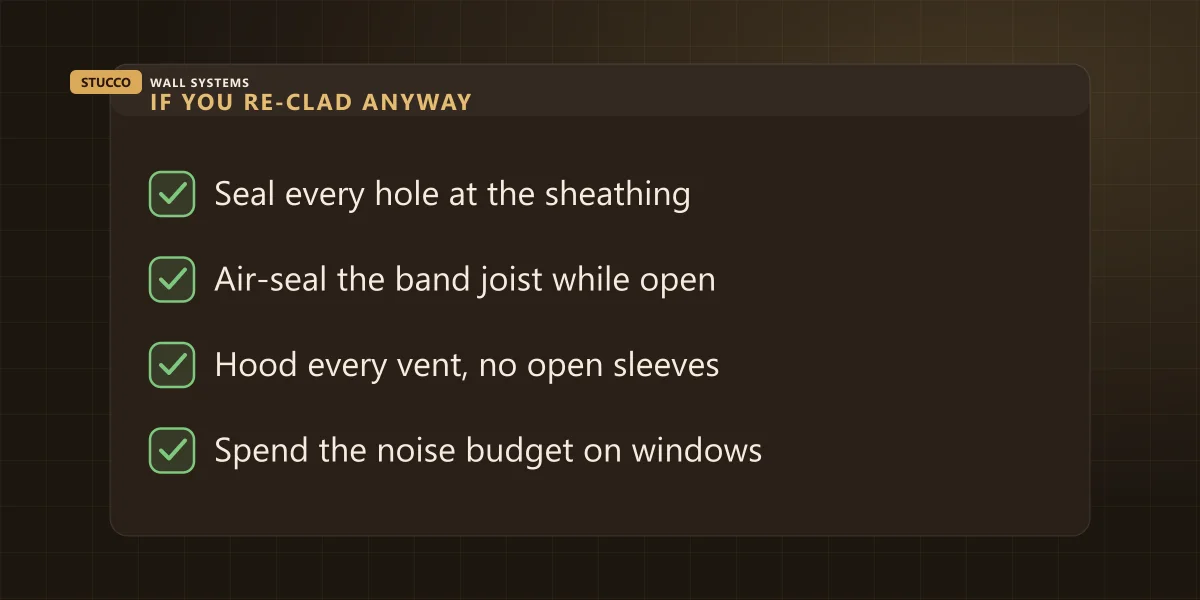
Seal every hole at the sheathing. Not a bead over the top. Sealant goes down into the hole against the sheathing so the barrier is closed where it was opened — the same detail that stops a light fixture leaking, which I set out in full in how to mount things on stucco without leaks. Every one of those holes is an air path, and every air path is a sound path.
Air-seal the band joist while it is open. The band at each floor line is one of the biggest air leaks on a typical GTA house, and a strip-and-re-clad is the only time in the life of the building that anyone can reach it from outside. Sealing it is a genuine improvement to comfort, to the heating bill and to noise all at once. It is also the fix for a different problem entirely — winter condensation that starts inside the house follows the same air paths.
Hood every vent, no open sleeves. Anything passing right through the wall gets a hood with a working damper and a sealed sleeve. An open sleeve is a speaking tube, and it is also the thing that lets a wasp into your wall cavity. Same detail, two problems solved.
Spend the actual noise budget on windows. If quiet is a real goal and there is money set aside for it, put it into the glass on the loud elevation and let the wall be a wall. I would rather say that on the driveway than have you find it out afterwards.
What a stucco job will never fix
Four things, no matter what system you buy or what anyone quotes you. Worth knowing before you sign, because these are the complaints I hear most often after somebody has already spent the money somewhere else.
Low-frequency rumble. Truck engines, exhaust brakes, the drone off the 401 at four in the morning. Long wavelengths are exactly what mass is worst at stopping, they travel through the ground as well as the air, and they bend around barriers rather than bouncing off them. The frequencies that keep you awake are the ones a heavier wall does least about.
Aircraft. If you are under an approach path in Etobicoke or north Mississauga, the sound is arriving through your roof and your ceiling. Attic insulation depth and a sealed ceiling plane are your levers there. Nothing on your walls will move it.
Anything bolted to your wall. An air conditioner or heat pump on a wall bracket makes the wall itself a sounding board — a compressor is a vibrating load, not a light fixture, which is one of the reasons I argue against wall brackets in what a heat pump does to a stucco wall. Put the unit on the ground on a pad, away from bedroom windows, and you will have done more for your own noise than any cladding could.
A rattle you already own. A loose downspout, a vent flap slapping in wind off the lake, a satellite bracket nobody has used in a decade. Before you conclude anything is coming through the wall, walk each elevation on a windy evening and listen for hardware on the outside of it. It is the only item on this list a screwdriver fixes.
What it costs, honestly
Here is the same money laid out against what it actually buys you in quiet. These are our normal published ranges, not special numbers invented for this page.
| The work | Typical range | What it does for noise |
|---|
| Weatherstrip, door sweeps, vent dampers | A few hundred, often DIY | The best value on this page by a distance |
| Renewing sealant at every penetration on the house | $800–$2,500 whole-home | Modest on its own, real alongside the rest — and it keeps the wall dry |
| Opening and rebuilding an area of wall | $450–$1,200 per area | Nothing measurable by itself |
| Full residential re-clad | $8–$16 per sq ft installed | Some with hard-coat, little with EIFS. The right job for a failing wall, the wrong one for noise |
If noise is the only reason you are considering a re-clad, I would rather you spent the money on windows and kept my number for the day the wall genuinely needs doing. That sentence has cost me work. I would still say it standing at your kitchen table, because the alternative is you paying for a wall and being disappointed by a bedroom.
Where it changes is when the wall needs work anyway. If you are already looking at cracking, staining or a failing finish — the tells are all in six signs water is behind your stucco — then the four asks above ride along inside a job you were doing regardless, and the marginal cost of doing them properly is close to nothing.
The short version
Hard-coat stucco blocks more sound than EIFS because cement is roughly ten times the weight of foam, and that is a real difference in the wall's own performance. It is also not what you are hearing. Windows, vents, door gaps and the roof beat the wall on every house I have measured with my ears, and the province's own guideline for road noise reaches for windows, barriers and air conditioning long before it reaches for the cladding. Fix the openings first. Then, if the wall needs doing, do the wall — and have every penetration sealed at the sheathing and the band joist closed while it is open.
We re-clad and repair houses right across the GTA, from Toronto out through Mississauga, Oakville and Vaughan; the full scope for a house is under residential stucco, sealant renewal sits on the caulking side, and there are finished walls in the project gallery. If you are on a loud road and trying to work out whether the wall is worth it, send us the address and a photo of the elevation or call (905) 973-6470. I will tell you the same thing on the phone that I have told you here, even when the answer is that you do not need me yet.