Nobody phones me about stucco removal. They phone about a crack that keeps coming back, or a soft patch under a window, and part-way through the conversation it turns out the honest answer is that the finish has to come off. That is a different job from a repair — priced by different things, scheduled around different risks, and the one part of a re-clad where an honest contractor cannot give you a firm number for everything, because until the wall is open nobody knows what is behind it. Here is what actually happens when we take a wall down to the sheathing.
Should you remove the stucco or repair it?
Repair while the damage is local and the substrate behind it is dry. Remove when the same spot has been patched twice, when a moisture meter reads wet across more than one stud bay, or when the patchwork would cost more than refinishing the whole elevation. It is arithmetic about condition, not about age.
The unit of decision is an elevation, not a square foot. A patch that stops in the middle of an open wall stays visible for years no matter how well it is matched — that is the whole reason a stucco patch shows and why we break a repair at a control joint or a corner wherever the wall gives us one. So once three or four separate patches are needed on the same face, you are paying repair prices for something that will still look repaired.
| What the wall is doing | Repair it | Remove that elevation |
|---|
| Fine map cracking, wall sounds solid everywhere | Yes — a flexible coating or a skim | No |
| One crack running off a window head | Yes — cut back, re-mesh, break the finish at a joint | No |
| Soft spot under a sill, dry sheathing either side | Yes — local cut-out | No |
| Same crack back within two years of a second patch | No — you are buying the same defect twice | Yes |
| Meter reads wet across more than one stud bay | No | Yes |
| Drummy or bulging across a large part of one wall | No | Yes |
| Barrier EIFS with staining now showing up inside | No | Yes |
“Drummy” is the row you can check yourself. Tap along the wall with a knuckle: solid stucco sounds dead, stucco that has let go of its base sounds hollow. A hollow patch the size of a dinner plate is a repair. Hollow wandering across half a wall means the bond is gone, and no patch fixes a bond.
What does stucco removal cost in the GTA?
On a full re-clad it is not a separate line at all. Stripping the old finish and getting rid of it sits inside the $8–$16 per square foot installed that we quote on residential stucco, and $10–$18 on commercial work. What sits outside that number is everything the removal uncovers — and that part genuinely cannot be priced before the wall is open.
| Line item | Inside the installed price | Priced after the wall is open |
|---|
| Stripping the old finish off | Yes | — |
| Disposal of the finish material | Yes | — |
| Lath, mesh, base coat, finish coat | Yes | — |
| Flashing at heads, sills and the roof line | Yes | — |
| Scaffold, site protection, final cleanup | Yes | — |
| Replacing wet or rotted sheathing | No | Per sheet, at a rate agreed in advance |
| Framing repair behind the sheathing | No | Hourly, with dated photos |
| Extra disposal if the debris runs over | No | By weight |
| Asbestos sampling on a pre-1990 house | No | Tested before the start, never after |
Removal is only its own price when you are putting something else on afterwards, so there is no finish work to carry the cost. That job is quoted by the day and the bin, and it is almost always the dearer way to buy the same demolition. Get the re-clad number beside it before you decide.
Anyone quoting a removal at a firm all-in price without seeing the wall is pricing the part they can see and hoping about the rest — the same instinct as the quote written from a car window. It sounds decisive right up to the moment somebody has to stand behind it.
Why removal is priced by weight, not by square feet
Because two walls of identical size can produce debris loads that differ by a factor of eight. Traditional three-coat cement stucco at the standard 7/8 inch weighs roughly ten pounds per square foot. EIFS — foam with a thin reinforced skin over it — weighs a little over one. Same wall, same square footage, wildly different day.
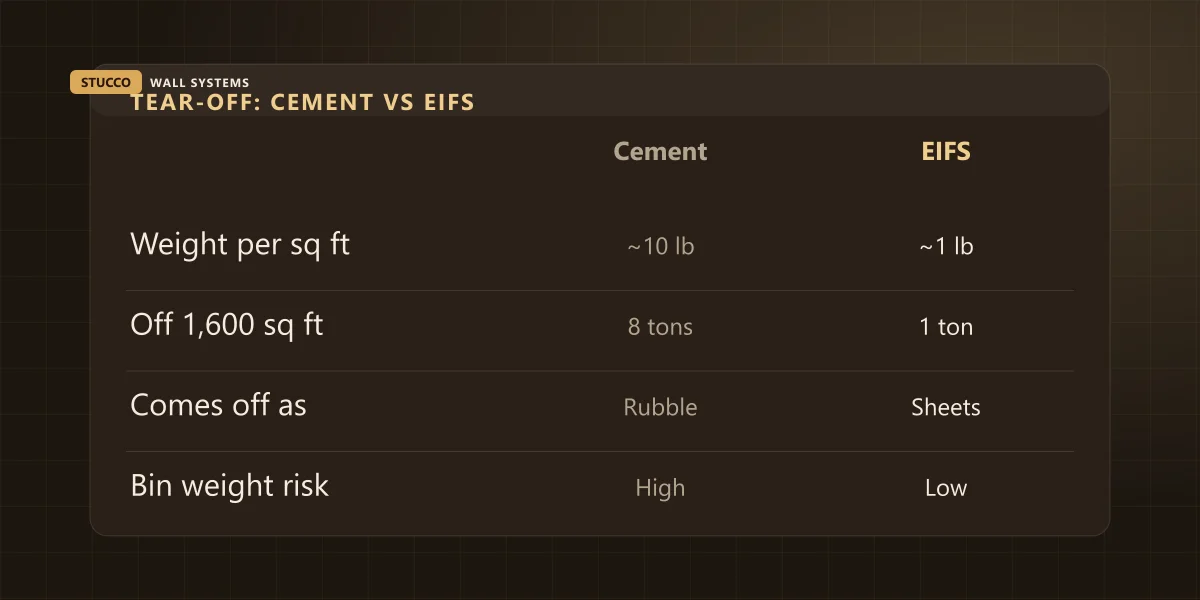
Run it on a real wall. A two-storey GTA detached with about 1,600 square feet of actual wall area, finished in three-coat cement, produces something in the order of eight tons of rubble. That has to come off the scaffold, cross your lawn, and go into a bin that is billed with an included tonnage and a per-tonne charge after it. The same house in EIFS gives up maybe a ton, in sheets, and one worker carries a full storey’s worth to the bin in an afternoon.
That is why two quotes for “the same size house” can sit thousands apart with nobody padding a margin: weight buys labour hours, bin space and lawn protection. It is also why the crew promising to take your cement stucco off in one afternoon has not thought about where eight tons of it is going to sit.
What is actually under GTA stucco?
Four assemblies cover almost everything I open in this market, and the age of the house predicts which one you have with reasonable accuracy — along with what the strip-out will find, which is the part that decides the final invoice.
| When the house was built | What is usually behind the finish | What the strip-out normally finds |
|---|
| Pre-1950 — older Toronto, The Kingsway, Leaside | Cement over solid masonry, sometimes over board sheathing and wood lath | A sound wall with no flashing at the openings, because none was ever installed |
| 1950s–70s — Etobicoke and North York bungalows | Cement over concrete block or brick | Very little wrong. Block does not rot — heavy, dusty work with a boring ending |
| 1980s–90s subdivisions — Erin Mills, Meadowvale, Bramalea | Cement or acrylic finish over plywood or OSB with building paper | Wet sheathing, nearly always under windows and along the roof-to-wall line |
| Mid-90s–2000s customs — Kleinburg, Vaughan, parts of Oakville | EIFS foam over sheathing, sometimes with nothing draining behind it | Fast, light removal — and sheathing that tells you the whole story in ten minutes |
The 1980s and 90s row is the one that costs money. Those walls were built when the industry still believed a face-sealed finish could keep water out on its own, which is the story behind why EIFS got its bad name. Water gets past every finish eventually; the question is whether the assembly gives it anywhere to go. When it does not, it goes into the sheathing, concentrated under sills and at the roof-to-wall junction.
The useful part for you: you can predict this before anybody quotes. If your house is from that era and you already have any of the six signs of water behind stucco, assume the removal will find sheathing to replace and get the unit rate in writing. If your bungalow is cement over block, relax — the wall behind it is almost certainly fine and the noise is the worst part.
How long is the wall left open to the weather?
Only as long as it takes to dry it back in, which on a competent crew means the same day. We strip what we can paper and flash before we leave, not what looks efficient at nine in the morning. An elevation sitting open under a tarp over a rainy weekend is a scheduling decision somebody made, and you should hear about it in advance.
The working unit is one elevation, sometimes half of one on a big face — deliberately slower than tearing the whole house to sheathing on day one, and the difference between a controlled job and a bet on the forecast. Tarps are wind protection and dust control. Anybody telling you a tarp holds through a real GTA thunderstorm has not stood under one at four in the afternoon watching it fill.
So removal runs on a weather window and the schedule flexes. A start pushed two days in late October is a crew reading a forecast, not a crew that forgot about you. The alternative — opening a wall into rain because a date was promised — costs you sheathing.
Is there asbestos in old stucco?
Possibly, in pre-1990 material, and it is a testable question rather than a guess. Ontario’s asbestos regulation puts the obligation on the contractor doing the cutting and grinding, not on the homeowner. On an older house we sample before anyone starts, because a positive result changes the method and the trade — not the price of the new stucco.
What gets sampled is not only the stucco. Old parging patches and whatever somebody used to fix a crack in 1974 each get their own sample, because a house can be clean in one material and not in another. Undisturbed material on a wall is not the hazard; grinding it to dust is, which is exactly what a removal does.
If a sample comes back positive, that work belongs to a licensed abatement contractor under O. Reg. 278/05, Ontario’s asbestos regulation for construction projects, and I will tell you that rather than find a way to work around it. I would rather lose a job than hand somebody a dust problem inside their own house. Most exterior cement stucco I have opened tests clean — but “most” is not a basis for skipping a sample that takes a few days to come back.
The bin, the dust and your garden
Eight tons of rubble sits somewhere for a week, and that somewhere is usually your driveway. A loaded bin presses interlock down unevenly, so it goes on plywood — not optional just because it looks like overkill on day one. On a narrow lot with a shared drive, settle the bin location before the truck arrives rather than while it is idling.
Cement dust travels further than people expect, and in rain it turns to slurry and stains what it lands on. Beds against the wall get tented, screens come off and go in the garage, and anything with a fabric top — patio furniture, a car cover, the neighbour’s barbecue — gets moved or wrapped. None of it is difficult. It either happens on the first morning or gets argued about on the last.
The clause that keeps a surprise from becoming an argument
Both sides of this are honest. I cannot see through your stucco, so I cannot promise what the sheathing looks like — and you should not sign a blank cheque for whatever I find. The way out is agreeing the price of the unknown before the unknown appears.
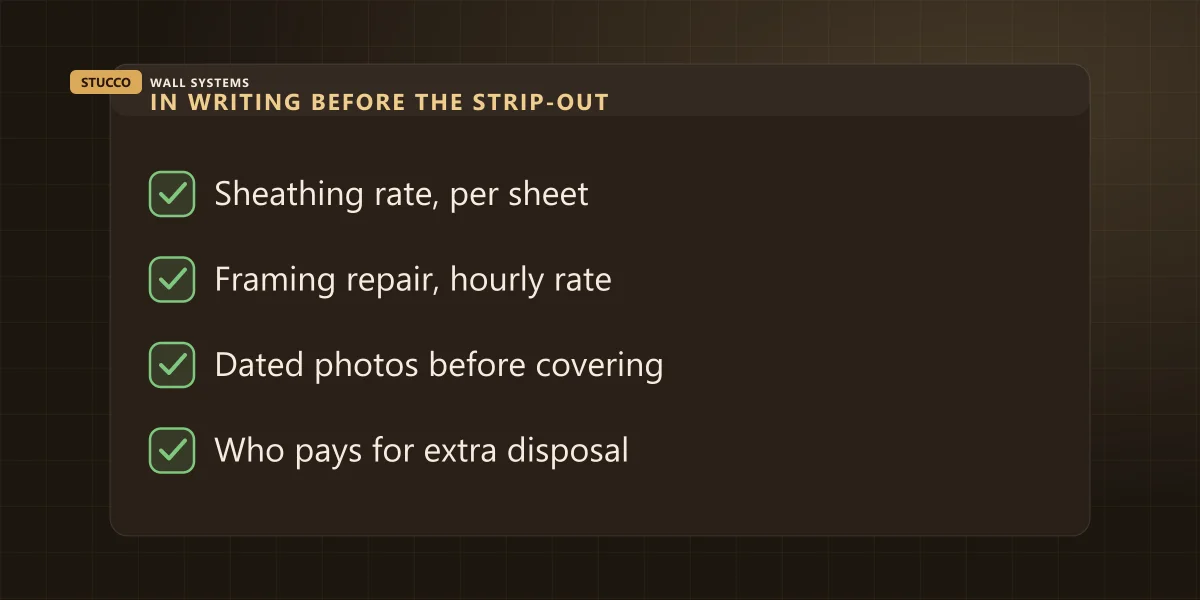
Four lines, and they take one conversation. A rate per sheet for sheathing replacement, so the number is not invented on the day it is needed. Framing repair billed hourly at a stated rate rather than as a lump. Dated photographs of everything uncovered, taken before it gets covered again — that protects you and it protects me. And who pays if the debris runs past the estimated tonnage, which on a cement wall is the overrun that actually happens.
Put those beside a payment schedule tied to finished stages and there is very little left to argue about, because each surprise arrives with a rate and a photograph already attached to it. The wall still decides what turns up. What the contract decides is whether that costs you a phone call or a fight.
What this means for your wall
If you are somewhere between “patch it again” and “take it all off”, the deciding facts are whether the substrate is dry and how many separate repairs the face needs. Both are answerable in an hour with a moisture meter and a knuckle, and we do not charge to come and do it. Twenty-five years on the tools in this market, 4.3 stars from 12 Google reviews, and a straight answer either way — including the times the answer is that your wall needs a targeted repair rather than the re-clad you were bracing for.
You can see finished work of both kinds in our project gallery. When you want the wall looked at properly, send us the address and a few photos of the worst area and we will tell you which side of the line you are on, in writing, before anybody quotes a removal.