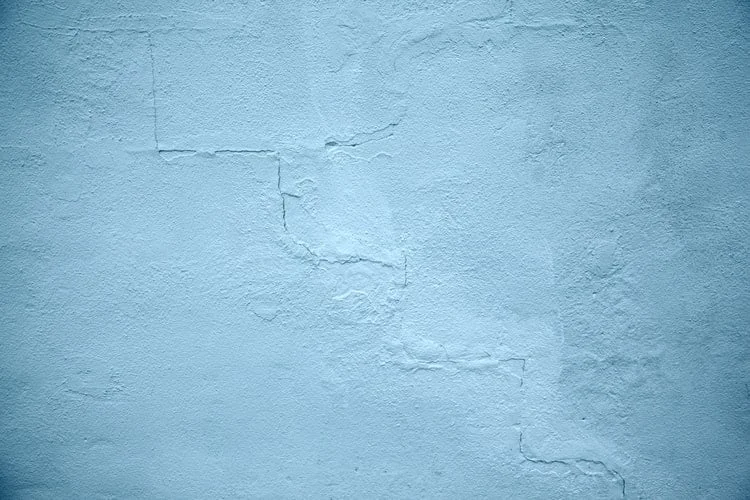
Every wall on this blog gets wet from the outside — rain, snow, a bad flashing, a weep screed buried under mulch. That covers most of the calls I take. But a few times each winter I stand in front of a soaked wall and there is nothing wrong with the outside of it at all. Stucco condensation is the other kind of wet wall: water your own house put there, carried out into the assembly by warm indoor air and dropped the moment that air touched something cold. It is a far smaller category than rain. It is also the one that stays misdiagnosed the longest, because people keep opening the wall looking for a leak that was never there.
Can condensation really damage a stucco wall?
Yes, but not the way rain does. Rain arrives fast and leaves a mark you can trace to a joint. Condensation arrives slowly, wets the cold back face of your sheathing all winter, and only shows on the outside once that sheathing has been damp for months. By then it is a rot problem, not a stain.
The mechanism is worth two minutes, because everything else on this page follows from it. Warm air holds far more water vapour than cold air does. Natural Resources Canada sets it out plainly in Keeping the Heat In: vapour turns back into liquid at the dew point, the moment the air can no longer carry what it is holding, and the everyday example is the window running with water on a January morning. Your window is simply the coldest surface you can see. There are colder ones you cannot see, and several of them are inside your walls.
Two things move that vapour outward. Diffusion seeps slowly through the materials themselves. Air leakage carries it bodily through any hole in the envelope. The same NRCan section is blunt about which one matters: one small air leak can let through roughly a hundred times more moisture than diffusion will over the same area. That ratio is the whole reason a stucco crew cannot solve this from outside. A hundred-to-one problem is not fixed by anything you trowel on.
Then the wall has to dry, and in a GTA winter it barely can. Cement stucco and acrylic-finished EIFS both dry outward well enough in July sun. In February there is no sun on the north elevation, the wall is frozen through half the day, and whatever gets in stays in. Water that arrives in December is still sitting against wood in March. That is the difference between a nuisance and a repair bill.
How do I tell condensation from a leak?
Weather is the test. A leak tracks the rain: wet within a day of a storm or a thaw, dry through a dry week. Interior moisture tracks the cold: worst in a dry January cold snap, easing in March, gone by May. If the wall is at its wettest in a week with no precipitation, stop looking for flashing.
| What you are reading | Outside leak | Moisture from inside |
|---|
| When it is worst | Within a day or two of rain, or during a thaw | The coldest, driest weeks of the winter |
| Where it shows | One place, tied to a junction — window head, roof line, chimney, base of the wall | Spread across a whole elevation, usually the upper storey |
| Which elevation | Whichever one the weather drives at, commonly the south-west | The cold shaded ones that never warm up, north and east |
| What is happening indoors | Nothing, usually, until it is already bad | Fogged windows, musty upstairs rooms, mould in ceiling corners |
| What actually changes it | Metal, sealant, grading and downspouts | Exhaust fans, humidifier setting, air sealing |

Read that table honestly and most people will land in the left-hand column, and they should. Rain, snow and bad detailing cause the large majority of wet stucco in this market, which is why almost everything else we have written — the roofline as a water system, the six signs water is behind your stucco — is about keeping outside water outside. This post exists for the minority of walls that do not fit that story, because those are the ones that get torn open twice.
One more tell, and it is the cheapest of all. Both kinds of wet wall can produce white salt bloom, but they produce it on different schedules. Rain-fed efflorescence on stucco shows up after wet spells all year. Condensation-fed bloom shows up in one place every single spring, on the same elevation, as the wall dries out for the season. If you can predict the month, the water is coming from your side.
Where is all that moisture coming from?
Your household, mostly. Showers, cooking, laundry, dishes and breathing put water into the air all day, and in winter that air has nowhere to go but out through the building. NRCan adds the direct sources people forget: houseplants, aquariums, humidifiers, plumbing leaks, open sumps and damp foundations. Nothing exotic. Just volume, running around the clock.
| Source | What it puts into the house | The tell |
|---|
| Showers, cooking, laundry, people | The daily baseline, every day of the year | Mirror stays fogged long after the shower is done |
| A furnace humidifier set once in October | Often the single largest one, and completely under your control | Hygrometer reads the same in a mild week and at minus fifteen |
| A bathroom fan ducted into the soffit or attic | All of it, straight into a cold space instead of outdoors | Frost or dark staining on the attic sheathing above that bathroom |
| A dryer vented indoors, or a duct off its collar | A full load of laundry’s worth of water at a time | Lint on the basement joists; that room warms up and smells damp |
| Wet basement, crawl space or an open sump | Constant, and the stack effect carries it up through the house | Musty basement, salts blooming on the foundation wall |
| A first winter in a new build or after a renovation | Water still leaving fresh concrete, plaster and drywall mud | Bad the first winter, noticeably better the second |
Notice that only one line on that list is a defect. The rest is a house being lived in. Which is why the fix is almost never to make the family behave differently — it is to give the water a door, and to stop it leaving through the wall.
Why does it show up high on the wall?
Stack effect. Warm air rises, so the top of a heated house sits at slightly higher pressure than outdoors while the bottom sits lower. NRCan describes the result exactly: air escapes through holes in the ceiling, through cracks in the walls and around upper-storey windows, while replacement air gets drawn in low. Your moisture leaves upstairs.
That single fact is the most useful diagnostic on this page, because it runs opposite to how rain behaves. Rain damage concentrates low and at junctions — the base of the wall, under sills, below a roof line. Stack-effect moisture concentrates high: the top of the second storey, the band under the eaves, the corners around upper windows. A house with a perfectly sound bottom half and trouble along the top is telling you something, and it is not telling you about your grading.
NRCan also notes that stack effect grows with leakage, with building height and with the temperature difference across the wall. In practice that means a three-storey infill on a minus-twenty night is working much harder at this than a bungalow on a mild one, and that the worst nights of the year are doing most of the damage. It is also why an upper window that keeps failing at its corners deserves a second look before anyone blames the installer.
What should you do about it, in order?
Cheapest first, and the first two moves do not involve a stucco contractor at all. Cut the moisture your house is making, close the holes carrying it into the assembly, then measure again through one winter. Only after that does anyone touch the cladding — and by then a good number of these walls have quietly stopped being a problem.
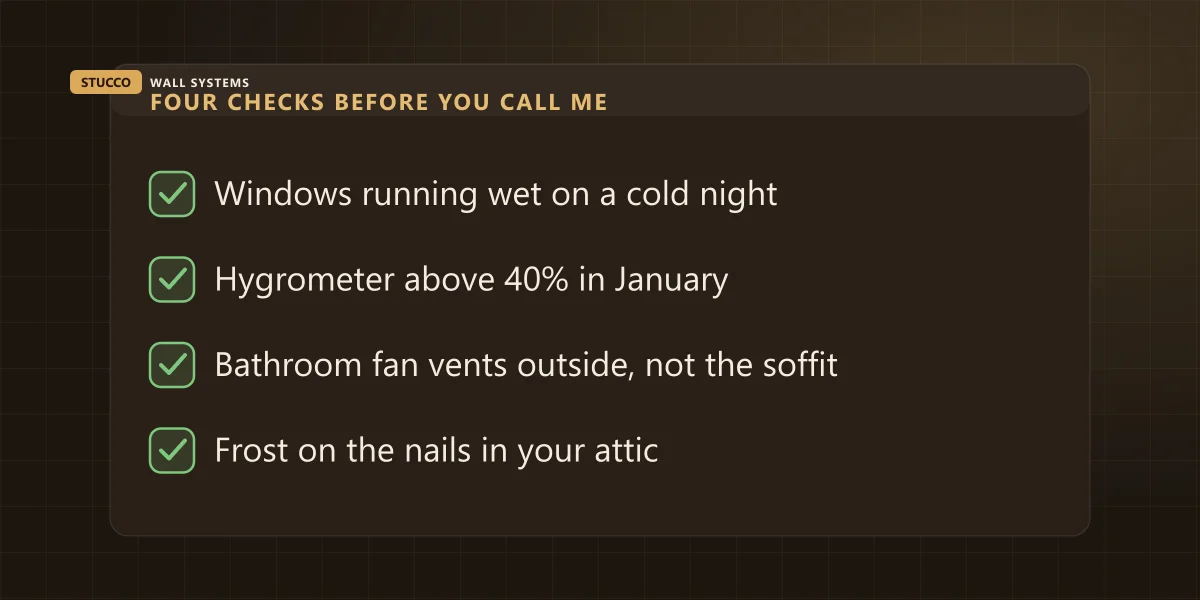
Start with the four readings on that list, because all four are free or nearly so and together they either confirm the diagnosis or kill it.
Watch your windows on the coldest night. NRCan names fogging and frosting on glass as a direct indicator of high indoor humidity, along with stale air and lingering odours. Glass is the coldest surface in the room and it reports first. Water running down it is the same water your walls are getting.
Buy a hygrometer and read it in a cold snap. NRCan puts the healthy indoor range at 30 to 50 percent relative humidity, lower in winter and higher in summer. My own rule after twenty-five years of looking at the damage: in a real January cold snap I want to see the low thirties, and a reading sitting in the forties is doing work on your walls whether or not it feels comfortable. If the number never moves as the weather does, something is holding it there. Usually the furnace humidifier.
Follow your exhaust ducts to daylight. Every bathroom fan should terminate outdoors through a wall or roof cap, not into the soffit and not into the attic. A soffit termination is not venting; it is delivering warm wet air to the coldest cavity in the house and letting the intake pull some of it straight back in. Same question for the dryer and the range hood. This is the most common real defect I find, and it is a duct problem, not a wall problem.
Put your head into the attic on a cold morning. Frost on the nail points coming through the roof sheathing, damp plywood, or a wet ring around a fan duct all mean the house is pushing moist air into cold assemblies. The attic is simply the easiest place in the building to see it happening. If it is happening up there, it is happening in the walls too.
Then fix in that order: cut the load, vent it, seal the leaks. Air sealing does the heavy lifting — the top plates, pot lights, the attic hatch, plumbing stacks and wiring penetrations. But do it with your eyes open, because NRCan is careful about this and so am I: tightening a house reduces the moisture escaping into the structure and simultaneously raises the humidity inside it, so sealing without ventilating trades one problem for another. Seal the wall, then make sure the house can breathe on purpose instead of by accident.
When does this become a stucco job?
When the assembly has already taken damage, or when you are re-cladding anyway. Those are the two honest answers. If the finish is sound and the problem is interior air, there is nothing for me to do yet, and any contractor who quotes you a wall on that evidence is selling you the wrong thing.
| What we find when we look | What it actually is | Our range |
|---|
| Finish sound, problem is interior air | Not a stucco job yet — go do the four checks | No stucco work |
| Blistered coating or a spring salt bloom on the field | Cosmetic, once the moisture load is dealt with | $300–$800 |
| Failed sealant at a joint or a penetration making it worse | Sealant and detailing, before it gets structural | $500–$1,500 |
| A section sounds drummy, or the finish is letting go in a band | Section rebuild — the lath behind it is usually rusting | $18–$34 per sq ft |
| Sheathing or framing is wet or rotted | Open it, dry it, replace what is gone, rebuild | $1,500–$5,000+ |
| Re-cladding regardless, and adding exterior insulation | Full residential re-clad | $8–$16 per sq ft |
Those are the same bands we publish everywhere else on this site, and they do not change because the water came from a different direction. What does change is the sequence. Doing the repair before the moisture load is under control means paying for the same wall twice, and I would rather lose the first job than do the second one.
Does exterior insulation actually help?
Yes, and it is the one place where the cladding decision changes the physics rather than covering it up. Insulation outboard of the sheathing keeps that sheathing warmer through the winter. A warmer surface is one the indoor air is less likely to reach its dew point against, so less water gets deposited at all.
That is a real advantage of an insulated system over a thin coating, and it is the same continuous layer that shows up on the heating bill. If you were already planning a re-clad on a house with a history of winter damp, this is the argument for spending the extra on insulation rather than on a fancier finish.
I will not oversell it. Exterior insulation moves the cold surface, it does not remove the water. A house producing more moisture than it vents will find another cold spot — a rim joist, a window frame, an attic hatch — and carry on. Warmer sheathing buys you margin. Fans, a sensible humidifier setting and a sealed ceiling plane buy you the fix.
What this means for your wall
If your stucco is wet, start with the calendar, not the ladder. Note the month it looks worst and whether it rained that week. Then check the glass on the coldest night, buy the hygrometer, follow the bathroom duct and look at your attic nails. No money, and you will know which half of that first table you live in.
If the answer turns out to be outside water, the rest of this blog is about exactly that, and we will come and look. If it turns out to be inside moisture, the first two things you need are a duct and a dial, and neither of them is sold by a plasterer. Twenty-five years on the tools in this market, 4.3 stars from 12 Google reviews, and a habit of telling people when the job is not ours. You can see finished walls across the GTA in our project gallery, and when you want somebody to actually read your wall, send us photos and the month it looks worst or call (905) 973-6470. We work across Toronto and the surrounding cities, and the first thing we will ask is what the weather was doing.