If your house has a newer gas furnace, there is a white plastic pipe coming out of the side wall, usually with a second one beside it. On a stucco house that furnace vent sits right in the finish, and over a few winters the wall around it starts to show it: a white crust, a dark streak, a sheet of ice in January, a hairline ring around the pipe. Some of that is a furnace problem, some is a wall problem, and the order you fix them in decides whether you pay once or twice.
Why does a high-efficiency furnace vent make the wall wet?
Because its exhaust is mostly water vapour and it comes out cool. An older furnace sent hot gas up a chimney. A high-efficiency one pulls so much heat out of the gas that the vapour condenses inside the unit, so the pipe can be plastic and run out the side wall. What leaves the pipe is a wet plume, and on a cold day it lands on whatever is next to it.
Inside the house, that condensed water is supposed to run back down the pipe to the furnace and out through its drain. That only works when the pipe is pitched back toward the furnace along its whole run. When a section sags, an elbow works loose or the pipe was run level, water collects and dribbles out at the wall instead. Tankless water heaters and some gas fireplaces vent sideways the same way, and everything below applies to them too.
None of this means the furnace is dangerous or that the installer was careless. A wall vent is a normal, approved way to do it. It just puts a source of water on the outside of your house all winter, in a spot nobody looks at until something shows.
What does each mark around the vent mean?
Stand back from the wall and read it by position. Where a mark sits relative to the pipe tells you more than its colour does, because the plume, the drips and the wind each leave their trace in a different place.
Above the pipe
Rarely marked. Staining here usually comes from the roofline or a window above, not from the vent.
Upwind side
Normally clean. A clean side next to a stained side tells you the plume is doing the work.
The joint at the pipe
A crack ring, a gap, missing sealant or crumbly finish means water is getting into the wall right here.
Downwind side
A fan of grey or green staining, or frost feathers in winter, is the plume settling on the wall.
Directly below
A vertical streak, white crust or soft finish means water is running or dripping out of the pipe.
At the ground under the vent
Ice humps on the walk, a wet patch of lawn, or crumbling finish at the bottom of the wall where meltwater collects and freezes.
| What you see | Most likely cause | Whose fix comes first |
|---|
| Dark fan of staining to one side | The plume settling on the wall in the usual wind | Wall cleaning; ask the gas technician about the termination fitting |
| Streak straight down from the pipe | Water leaving the pipe instead of draining back to the furnace | Gas technician: pitch, loose elbow, termination |
| White crust below the pipe | Water moving through the finish and leaving its minerals behind | Gas technician first, then the wall |
| Crack ring or open gap around the pipe | The joint between the pipe and the stucco has failed | Stucco crew: rebuild the joint |
| Finish soft or hollow around the pipe | Water has been getting in behind the face for a while | Both: stop the water, then cut out and repair |
| Thick ice on the wall in a cold snap | Plume freezing onto the finish faster than it can dry | Gas technician if it builds every winter |
Two of those marks get mixed up with other problems. White crust is efflorescence, the salt that water leaves when it dries out of cement or stone, and I go through how to read it in the post on white stains on stucco. The grey or green fan downwind is often growth that loves a wall that never quite dries, which is the same thing mould on a shaded stucco wall does, just in a smaller patch.
Is the damage different on cement stucco and EIFS?
The water is the same, the way in is not. Cement stucco is a hard render roughly an inch thick, so it soaks water into the face and cracks around a penetration. EIFS is a thin coat over foam board, so an open joint at the pipe lets water straight into the foam and behind it, where you cannot see it.
Cement stucco
The pipe goes through a hole cut in the render, and the metal lath behind it is cut too. The sealant joint around the pipe is the only thing between the plume and the cut edge.
When that joint opens, water soaks in at the edge, freezes, and the render around the pipe cracks in a ring. Below the pipe, a face that stays wet all winter flakes and shows salt.
EIFS
The coat over the foam is a few millimetres thick. Around a pipe it should be wrapped back to the foam edge and sealed with a joint that can move as the plastic warms and cools.
When it is not, water gets past the coat on the first cracked bead and runs down behind the foam. The face can look fine while the sheathing under it is wet, which is why I press around the pipe with a thumb, not just look.
The penetration itself is the same detail as any other pipe or bracket through stucco: a hole slightly bigger than the pipe, the wall sealed at the sheathing, and a flexible joint at the face. I go through that layer by layer in the guide to drilling into a stucco wall. The furnace pipe is just the one that is wet and changes temperature every time the burner fires.
Who fixes what, and in which order?
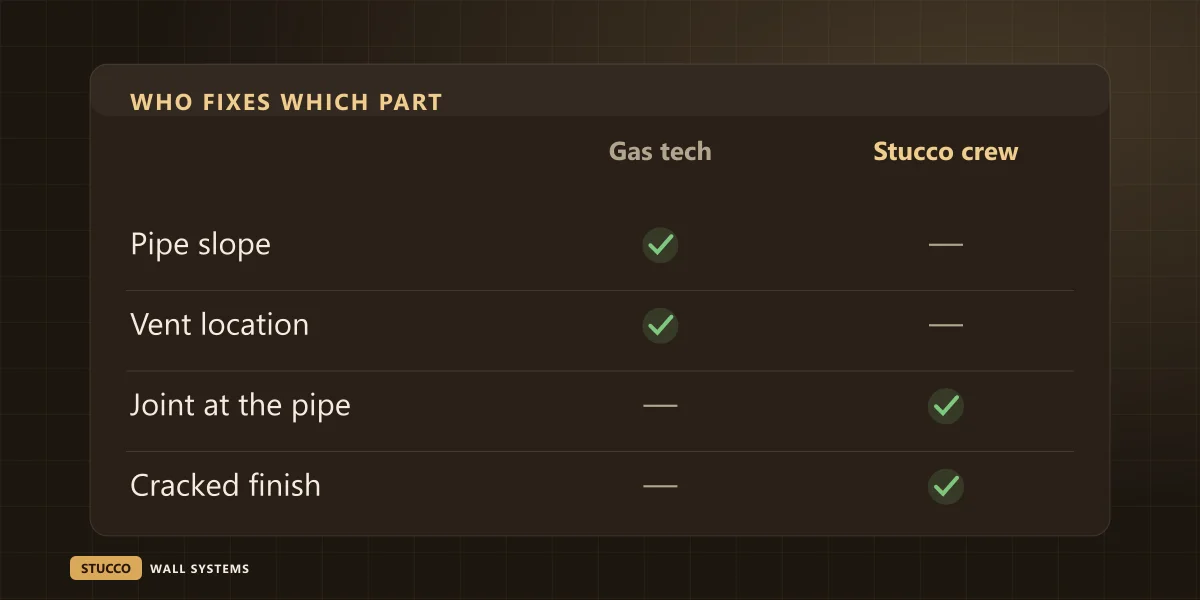
The gas technician fixes the pipe, the stucco crew fixes the wall, and the pipe goes first. If the wall is repaired while the pipe still drips or ices it up, the new patch is wet by February and you pay for it twice. If the pipe is fixed and the wall is left open, the water already in it keeps doing damage.
Call a licensed gas technician
They check the pitch of the pipe back to the furnace, every joint and elbow, the condensate drain, and the fitting at the end of the pipe. Where the vent can go, how far it must be from windows, doors and the gas meter, and whether it can be extended or moved, all come from the gas code and the furnace manual. That is their call, not mine.
Let the wall dry
Once the water source is stopped, a wall that was only damp on the face dries out over a few weeks of decent weather. A wall that stays soft or hollow after that has water behind it.
Rebuild the joint at the pipe
Old sealant out, the edge of the stucco checked and cut back to sound material, a sleeve or backer where needed, and a fresh flexible joint that bonds to the stucco and to the pipe.
Repair the face
Cut out finish that is soft, cracked through or delaminated, re-mesh and patch, then match the texture and colour. On EIFS that can mean replacing a section of foam if it has been sitting wet.
If the vent was moved, close the old hole properly
A cap screwed over an abandoned hole in stucco is a leak with a lid on it. It gets filled, meshed and finished like the rest of the wall.
On cost, the wall side of this is usually small if you catch it early: resealing the joint and patching a stained, cracked ring around the pipe sits at the low end of our stucco repair range, a few hundred dollars. When water has been behind the finish for several winters and a section of the wall has to be opened, it climbs toward the $5,000-plus end, because then we are fixing sheathing and lath, not just finish. A pipe that has dripped for one winter is a much cheaper conversation than one that has dripped for five.
What should I do about ice and snow at the vent in winter?
Keep the pipe clear, and do it gently. A furnace vent buried in snow or capped with ice is a safety problem first, because the exhaust has nowhere to go. Brush snow off by hand, never chip ice off the pipe or the wall with a shovel, and do not pile shovelled snow against that part of the house.
Enbridge repeats this every winter. Its public notice on meters and vents warns that a plugged exhaust can let carbon monoxide build up in the house, says to clear snow with a brush or broom, not to scrape the pipe with anything sharp, not to shovel, plow or blow snow against it, and to knock icicles down from the eavestrough above so drips do not freeze onto the vent. If you cannot clear it, they ask you to call them.
From the wall's side I add two things. A chunk of ice frozen to stucco comes off with the finish attached if you pry it, so let it melt or break it off the pipe side only. And if the same thick ice builds on the wall every cold snap, that is worth mentioning to your gas technician in the fall, because the fitting at the end of the pipe and its distance from the wall change where the plume lands. The same idea, on a different appliance, is in my post about putting a heat pump on a stucco house, where the defrost water causes most of the trouble.
A ten-minute look worth doing this month
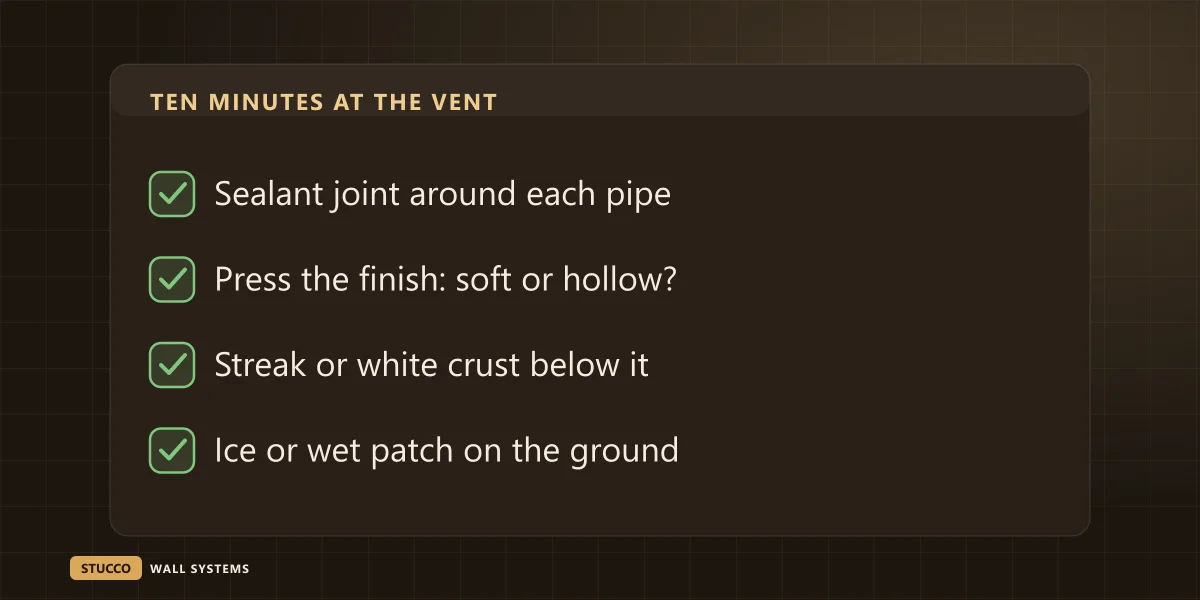
Do it in October, before the furnace runs hard. Walk to the vent, look at the sealant joint around each pipe for gaps and cracks, press the stucco around and below it with your thumb, and look straight down the wall for a streak or crust. Then look at the ground under it. If everything is tight and solid, you are done until spring.
If you find a crack ring, soft finish or a streak, get the gas side checked first, then tell us what you found through the contact page or call (905) 973-6470. Quotes are free, fixed and in writing, and the visit sorts out whether it is a joint, a face repair, or a section that needs opening.