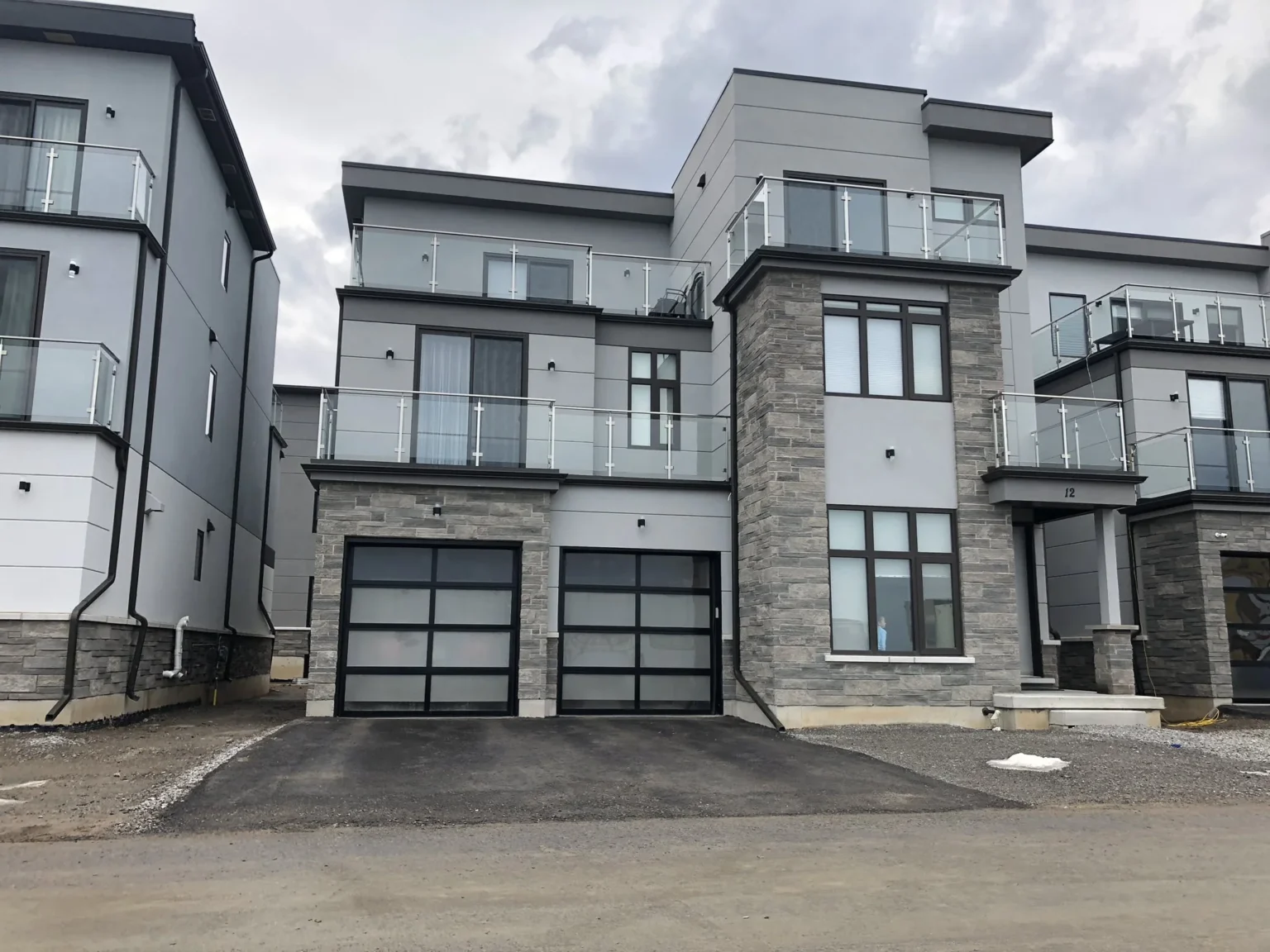
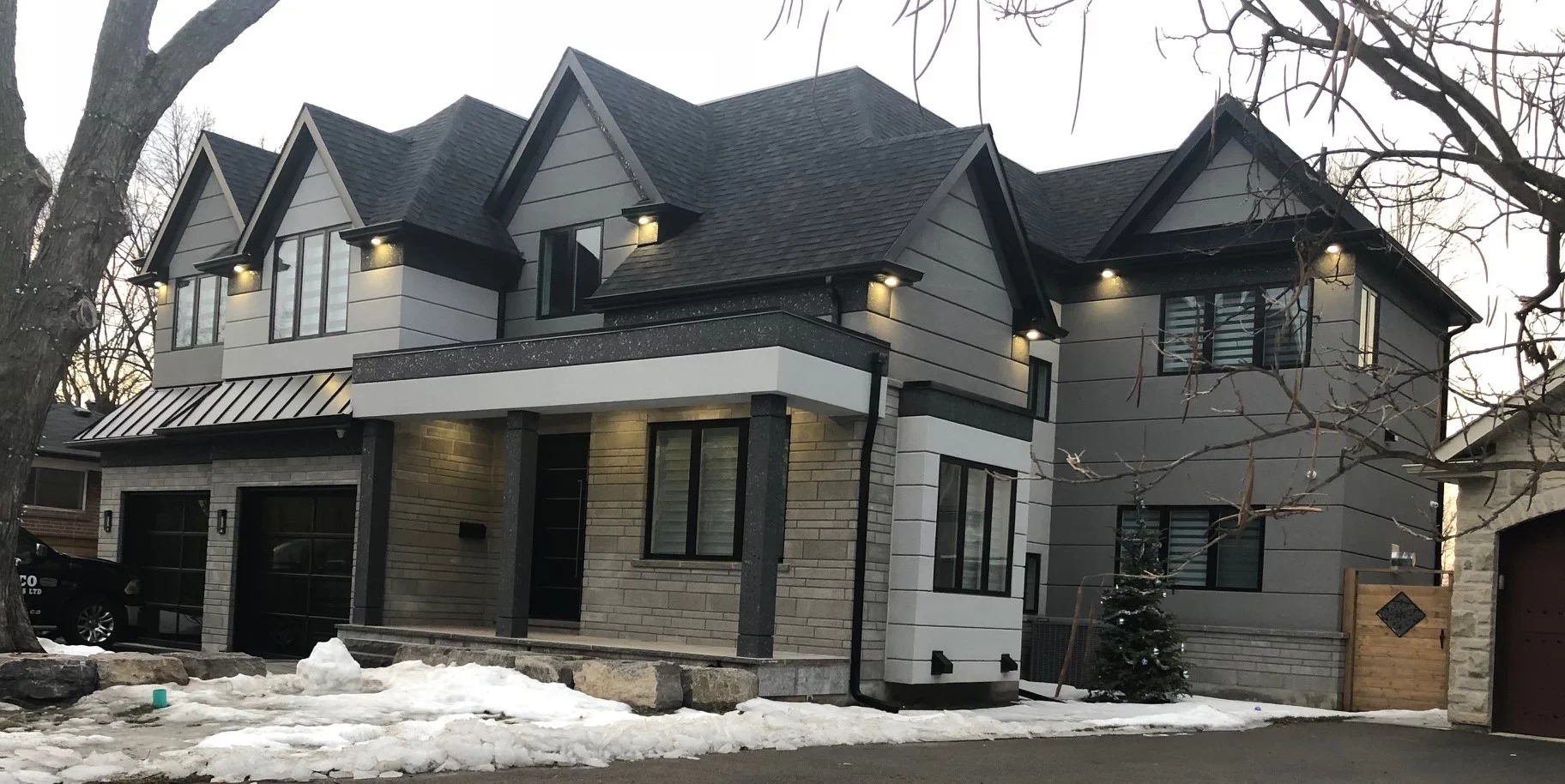
The bungalow next door came down in August, the excavator dug a basement two feet from the lot line, and now there's a crack running up from the corner of your side door that you don't remember seeing. If your neighbour's construction cracked your stucco, the next few weeks matter more than the repair itself, because what you write down and photograph now is what anyone will believe later.
I'm Musa Kastrati. I've spent 25+ years fixing stucco across Halton, Peel, Toronto and York region, and infill streets are where this question keeps coming up: a 1950s house in Mimico or Port Credit with a three-storey build going up on the next lot. Below is how to date a crack, what the City of Toronto asks of the builder, and what the repair costs on our price list.
Can construction next door really crack stucco?
Yes. Stucco is a rigid coat on a wood frame and sheathing that flex, so it shows movement before brick or siding does. Demolition, digging a new basement, compacting fill, drilled piles and loaded trucks near the lot line all shake the ground. The wall facing the work, and the corners of its windows and doors, crack first.
Feeling the house shake doesn't mean it's being damaged. People notice vibration at levels far below what cracks a wall, which is why the city sets its limits in numbers and not by how it feels. But a house that already had a weak spot, a corner with no control joint or a window with no mesh patch at the corners, can let go at a level the rest of the wall shrugs off. That's also why the builder's side will often say the crack was there already. Your job is to make that easy to check.
Three stages of the build, and what to do at each one
Nearly all the shaking happens in the first months. By the time the walls are framed, most of the risk is behind you, and so is your chance to show what the wall looked like before.
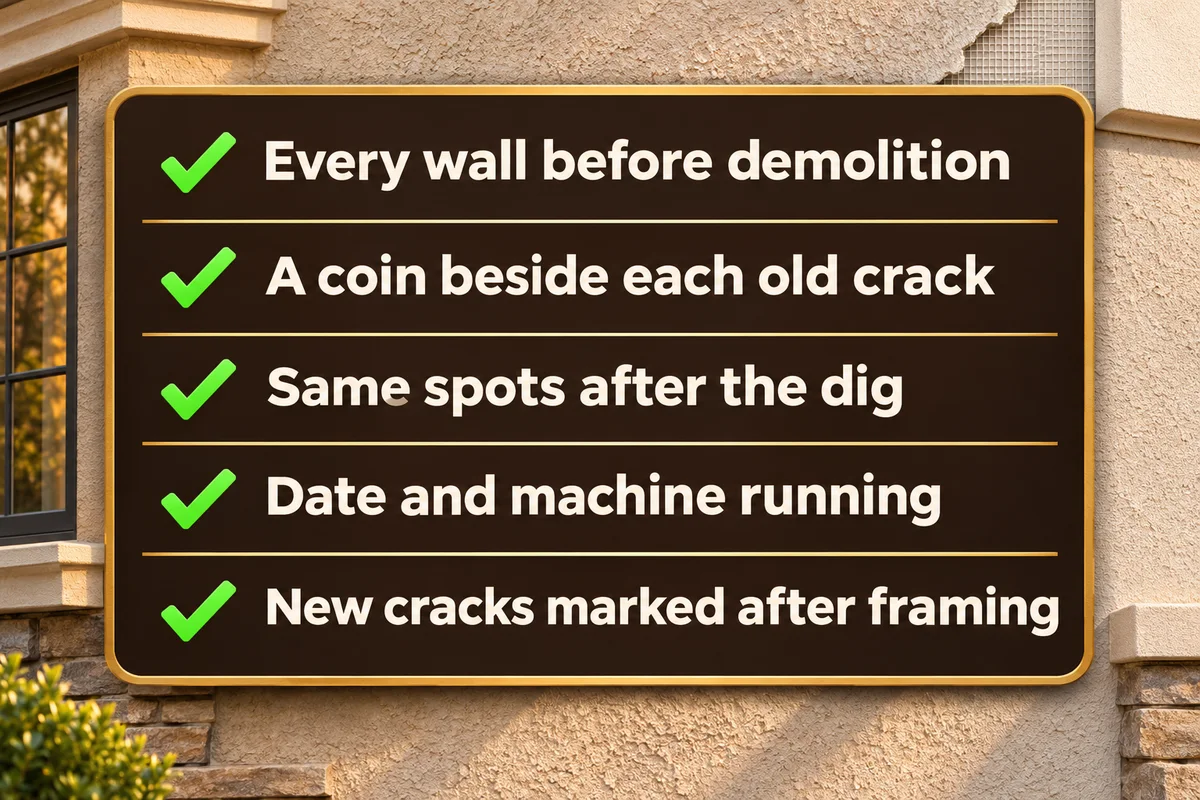
Before the excavator: record the wall as it is
- Photograph every elevation, then close-ups of every corner of every window and door.
- Put a coin or a tape measure beside any crack you already have, so its width is on record.
- Keep the notice the builder or the city sent you, and write down the date demolition starts.
During demolition, the dig and the foundation: watch the wall facing the lot
- Re-shoot the same spots after each heavy day: demolition, the dig, any pile drilling, the pour.
- Note the date and what machine was running when you felt the house move.
- Look for dust, splash and hits on the stucco too, not only cracks. Bins and fill piles end up against your wall.
Once the framing is up: compare, then price it
- Walk the house with your first set of photos in hand and mark every crack that is new or wider.
- Check inside too: drywall cracks over doors and sticking doors on the same side back up what the outside shows.
- Get a written repair quote with the cracks listed, so the conversation has a number in it.
How do I tell a new stucco crack from an old one?
Look inside the crack, not at its length. A crack that has sat through a few winters collects dirt, cobwebs and old paint, and its edges go dull and rounded. A crack that opened last month has sharp, clean edges in a lighter colour than the face around it, and sometimes a little fresh dust on the sill below.
That reading isn't a lab test, and an engineer may still be needed if the money at stake is large. But it's what I check first on site, and it settles a lot of arguments before they start.
| What to look at | Old crack | Fresh crack |
|---|
| Inside the crack | Dirt, cobwebs, paint that has run into it | Clean, lighter than the wall face |
| The edges | Dull and rounded off by the weather | Sharp, with crumbs that fall when you touch them |
| Pattern | Fine map cracking across the whole wall from the first cure | One line, or a stair step from a window corner, on the side facing the work |
| Inside the house | Nothing new | A new drywall crack or a sticking door on the same side |
| Your photos | Visible in the shots from before the work | Missing in the before shots, there in the after shots |
Two more things worth knowing. A crack that runs straight along a floor line, all the way across the wall, is usually framing shrinkage from the house's own first years, and my post on why stucco cracks in GTA winters covers that kind. And a bulge, or a section that sounds hollow when you knock on it with your knuckles, means the coat let go of the wall, which is a bigger repair than a crack.
What Toronto asks of the builder
The City of Toronto added rules on construction vibration to its building code chapter in By-law 514-2008. The chapter has been reorganized since, so ask the builder or the city which version applies to the permit next door. As written in that by-law:
- A form with the permit
- Anyone applying for a construction or demolition permit files a vibration control form saying whether the job involves things like blasting, deep foundations, drilled caissons or large-scale soil compaction.
- An inspection of your house first
- If an engineer finds the zone of vibration reaches past the lot line, the builder has to inspect neighbouring buildings before the work, recording existing cracks in walls, floors and exterior cladding of the first two storeys. If you refused access, the report says so.
- Notice and limits
- Neighbours in that zone get notice at least a week before the shaking work starts, with a contact name. The by-law caps vibration at 8, 15 or 25 mm per second depending on frequency.
- What happens when you complain
- The engineer monitoring the job measures at your house and gives the result to you and to the building inspector. If the reading is over the limit, that work stops until it is brought under.
So if a surveyor asks to walk your house before the dig, say yes and ask for a copy. Outside Toronto the rules differ; the Town of Oakville's page on your neighbour's construction suggests photos of your property before and after any damage.
Who pays for the repair?
I fix walls; I'm not a lawyer, so take this as the plain version. Oakville's page says that if construction damages your property you may have a right to compensation, and that if your neighbour won't deal with it, your remedy is the civil courts. Most of the time it starts with a polite email to the neighbour and the builder, your before and after photos attached, and a quote for the repair.
Your own home insurance is a second door, and whether it opens depends on the wording of your policy. I wrote down how insurers tend to treat stucco damage in my post on stucco insurance claims in Ontario. If the two sides can't agree on whether the build caused the crack, that's when an engineer's report, or a lawyer or paralegal, earns their fee.
What does it cost to fix stucco cracked by construction next door?
The repair is the same as any other crack or patch, and it's priced from the same lines on our stucco repair price list. What changes the number is whether the coat only cracked or also came loose from the wall behind it.
| What the wall shows | The repair | Price on our list |
|---|
| A few fine cracks, coat still tight | Each crack routed out, meshed, base coated and textured | $120 to $400 per crack |
| Cracks plus a loose or hollow patch | Cut back to sound stucco, new lath where needed, patched and matched | $450 to $1,200, up to about 20 sq ft |
| A bulge, or the sheathing moved behind it | Opened to the framing, fixed, rebuilt | $18 to $34 per sq ft |
| Repairs that show on a wall facing the street | New base coat, mesh and finish over the whole wall | $9 to $16 per sq ft |
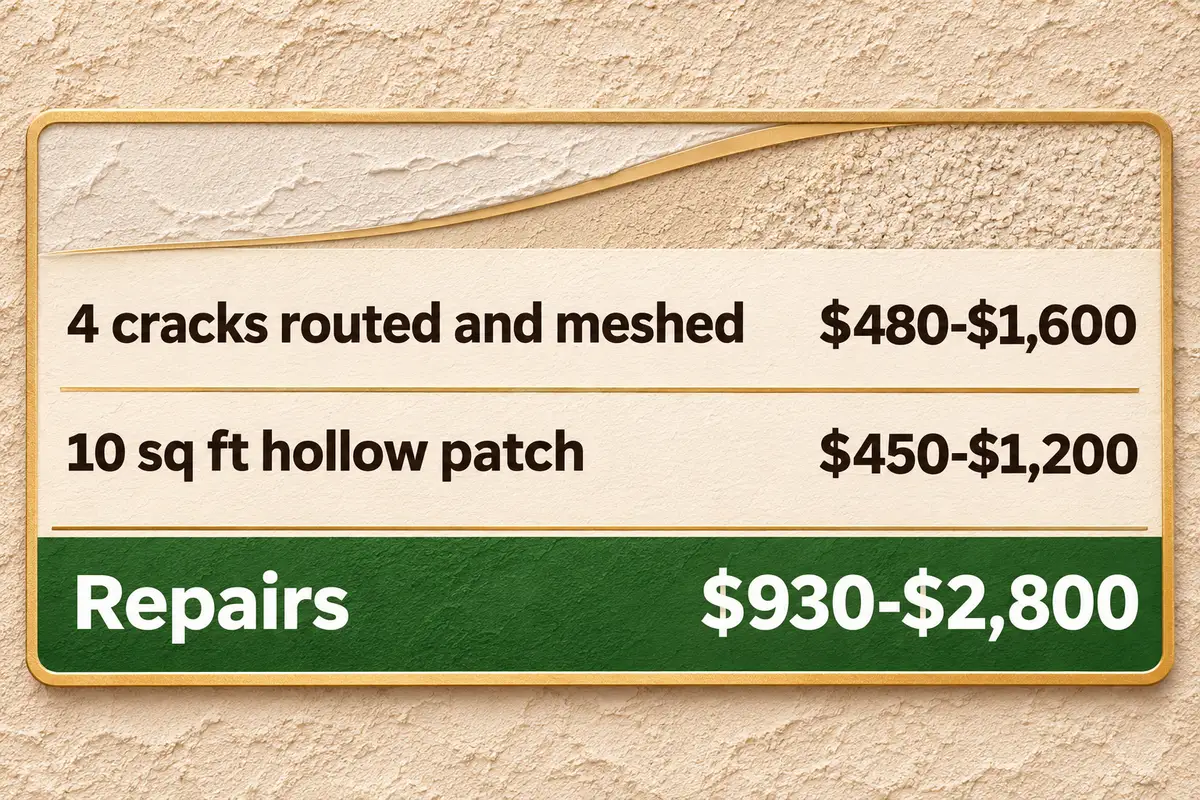
Take a side wall with sizes I've picked for the example. Four cracks open from the corners of two windows, and one 10 sq ft spot by the side door sounds hollow. Four cracks at $120 to $400 is $480 to $1,600. The hollow patch is $450 to $1,200. That's $930 to $2,800 for the repairs. If the patches would stand out on a wall everyone sees, say 400 sq ft, refinishing it whole at $9 to $16 adds $3,600 to $6,400. My post on matching a stucco patch explains when a patch disappears and when it won't.
One warning. Don't let anyone skim over the cracks with fresh paint before the claim is settled. The $99 patch-and-pray crew who does that also paints over your evidence, and a crack under elastomeric paint is still a crack; it just stops showing up in photos for a year.
If the build started this fall
Cement needs warmth to cure, and November is the end of the GTA's repair season for most crack work. That's fine here. A fine crack can sit through the winter while the paperwork moves. Take your photos now, before snow hides the bottom of the wall, and keep the files with their original dates on them. A crack wide enough to see daylight through, or a piece that has come loose, should get covered before the freeze-thaw cycles start working water into it.
Send me your before and after photos through the contact page or by text to (905) 973-6470, and tell me what is being built next door and when it started. I call back usually within a day, and the written quote is free and fixed. If you're on an infill street in the city, the Toronto stucco page shows what we do there; in Halton, it's the Oakville stucco page.