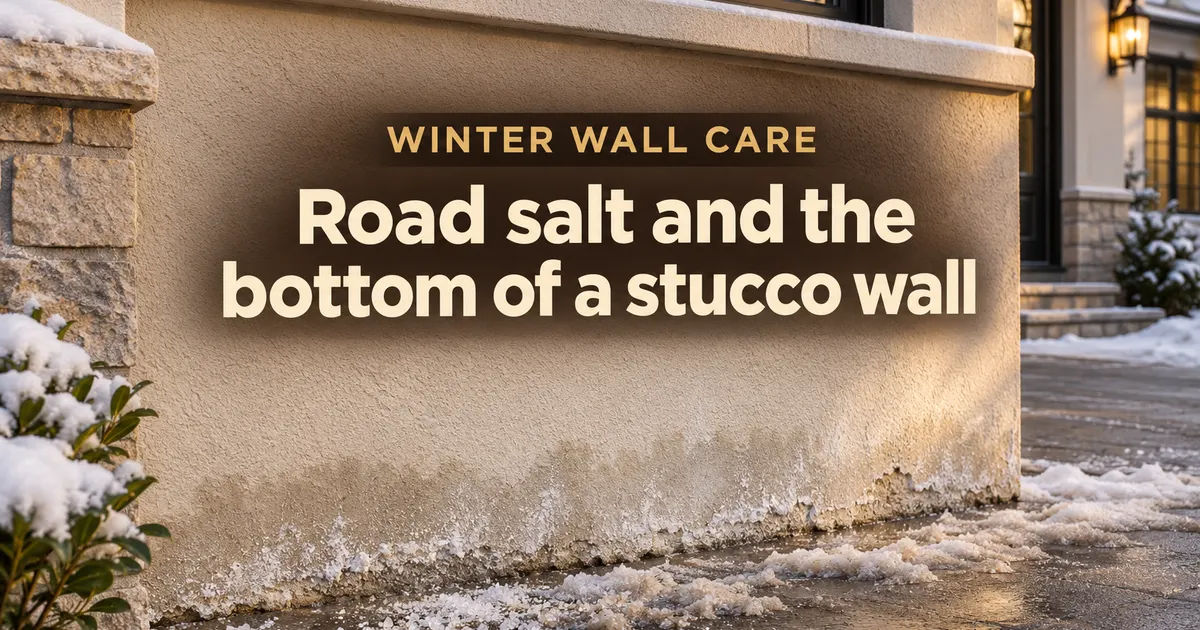
The first bags of salt are already sitting by the front door in half the houses on my street. In a few weeks they'll be on every driveway in the GTA, and by March a good part of that salt will be on the bottom of somebody's stucco. Road salt damage on stucco is slow, it hides behind a snowbank all winter, and it shows up in April as a grey, powdery band along the base of the wall beside the driveway and the front steps.
I'm Musa Kastrati, and I've spent 25+ years on stucco walls across Halton, Peel, Toronto and York region. Salt isn't the end of a wall. It is a slow tax on the bottom two feet, and most of it can be avoided with how you shovel. This is where it lands, how to tell a stain from real damage, and what the repair costs when it has gone too far.
Does road salt damage stucco?
Yes, at the bottom of the wall. Dry salt sitting on a wall does little. The trouble starts when slush and meltwater carry it into the base coat and the parging, the water dries and leaves the salt behind in the pores, and the next freeze and thaw works on a coat that is wetter and saltier than the rest of the house.
Stucco is a cement coat with fine pores, made to take rain and dry out again. Up high it does that all winter. Down at the driveway it sits in wet snow for weeks, and salt holds on to water, so the base of the wall stays damp long after the rest has dried. Each cycle of wetting, drying and freezing loosens a few more grains of sand from the finish. Nobody sees it happen in one winter. After a few of them, the texture at the base has worn smooth, the coat sounds hollow when you knock, and the metal edge at the bottom of the wall starts to show rust.
Where the salt lands on a stucco house
Salt doesn't spread evenly. It goes where the snow goes, and on most GTA houses that means four places.
The dashed line marks the top of the splash band. Everything under it gets salt every winter; the numbers match the cards below.
1Behind the snowbank
Shovelled and ploughed snow from a salted driveway gets piled along the wall and stays there for weeks. When it melts, salty water soaks straight into the base of the stucco.
2The splash band
Tires, the snow blower and the shovel throw grey slush at the wall. You can see the line in March: a dirty band about as high as a car's wheel.
3Where the steps meet the wall
The landing gets salted more than anything else on the property. Melt runs off its edge and down the side of the steps, right where the stucco or parging meets the concrete.
4Beside the garage door
The car brings slush home in its wheel wells and drops it at the garage. The short wall beside the door and the bottom of the door frame take that water every night.
Houses with a long driveway down one side, like the side-splits and backsplits in Etobicoke and the older parts of Oakville, take zones 1 and 2 along the whole side wall. Townhouses with a front landing right on the sidewalk get zone 3 from the city's sidewalk salt as well as their own.
Salt residue or real damage? Read the bottom of the wall
A white mark isn't always damage. Some of it brushes off and never comes back; some of it is the wall telling you water is moving through it. Go out on a dry day in spring and look at the bottom two feet with your hand as well as your eyes.
| What you see at the base | What it is | What to do |
|---|
| A white crust that brushes off dry and stays gone | Salt left behind as meltwater dried on the surface | Brush and rinse in spring, nothing more |
| A white bloom that comes back after every rain | Salts coming out from inside the wall, carried by water moving through it | Find where the water gets in before cleaning again |
| Sand grains that rub off on your palm, texture gone smooth | The finish coat breaking down | Patch before the base coat goes too |
| A band of finish that is bubbled, flaking or sounds hollow | Salt and water have got under the finish | Patch or rebuild back to firm coat |
| An orange line along the metal edge at the bottom | The bottom bead or weep screed rusting | Replace the bead when the base is rebuilt |
| Parging below the stucco falling off in flakes | The foundation coat failing first | Rebuild that section of parging |
The second row is the one people mix up. A bloom that keeps coming back is efflorescence, and my post on white stains on stucco explains how to tell where it comes from. If the bottom of your wall is also buried in soil or mulch, start with how far stucco should stop above the ground, because no salt habit fixes a wall that sits in the dirt.
Cement stucco, EIFS and parging take salt differently
Most GTA houses have one of two kinds of stucco above a parged foundation, and salt finds the weak point of each.
| The wall at the base | What salt does to it | Where it shows first |
|---|
| Three-coat cement stucco on mesh | Soaks into the base coat, keeps it damp, wears the finish grain by grain | Smooth worn patches and hairline cracks just above the bottom bead |
| EIFS: a thin finish over mesh and foam board | Wears through the thin finish; then water reaches the mesh and the foam behind it | Dents and soft spots where the snow shovel and the bank rub the wall |
| Foundation parging below either one | Takes the most salt, sits in the bank all winter | Flaking sheets and a crumbling top edge where it meets the stucco |
On an EIFS house the reinforced base coat does the work at the bottom edge, and it does it well as long as the finish over it stays whole. Keep the steel shovel blade and the snowbank off it, and the gap in the habits below matters a little more for you than for your neighbour with cement stucco.
Winter habits that keep salt off the wall
Most of this comes from the City of Toronto's own advice on reducing the use of road salt, which says plainly that salt is damaging to infrastructure and that more salt isn't safer. The parts about the wall are mine.
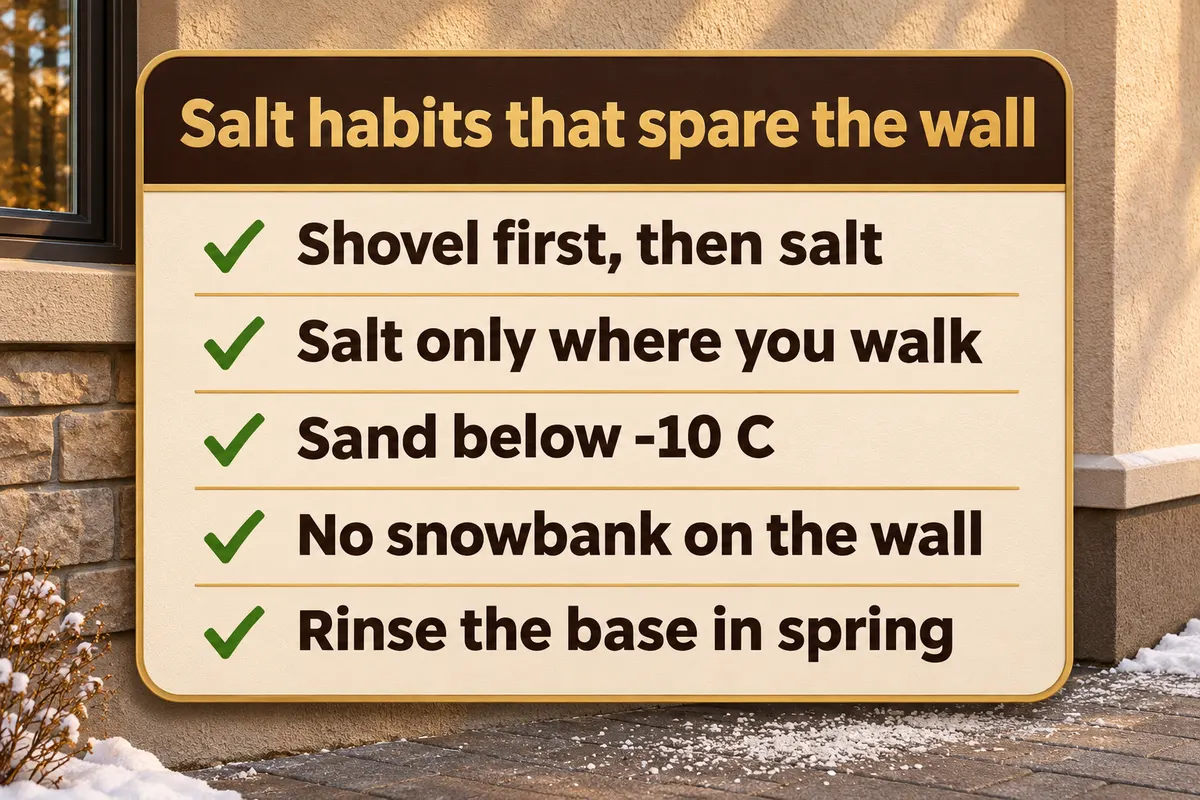
- Shovel before you salt. The city's page says salt doesn't work on top of a pile of snow; on a driveway it only turns the pile into salty slush, and that slush is what ends up against your stucco.
- Salt only where people walk. Toronto's advice is not to salt where you don't walk. Nobody walks on the six inches of landing next to the wall, so keep the grains off it.
- Throw the snow away from the house. Pile it on the lawn side of the driveway. If that side is the property line, a pile at the end of the driveway is still better than a bank along the wall.
- Leave a gap. If the bank has to be on the house side, keep a shovel's width of clear ground between it and the stucco so meltwater can run away instead of sitting against the base.
- Switch to sand in deep cold. The city says salt starts losing its punch at -10 C and stops working below -20 C. On those mornings extra salt just sits there waiting to wash onto the wall; sand gives you grip without it.
- Sweep up what's left. Once the ice is gone, sweep the spare grains off the landing and the steps. Otherwise the next thaw carries them down the side of the steps and into zone 3.
If a contractor clears your snow
A lot of families in Mississauga and Vaughan pay someone to clear the driveway, and the plough blade decides where the bank goes. Tell them, before the first storm, which side of the driveway the snow goes on and that nothing gets pushed against the wall. A blade that scrapes the bottom of the stucco does in one pass what salt takes years to do.
Toronto points property owners to the Smart About Salt program, Ontario's training and certification for winter salt contractors. Asking whether your contractor has it is a fair question, and so is asking how much salt they put down per visit.
The spring rinse
When the salting season is over and you've had a week of mild, dry weather, give the base of the wall a wash. It's an afternoon job with a brush and a hose, and it gets the salt out of the surface before the spring rain carries it in.
Start dry: brush the white crust off with a soft nylon brush, working from the top of the stained band down, so the crystals fall away from the wall instead of dissolving into it. Then rinse with a garden hose at normal pressure, top down again, and let the wall dry for a few days. Look again after a week. If the white comes back, it's coming from inside the wall, and that's a different conversation.
What I wouldn't do: point a pressure washer at the bottom of a stucco wall. It drives water behind the bottom bead and, on EIFS, into the foam. My guide on how to clean stucco covers the brushes, the cleaners and the pressure question in more detail.
What does salt damage on stucco cost to repair?
On our price lists, a crack at the base runs $120 to $400, a crumbling or hollow patch up to about 20 sq ft costs $450 to $1,200, and a bottom strip rebuilt back to the substrate is $18 to $34 per square foot. Parging below costs $500 to $1,500 for one section rebuilt.
The stucco numbers come from our stucco repair price list and the parging numbers from our foundation parging page, so they match what you'd see on a written quote.
| What you found at the base | The repair | Price on our list |
|---|
| A crack or two just above the bottom bead | Crack routed, mesh bedded across it, texture matched | $120 to $400 per crack |
| A worn or hollow spot by the steps or the garage | Loose coat cut back to firm edges, filled and textured to the wall | $450 to $1,200, up to about 20 sq ft |
| A long band along the driveway that is soft or bubbled | Bottom strip taken off, new bead, base coat, mesh and finish | $18 to $34 per sq ft |
| Parging hairline cracks only | Cracks opened and filled, top edge sealed to the stucco | $300 to $800 |
| One section of parging flaking off | Section removed and re-parged | $500 to $1,500 |
| Parging failing all the way round | Whole exposed foundation re-parged | $1,500 to $3,000 |
Here is one driveway wall worked through, with sizes I've picked to show the arithmetic. It's 30 feet long, and the bottom two feet have gone soft and hollow: 60 sq ft rebuilt at $18 to $34 is $1,080 to $2,040. There are two cracks where the front steps meet the wall at $120 to $400 each, so $240 to $800. One section of parging under the worst of the bank is flaking: $500 to $1,500. That wall comes to $1,820 to $4,340.
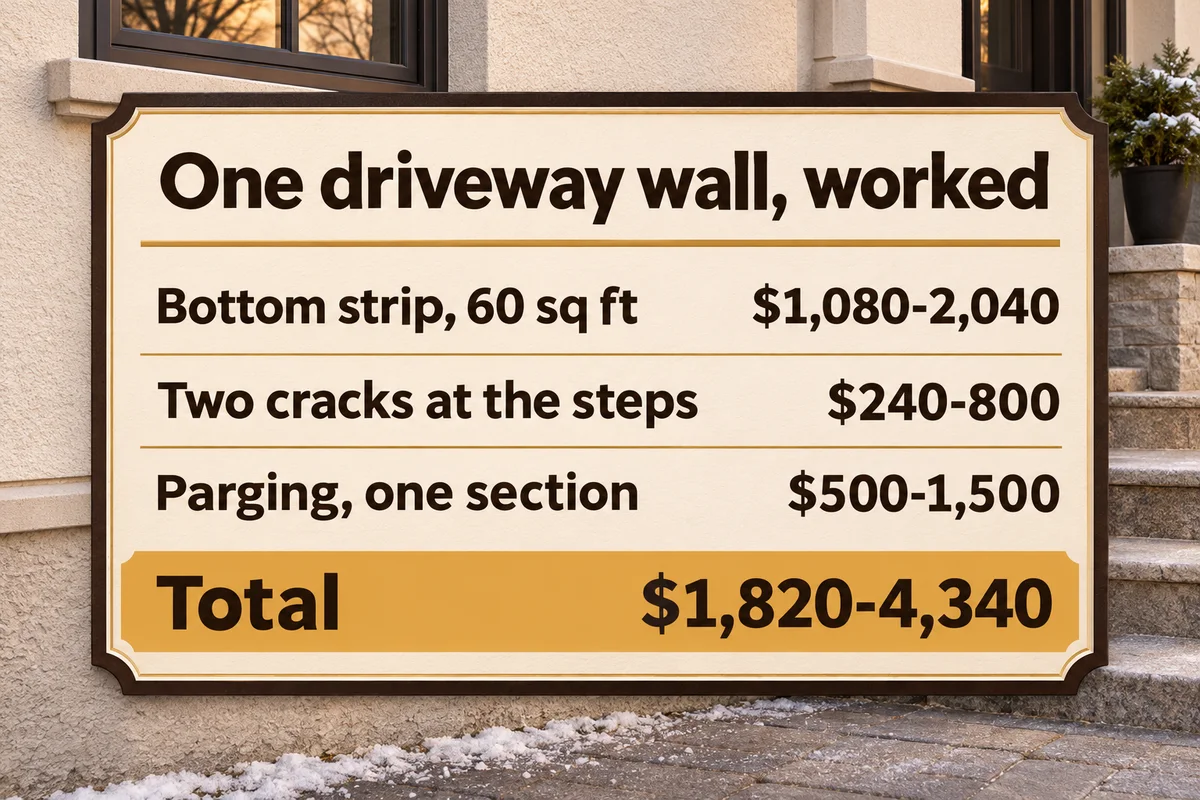
Caught two winters earlier, the same wall is usually two cracks and a patch by the steps, which is $690 to $2,000 on the same list. That gap is what a habit of throwing the snow the other way is worth.
And skip the $99 patch-and-pray crew who rolls paint over the grey band in April. Paint over salty stucco traps the damp behind it, and next spring it peels off in sheets with the finish still crumbling underneath.
Book it for spring, not for February
Salt damage isn't an emergency. A worn base can get through one more winter if you keep the bank off it. Stucco and parging need days above freezing to cure, and a patch done in February meets the next storm's salt before it has set. If a piece has actually fallen off and opened the wall, my post on holding damage until spring covers what to do in the meantime.
Send photos of the bottom of the wall through the contact page, or text them to (905) 973-6470. I call back usually within a day, and the written quote is free and fixed. In Toronto, start with the Toronto stucco page; in Peel, the Mississauga stucco page.