Your house is eighteen months old, a crack is running out of the corner of a bedroom window, and the site supervisor has told you it is normal. What you actually want to know is whether the new-build stucco warranty covers it, or whether you have just bought a repair bill on a house you are still paying a builder for.
The short version: Ontario’s new home warranty does cover exterior cladding, it covers it more specifically than most people expect, and it covers it for a much shorter time than most people assume. I have been finishing walls across the GTA for over 25 years, and I get called to new-build walls in Vaughan, Kleinburg and Richmond Hill constantly — almost always by an owner who has been told “that’s hairline, it’s normal” and has no way of knowing whether that is a fact or a brush-off. Sometimes it is a fact. Here is how to tell the difference, and what the calendar does to you while you decide.
One thing up front: I am a plasterer, not a warranty adjudicator. Everything below about coverage comes from Tarion’s own published pages, linked where it matters, and you should read them yourself before you file anything.
Does the Ontario new home warranty cover stucco cracks?
It covers cracks that are a defect, not cracks that are curing. There are two doors into a stucco claim. In the first year, the home must be built in a workman-like manner, free of defects in material, and in compliance with the Building Code. In the second year, the warranty covers defects that let water into the building envelope, and defects that cause exterior cladding to fail.
That second door is the one worth memorising, because it names your wall directly. Tarion’s coverage page for freehold homes and condo units says the two-year warranty “covers defects in work or materials that result in the detachment, displacement or deterioration of exterior cladding”, and separately covers “defects in work or materials that result in water penetration into the building envelope”. You can read both clauses on Tarion’s coverage for freehold, contract and condo units page.
Detachment, displacement and deterioration are the three words worth memorising, because they describe a wall coming off, moving, or breaking down, and none of them describe a fine crack in a finish doing what cement does when it dries. That distinction is the whole argument, and it is why a claim that says “my stucco is cracked” goes nowhere while a claim that says “there is a stain on the inside of the wall after every rain” gets an inspector out.
How long is stucco actually covered?
Two years, for everything that matters on a wall. The one-year warranty covers workmanship, materials and Code compliance. The two-year warranty covers water penetration and cladding failure. The seven-year warranty covers major structural defects only — and your stucco is not structural, so in practice month 24 is when the wall becomes yours.
People hear “seven-year warranty” and relax, and that is the single most expensive misunderstanding in this subject. Tarion defines a major structural defect as a defect in a structural load-bearing element, and it explicitly excludes damage “resulting from dampness not arising from failure of a structural load-bearing element of the building”. Stucco holds up nothing but itself. Cladding, water and finishes are two-year business.
| What is wrong with the wall | Which warranty period | Why it lands there |
|---|
| Sloppy finish, wavy plane, bad texture match at a joint | Year 1 only | This is workmanship and materials. It is not a water problem and it is not structural, so it dies at month 12 |
| Missing or fake control joints, wrong lath, no backwrap | Year 1, and year 2 if it lets water in | A build defect first. It becomes a two-year item the moment it produces water penetration or cladding failure |
| Stain, damp drywall or efflorescence after rain | Year 2 | Water penetration into the building envelope is named directly in the two-year warranty |
| Stucco drummy, bulging, spalling or falling off the wall | Year 2 | Detachment, displacement and deterioration of exterior cladding, in exactly those words |
| Cracking caused by the frame or footing moving | Year 7, if it meets the structural test | Only if a load-bearing element has actually failed or lost capacity. The crack in the finish is the symptom, not the defect |
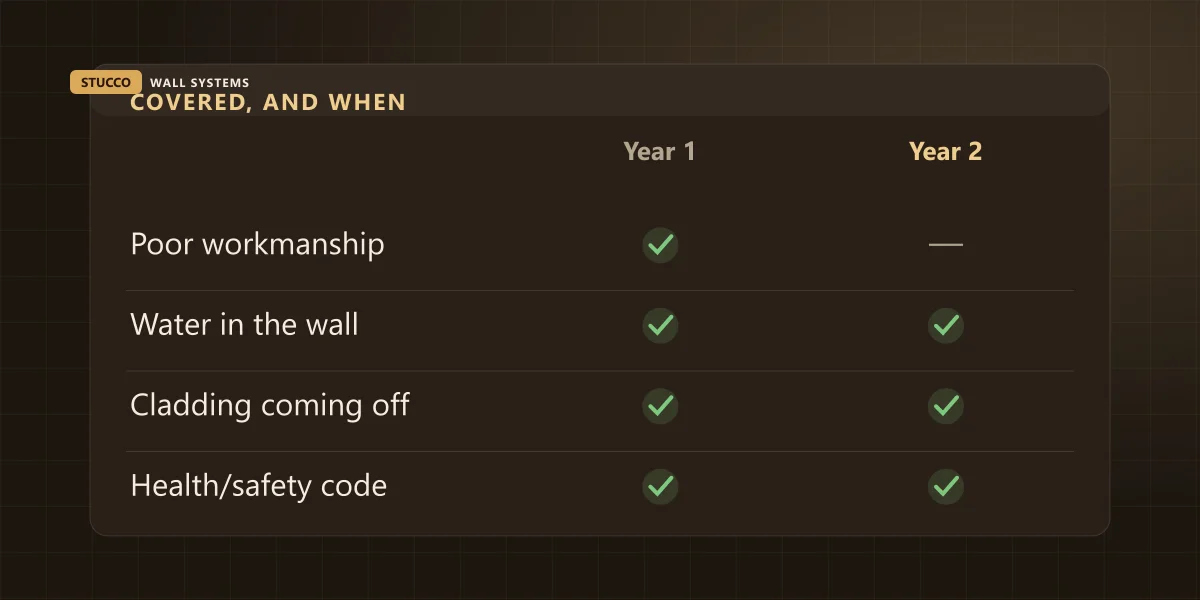
Read the bottom row honestly. Homeowners reach for the seven-year warranty when the two-year one has run out, and the test is a high one: a load-bearing element has to have failed, or lost its ability to carry load, or a significant part of the house has to have become unusable. A cracked finish over a wall that is standing perfectly well does not get there.
Which cracks are normal and which are a claim?
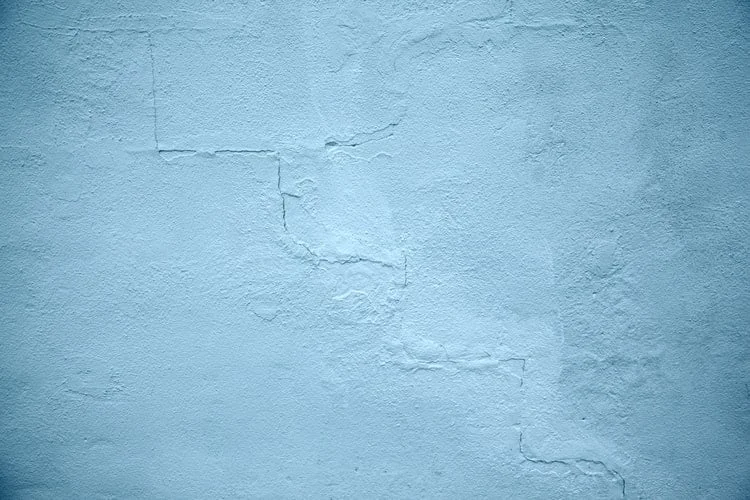
Fine surface cracking spread evenly over a wall in the first year is usually shrinkage, and shrinkage is expected. Cracking that follows a line, reappears after being filled, radiates diagonally from window corners, opens along a joint, or produces a stain that returns within a day of rain is not shrinkage. That is the wall telling you where it was built wrong.
Tarion decides these disputes against a published document called the Construction Performance Guidelines, which it describes as advance guidance on how it will decide disputes about defects in work or materials, intended to complement the Ontario Building Code. It is free and public. Before you argue with anybody, find your item in it and read what the standard actually is, because both you and the builder will be measured against the same page.
| What you are looking at | Usually normal? | What it actually means |
|---|
| Fine map-like cracking spread evenly, first winter | Yes | Shrinkage as the base and finish cure. Annoying to look at, not a defect |
| A crack running diagonally out of a window corner | No | Stress concentration with no reinforcement at the corner. A build detail, not a curing artefact |
| A straight crack in a line across a large blank wall | No | The wall needed a control joint there and did not get one, or got a groove instead of one |
| A crack that reopens in the same place after filling | No | Something is still moving. Filling it again is a decorating exercise, not a repair |
| Hollow or drummy sound when you tap the finish | No | Debonding. This is detachment of cladding, and it is named in the two-year warranty |
| White powder blooming through the surface | Sometimes | Primary bloom in year one is common. A patch that keeps returning is water arriving from somewhere |
That last row has its own post — what white staining on stucco is telling you — and it is worth reading before you decide whether to file, because primary efflorescence on a young wall genuinely is normal and a repeating bloom genuinely is not. The same goes for the cracking rows: why stucco cracks in GTA winters covers the mechanics in more depth than I can here.
The three defects I actually find on new-build GTA walls
Not exotic ones. The same three, over and over, on houses from good builders and bad ones alike, because all three happen at the boundary between two trades where nobody owns the detail.
Control joints that are not control joints. A real joint cuts through the reinforcement so the wall can move at a line you chose. What I find on a lot of new walls is a groove tooled into the finish coat with the mesh running straight through behind it. It looks like a joint on the drawings and in the photos, and the wall cracks anyway, usually a foot or two away from the fake one. I set out the difference in what those lines on your wall actually do. That is a year-one workmanship item, and it becomes a year-two item the day it lets water in.
No kick-out flashing where the garage roof dies into the wall. The classic projecting-garage detail on a GTA two-storey, and one inch of rain on a modest garage roof is hundreds of litres arriving at one twelve-inch strip of wall. Without a kick-out, that water goes behind the cladding instead of into the gutter. Flashing, explained for homeowners shows you what to look for from the driveway. Year two, without much argument, because it is a defect in work that results in water penetration.
A weep screed buried by the builder’s own landscaper. Final grade goes in after the wall is finished, and I regularly find the bottom termination of a brand-new wall sitting under soil or interlock. The wall then has no way to drain and no way to dry. That one is worth photographing early, because if you later add a garden bed yourself, it becomes your grading and not the builder’s. Keeping the weep screed clear has the ten-minute self-check.
The forms, and the calendar nobody reads
Coverage is only half the story. To get Tarion’s help you have to report items on the right form inside the right window, and the windows are counted in days from your date of possession, not in convenient calendar months. Miss one and you are relying on goodwill.
| The form | When it is open | What belongs on it for a wall |
|---|
| Initial Form | From day 1, submits itself on day 41 | Anything visible at move-in: damage, missing sections, obvious plane and texture problems |
| Mid-Year Form | Day 42 to day 183 | What the first months exposed. If you took possession in summer, this is the form you fill in autumn |
| Year-End Form | Day 183 to day 365 | Your last chance for one-year items. There is a short grace period, but it needs written proof you told the builder inside the year |
| Second-Year Form | Any time in year two | Water penetration and cladding failure. You may submit as many as you need during the year |
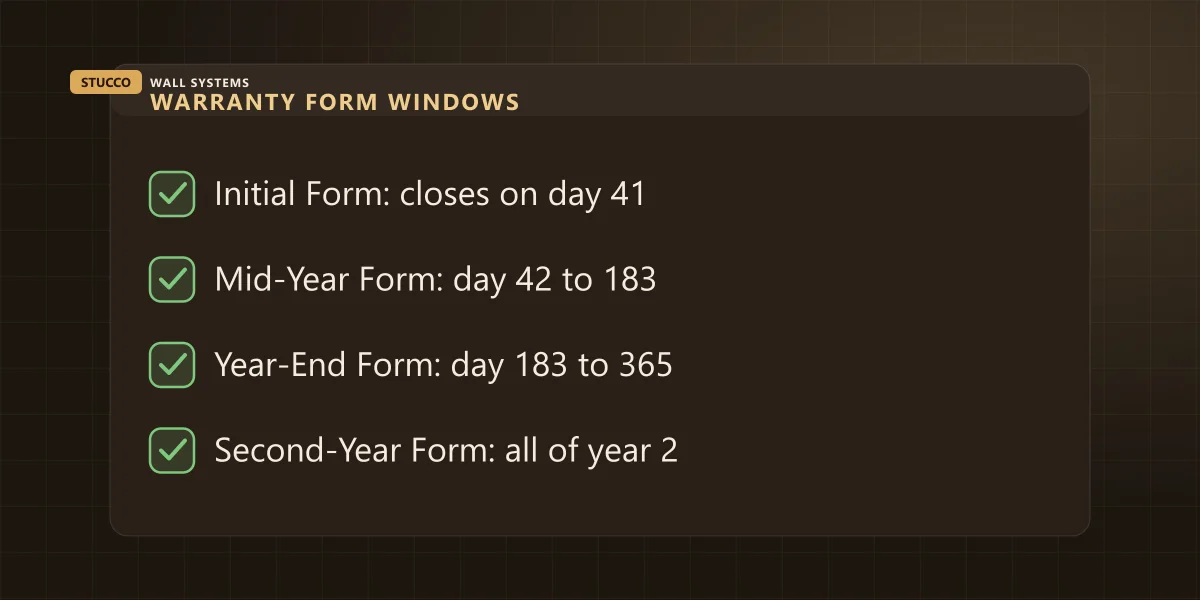
The full list, including the major structural defect form for years three to seven, is on Tarion’s claim forms and timelines page, and the forms live in the MyHome portal. Note that the Initial, Mid-Year and Year-End forms submit themselves automatically on their closing day — so the risk is not forgetting to submit, it is forgetting to add the item before the day arrives.
Now the part that matters for a wall specifically: the seasons are not on your side. A stucco defect declares itself after a freeze-thaw cycle and after a few driving rainstorms, which in the GTA means January through March. If you closed in June, your first honest look at the wall lands somewhere around day 240 — comfortably inside the Year-End window, but only if you go and look. If you closed in November, your first real winter is behind you before day 150, which is a much better hand to be holding.
Either way, walk the wall in March. Not in December, when it is under snow, and not in the week the Year-End form closes. Our fifteen-minute spring walk-around is written for exactly that, and on a new house you are doing it with a deadline attached.
Once you submit a form, it triggers a 120-day builder repair period, with the note that exterior work can run to different timeframes — which is honest, because nobody can render a wall in February. If the builder does not resolve a warranted item, you can request a conciliation and Tarion inspects. Worth knowing: if a builder pressures you not to file, Tarion states plainly that this breaches the Code of Conduct for builders regulated by the Home Construction Regulatory Authority.
Should you just hire a stucco contractor and get it fixed?
While the wall is still inside its warranty period, no — and I am arguing myself out of work by saying so. Paying a private crew to open and repair a warranted wall does two things to you at once: it takes the repair off the builder, and it destroys the evidence an inspector would have looked at.
There is a version of hiring me that is genuinely useful, though, and it is the cheap version. An independent set of eyes, a set of dated photographs, and a plain description of what the water is doing and where it is getting in. Not a repair — a second opinion you can attach to a form. When an owner tells a builder “there is a stain” it is a complaint; when they can say “the finish is drummy over about two square feet under the second-floor window on the north elevation, and it reappears within a day of rain”, it is a report.
The exception is an emergency — water actively entering the house. Stop the water, keep every photograph and every invoice, and file immediately. Tarion has an exceptions route for emergencies precisely because nobody expects you to sit and watch your ceiling get wet for 120 days.
How to word the claim so it gets inspected
Describe what you can see and when it happens. Skip the diagnosis. You are not required to know why your wall is failing, and guessing at a cause gives everybody something to disagree with that is not the actual problem.
Four things make a form easy to act on: location (which elevation, how high, near what), what you observe (crack, stain, drummy area, powder, damp drywall inside), when it appears (after rain, after a thaw, always), and dated photographs from the same spot each time. A photo of a dry wall in August and the same wall wet in November is worth more than any adjective. This is the same discipline as writing a deficiency list at the final walkthrough: what you are describing is water, not workmanship.
What it costs once the warranty is finished
After month 24, the same wall costs what any other wall costs. Localised crack work on our published stucco repair rates runs $120 to $400 for minor work and $450 to $1,200 for a moderate repair. Detail work over an opened area is $18 to $34 per square foot, and water damage that has reached the sheathing is the $1,500 to $5,000 range. A full re-clad on a house is $8 to $16 per square foot installed, and no new house should be anywhere near needing one.
Set those numbers against the effort of filling in a form inside a window that is already open to you, and the arithmetic makes itself. The most expensive stucco repair I do on a new house is the one that was warranted eleven months ago.
The short version
Your wall is covered for one year on workmanship and two years on water and cladding, in those exact words, and the seven-year warranty is about structure rather than finishes. Fine even cracking in the first year is usually curing. Anything that follows a line, keeps coming back, sounds hollow, or leaves a stain is a claim — and it goes on a form with a date, a location and a photograph, inside a window counted in days from the day you got your keys.
We finish and repair walls right across the GTA, including plenty of new-build and builder work in Vaughan and Richmond Hill, and there are finished elevations in the project gallery. If you have a wall you are unsure about and a warranty clock running, send us the address and two photos of the spot or call (905) 973-6470. Sometimes the honest answer is “that is curing, leave it alone” — and that answer is free.