I have opened up a lot of walls in twenty-five years, and I can tell you what I almost never find behind a stain: bad stucco. What I find is flashing that was never installed, was installed the wrong way up, or stopped six inches short of where the water actually goes. Flashing is the least interesting thing on your house. It is also the only part of the wall whose entire job is to give water a way back out.
What is flashing on a house?
Flashing is thin sheet metal — sometimes a membrane — installed wherever two parts of a building meet. Its job is to catch water that has got past the surface and send it back outside, below the joint. It is not a sealant and it is not trim. It is a drainage path built into the wall before the finish goes on.
That last part is what most homeowners have never been told. The finish sheds the rain that hits it, and on a decent stucco or EIFS wall that is most of it. But a March storm coming off the lake does not fall straight down — it arrives sideways and gets driven into every joint on the elevation. Nobody in this trade designs a wall assuming no water ever gets in. We design it assuming some always will, and that it needs a route out.
This is not my opinion, either. Canada’s own code-compliance evaluations for EIFS systems put flashing in the conditions, not the suggestions: the products “must be installed with suitable flashing to drain any incidental water from the drainage cavity to the exterior and to protect the exposed top edge of the cladding.” You can read one of those evaluations yourself on the National Research Council’s CCMC registry. Leave the flashing out and you no longer have the wall that was evaluated.
Where does flashing go on a stucco wall?
Anywhere the wall stops, changes direction, or gets interrupted. Above every window and door, under every opening, where a roof edge dies into a wall, at a deck ledger, around a chimney, at horizontal banding, and at the base where the weep screed lets water out. Each of those is a joint, and water finds joints.
| Where | What the water does there | What happens with no flashing |
|---|
| Head of a window or door | Runs down the wall and arrives at the top of the opening | Soaks into the framing above the window — shows as a stain months later |
| Sill, under the opening | Anything past the window drains to the bottom of the frame | Sits in the rough opening and quietly rots the sill |
| Roof edge into a wall | A whole roof slope’s worth of water arrives at one point | The wall takes roof volume it was never built to handle |
| Deck or porch ledger | Runs down onto a horizontal board bolted to the house | Rot behind a structural connection, hidden by the deck |
| Chimney or any penetration | Has to be steered around a solid object in the wall | Leak at the interruption, usually noticed inside first |
| Horizontal band or offset | Lands on the flat top edge where the wall steps out | Sits on the ledge and works its way in from above |
| Base of the wall | Everything that drained inside now needs to leave | Trapped water at the wall base and freeze-thaw damage |
Look at that list again and notice something: not one of those is a place where the stucco failed. Every one is a place where the wall was interrupted by something else — a window, a roof, a deck, a chimney. Twenty-five years of callbacks in one line: walls leak at the edges, and the edges are what flashing is for.
It also explains why the older subdivisions across the west end give me the most work. Through the eighties and nineties plenty of GTA houses went up with the finish done well and the junctions treated as an afterthought. Thirty winters of freeze-thaw later, the junctions are where the money goes.
Isn’t caulking the same thing?
No, and this mix-up costs more money than anything else on this page. Caulking is a sealant with a service life — roughly five to ten years, less on a sun-beaten south wall. Flashing is a permanent path. Sealant tries to stop water getting in; flashing assumes it already has and drains it out. You want both, in that order.
| | Caulking | Flashing |
|---|
| What it does | Seals a joint so water cannot get in | Catches water that got in and drains it back out |
| Service life | Roughly 5–10 years, less facing south | Decades — it is sheet metal, sitting inside the assembly |
| When it fails | Water goes straight into the joint behind it | If flashing is there, the wall carries on draining |
| Renewing it | Routine maintenance — $6–$12 per linear foot | Means opening the wall — $18–$34 per sq ft |
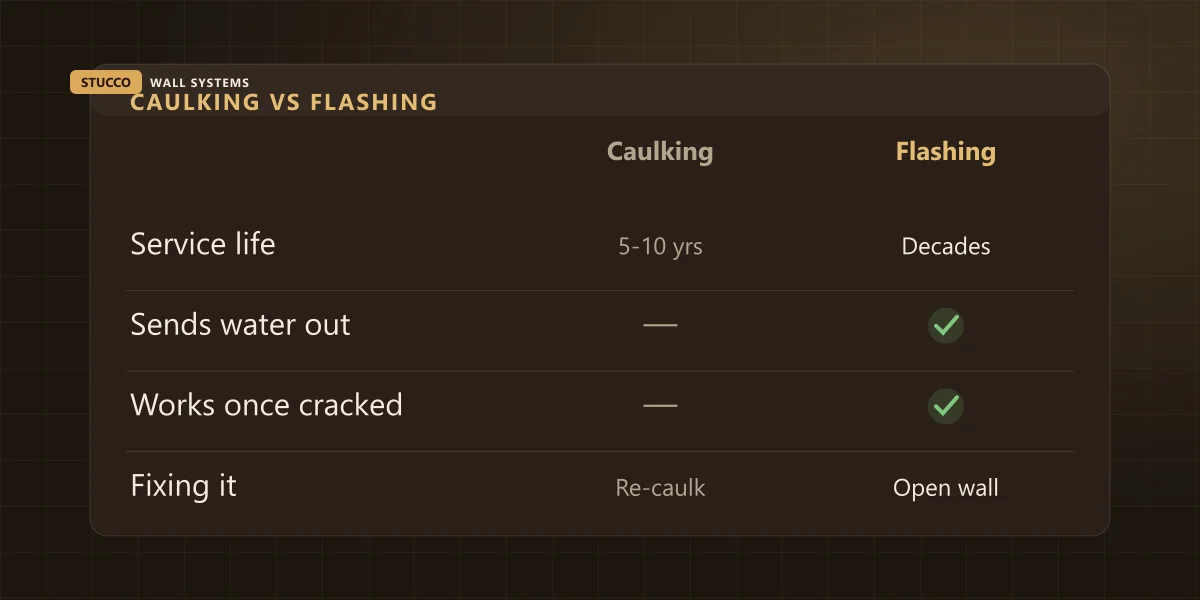
Read that bottom row and you will understand why a certain kind of crew loves caulk. It is the cheapest thing on the truck, it goes on from a ladder in ten minutes, and it makes the evidence disappear. A bead run over a missing flashing buys you one dry winter and hides the problem for the next three, by which point the framing behind it has been wet for four seasons. If somebody answered a leak on your house with a caulking gun and nothing else, they postponed it and started the clock.
None of which makes caulking bad. Renewing it on schedule is one of the best-value things you can do for a stucco wall. It was just never meant to be the only thing standing between a joint and your framing.
What is kick-out flashing, and why do I look for it first?
Kick-out flashing is a small angled piece of metal at the very bottom of a roof edge where it dies into a wall. It kicks water coming down that roof away from the wall and out into the eavestrough. It is a hand-sized piece of metal, it costs almost nothing, and leaving it out is the most reliable way I know to rot a wall in this climate.
The geometry is the whole story. Picture the front of a typical GTA two-storey with a garage projecting forward. The garage roof slopes down and ends against the second-storey wall. Every drop of rain that lands on that roof slope funnels along the edge and arrives at one single point — the corner where the roof meets the wall. With a kick-out, all of it turns and drops into the trough. Without one, it runs straight down the face of the wall, and worse, right into the joint behind the cladding at exactly that corner.
You can spot the result from the driveway without a ladder. It is a vertical dark streak on the wall starting where a roof edge meets it, running straight down, usually noticeable one storey below the junction. It does not spread sideways like a general dirty-wall stain does. It is a narrow line, because it is being fed from one point.
Because the water arrives from the roof rather than the wall, this is also the detail that starts the most arguments. Read the exclusions on almost any stucco warranty in Ontario, ours included, and water from the roof or eaves is listed as not covered — fair enough, since the wall was never the source. I went through that document in what a stucco warranty actually covers. So a missing kick-out is nobody’s warranty claim and entirely your problem, which is what makes it worth twenty seconds of looking.
The roofline works as one system with the wall, and I laid out how the eavestrough, downspout and soffit feed into it in your roofline is a water system. If yours needs the metalwork done properly rather than patched, that is our soffit and eavestrough work, and there is a full package of it on the Burlington roofline project.
How do I tell if flashing is missing or has failed?
From the ground, with your eyes, in about ten minutes. Look for metal where a roof edge meets a wall. Look for narrow vertical stains below those junctions and below window corners. Look for joints where caulk is clearly the only thing doing the work. Anything soft or hollow to a knuckle tap means water is already inside.

Walk the roof-to-wall junctions first. Every place a roof edge ends against a wall, you want to see a small piece of angled metal at the bottom of it. Shingles running straight into stucco with nothing between them is the single highest-value thing you will find on this walk.
Look for stains that run, not stains that spread. A generally dirty wall gets dirty in patches across the whole elevation. A flashing problem makes a narrow vertical line, because the water arrives from one point above and follows gravity. Trace the line upward and you are usually looking straight at the missing detail.
Find the joints where caulk is doing all the work. Around a window, at a deck ledger, at a horizontal band. If the only thing at that junction is a bead of sealant — especially one run over an older cracked bead — there is a decent chance nothing is behind it.
Check the bottom of the wall. The weep screed is the exit and it needs a few inches of clearance. Mulch beds, new paving stones and years of soil creep quietly bury it, and once it is buried everything draining inside the wall has nowhere to go.
Then look inside. A stain in a ceiling corner or on the drywall beside a window gets blamed on the roof far more often than it deserves. Plenty of those are flashing stories. The full diagnostic list is in the six signs water is behind your stucco.
What does fixing flashing cost in the GTA?
Almost never as a line of its own. Flashing lives behind the finish, so retrofitting it means cutting the wall back and rebuilding that section — $18 to $34 per square foot on our repair schedule, over a small area. Installing it during a full re-clad costs effectively nothing extra, because it is simply part of the assembly at $8 to $16 per square foot installed.
| When the flashing goes in | What it involves | What it costs |
|---|
| During a full re-clad | Part of the assembly, on a wall that is already open | Included in $8–$16 / sq ft installed |
| As a repair, wall still sound | Cut the finish back at the junction, flash it, rebuild | $18–$34 / sq ft over a small area |
| As a repair, water already in | Strip to substrate, dry it out, then rebuild | $1,500–$5,000+ once framing is wet |
The same piece of metal is either free or expensive depending entirely on when it goes in. Nothing about the metal changes between those three rows — the access does, and so does how much wet framing is waiting behind it.
Which is why you want to ask about it while you are comparing quotes rather than after. When I price a residential re-clad or a commercial facade, the flashing details are not a separate number — they are in the price, because they are in the wall. If a quote you are holding is three dollars a square foot cheaper than the others, that is one of the first places I would look for the difference. I took that comparison apart layer by layer in why the cheapest stucco quote costs the most. And if your wall is already stained, that is exactly what a stucco repair assessment is for.
Does flashing need maintenance?
The metal itself, almost none. It sits inside the wall doing nothing but existing, and it will comfortably outlive the finish over it. What needs attention is everything feeding it: the eavestrough it drains into, the sealant at its exposed edges, and the grade at the base of the wall. Flashing usually fails because something upstream stopped working.
One hour in the fall covers all of it, and it is the same walk-around I set out in the one-hour fall stucco checklist.
The honest bottom line
Flashing is the part of your wall you will never see, never think about, and never be sold on. It is also why two identical-looking houses on the same street are in completely different condition after fifteen winters. When you compare quotes, ask where the flashing goes at the windows, the roof junctions and the base — not because you need to check the answer, but because how a contractor responds to that question tells you how they build a wall.
If you want a straight read on your own house, send me the address and a few photos from the driveway, particularly of anywhere a roof edge meets a wall. The assessment is free and written, whether it turns into a small repair or nothing at all. We work across Mississauga, Oakville and the rest of the GTA, fully insured and WSIB covered, with 25+ years of finished walls in our project portfolio and a 4.3-star rating from 12 Google reviews you can go and read.