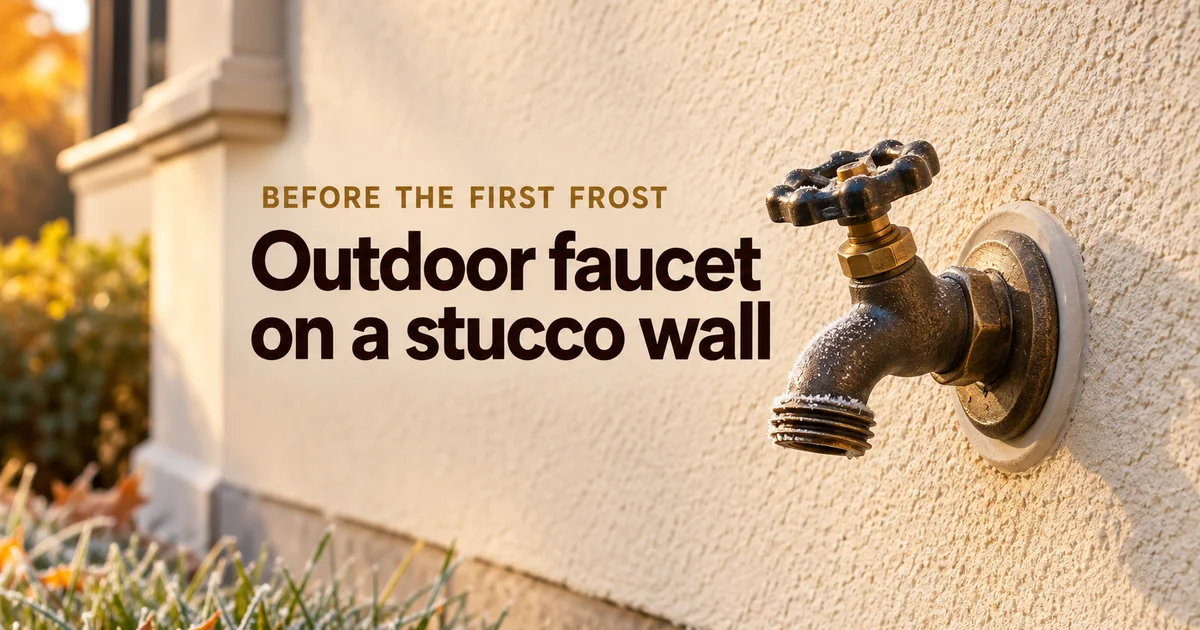
Every October I get the same phone call in a slightly different accent: "Musa, I turned off the outside tap, is that enough?" Usually it is. Now and then it isn't, and on a stucco house the outdoor faucet is one of the few places where a plumbing problem turns into a wall problem without anyone noticing for months. The pipe runs straight through the stucco, and when it splits in January, the water goes where you can't see it.
This post covers the shut-off, the one test in April that catches a burst early, how to read the stucco around a leaking hose bib, and how the job splits between the plumber and someone like me. The stucco prices are from our own stucco repair price list.
Why does an outdoor faucet matter more on a stucco wall?
Because the tube of the faucet passes through every layer of the wall, and a split inside it leaks behind the stucco, not in front of it. On siding you would see the water run down. On stucco it soaks the paper and sheathing first and only shows on the face days or weeks later.
The hole the faucet sits in runs like this, from the garden side to the basement side. On a cement stucco house the third layer is metal lath; on an EIFS house it is a board of foam, which is thicker.
Finish coatThe colour and texture you see.
Base coat and meshThe hard layer that holds the wall together.
Lath or foamMetal lath on cement stucco, an insulation board on EIFS.
Building paperThe last line that sends water down and out.
SheathingPlywood or OSB. Rots if it stays wet.
Rim joistThe wood band the pipe goes through into the basement.
ValveOn a frost-free tap, the real shut-off sits in here, in the heat.
Seven layers between the spout and the valve. A split tube can leak into any of them.
The foam matters more than people think. When an older brick or siding house gets re-clad in EIFS, the wall gets thicker by the thickness of the board. If nobody swaps the faucet for a longer one, the valve seat of the old frost-free tap can end up out in the cold part of the wall, and the tap that never froze in twenty years freezes the first January after the re-clad. So on a re-clad, the outdoor taps belong on the same list as the dryer vent and the lights: things that come off and go back on properly, not things the crew stucco around. How things should be fixed through a finished stucco wall is in the post on drilling into stucco.
How do I shut off the outdoor tap before the first frost?
Take the hose off, close the shut-off valve inside the house if there is one, open the outside tap so the line drains, and leave it open all winter. While you're out there, look at the caulk where the faucet's flange meets the stucco. That joint is the stucco's half of the job.
The City of Toronto puts the plumbing side in one line: outdoor faucets are the first to freeze, so unscrew the hoses, turn off the outdoor supply and let the taps drain. In order, on a typical GTA house, it goes like this:
- Unscrew the hose, and anything else on the spout: a splitter, a timer, a quick-connect. Any of them keeps water sitting in the tube.
- Find the shut-off inside. It's usually in the basement ceiling, on the inside of the wall the tap is on. Turn it clockwise until it stops. Newer houses with frost-free taps often have none, which is fine.
- Open the outside tap and let it run dry. Some inside valves have a small drain cap on the side; put a bucket under it and open it too.
- Leave the outside tap open until spring, so anything that gets in can run out.
- Check the spout points slightly downhill, away from the wall. A tap that tips back toward the house holds water in its tube.
- Run a thumb around the flange where the tap meets the stucco. Caulk that has pulled away or cracked lets rain run along the pipe into the hole.
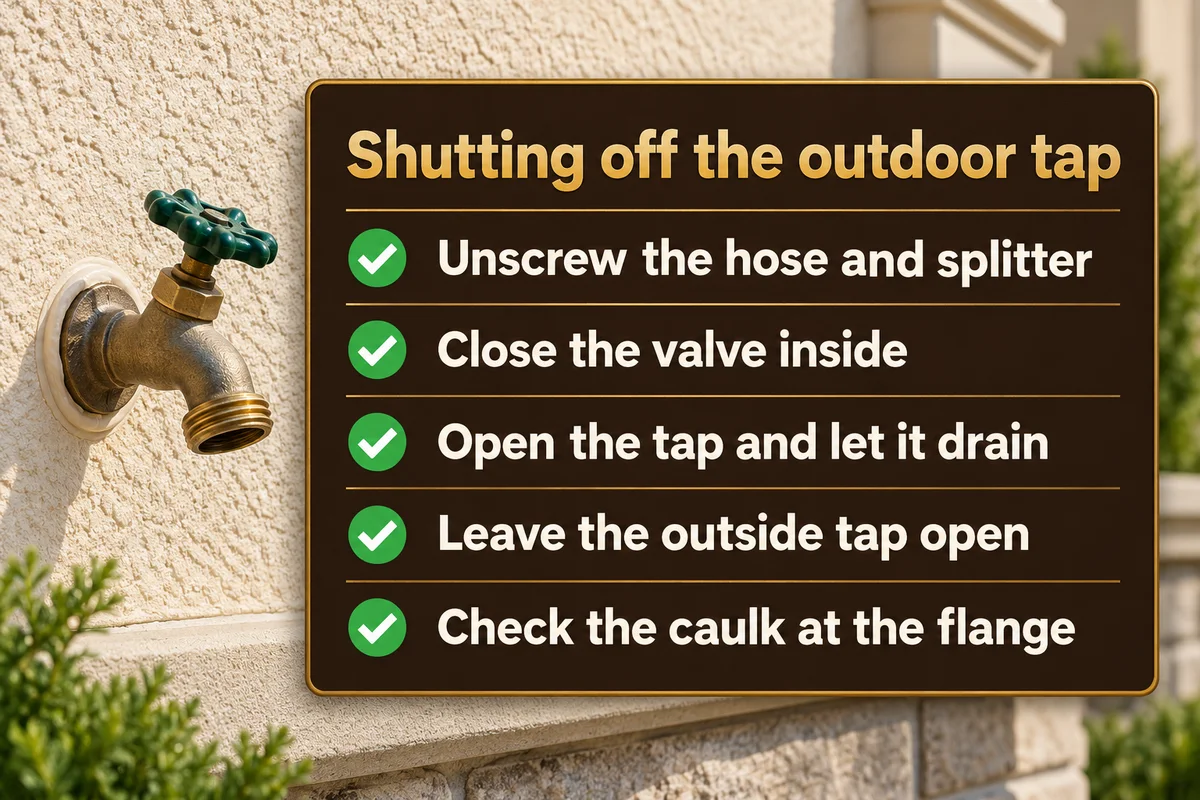
That last step is the one plumbers don't mention, because it isn't plumbing. A gap at the flange is a small hole in the stucco with a pipe in the middle of it, and wind-driven rain finds it. Which sealant belongs there and how a proper bead is shaped is covered in caulk for stucco.
A year in the life of the tap
A burst outdoor faucet almost never shows when it happens. It splits in the cold and leaks the first time someone turns it on, which on a GTA house is a nice Saturday in April. Three dates matter.
- October to mid-November
The shut-off above. If you miss it and a hose stays on through the first hard night, the water in the tube freezes from the spout end back. On a frost-free tap the split is usually inside the wall, past where you can see.
- January and February
Nothing to see. A split tube with the valve closed holds no water, so it doesn't leak. The damage is done, it just hasn't been used yet. A tap that was left on with the inside valve open is the exception: that one can leak all winter, and you'd find it as a wet basement wall or a water bill that jumps.
- April, the first turn-on
The test that matters. Have someone stand in the basement by the wall behind the tap. Open the inside valve, then open the outside tap. Strong flow at the spout and a dry basement: you're done. Weak flow, a hiss inside the wall, or water on the basement side: close it and call a plumber that day. Then watch the stucco below the tap for the next week.
From the stucco side, the tail end of it shows up in May and June: a patch under the tap that never dried out after the April leak, and a homeowner who thought the plumber had fixed everything.
What does a burst tap look like on the stucco?
A dark, damp-looking patch below the tap that grows after the tap is used, white salt bloom under it a few weeks later, and stucco that sounds hollow or feels soft when you press near the flange. On EIFS, a loose or spinning faucet is another sign the board around it is wet.
| What you see outside | What you might see inside | What it means |
|---|
| A dark patch under the tap that grows each time it runs | Damp rim joist or insulation behind the tap | Water from a split tube is getting out between the layers. Stop using the tap until it is fixed. |
| White powder or crust below the tap weeks later | Nothing | The wall got wet and is drying out through the face. The salt is left behind. Find out whether the wetting has stopped. |
| Stucco around the flange sounds hollow or gives under a thumb | Stain on the basement ceiling near the wall | The sheathing or the base coat behind has been wet long enough to soften. Needs opening, not caulk. |
| Faucet turns or wobbles when you open it | Pipe moves at the rim joist | The fixing behind it has let go. On EIFS this often means the foam around it is crushed or wet. |
| Water at the bottom edge of the wall, at the weep line | Nothing | Water is running down behind the stucco and draining out, which is what a drained wall is built to do. Still find where it starts. |
The white bloom is easy to confuse with other things. The post on white stains on stucco explains how to tell a one-time drying bloom from one that keeps coming back. And if you want to know how wet a patch really is before anyone cuts, stucco moisture testing covers how it's measured.
Plumber or stucco contractor: who opens what?
The plumber goes first and works from the basement whenever possible. A new washer or a new frost-free tap in the same hole usually leaves the stucco untouched apart from fresh sealant at the flange. The stucco crew comes in only when the tap moves, when the hole has to be enlarged, or when the wall behind it got wet.
| The job | Done from | Is the stucco opened? |
|---|
| Dripping spout, new washer or stem | Outside, at the tap | No |
| Split frost-free tap replaced, same length, same hole | Basement side, tap slid out through the wall | No. The flange joint gets resealed once the new tap is in |
| Longer tap needed after an EIFS re-clad | Basement side, plus the hole through the foam | Sometimes, if the hole has to be enlarged or the tap needs a proper mounting block |
| Tap moved to a new spot | Both sides | Yes. The new hole is cut and sealed, the old hole is filled and textured to match |
| Sheathing behind the tap wet or soft | Outside, after the plumber is done | Yes. Cut back to the sheathing, dried or replaced, then rebuilt |
The order matters more than who's cheaper. If the stucco gets patched before the pipe is fixed, the next turn-on wets the new patch. If the patch goes on while the sheathing behind is still wet, it traps the water in. Plumber, then a week or two of drying, then the stucco. That's also the order an insurer will want to see in the paperwork if you claim, which I go through in stucco damage and home insurance in Ontario.
What the stucco side of a burst tap costs
Say a frost-free tap on the back wall of a split-level in Streetsville cracked in January, got turned on in April, and leaked into the wall for a weekend before anyone noticed. The plumber replaced it from the basement. Below the tap, about 3 feet wide by 4 feet tall, the sheathing is soft.
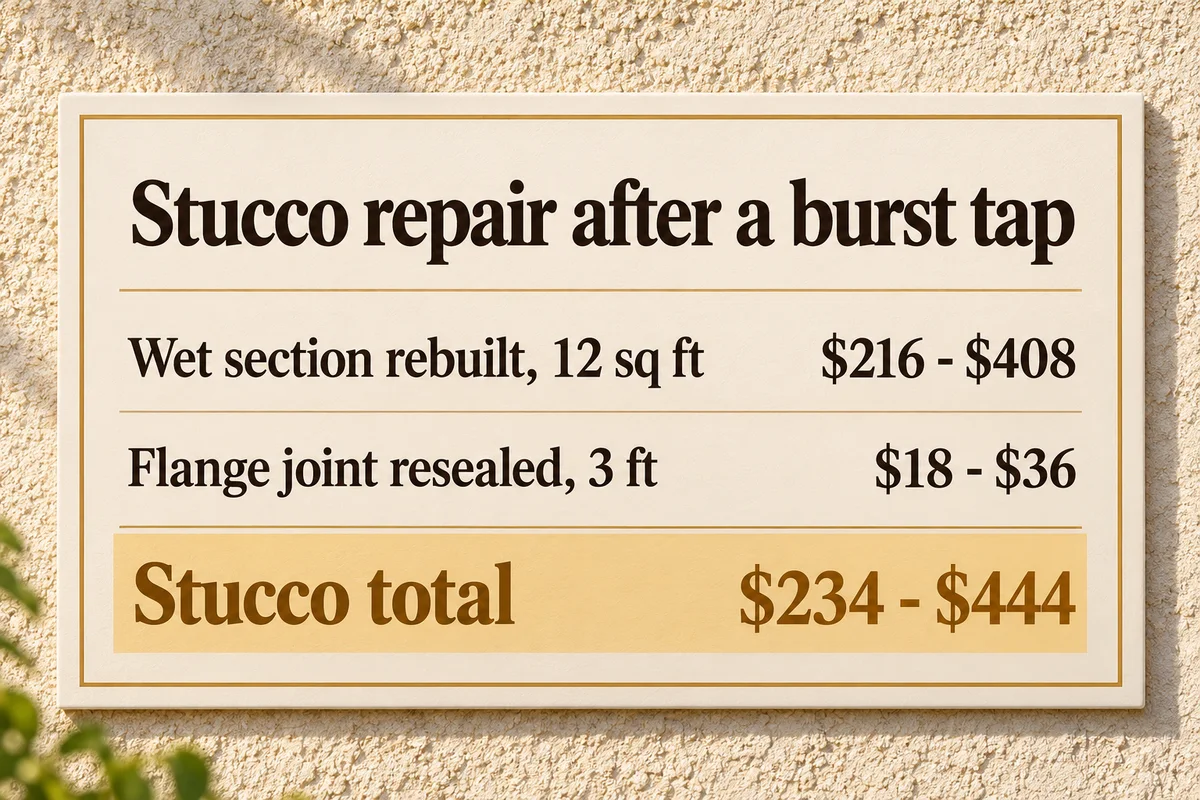
Twelve square feet cut back to the sheathing and rebuilt, at $18 to $34 a square foot, is $216 to $408. Three feet of sealant around the new flange at $6 to $12 a foot is $18 to $36. The stucco side comes to roughly $234 to $444, before the plumber's part, which the plumber prices separately. If the wet area turns out bigger once it's open, the per-foot rate is the same, and a fair quote says that in writing before the wall gets cut.
Two other cases change the bill. If the tap moved and the old hole needs filling, that's a patch and texture match at $450 to $1,200 on our list, because the hard part is making a small patch disappear into an old finish. And if the leak ran for weeks instead of a weekend, the wet area is usually much bigger than the stain on the face suggests. That's the $99 patch-and-pray crew's favourite moment: a can of foam in the hole, a dab of caulk, a fresh coat of paint over the dark patch, and a soft wall that keeps rotting behind it until the next owner's inspector finds it.
If your tap leaked this year, or the stucco around it looks wrong, send a photo of the tap and the wall below it through the contact page, or call (905) 973-6470. I usually get back to people within a day, and the quote is fixed, written and free. If you're west of the city, our Mississauga stucco page shows the neighbourhoods we work in there.