If you walk around a stucco house in Oakville or Mississauga with me and look for damage, I will spend most of the time looking at your knees rather than at the sky. Stucco impact damage is the most common repair I quote on newer houses, and almost none of it comes from weather. It comes from a string trimmer throwing a stone, a recycling bin blown against the garage return, a ladder foot, a basketball, a snow shovel. On an EIFS wall those marks look alike from the driveway. They are not alike at all once you know what is behind the finish.
This is the guide I wish every owner of a 1990s-or-newer stucco house had: what hits the wall, what each hit does to the two kinds of stucco, which marks can wait and which ones are letting water in, and the cheap changes in the yard that stop the same spot getting hit every summer.
Why does the bottom of a stucco wall take all the hits?
Because that is where people, tools and garbage live. Everything a household moves around the outside of a house moves in the band from grade up to roughly head height: mowers, bins, bikes, strollers, snow shovels, balls and ladders. Weather reaches the whole wall. Impact damage concentrates in the bottom eight feet and on the corners people walk past.
When I map the marks on a house before quoting, they cluster in the same five places nearly every time. The garage return beside the overhead door, where bikes, bins and the snowblower get parked. The side yard, where the bins live and the mower squeezes through. The driveway elevation, if there is a basketball net or a kid with a hockey stick. The wall beside a walkout or patio door, where furniture and barbecues get dragged. And the outside corners, because everything that goes around the house clips them on the way.
| What hits the wall | Where it lands | On cement stucco | On EIFS |
|---|
| Stones off a mower or trimmer | First 12–24 inches above grade | Small chips, often ignored for years | Pinholes and small punctures through the finish |
| Garbage and recycling bins | About 2–3 feet up, side yard and garage return | Scuffs and dirt | Dents in a row at bin-rim height, cracked rims |
| Bikes, strollers, snowblower | Garage return and the wall beside the door | Chipped corners | Dented corners, crushed corner bead edge |
| Balls and pucks | Driveway elevation, 1–6 feet | Usually nothing | A field of shallow dents, the odd crack |
| Ladder feet and ladder tops | Base of the wall and the second-storey band | Scrapes | Two neat dents at the top rail, one at each foot |
| Hail | The windward elevation, top to bottom | Usually nothing | Pitting across the whole face after a bad storm |
Note the ladder row. It is the one impact mark that shows up high on the wall, and it is nearly always another trade: the window cleaner, the eavestrough guy, the satellite installer. Two dents a ladder-width apart just under the soffit are a signature. I will come back to that.
Is a dent in EIFS a problem?
A dent on its own usually is not. If the finish is still one continuous skin, with no crack you can see or catch with a fingernail around the rim, the mark is cosmetic and can wait. Once the finish is cracked, crazed or punctured, it is a water path into the foam, and it should be closed before the next winter.
The reason is simple once you know what EIFS is. The acrylic finish and the meshed base coat under it are the part that keeps rain out, and together they are only about an eighth of an inch thick. The foam behind them is insulation, not waterproofing. So the question about any mark on an EIFS wall is never how big it is. It is whether that thin skin is still whole.
Here is how I grade them, in the order a homeowner can check them from the ground:
| What you see | What it means | How soon | Typical cost on our numbers |
|---|
| A shallow dent, finish intact, no cracks | Foam compressed behind an unbroken skin | No rush. Fold it into the next repair visit | Often nothing on its own |
| A dent with hairline cracks around the rim | The skin is broken. Water can get in and freeze in the crack | Before winter | $120–$400 per spot |
| A puncture you can see into | Open path into the foam | This season | $120–$400 each; several on one visit usually $450–$1,200 |
| A hole with a dark or soft patch below it | Water has been getting in for a while | Now, and expect the sheathing to be in scope | $1,500–$5,000+ once it is opened up |
The prices are the same ones we publish for every repair on this site. The jump in the last row is not a sales trick. It is what happens when a two-dollar hole is left open for three winters and the sheathing behind it gets wet, and why I keep telling people that the cheapest time to fix a puncture is the week it happens.
One quick test is worth doing on any dent. Press gently around the edge with your thumb. If the finish flexes or you feel a crunch, the foam behind it is crushed over a wider area than the dent shows, and the repair will be a bit bigger than the mark.
Why cement stucco and EIFS take a hit so differently
Traditional cement stucco is about seven eighths of an inch of hard cement in three coats, locked onto metal lath. It is brittle, so a hard hit chips it, but there is nothing soft behind the surface to push into. EIFS has a skin of roughly an eighth of an inch over foam board. The foam gives, so the same hit leaves a dent, and a sharp enough one goes straight through.
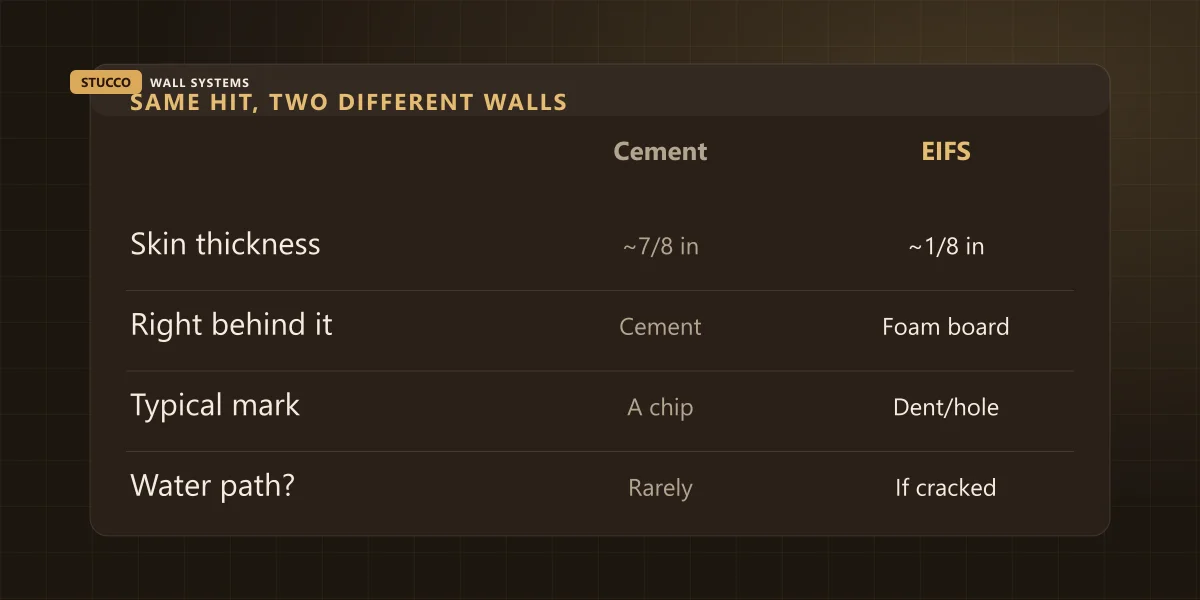
That is the honest trade-off between the two systems. EIFS gives you continuous insulation, a lighter wall and far fewer shrinkage cracks. Cement gives you a surface that shrugs off a hockey puck. I went through the whole comparison in EIFS versus traditional stucco, and it is why I often suggest cement, or heavily reinforced EIFS, for the garage-level walls of a house that is otherwise EIFS.
You can usually tell which one you have with a knuckle. Cement feels dense and dead. EIFS sounds hollow and gives very slightly. If you are not sure, look at an existing puncture: white or grey foam beads behind the finish settle it.
What is impact-resistant mesh, and where does it belong?
It is heavier fibreglass reinforcing mesh, or two layers of mesh, bedded in the EIFS base coat. The test standard, ASTM E2486, sorts EIFS into Standard, Medium, High and Ultra High impact resistance, and the industry association advises considering high or ultra-high assemblies on walls within 8 feet of grade.
That advice comes straight from the EIFS Industry Members Association, and it matches where I find damage. The standard mesh that goes on a whole wall is there to control cracking. It is not armour. The heavier meshes are about two to five times the weight of it, and the ultra-high assemblies are usually a heavy mesh with a standard layer over it.
| Impact class under ASTM E2486 | Rated energy | Where I would put it on a house |
|---|
| Standard | 25–49 in-lb | Upper storeys, gables, anywhere nobody can reach |
| Medium | 50–89 in-lb | Back elevations with no traffic along them |
| High | 90–150 in-lb | The bottom band of most walls, side yards, the driveway elevation |
| Ultra High | Over 150 in-lb | Garage returns, bin areas, outside corners, anything beside a basketball net |
Heavier mesh costs more in material and labour, and it is stiffer to bed flat, so I do not put it everywhere. A second-storey gable does not need it. But on a new wall or a re-clad, specifying it in the bottom band is one of the cheapest upgrades you can buy, because it is only a few hundred square feet of the wall and it is exactly the few hundred that get hit. Ask for it to be written into the residential stucco quote as its own line, so you can see what it is and so nobody quietly leaves it out.
On commercial buildings the case is even stronger. Carts, dollies, delivery trucks and sidewalk ploughs all work along the ground floor, and I specify high-impact mesh along the at-grade band on almost every commercial stucco job. Retrofitting it later is possible, as a meshed overlay over the damaged band, but it is always dearer than doing it the first time.
What does hail do to a stucco wall?
On cement stucco, usually nothing you will notice. On EIFS, a serious hailstorm can leave shallow pitting across the whole windward elevation, and a big stone can crack the finish. Look at the side of the house the storm came from, photograph it the same day, and check the pits for cracks before deciding it is cosmetic.
Hail is the one impact event that insurance policies commonly treat as a sudden weather peril, which is a different conversation from a mower stone. What is covered depends entirely on your own policy, and I covered how to document the wall for a claim in stucco damage and home insurance in Ontario. The short version: date-stamped photos of the damage and of the hail itself, before anybody touches the wall.
How is an impact hole in EIFS properly repaired?
The damaged finish is cut back to sound material on a square edge, crushed foam is replaced with new board at the same thickness, fresh mesh is lapped at least two and a half inches onto sound base coat, then base coat and finish go on. The mesh lap is what turns a plug into a repair.
I walked through every step of that in the post on woodpecker holes in stucco, because a hole a bird makes and a hole a lawnmower makes are repaired the same way. The one thing I would add for impact damage: if the same spot has been hit twice, the repair should go back with heavier mesh than the wall had, or you are just paying to reset the target.
What does not work is the $99 patch-and-pray approach: a thumb of caulk, a dab of paint, and a crew that is gone before it dries. Caulk has no mesh, shrinks, reads as a grey blob from the street and traps water behind it. And whoever does the repair should end the new finish at a corner or a joint line rather than in the middle of the wall, or the patch will show forever. That is explained in why stucco patches show.
The cheapest fix is moving what keeps hitting it
Most impact damage is repeat damage. The same bin hits the same spot every garbage day, and the same ladder rests on the same corner every spring. Before paying anyone to fix a dent, spend twenty minutes finding out what made it, because a repair in front of the same bin will be dented again by August.
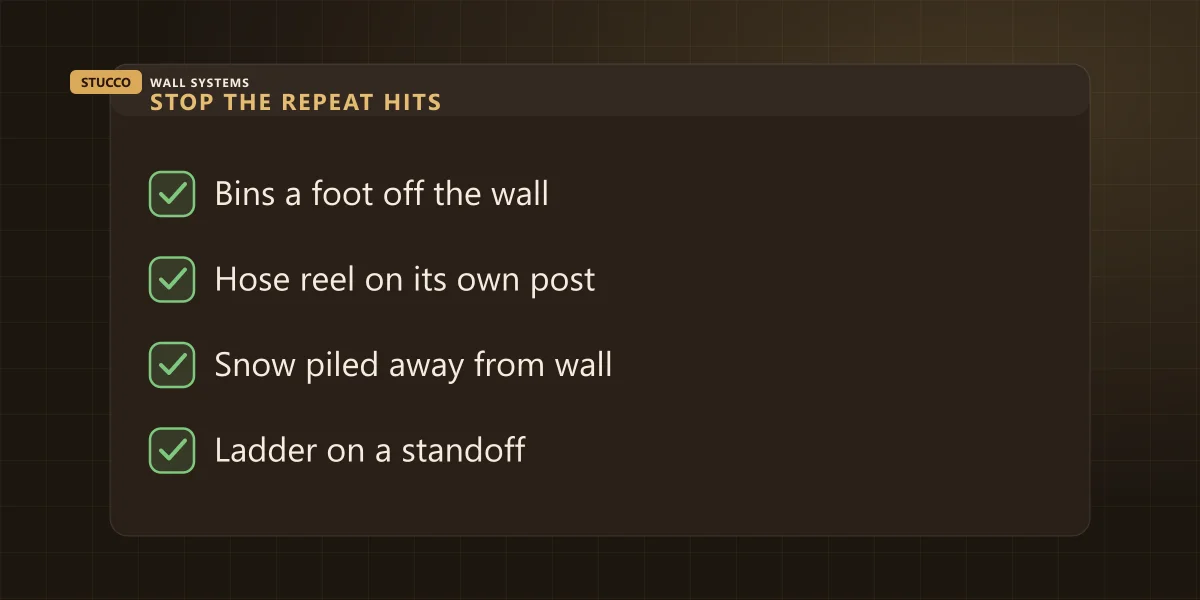
| The habit | What it does to the wall | The fix |
|---|
| Bins stored against the wall | A row of dents at rim height, cracked once the wind knocks them over | Keep them a foot off the wall, or put a wood or rubber bumper rail on posts in front of them |
| Hose reel bolted to the wall | Every pull yanks the bracket; the reel bangs the finish | Mount the reel on its own post a foot out, and leave only the hose bib in the wall |
| Snow shovelled against the house | Shovel blade hits the bottom band all winter, and the pile buries the weep screed | Throw snow away from the wall. Our clearance at grade post shows why the bottom matters so much |
| Ladder leaned straight on the wall | Two dents at the top rail, often cracked | Use a standoff that rests on the roof edge or on two points of the wall at once |
| Trimmer run tight to the wall | Pinholes along the bottom foot | A strip of gravel or a mowing edge, so nothing needs trimming against the finish |
The ladder standoff is the one worth putting in writing. When a window cleaner or roofer quotes you, ask them to use one on a stucco house. It is a cheap attachment, most good crews already own one, and it saves you a second-storey repair that needs scaffold or a lift just to reach two dents.
When is it worth calling someone?
Call when any mark on an EIFS wall is cracked or open, when there is staining below a hole, or when you have more than a handful of marks and want them done in one visit rather than one at a time. Shallow, intact dents can wait for that visit. Nothing that is open should wait through a freeze-thaw season.
If you do call, a few photos from ground level with something for scale, plus one step-back shot showing where on the house the damage sits, lets me tell you from the office whether it is a $120 spot or something that needs a closer look. You can send them through the contact page or call (905) 973-6470. The stucco repair page sets out how our repair visits are priced, and repaired and re-clad walls from across the GTA are in the project gallery.
The short version
Look low before you look high: impact damage lives in the bottom eight feet and on the corners. On EIFS, the question is never how big a mark is, only whether the thin skin is still whole. An intact dent can wait; a crack or a hole cannot. Put heavy mesh where the hits land when the wall is new or re-clad, and move the bin, the hose reel and the snow pile before you pay to fix the same spot twice.