A wall of Boston ivy going red in October is one of the prettiest sights in The Kingsway or Port Credit, and the question I get about it is always the same: is it hurting the house? If the house is brick, that is a longer conversation. If it is ivy on stucco walls, my answer is short. Yes, in most cases it is, and on an EIFS wall it is doing more damage than you can see from the driveway.
This is not a war on gardens. I like a green house as much as anyone. But stucco works because it is a continuous skin with sealed edges that you can look at, and a vine attacks all three of those things at once. Here is what each common vine does, why EIFS takes it worse than cement, how to get it off without peeling the finish with it, and how to have the green without the repair bill.
Is ivy bad for stucco?
On stucco, usually yes. A vine will not drill through a sound finish, but it roots into every hairline crack, control joint and sealant gap it finds, keeps the wall damp behind its leaves, and hides damage until it is expensive. On EIFS the grip pads bond to a finish only an eighth of an inch thick, and taking the vine down can take the finish with it.
You will read that ivy protects walls, and on old solid brick or stone there is some research behind that: a thick leaf cover can soften temperature swings on a masonry wall. That argument does not carry over to stucco. A brick wall is the structure and the weather face at once. A stucco wall is a thin weather face over something that must stay dry, and it relies on sealant and flashing at every edge. Anything that hides those edges and holds water against them is working against the wall, however nice it looks.
How does each vine hold on to the wall?
It depends on the vine. Boston ivy and Virginia creeper grab with tendrils ending in small adhesive pads. English ivy and climbing hydrangea grow short aerial rootlets that glue themselves on. Wisteria and clematis only twine, so they cannot climb a bare wall at all and need something to wrap around. The grip decides the damage.
| Vine | How it climbs | On cement stucco | On EIFS |
|---|
| Boston ivy | Tendrils with adhesive pads | Pads stay behind as brown lace; stems work into joints | Pads can lift the acrylic finish on removal |
| Virginia creeper | Tendrils with adhesive pads (it is the native one, five leaflets) | Same as Boston ivy, slightly less tenacious | Same risk to the finish |
| English ivy and climbing hydrangea | Aerial rootlets glued to the surface | Rootlets push into cracks and texture | Rootlets key into the finish; worst to remove |
| Wisteria | Twining woody stems | Cannot cling, but crushes downspouts and lifts eavestroughs it wraps | Same; heavy stems pry at anything they grip |
| Clematis, climbing roses | Twining leaf stalks or tied canes | Harmless if kept on a trellis off the wall | Harmless if kept on a trellis off the wall |
The first three are the self-clingers, and they are the ones I find on stucco walls, because they need nothing but the wall itself. That is exactly why they are the problem. Wisteria is a different animal: it never touches the finish directly, but its woody stems are strong enough to crush a downspout they wrap and pull a run of eavestrough away from the fascia, and then the wall below takes the roof water. I covered why that matters in the roofline as a water system.
What does a vine actually do to a stucco wall?
Four things, and only one of them is visible. It pushes into every gap in the skin, it keeps the surface wet long after rain, it climbs into the openings at the roofline and the windows, and it hides all of the above from you. When a vine comes down, the hidden damage is usually worse than anything the vine did directly.
It finds the gaps
A clinging vine does not make cracks, but it is very good at finding them. Rootlets and tendrils follow the shade into hairline cracks, the groove of a control joint, the sealant line around a window, the gap at a hose bib or dryer vent. As the stems thicken over the years, they widen whatever they are in. Every one of those gaps was a water path already; now it is a water path held open.
It keeps the wall wet
A stucco wall is meant to get rained on and then dry in the sun and wind. Under a mat of leaves it does not dry. The surface stays damp for days after every rain, which is how you get the green and black growth I talked about in mould on stucco, and in winter the water sitting in any crack under the vine freezes and opens it a bit more. A north wall in Erin Mills with ivy on it is about as wet as a stucco wall gets without a leak.
It climbs into the openings
Left alone, the vine keeps going: under the soffit, behind the eavestrough, across the window heads and into the gap under a sill. Those are the places where the flashing and sealant are, which are the places water is supposed to be turned away. A vine there is a wick.
It hides the wall from you
This is the one that costs real money. The whole point of the fifteen-minute spring walk-around is to catch a crack or a stain in its first year. Under a vine you cannot see either. The wettest, most-cracked section of the house is also the one nobody has looked at in ten years, and it gets found the week the vine comes down.
Why is ivy worse on EIFS than on cement stucco?
Because of the thickness of the skin. Cement stucco is about seven eighths of an inch of hard cement, so the pads and rootlets grip the surface and the wall underneath is still there when you pull them off. EIFS has a finish and meshed base coat about an eighth of an inch thick over foam, and a well-stuck vine can pull patches of that skin away.
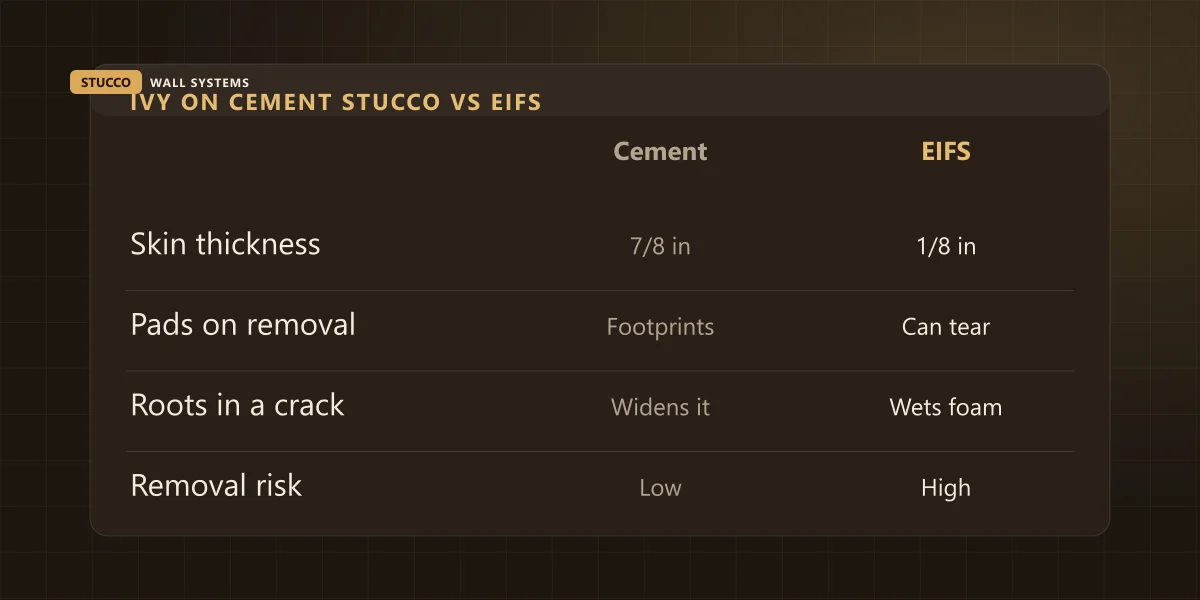
| What the vine does | Cement stucco | EIFS |
|---|
| Grips the finish | Bonds to a hard, thick surface | Bonds to a soft acrylic finish over a thin base coat |
| Pulled off the wall | Leaves brown footprints; the surface survives | Can tear the finish and expose the mesh or foam |
| Roots into a crack | Widens it slowly; water reaches lath and sheathing | Water reaches foam and, on older barrier EIFS, has no way out |
| Keeps the surface damp | Mould, efflorescence, freeze damage in cracks | Same, and the acrylic finish softens and stains faster |
The older barrier EIFS on a lot of 1990s houses in Oakville, Mississauga and Vaughan has no drainage cavity behind the foam, so any water that gets in through a gap under the vine stays in. That is the wall I least want to see covered in ivy. If you are not sure which system you have, the EIFS versus traditional stucco post explains how to tell with a knuckle.
How do you remove ivy from stucco without wrecking the finish?
Kill it before you pull it. Cut every stem near the ground, remove a short section so the ends cannot rejoin, and wait a few weeks until the vine on the wall is brown and brittle. Dry pads let go far more easily than living ones. Then ease it off by hand, close to the wall, and wash the residue with water and a soft brush.
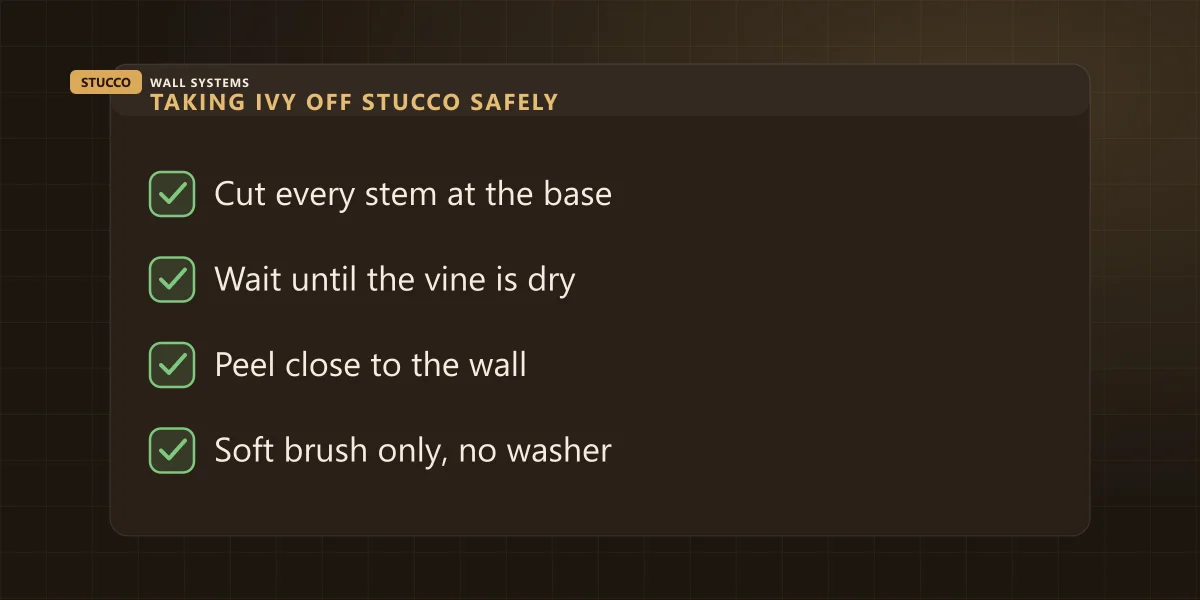
The patience is the whole trick. A green vine pulled off a wall hangs on to the finish with every pad it has, and on EIFS you watch the finish come away in coin-sized flakes. The same vine a few weeks after it has been cut lets go with a fraction of the force. Deal with the root itself as well, or it will be back up the wall by June; if you use a weed killer, put it on the cut stump following the label, not on the wall.
| Do | Do not |
|---|
| Cut the stems at the base and wait for the vine to die back | Rip living vine off the wall from the bottom |
| Pull close to the wall, a small section at a time | Yank long runs from a ladder at arm’s length |
| Wash leftover pads with water and a soft nylon brush | Use a wire brush, a scraper or a heat gun |
| Leave stubborn pads on an EIFS finish for the repair crew | Pressure wash the footprints off |
| Photograph the wall once it is bare | Paint straight over the footprints and cracks |
The pressure washer deserves its own line, because it is what most people reach for once they see the brown lace pattern the pads leave. It drives water into exactly the cracks the vine has just been holding open, on a wall that has been damp for years. The painting stucco rules post explains why a quick coat of the wrong paint over the footprints makes the same problem worse.
What does it cost to fix the wall once the vine is gone?
That depends entirely on what the vine was hiding. If the footprints are cosmetic and the skin is whole, it is cleaning and possibly a finish coat. A handful of cracks and torn spots is an ordinary repair visit. If there is soft or stained wall under the vine, the sheathing is in scope, and that is a different bill.
On the same repair numbers we publish everywhere on this site, a single small repair runs about $120 to $400, and a visit that covers several spots usually lands between $450 and $1,200. Where water has reached the sheathing behind the finish, the job becomes a substrate repair at $1,500 to $5,000 or more, depending on what is found once it is open. The stucco repair page sets out how those visits are priced.
One thing to expect: a wall that was under a vine for years will not match the rest of the house even after a perfect repair, because the rest of the house has been in the sun. The honest fix is usually to refinish the whole elevation, ending at corners, so there is no line in the middle of the wall. I explained why in why stucco patches show. And please do not let anyone sell you the $99 patch-and-pray version, where the footprints get painted over the same afternoon and the cracks underneath get a smear of caulk.
Can you have a green wall on a stucco house?
Yes, as long as the plant never touches the stucco. Build a freestanding trellis on its own posts set in the ground, at least a foot out from the wall, and train a twining vine on it: clematis, a climbing rose, even wisteria if the trellis is strong enough. Keep it below the soffit and trim it off the windows every year.
Three details make the difference. First, the trellis stands on its own posts. Screwing a trellis to the wall puts a row of holes in the skin, and I have explained what that does in drilling into stucco. Second, the gap: a foot is the minimum so you can still see the wall and air can move behind the leaves. Third, the ground: keep the planting bed and any irrigation heads back from the foundation, and keep the soil below the bottom edge of the stucco. The clearance at grade post shows what happens when a garden bed buries the weep screed.
| Setup | Wall risk | Verdict |
|---|
| Self-clinging ivy or creeper straight on the stucco | High, and highest on EIFS | Take it off |
| Trellis screwed to the wall, vine on it | Medium: holes in the skin, vine reaches the wall anyway | Move it onto posts |
| Freestanding trellis a foot or more off the wall, twining vine | Low, if trimmed back each year | The way to do it |
| Tall shrubs or planters instead of a vine | Low, if kept clear of the wall | Good for a shady north wall |
Before you touch it, make sure it is not poison ivy
Poison ivy climbs too, and it grows across southern Ontario. It has leaves in threes, while Virginia creeper usually has five. If what is on your wall has three leaflets, or you are not sure, do not pull it bare-handed; the Ontario government’s poison ivy page shows how to identify it and what to do if you touch it.
The oil stays active on dead vines as well, so waiting for it to dry does not make it safe to handle. That is a job for gloves, long sleeves and ideally someone who does it for a living.
When to call someone about the wall
Call once the vine is off and you can see the wall. If there are cracks, torn finish, stains or anything that feels soft when you press it, send a few photos, one close and one from far enough back to show where on the house it is, through the contact page or call (905) 973-6470, and I can usually tell you from the office whether it is a repair visit or something that needs opening up. Refinished walls from across the GTA are in the project gallery, and if the whole wall needs redoing, the residential stucco page covers how a full job runs.
The short version
A self-clinging vine on stucco keeps the wall wet, holds its cracks open and hides them from you, and on EIFS it can take the finish with it when it comes down. Cut it at the base, let it die, peel it gently, and never pressure wash the footprints. If you want green on the house, put it on a freestanding trellis a foot off the wall.