Every November the same call comes in. The first real wind-driven rain of the fall hits the front of the house, and the next morning there's a brown ring on the ceiling of the bay, a wet seat cushion, or a soft spot in the floor by the window. A stucco bay window is one of the hardest-working pieces of a GTA house front, and one of the most common places I find water behind the wall.
I'm Musa Kastrati, and I've been fixing stucco walls across Halton, Peel, Toronto and York region for 25+ years. A bay leaks in more ways than a flat wall, and the fix depends entirely on which way yours does. So before anyone quotes you a price, the job is to find out where the water gets in.
Why do bay windows on stucco houses leak more than flat walls?
A flat wall has one window opening. A bay has a small roof where it meets the house, two or four outside corners, a long sill, and a floor that hangs in cold air. Each of those joints needs its own flashing or seal, and every one sits right where wind drives rain against the front of the house.
Read the bay from the top down. These are the four places I check, in the order water usually travels.
-
The little roof and its joint with the wall
The bay's roof, shingled or metal, meets the stucco in a line across the top. That line needs a flashing tucked behind the stucco, and at each end a small kick-out that throws water away from the wall. When it's missing or the stucco was trowelled tight onto the shingles, rain runs off the main wall straight into the top of the bay.
Inside, it shows as a stain on the ceiling of the bay or at the top corners of the window trim.
-
The corners between the faces
An angled bay has two corners where the side windows meet the front one, and two more where the box meets the house. Stucco against a window frame or a corner post cracks as the wood moves through the seasons, and a hairline crack on a corner faces the weather from two directions.
Inside, look for paint lifting on the narrow trim pieces between the windows.
-
The sill
This is the most common one by far. The bottom of each window sits on a sill that should slope away from the house and drip clear of the stucco below. Many bays were built with a flat or nearly flat sill, a bead of sealant along the bottom of the frame, and no pan flashing underneath. Rain sits there, the sealant ages, and water runs in under the frame.
Inside, the seat board gets wet or swells, and the stucco apron under the windows outside cracks or bulges.
-
The underside
Most bays cantilever, which means the floor of the bay sticks out past the foundation with open air below. That underside is covered with soffit or stucco. Water that came in higher up collects here, and on a bay close to the ground, splash and snow pile against it all winter.
Inside, the floor at the bay feels cold, the flooring lifts, or you smell damp when you open the cabinet in a window seat.
A bay can leak at more than one zone, and water that enters at the top often shows up at the bottom. That's why I don't trust a stain to tell me where the hole is. It tells me where the water ended up.
Read the inside first
You see the inside of the bay every day, so start there. Write down what you see and when you saw it, because "after the east wind on Tuesday" tells me more than "sometimes".
| What you see inside | Likely zone | What it usually means |
|---|
| Brown ring on the bay ceiling | Roof joint | No flashing or a short one where the bay roof meets the wall |
| Paint peeling at the top corners of the trim | Roof joint or upper corners | Water running down behind the stucco from above |
| Wet or swollen seat board | Sill | Water getting under the window frame at the bottom |
| Flooring lifting or a soft spot at the bay | Sill or underside | Water collecting on the floor framing of the bay |
| Only after wind from one direction | Corners on that side | A crack or open joint facing that wind |
| Damp smell in the window seat cabinet | Underside | Wet sheathing below the bay floor |
If you also see cracks or a bulge in the stucco outside, my guide on signs of water damage behind stucco covers what each one means for the wall around the bay. A bay with a soft floor is not a wait-and-see job. Wood that stays wet over a winter goes from stained to rotten.
A hose test from the bottom up
A water test is how the trade finds a leak before cutting anything. You wet one zone at a time, starting at the bottom, and someone inside watches. Starting at the top is the classic mistake: water from the roof joint runs down and wets everything below it, and you learn nothing.
- Pick a dry day after a dry day, and clear the window seat so you can see the inside of the bay walls and the floor.
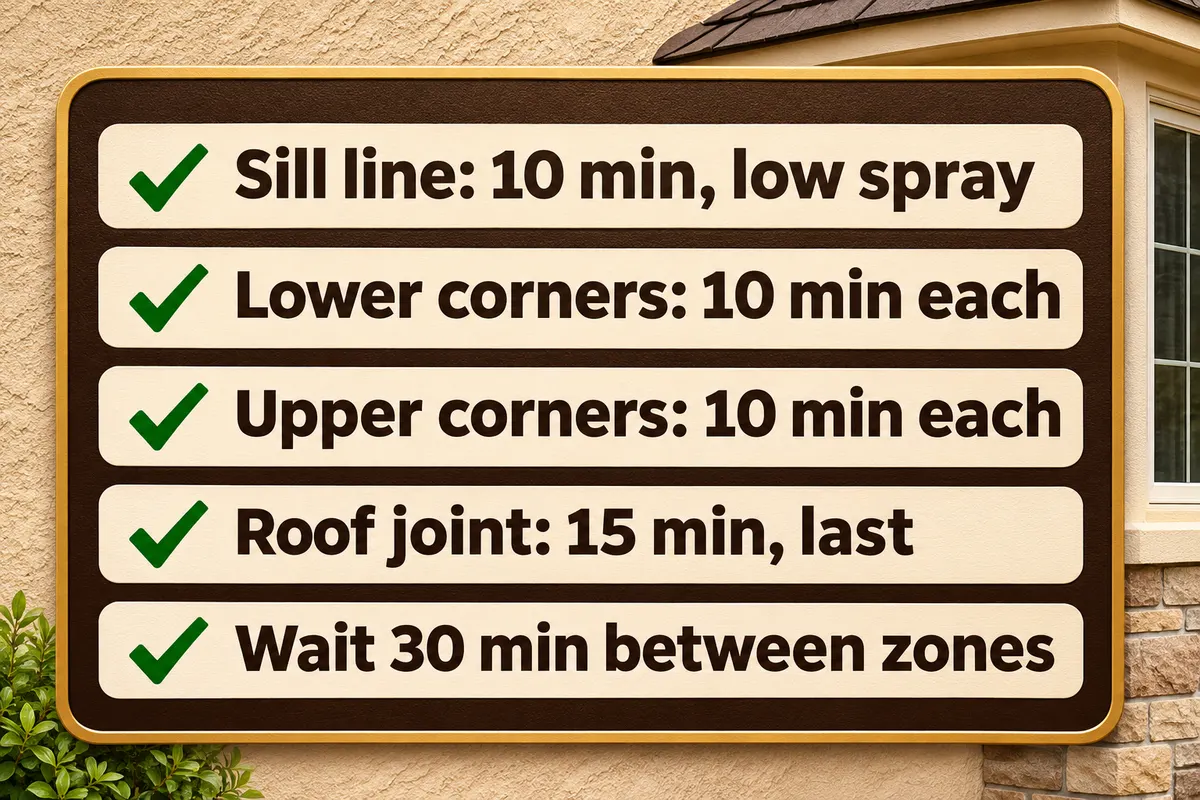
- With a garden hose on a gentle spray, not a jet, wet the sill line and the stucco just under it for about 10 minutes. The person inside watches the seat board and the floor.
- Nothing inside? Move up to the lower half of each corner, 10 minutes each. Then the upper half of each corner.
- Last, wet the joint where the bay roof meets the wall for about 15 minutes. Keep the water on the wall above the roof, the way rain runs down it.
- Wait about 30 minutes between zones. A leak can take time to show, and you want to know which zone started it.
Never use a pressure washer for this. It forces water through joints that rain would never get past, and you end up chasing a leak you made yourself. If the test shows nothing and the leak only comes with storms, that's useful too: it points to wind-driven rain at the corners or the roof joint, and a moisture meter reading on the stucco tells us where the wall is wet.
Will caulking fix a leaking bay window?
Sometimes. If the test shows water coming in at a visible gap between the window frame and the stucco, new sealant over a backer rod can be the whole repair. If the water gets in at the roof joint, under the sill or behind the stucco, caulk on the outside only hides the entry point and keeps the wall wet longer.
What new sealant does stop
- A dried, cracked bead between the window frame and the stucco.
- An open joint where a corner post meets the stucco, if the stucco behind it is still hard and dry.
- A gap at the ends of the sill where the old bead has let go.
What it cannot reach
- A missing flashing under the bay roof or a missing kick-out at its ends.
- A sill that slopes back toward the house or has no drip edge.
- Water already in the sheathing and the floor framing.
- Stucco that sounds hollow when you knock on it.
The $99 patch-and-pray crew goes around the whole bay with a tube of caulk because it's quick and looks tidy for a season. On a bay with no flashing under its roof, that bead just traps the water behind the stucco instead of letting it out. I cover where those flashings belong, in plain words, in flashing explained for homeowners, and the rules for sealant around ordinary windows are in my post on stucco around windows and doors.
What does stucco repair around a bay window cost?
On our price list, sealant renewal is $6 to $12 per linear foot, a patch up to about 20 sq ft is $450 to $1,200, and a section rebuilt to the substrate after water damage is $18 to $34 per sq ft. Most bays need a mix of two or three of those lines.
| The work | Price on our list | On a bay, it covers |
|---|
| Caulking and sealant renewal | $6 to $12 per linear ft | Around each window frame, the corners and the sill ends |
| Crack repair, routed and meshed | $120 to $400 per crack | A crack running from a window corner |
| Patch and texture match | $450 to $1,200, up to about 20 sq ft | A small wet or broken area under one window |
| Section rebuild after water damage | $18 to $34 per sq ft | The stucco apron under the windows, cut back, dried and rebuilt |
| Elevation refinish | $9 to $16 per sq ft | A new finish so the repair does not show on the front of the house |
| Soffit and fascia | $18 to $30 per linear ft | The underside of the bay and the edge of its roof |
The first five rows come from our stucco repair price list and the soffit row from our soffit and eavestrough page. Rotten framing or sheathing is a separate line, and nobody can price it honestly before the stucco is off and the wood is in front of them. A written quote should say that plainly, not bury it in a lump sum.
Here is one bay worked through. The sizes are my example: an angled bay about 9 ft across its three faces, a stucco apron 2.5 ft high under the windows, a band about 1.5 ft high above them, and water that came in at the sill.
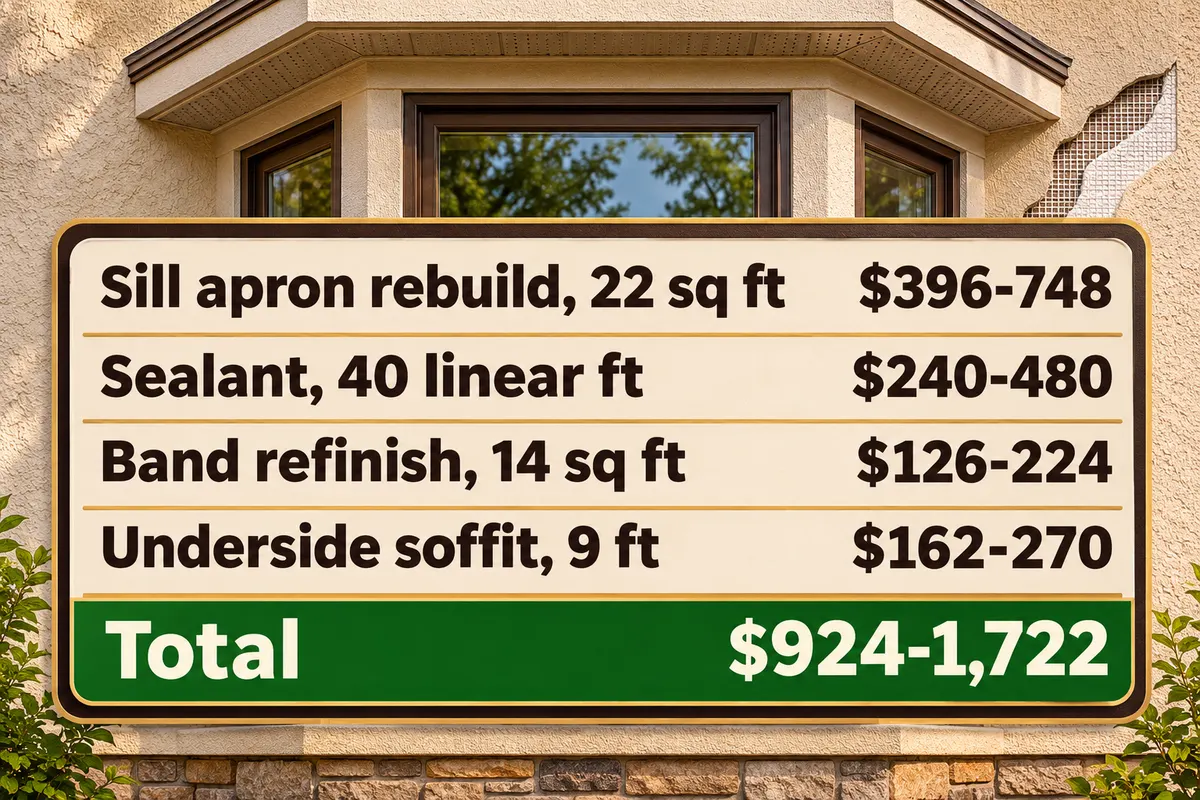
The apron is about 22 sq ft, rebuilt at $18 to $34, so $396 to $748. New sealant around three windows and the corners is about 40 linear feet at $6 to $12, so $240 to $480. Refinishing the band above, about 14 sq ft at $9 to $16, adds $126 to $224 so the new apron and the old band end up one colour. Replacing the soffit under the bay, about 9 ft at $18 to $30, adds $162 to $270. The total is $924 to $1,722, before any wood repair the opened wall shows.
Compare that with a quote written from a car window that says "bay window repair, $600" and nothing else. Ask what it includes. If the answer is caulk, you'll be paying for the same leak again next fall.
A bay that starts leaking in November
The leak won't wait for spring, but the stucco has to. Base coats and finishes need temperatures above about 5 C to cure, so in the GTA a proper rebuild is done from roughly April to November. What can happen now is a cover that keeps water out: a sealed gap, a temporary flashing over the roof joint, or a wrap over the sill line. My post on holding stucco damage until spring walks through what a good winter cover looks like.
Keep snow shovelled away from the underside of a low bay, and keep the window seat open a little in cold weather so the inside of the bay doesn't stay damp. Then book the rebuild for the first warm weeks, before the spring rains find the same hole.
Getting your bay looked at
Send three photos through the contact page, or text them to (905) 973-6470: the whole bay from the front, a close-up of the sill, and the stain or wet spot inside. Tell me which way the bay faces and when you saw the water. I call back usually within a day, and the written quote is free and fixed. In the city, start with the Toronto stucco page; in Halton, the Oakville stucco page.