Most of the stucco on a GTA house covers the walls, but a fair amount of it hangs over your head: the ceiling of the front porch, the underside of a garage that sticks out under a bedroom, a stucco eave soffit, the bottom of a balcony. Stucco ceiling repair is its own job, because up there gravity pulls the coat off instead of pressing it onto the wall. If a piece has already dropped, keep people out from under that spot before you read another line.
I'm Musa Kastrati, and I've spent 25+ years on stucco around Halton, Peel, Toronto and York region. Below is how overhead stucco is put up, why it lets go, how to tell a cosmetic crack from a ceiling that is getting ready to fall, and what the repair costs on our price list.
Why does a stucco ceiling fail differently from a wall?
On a wall the stucco rests its weight on the coat below it and on the wire. On a ceiling every pound hangs from the metal lath and the fasteners in the joists. Once water rusts that lath, or the first coat loses its grip on it, nothing holds the piece up. A wall cracks; a ceiling drops.
The first coat on a ceiling has to be shoved hard up through the openings in the lath so it curls over and locks on the back side. A plasterer who is tired by hour six, or a mix that went on too wet, leaves a coat stuck to the face of the lath and nothing more. It can hang like that for years until water and frost start working on it. That's why two porch ceilings on the same street, built the same year, can age so differently.
| Stucco on a wall | Stucco on a ceiling |
|---|
| What holds it up | The coat below it, plus the lath and its fasteners | Only the lath and the fasteners in the joists |
| Where the water comes from | Rain on the face, and the details around windows and joints | Whatever sits above it: a roof, a deck, a floor, a gutter |
| How it dries | Sun and wind on the face | Slowly; the sun barely reaches it |
| How damage shows | Cracks, stains, a bulge | A stain, then a sag, then pieces on the floor |
| If you leave it | The framing behind rots | The same, and the coat can come down on someone |
Five places stucco hangs over your head
Walk around the house and look up. On most GTA houses I find at least two of these, and each one has something different sitting on top of it. That top side is where your problem starts.
Front porch ceiling
Above it: the porch roof, its flashing at the house wall, and usually a light fixture box.
Look for a stain that spreads out from the house side, and rust dots or a crack around the light. If the columns holding that roof are wrapped in stucco too, my post on what is inside a stucco porch column covers them.
Garage or bedroom overhang
Above it: the floor of a heated room that sticks out past the wall below.
Look for straight cracks spaced about a joist apart, and a damp patch that shows up in the coldest weeks rather than after rain.
Stucco eave soffit
Above it: the roof edge, the eavestrough and the attic.
Look for stains under the corners where the gutter overflows, and check whether the soffit has any vent openings at all.
Underside of a balcony
Above it: a floor people walk on, with snow, puddles and a drain.
Look for a stain under the door sill and along the edge. My post on stucco balcony leaks traces where that water gets in.
Portico or entry arch
Above it: a small flat cap or a parapet over the front door.
Look at the inside corners and the edge where the cap meets the house; stains there come from the top, not the ceiling.
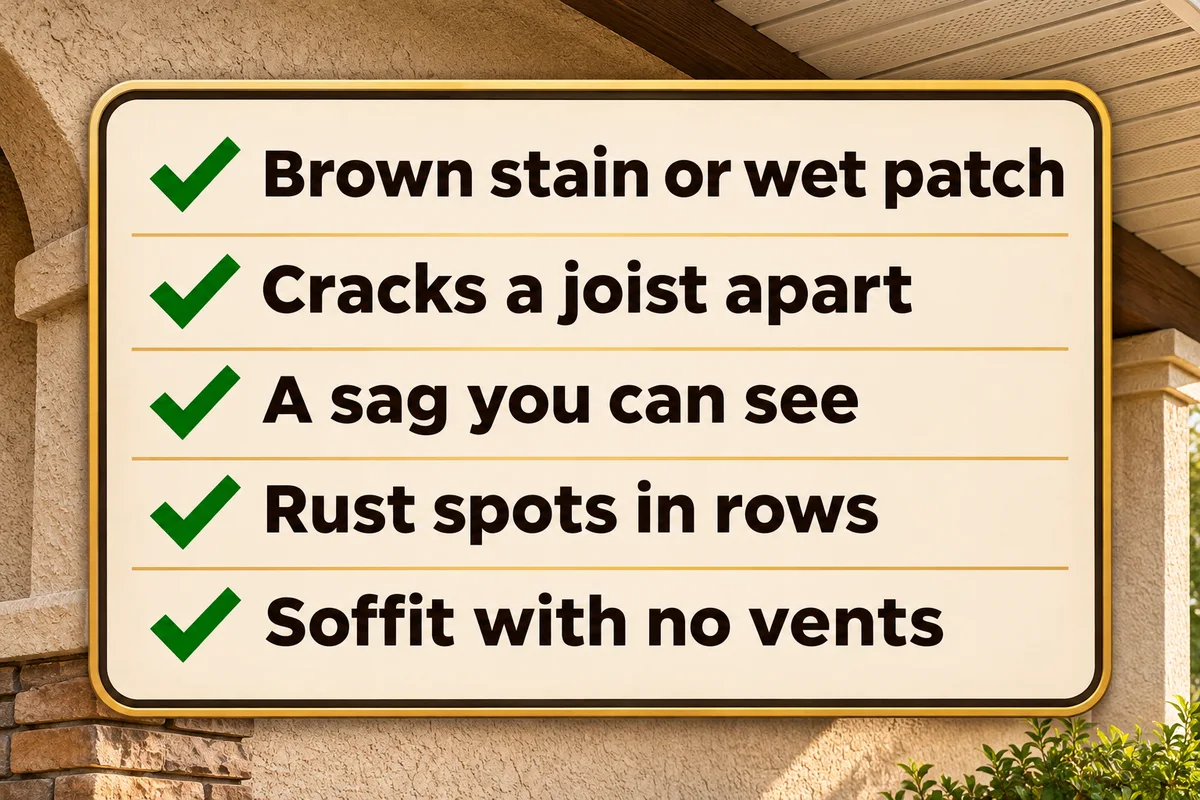
Is a sagging stucco ceiling dangerous?
It can be. A hairline crack in a ceiling that is otherwise solid is not. A sag you can see from the steps, a crack where one side hangs lower than the other, or chunks already on the porch floor mean the coat has lost its hold. Cement stucco is heavy, so treat the spot as a hazard until it's looked at.
What I'd do today, in this order:
- Keep people, pets and cars out from under the spot. Move the bench, the stroller or the car parked under the overhang, and tape the area off if kids use that porch.
- Don't push on it, and don't climb a ladder under it to knock and listen. If it is coming down, you want it to land on nobody.
- Take three photos from off to the side: one wide, one close, and one of whatever sits above it. The shape of a stain tells me a lot before I ever see the house.
- Look at that top side. A gutter packed with leaves, lifted shingles where the porch roof meets the wall, a balcony that holds a puddle: write down what you see.
- If a piece already fell, turn it over. Rusty wire stuck to the back means the lath is rotting away. A smooth back with no wire marks means the coat never locked onto the lath in the first place.
What sits above it decides the fix
A new ceiling under an old leak is money spent twice. The table pairs each spot with the source I run into most often, and what has to be fixed before anybody touches the stucco.
| Spot | Usual source of the water | What gets fixed first |
|---|
| Porch ceiling | Porch roof flashing at the house wall, or a light box with no seal | The flashing and the box, then the ceiling |
| Garage or bedroom overhang | Warm, damp house air getting into the cold floor above, or a leaking window over it | Air sealing and insulation in that floor, or the window sill |
| Stucco eave soffit | Overflowing eavestroughs and ice at the roof edge | Gutters and downspouts; see our soffit and eavestrough work |
| Balcony underside | The deck surface and its drain | The deck above, before the ceiling below |
| Portico or entry arch | Open joints in the flat cap on top | The cap, re-flashed or re-sealed |
A solid stucco soffit can choke the attic
Some houses have the eaves closed in with the same stucco as the walls. It looks clean, but a solid stucco soffit has no vent openings unless somebody cut them in. The federal guide Keeping the Heat In says that, ideally, half of an attic's vent openings should be continuous soffit vents.
So if your stucco soffit is solid all the way around and the attic shows frost or dark sheathing in February, the soffit and the attic are one problem, and the stains on the soffit are a symptom of it. When a stucco soffit gets redone, ask for continuous vent strips set into it, with the attic insulation kept clear of them. I go through the rest of the roof edge in my post on the roofline as a water system.
What does stucco ceiling repair cost?
Overhead work uses the same lines as our stucco repair price list: a routed and meshed crack is $120 to $400, a patch up to about 20 sq ft is $450 to $1,200, and a section taken back to the framing and rebuilt is $18 to $34 per square foot. What moves the number is how much lath has to come down.
| What I find | The work | Price range |
|---|
| A hairline crack, ceiling solid around it | Route, mesh, base coat, texture match | $120 to $400 per crack |
| One loose or fallen piece, the rest solid | Cut back to sound stucco, new lath where needed, patch and match | $450 to $1,200, up to about 20 sq ft |
| A sag, rusted lath, soft wood behind | Down to the joists, dried out, new lath, rebuilt | $18 to $34 per sq ft |
| Solid but stained and patchy | New base coat, mesh and finish across the whole ceiling | $9 to $16 per sq ft |
Take one porch, with sizes I picked as an example. The ceiling is 8 by 12 feet, so 96 sq ft. If 12 sq ft came down near the house wall and the rest is still tight, that's a patch at $450 to $1,200. If the lath has rusted across the whole ceiling, all 96 sq ft comes down and goes back up at $18 to $34, which is $1,728 to $3,264. The flashing above is its own line, priced once I've seen it.

The gap between those two numbers is why I open a small test spot before I write the quote. A patch-and-pray crew will skim over a sag with fresh texture and call it fixed, and you'll be sweeping it off the porch two winters later. If you're building a new porch or closing in an overhang from scratch, that's new work priced per square foot on our residential stucco page.
Found it in November?
Cement needs warmth to set, and an overhead coat is the last thing I'd rush into a cold snap. A porch ceiling is sheltered from rain, which helps, but it still gets the frost. What can be done now: anything loose comes down by hand so it can't fall on its own, the opening gets covered, and the source above, a gutter, a flashing or a deck drain, gets dealt with. My post on holding stucco damage until spring shows how to cover an opening so it sheds water.
Send me your three photos through the contact page or by text to (905) 973-6470. Tell me what sits above the ceiling and roughly when the house was built. I call back usually within a day, anywhere across Halton, Peel, Toronto and York region, and the written quote is free and fixed.