Is stucco fire resistant? The cement kind is. It is sand, Portland cement, lime and water, and none of those burn. The answer changes for the other wall that gets called stucco. EIFS is a thin acrylic skin over foam board, and the foam burns. Behind both of them is a wood-framed house. Most of what you will read on this subject comes from California and is about wildfire. On a GTA street the fire that reaches your wall is the house next door, a barbecue or a car in the driveway, and the number that matters is how far the wall sits from the lot line. I go through the wall layer by layer first, then the distance, then what I check on a wall after a fire nearby.
Does stucco burn?
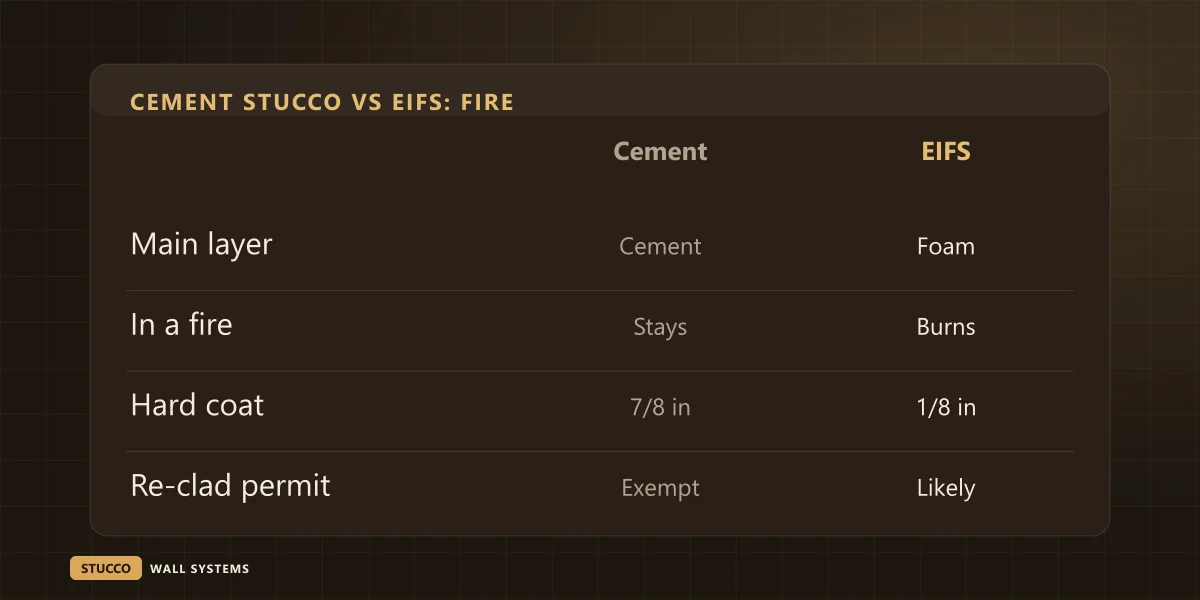
Cement stucco does not burn. There is nothing in the coat to catch: sand, cement, lime and water. It will not feed a fire or carry flame across a wall. EIFS is a different wall under the same name, and its foam board melts and burns once enough heat gets to it.
The Building Code ties the word "noncombustible" to a lab test, CAN/ULC-S114, and Toronto treats traditional cement stucco as non-combustible cladding in its re-cladding rule. That rule is the reason the two walls get different paperwork, which I cover in the stucco permits guide. I am a plasterer and I do not run a fire lab, so I take the claim only this far: the cement coat is not fuel. Everything behind it is another matter.
Cement stucco on a framed wall
Outside face at the top, room side at the bottom.
- Three cement coats, about 7/8 inDoes not burn
- Metal lathDoes not burn
- Building paperBurns
- Plywood or OSB sheathingBurns
- Wood studsBurn
EIFS on a framed wall
Same order, outside to inside.
- Acrylic finish and mesh coat, about 1/8 inThin cover
- Foam board, the thick layerBurns
- Water barrierBurns
- Plywood or OSB sheathingBurns
- Wood studsBurn
Read the two stacks from the top. On the cement wall a fire outside has to get through most of an inch of hard plaster on steel mesh before it reaches anything that burns. On the foam wall the first thing behind an eighth of an inch of skin is the fuel. If you are not sure which wall you own, knock on it. Cement is hard and dull under the knuckles. EIFS sounds hollow and gives a little under a thumb. There is more on telling them apart in EIFS vs traditional stucco.
Is a stucco wall fire rated?
The finish alone has no rating. A fire-resistance rating belongs to a whole wall that was tested or listed as built: studs, insulation, sheathing, interior board and cladding together. Under the Ontario code a rating comes from a fire test or from the province's published lists of assemblies. Your wall has whatever its full build earns.
American pages say three-coat stucco is "a one-hour wall". That figure comes from tests on particular walls in the United States, with a particular sheathing and a particular board on the room side. Take one layer out and the number no longer applies. When a drawing for a job here calls for a 45-minute or a one-hour wall, the designer picks a listed assembly and I build the outside of it as listed, coat for coat. The crew that says "stucco is fireproof anyway" and swaps the sheathing for whatever is on the truck has just built an unrated wall with a rated price.
How close is the wall to the lot line?
Distance decides what the Code asks of a house wall. In the 2012 Ontario Building Code a wall 1.2 m or more from the property line needed nothing extra for fire. Between 0.6 and 1.2 m it needed 45 minutes of fire resistance. Under 0.6 m it needed that and non-combustible cladding as well.
- Under 0.6 m (about 2 ft)A 45-minute wall, clad in non-combustible material. No windows in it.
- 0.6 to 1.2 m (2 to 4 ft)A 45-minute wall. No windows in it.
- 1.2 m and more (4 ft and up)No fire rating asked of the wall. Windows are allowed, and the share of the wall that may be glass grows with the distance.
The closest zone is written this way in O. Reg. 332/12, the 2012 Building Code:
"the limiting distance is less than 0.6 m, provided that the exposing building face has a fire-resistance rating of not less than 45 min and is clad with noncombustible material."
Ontario Building Code (O. Reg. 332/12), Sentence 9.10.15.5.(2)
Limiting distance is measured square off the wall to the property line, or to the middle of the street or lane where the wall faces one. Two cautions go with those numbers. That regulation was replaced by a new Building Code on January 1, 2025. I quote the 2012 text because it is the version posted in full on e-Laws and the one that houses built from 2012 to 2024 were permitted under. For a new house, an addition or a re-clad, the current numbers are on the permit drawings, and that is where I take them from. The second caution: the rule applies when something is built or changed under a permit. Nobody comes round to rate a wall that has stood since 1950.
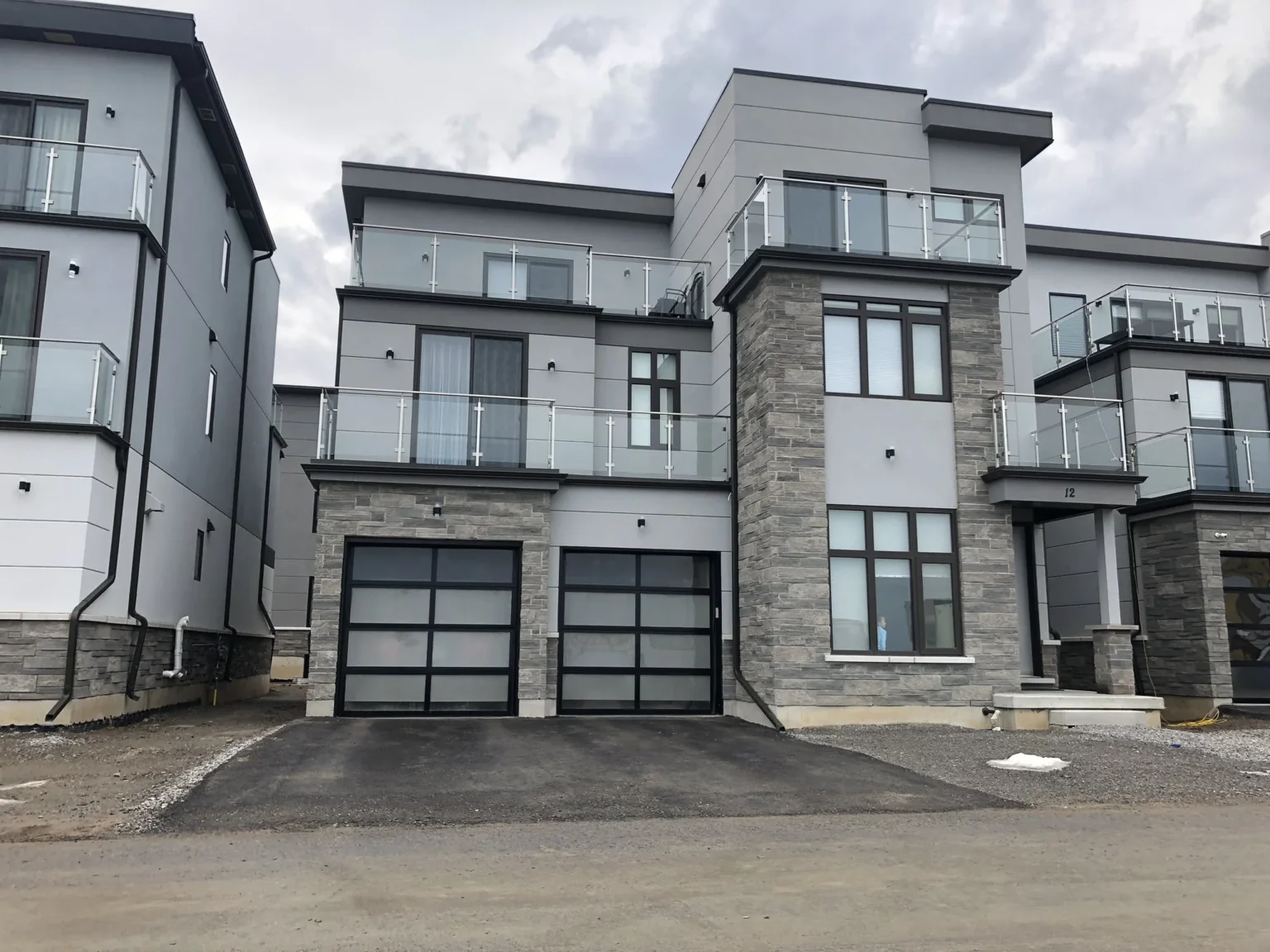
Where this reaches my trade is a re-clad on a tight lot. Plenty of side walls in the older parts of Toronto sit closer than four feet to the line. If you want foam on a wall like that for the insulation, what cladding is allowed there gets settled on the drawings before anyone orders board. Cement stucco on the same wall is the easy case. The same arithmetic shapes every laneway and garden suite I work on, because those sit close to two or three lines at once.
Which fires reach a GTA wall?
The ordinary ones. A barbecue left too close, a recycling bin or a mulch bed that catches, a car in the driveway, the house next door. Embers blown in from a forest are a California problem. Here the heat comes from a few feet away and from low down, so the bottom of the wall and the side facing the neighbour take it.
| What is burning | Cement stucco wall | EIFS wall |
|---|
| A barbecue pushed up against the wall | Soot and a scorched finish. The coat stays where it is | The foam can soften and shrink behind the skin and leave a dished or blistered patch |
| A bin, a mulch bed or a woodpile at the base | The coat does not light. Watch the wood trim, the door and the soffit above it | The bottom edge is the weak point wherever foam is open to the flame |
| A car beside the house, or the house next door | The coat adds no fuel. The heat goes for the windows, the soffit and the roof edge | Skin and foam facing the fire can be lost, and the sheathing behind is next |
Where does fire get past a stucco wall?
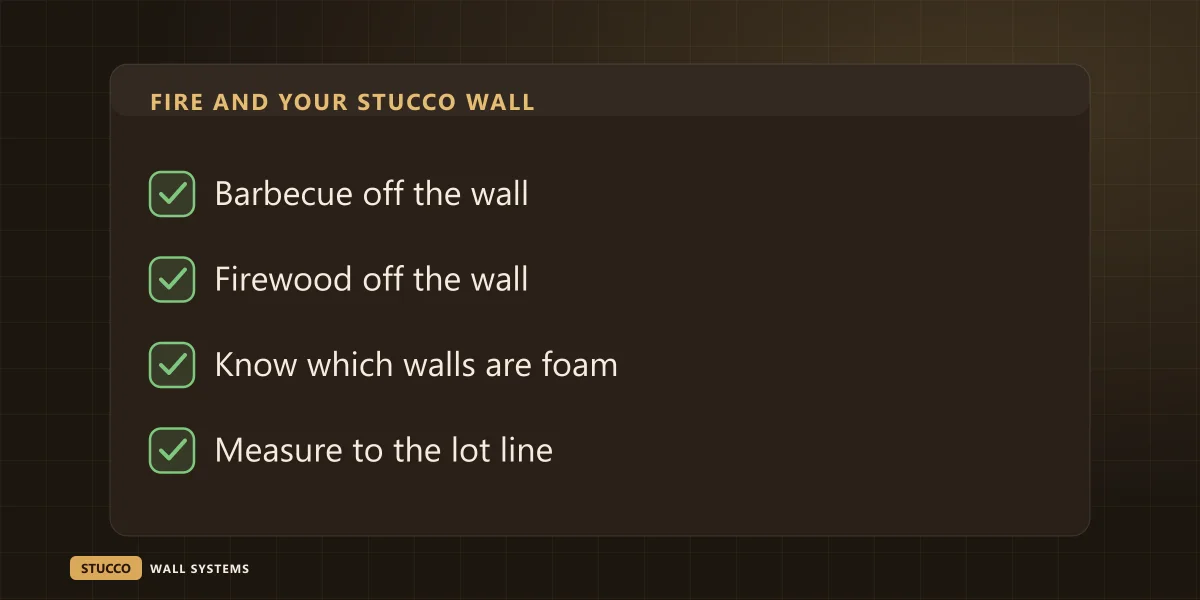
Through everything in the wall that is something other than stucco: windows, soffits, vents, wood trim, foam mouldings, a deck or a fence fastened to the house. A cement coat with no gaps in it is a good shield, and a house is mostly gaps. Walk round and look at these before you take comfort from the wall.
- The soffit and the roof edge. Vinyl soffit sags and drops with heat, and behind it is the open end of the attic.
- The windows on the side that faces the neighbour. Glass and vinyl frames give up long before a cement coat does.
- Plastic vent hoods for the dryer, the bathroom fan and the furnace.
- The bands and window surrounds. On many cement stucco houses they are foam shapes with a thin coat over them, so there is fuel at every window. I describe how they are built in foam trim repair.
- Wood fastened to the house: a deck, a pergola, a fence that runs right up to the wall.
- Whatever is parked against the wall, such as firewood, bins, a barbecue, cardboard waiting for recycling day.
What happens to stucco after a fire next door?
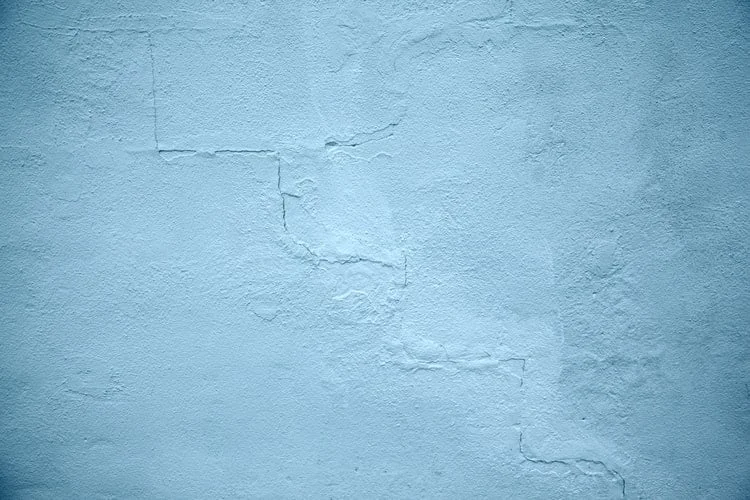
Often it is still standing and stained, and standing does not mean sound. Heat and hose water can crack a finish, loosen a coat from its base and soak the wall behind it. On EIFS the foam can be gone behind a skin that still looks whole. Have the wall sounded and checked before anyone paints over the soot.
On a cement stucco wall
- Sound the whole side that faced the fire and mark every hollow area. A coat that has let go rings differently from the wall around it.
- Look up. The soffit, the fascia and the line where the wall meets the roof take more heat than the middle of the wall.
- Check the sealant and the frame at every window on that side.
- Have the wall read for moisture a few weeks later. A fire crew puts a great deal of water on a wall, and some of it goes in at the top and round the windows. Moisture testing finds it without opening anything.
On an EIFS wall
Press the skin with a flat hand across the side that faced the heat. Where the foam has shrunk the skin gives or sits dished, and the shadow shows when the sun is low. Those sections are cut out, the wall behind is checked, and new foam, mesh and base coat are lapped onto the sound work around them. That is EIFS repair and it is priced on site.
| What the check finds | What the repair involves | Our price band |
|---|
| Soot on a sound coat | Cleaning, and a recoat if the stain is in the finish | Quoted on site |
| Finish cracked or lifted, base tight | Cut back and refinished to a corner or a joint | $450–$1,200 for a typical area |
| Cement coat loose from the lath | Section cut out and rebuilt | $18–$34 per sq ft |
| Sheathing or framing wet or charred | Carpentry first, then the wall rebuilt | $1,500–$5,000+ |
| Most of one side damaged | That wall re-clad | $8–$16 per sq ft installed |
If an insurer is involved, photograph everything before it is cleaned. The order of steps is in stucco and insurance claims.
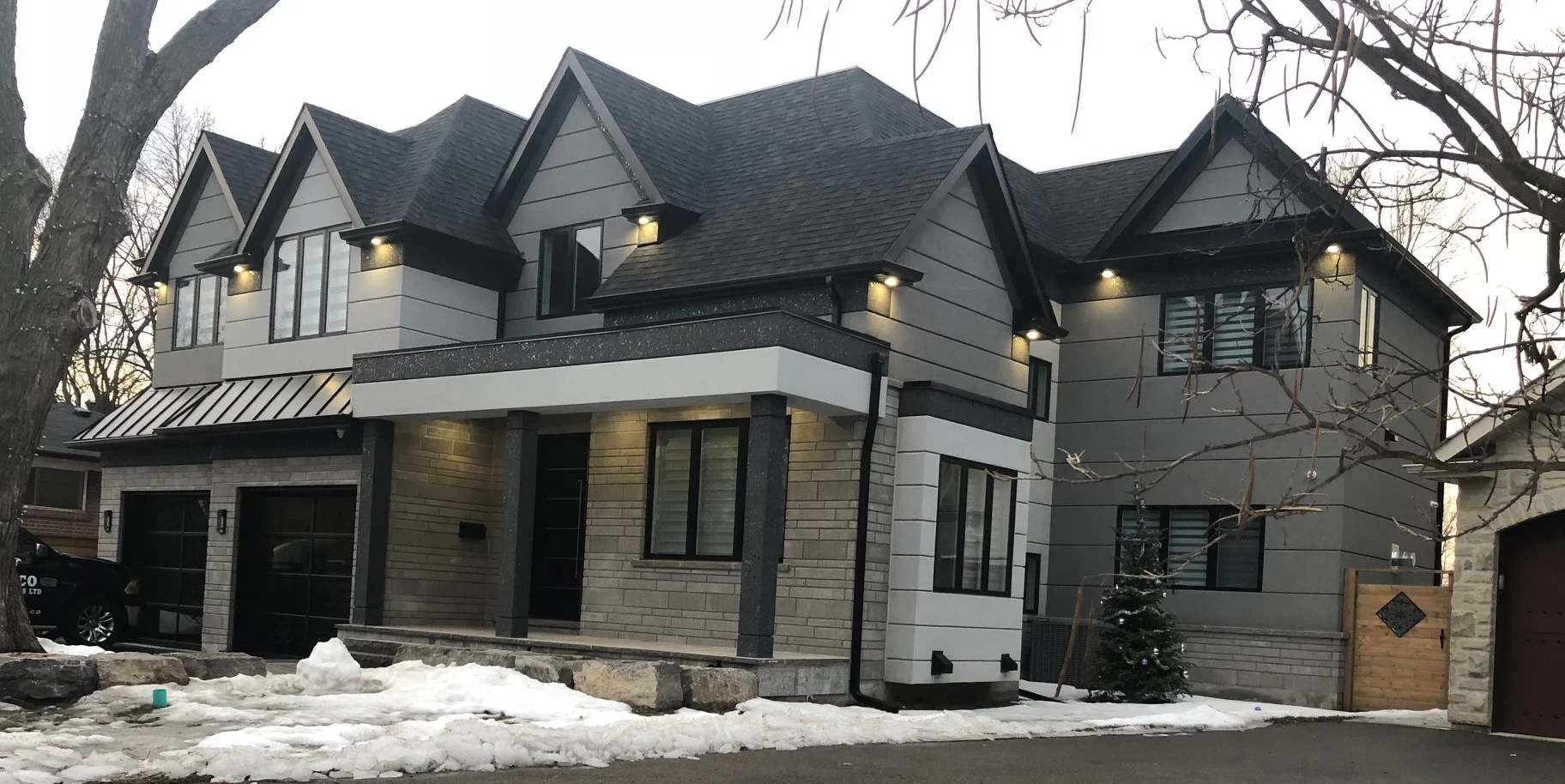
If you are choosing a finish for a new house or a re-clad and fire is part of the choice, measure from each wall to the lot line and send me the numbers with the drawings. Cement stucco is the plain answer on a tight side wall, and foam goes where the drawings allow it. Both are in our residential stucco work, and after a fire the stucco repair crew covers the GTA, including Toronto, where the side walls sit closest together.