An orange streak on a pale wall gets noticed fast, usually by a neighbour before the owner. The calls I get about rust stains on stucco come with two worries: is the house rusting from the inside, and will it wash off. Sometimes it is a five-minute clean. Sometimes it is the first visible sign that water has been reaching the steel behind the finish for a few winters. The stain itself tells you which, as long as you read it from the right end.
Is a rust stain on stucco a problem?
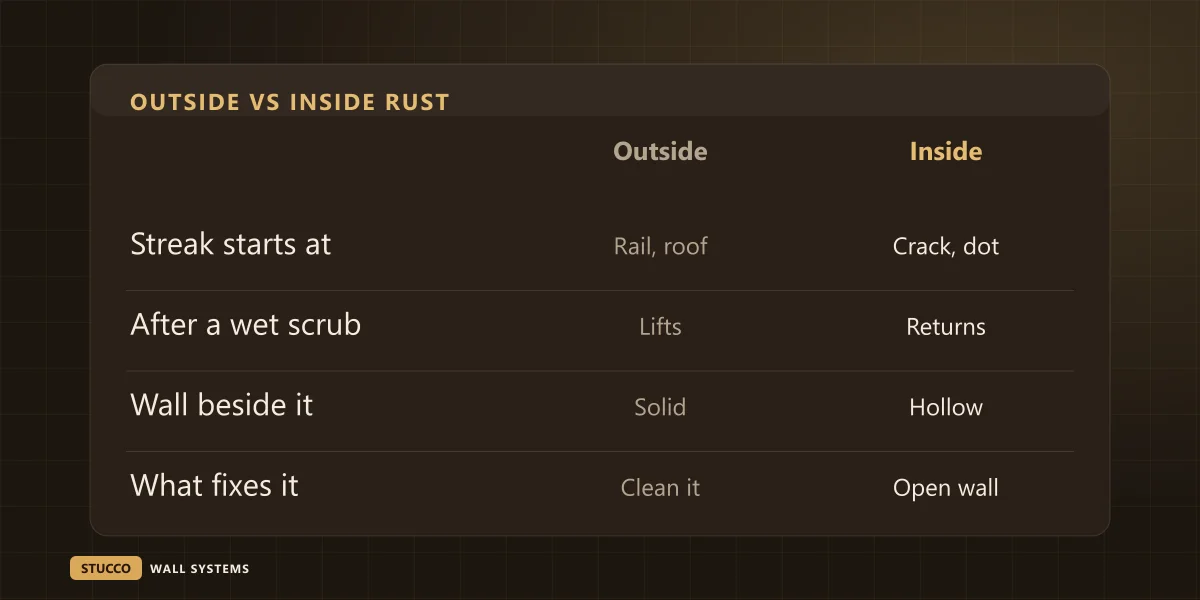
It depends on where the streak starts. Rust washing down from a railing, a bracket or roof metal is a cleaning job plus a fix to that piece of steel. Rust coming out of the wall itself, from a crack, a corner or a small dot, means metal inside the stucco is wet, and that is a water problem with a stain on top.
Stucco on most GTA houses is full of steel. Cement stucco goes on over metal lath fastened with staples or nails, with a metal corner bead on every outside corner, casing bead around many windows and a weep screed along the bottom. All of it is galvanized, and the zinc coat lasts a long time as long as it stays mostly dry. Once water gets behind the finish and sits there through a January thaw and a refreeze, the zinc goes and the steel underneath starts to bleed. EIFS has far less metal in it, so on a foam wall the orange nearly always comes from something fastened through it or mounted above it.
Follow the streak up to where it starts
Rust runs downhill with the rain, so the bottom of a stain tells you nothing. Stand back, find the very top of the orange, and match it to the spot on the wall below. I read a house this way from the roofline down to the grass.
The two rungs at the bottom overlap with how close the stucco sits to the ground, which I cover in the post on stucco clearance at grade. The roofline rung is the same family of leaks as in the guide to the roof-wall junction, where a missing kick-out is the usual culprit.
How do you tell rust from outside from rust from inside?
Clean a small section and watch it. Outside rust lifts with a wet scrub and stays gone once its source is fixed or removed. Inside rust fades, then comes back within a few weeks of rain, because the steel behind the finish keeps getting wet. A hollow sound or a crack at the top of the streak points the same way.
You can run this test yourself in an afternoon and a couple of weeks of patience. You need a hose, a soft brush, a phone camera and a pencil.
If the strip stays clean, the rust was on the face. If a fresh orange line has crept back down from the same spot, the metal inside is wet. Do not dig at the dot with a screwdriver on a cement wall; you will open a hole into the lath and give the water a better way in.
What each source costs to fix
The prices below come from the repair list on our stucco repair page. Most rust jobs are one or two lines of it, not a whole wall.
| Where the rust comes from | What it means | The usual repair | Price line |
|---|
| Railing, bracket, fixture on the surface | Steel on the outside is rusting | Clean the stain, replace or coat the steel, seal the fasteners | Sealant at $6 to $12 per linear ft, plus the part |
| Roof flashing or chimney cap | Metal above the wall is washing down | Fix the metal up top, then clean the wall | Wall cleaning only; the metal is a roofing line |
| Window corners | Water past the head or a failed sealant joint | Reseal or reflash, route and mesh the crack, match the texture | $6 to $12 per linear ft, cracks $120 to $400 each |
| Outside corner bead | Thin cover over the bead cracked open | Cut out the corner, new bead, rebuild and match | Small patch up to about 20 sq ft, $450 to $1,200 |
| Dot that keeps growing | Lath or a staple is wet near the surface | Open the spot, treat or cut out the steel, patch | $450 to $1,200 for a small patch |
| Wide area, hollow or soft | Lath behind the coat has corroded over a section | Remove to the substrate, dry it out, rebuild | $18 to $34 per sq ft |
The last row is the one to worry about. If the rust sits on a soft or hollow patch, read the six signs water is behind your stucco before you spend anything on cleaning, because cleaning a wall that is wet behind is money thrown at the wrong end of the problem.
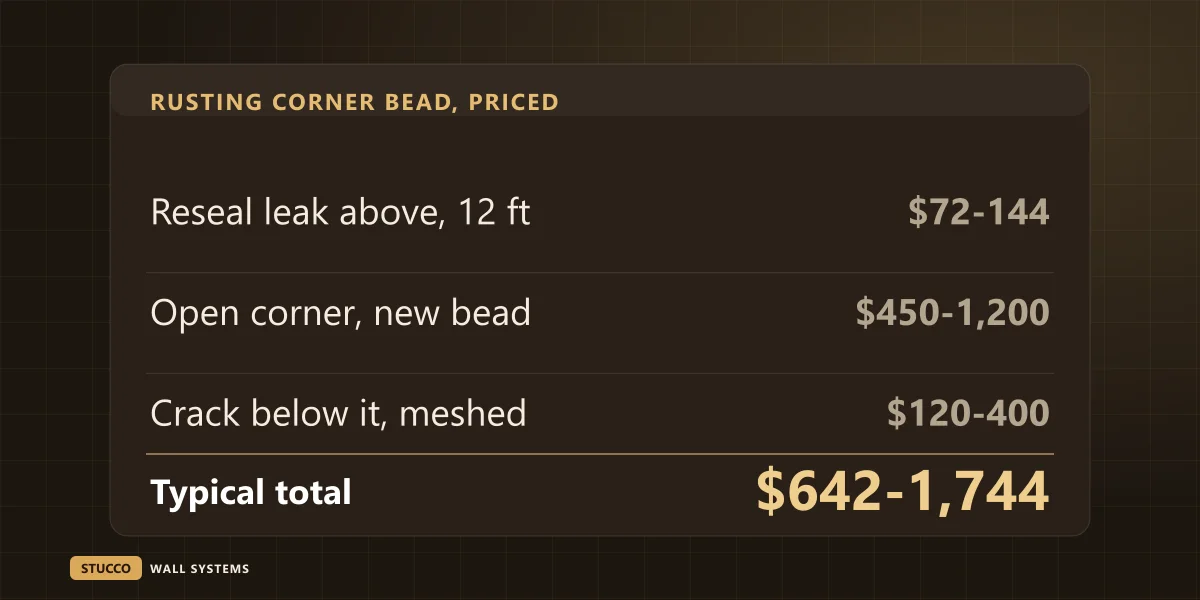
A typical corner-bead job adds up like the receipt above. Twelve feet of failed sealant at the window over the corner, the corner itself opened and rebuilt with new bead, and the crack that ran off it routed and meshed. On a lot of the 1980s and 1990s stucco houses around Erin Mills and Bronte, the corners are exactly where I find this.
Cleaning off rust that came from outside
Once the source is gone, the stain usually comes off. Wet the wall first so the cleaner does not soak in, then use a rust remover sold for masonry or stucco, many of them based on oxalic acid, and follow its label to the letter. Test it on a spot behind a downspout before you touch the front of the house. Work from the bottom up so drips land on wet wall, scrub with a soft nylon brush and rinse until the water runs clear.
On EIFS, check that the product is allowed by the maker of the finish; some strong removers bleach an acrylic finish lighter than the wall around it. Cover the plants below and keep it off windows and anodized frames. A pressure washer held close does more damage to a stucco finish than the rust ever did, and muriatic acid etches cement stucco and can attack the very metal you are trying to protect. My full routine for washing a stucco wall, including the gentle pressure that is safe, is in the guide to cleaning stucco.
What a rust repair quote should tell you
A quote that says "clean and paint rust stains" and nothing else is a quote written from a car window. It should name where each streak starts, whether the metal behind it gets replaced or only cleaned, how the leak feeding it will be stopped, and how the texture will be matched on any patch. If the source is a failed sealant joint, our caulking and sealant work is often the whole fix.
If you have orange running down your wall and you cannot tell which rung of the ladder it starts from, take a photo of the top of the streak and one of the whole wall, and send them through the contact page or call (905) 973-6470. I usually call back within a day, and the quote is fixed, written and free.