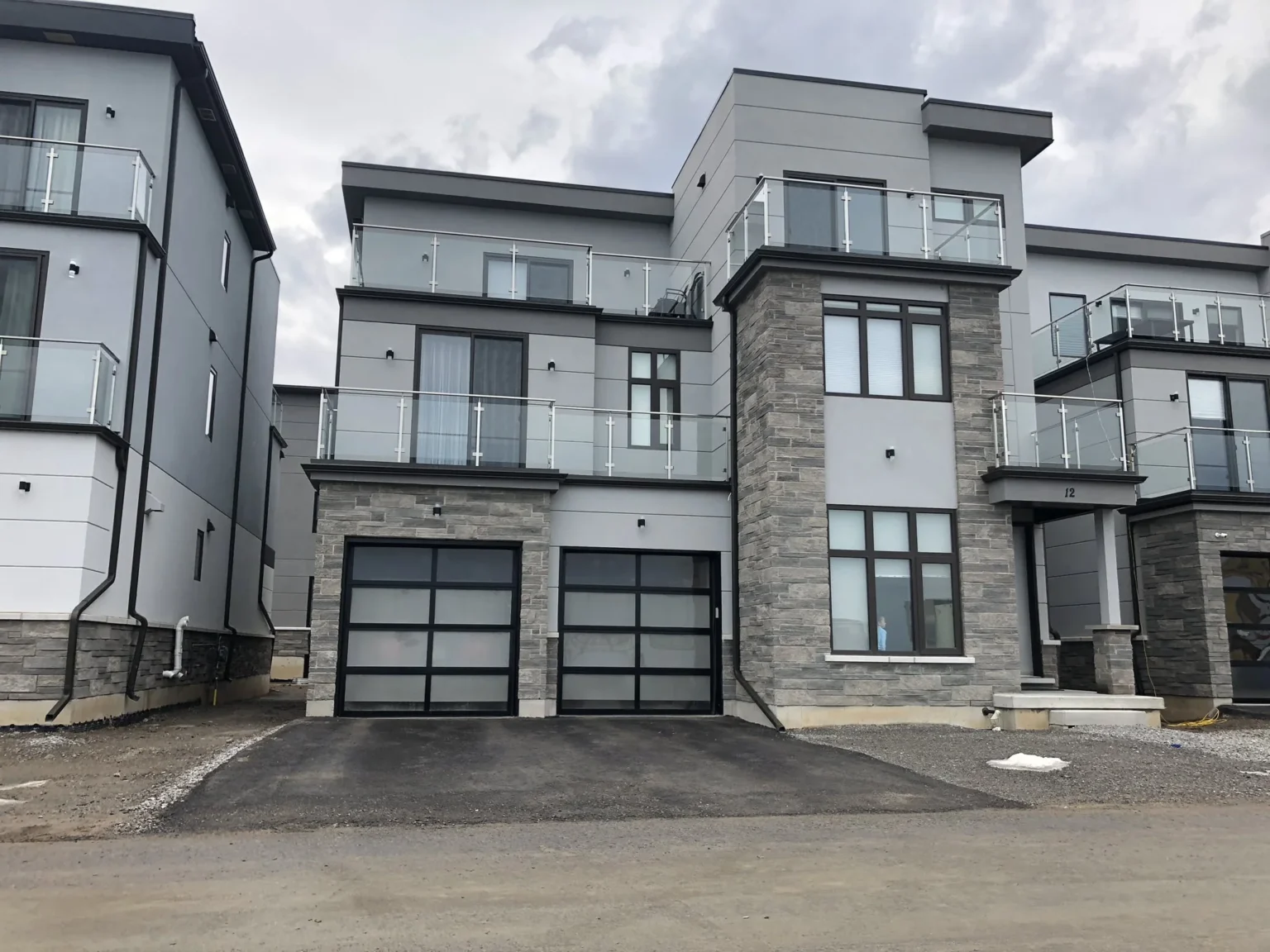
"Can you do just my side?" I hear it every season from owners of semis in Mississauga, Etobicoke and Brampton. One half of the house has a cracked, stained or chalky coat, and the other half belongs to somebody else. Semi-detached stucco repair on one half is normal work, and yes, it can be done without touching the neighbour's wall.
I'm Musa Kastrati, and I've worked on stucco across Halton, Peel, Toronto and York region for 25+ years. Whether a one-half job looks good comes down to three things: where the new coat stops, how that edge is finished, and what you agreed with the people next door before anyone set up a ladder.
Can you repair the stucco on only your half of a semi?
Yes. Each owner can have their own half repaired or refinished. The job needs a planned stopping line, usually a straight vertical joint at or just inside the line between the two halves. That gives the new coat a clean end, so it does not fade into the neighbour's old finish and leave a blurry stripe down the middle of the house.
A small repair is easy: one crack under your window or one hole from an old satellite dish is cut out, meshed and textured on your side, and the neighbour never knows. The question gets harder when the whole front of your half is tired and you want it refinished. Then the new coat has to end somewhere on a wall that reads, from the street, as one house.
The worst version is what I call the patch-and-pray edge: a crew refinishes your half and feathers the last foot into the neighbour's stucco to "blend it". Feathered finish over an old coat is thin, it bonds badly to the weathered surface, and the colour difference shows as a soft, dirty smear. In two winters you have a peeling stripe on the neighbour's wall with your name on it.
Where the new coat stops
There are four honest places to end the work on a semi. Which one is right depends on how the front is built and on how much the two halves already differ.
| Where the coat stops | How it looks | When it suits |
|---|
| A straight vertical joint at the centre of the front | A thin, sealed line from grade to soffit, right where the two homes meet | Most semis: the line already exists in people's minds, so a joint there reads as planned |
| A joint a few inches inside your side | The same sealed line, set back from the neighbour's wall | When the centre falls on a downpipe, a meter or uneven old stucco you should not cut into |
| An outside corner or a pier | No visible joint: the finish turns the corner and stops | Fronts where the two halves step in or out, or where a column or bump-out separates them |
| The whole front of both halves | One coat, one colour, one texture | When the neighbour wants the work too, or both halves are failing |
Done straight, plumb and sealed with a flexible sealant over a backer, a joint looks like the line every semi already has between its two front doors. My guide to what control joints on a stucco wall do explains why a planned line is better than a crack the wall picks for itself.
What to settle with the neighbour before the work
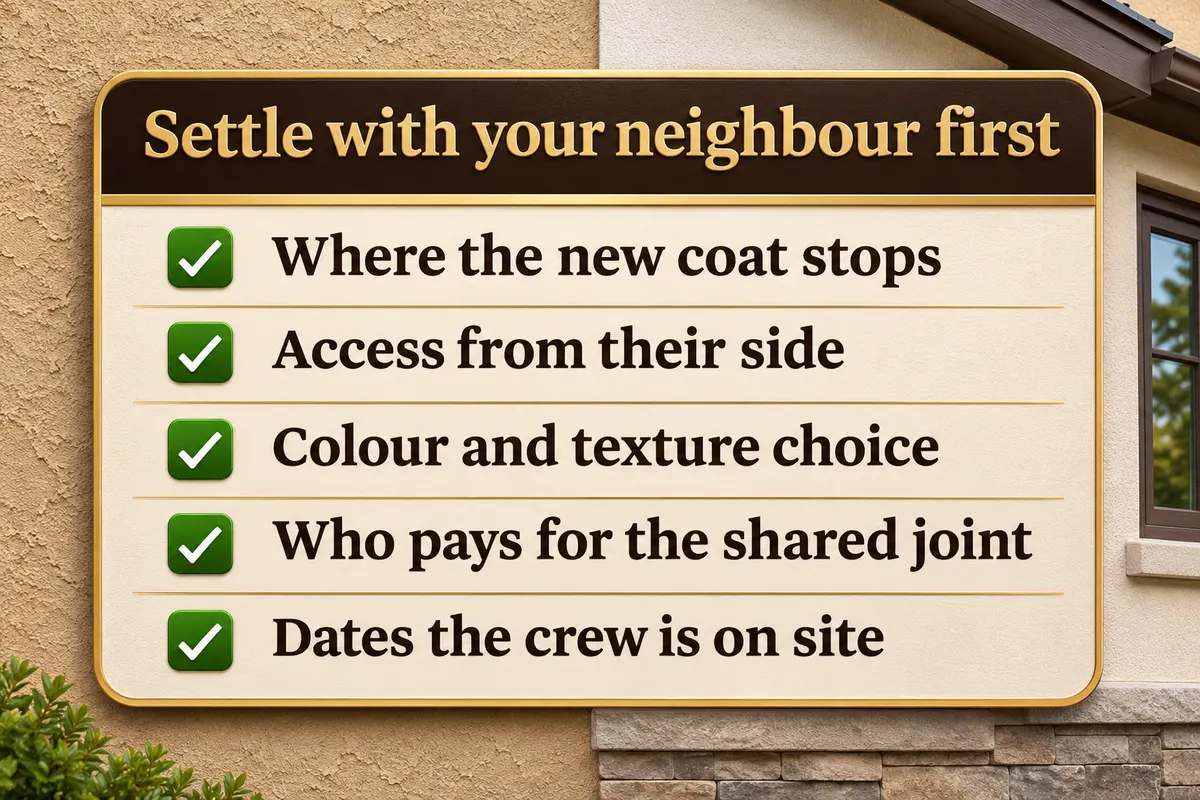
Even when every square foot of new coat is on your side, the last foot of the job sits right against their wall. On many semis the ladder or scaffold for the upper part of that edge has to stand on their walkway or lawn. So talk first, and put the answers in a short note or e-mail you both keep.
- Where exactly the new coat stops: at the centre, a few inches inside your side, or at a corner.
- Whether the crew may stand a ladder or scaffold on their side, and for how many days.
- The colour and texture of your half, so they are not surprised when the scaffold comes down.
- Who pays for the joint at the centre if it serves both halves, for example when you share an existing crack down the line.
- The dates the crew is on site, and how their windows and plants near the line will be covered.
If the two of you own a townhouse in a condominium, the front is usually a common element and the condo board makes the call, a different situation I wrote about in stucco repairs in condos and townhouses. A freehold semi has two private owners and no board, so the agreement is between neighbours. Where the property line runs is on your survey; check it if you are not sure.
Will the new stucco match the neighbour's half?
Close, but rarely exact on an older wall. The neighbour's finish has had years of sun, rain and road dust, so even the same colour code reads a little different beside a fresh coat. Texture also drifts, because every finisher's hand is a bit different. A straight joint makes that difference look planned. Only doing both halves in one batch gives a true match.
| The finish on the front | How close it gets | What helps |
|---|
| Acrylic finish, a few years old | Very close on colour; texture can be matched by hand | A sample board held against the neighbour's wall before ordering |
| Acrylic finish, 10 years or more, sun-faded | The new coat reads cleaner and a shade richer | Choosing a colour a step lighter, and a joint at the centre |
| Painted cement stucco | Good if both halves end up painted the same | Asking the neighbour for the paint name, or a shared repaint of the front |
| Unpainted cement dash or sand finish | Hardest: cement colour changes with the batch and the weather while it cures | A joint at the centre and a texture sample before the full coat |
Matching a patch on your own wall is a slightly different problem, and I've covered it in why stucco patches show and how we match them. On a semi the bar is a little lower, because nobody expects two homes to look identical. People do notice a smear. They don't notice a clean line.
One half or both halves: what the numbers look like
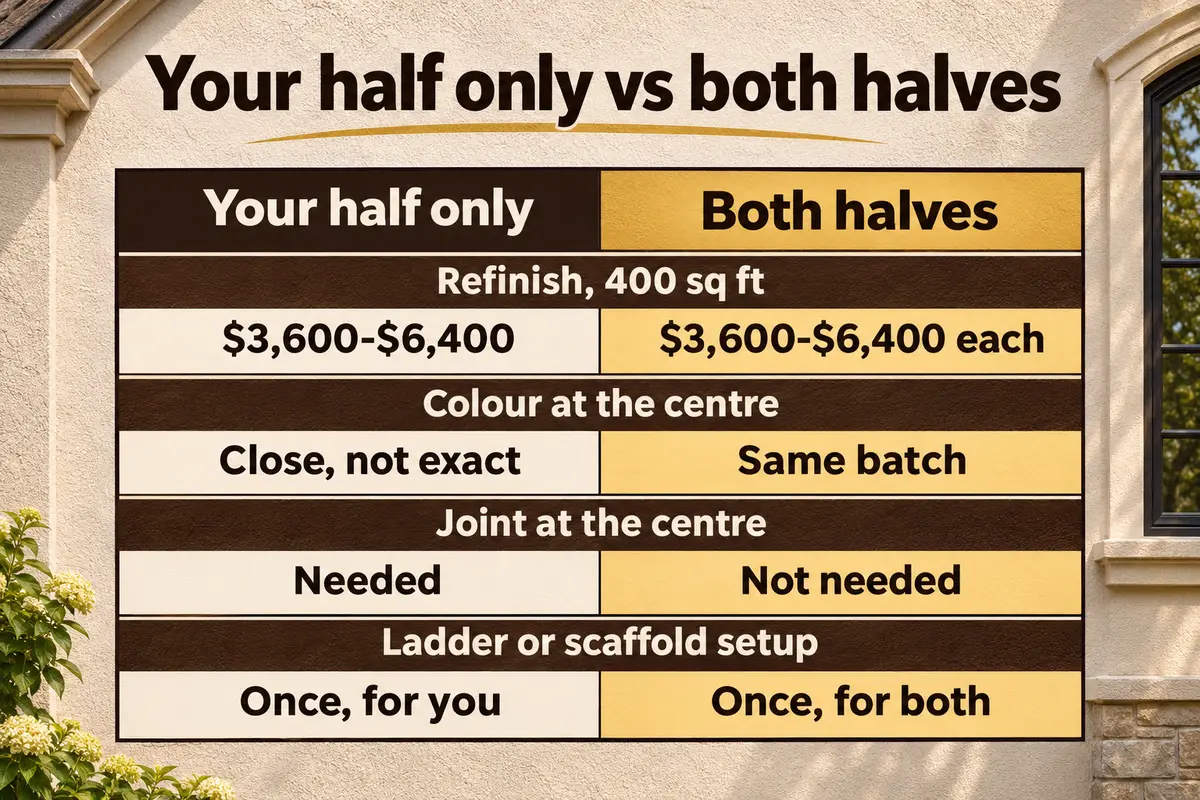
Here are three ways to deal with a tired front, worked out from the prices on our stucco repair page. The square footage is an example: 400 sq ft is a typical front for one half of a two-storey semi once you take out windows and doors, but your own number comes from measuring your wall.
Spot repairs on your half
$120 to $400 per crack
Patches up to about 20 sq ft are $450 to $1,200 each. No joint at the centre is needed.
Right when the coat is sound and the damage is in two or three places.
Refinish your half alone
$3,600 to $6,400
400 sq ft at $9 to $16 per sq ft, plus a sealed joint at the centre at $6 to $12 per linear foot. On a 22-foot-tall front that joint adds $132 to $264.
Right when your half is worn out and the neighbour is not ready.
Both halves together
$3,600 to $6,400 each
800 sq ft in total, the same rate per square foot, each owner paying for their own half.
One colour batch, one texture, no joint needed at the centre, and the ladders or scaffold go up once instead of twice.
If the coat behind the finish is wet or soft, none of these is the whole story: that part of the wall becomes a section rebuild at $18 to $34 per sq ft, and nobody can price it honestly from the driveway. When your half needs more than a refinish, the stucco restoration page explains what a full re-coat involves. A quote written from a car window will not tell you any of this. The fixed price comes after we've tapped the wall and looked at the line.
When an owner tells me "my neighbour is thinking about it too", I write the quote for both halves as two separate numbers. Each family sees its own price and decides on its own.
The crack down the middle of a semi
There is one crack only semis get: a vertical line running from the foundation up the centre of the front, right where the two homes meet. Often one half was re-coated years ago and the other was not, so two coats of different ages butt against each other with nothing between them. Sometimes the two halves were simply built and finished by different crews.
That crack belongs to both houses, and it is worth fixing before winter, because water running down the wall finds it first. The lasting repair is the same detail as the stopping line above: the crack is cut into a straight joint, a backer goes in, and it is sealed. At $6 to $12 per linear foot the cost is small, and on a crack that serves both halves it's normal to split it. A filled crack on that line usually comes back, because the two halves keep moving a little on their own.
Late November is a bad month to start a full refinish: cement stucco needs temperatures above about 5 C to cure, and acrylic finishes need the same mild window. A sealant joint at the centre can often still go in on a dry, mild day. If the damage can't wait, my post on holding stucco damage until spring explains what a proper temporary seal looks like.
Getting a quote for your half of the semi
Send three photos through the contact page, or text them to (905) 973-6470: the whole front of both halves from across the street, the line between the two homes close up, and the worst spot on your side. If the neighbour wants a price too, say so and I'll write two numbers. I call back usually within a day, and the written quote is free and fixed. In Peel, start with the stucco contractor page for Mississauga.