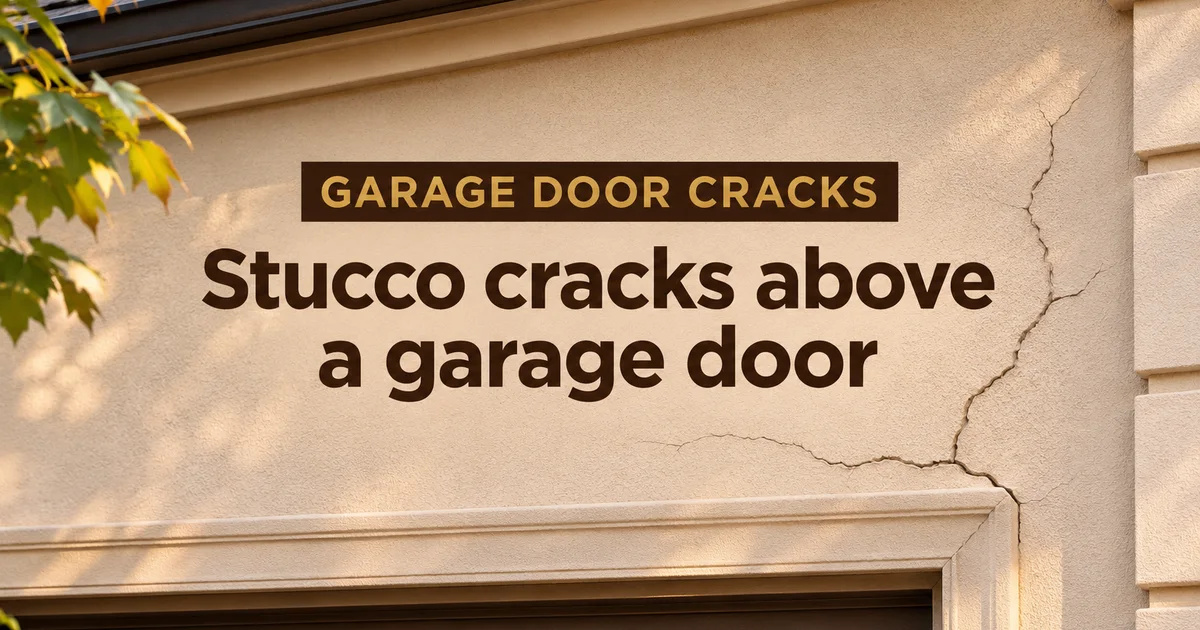
You pull into the driveway, look up, and there it is: a crack in the stucco above the garage door, running up and away from the top corner, or sitting right over the middle of the opening. Stucco cracks above a garage door get my phone ringing more than cracks anywhere else on the front of a GTA house, and the first question is always the same. Is the house moving?
I'm Musa Kastrati, and I've been fixing stucco for 25+ years across Halton, Peel, Toronto and York region. Most of the houses I'm talking about are the two-storey subdivision homes of Erin Mills, Meadowvale, Glen Abbey and Thornhill, with a double garage at the front and a bedroom sitting on top of it. The good news first: the crack's position tells you most of what you need, and you can check the rest from the driveway and inside the garage before anyone gets paid.
Is a crack above the garage door serious?
Most of the time, no. A fine crack running from a top corner of the opening is usually a stress crack in the finish where no extra mesh was laid. It turns serious when the door shows it too: a top panel that rubs, an uneven gap under the header, or a crack that keeps widening over a few weeks.
A garage opening is a different job from a window. A window in a stucco wall is maybe three feet wide. A double garage door is sixteen feet, and the wall above it isn't held up by anything except one beam, the header, which carries the wall, often a floor, sometimes a roof. Every bit of movement in that front wall (heat in July, cold in January, framing lumber drying in its first few years) collects at the ends of that beam. My post on stucco cracks around windows explains the corner part; the garage adds the length of the span and a header that can bend in the middle.
Where the crack starts tells you what moved
Stand at the end of the driveway and find where the crack begins. There are three places that matter, and they mean three different things.
The dashed band is the header, the beam over the opening. The numbers match the cards below.
1From a top corner, on a slant
The most common one by far. The corner of a big rectangle is where the wall's movement gathers, and the finish splits on a diagonal.
If it's fine, stays the same width and the door works, it's a finish repair: the crack was waiting for a mesh strip that wasn't there.
2In the middle of the span
A crack that drops down toward the centre of the door, or a line running along the top of the opening, can mean the header is bending.
This is the one to watch. Check the door (next section) before anyone patches it, because a bending header reopens any patch laid over it.
3On the narrow wall beside the door
The short strip of wall between two single doors, or between the door and the house corner, carries the header's end and resists the wall leaning sideways.
Cracks here, especially in an X or a stair-step pattern, mean the wall is racking. That's a framing question first, the same order I describe for stucco porch columns.
Check the door before you look at the wall again
A header that sags shows on the door before it shows in the stucco. Garage doors run in tracks with a set gap at the top, so even a quarter-inch drop in the beam changes how the door closes. Open and close it a few times and look at these.
| What you see | What it points to |
|---|
| The top panel scrapes the header or the trim at one end | The header has dropped on that side, or the opening is no longer square |
| The gap between the closed door and the header is wider at the ends than in the middle | The beam is bowing down in the middle of the span |
| The rubber seal across the top is crushed flat in one spot | Something above is pressing down there |
| A drywall crack inside the garage at an end of the header, or a dip in the ceiling of the room above | The movement is in the framing, not only the outside coat |
| The door works smoothly and nothing inside has changed | The crack is most likely in the finish alone |
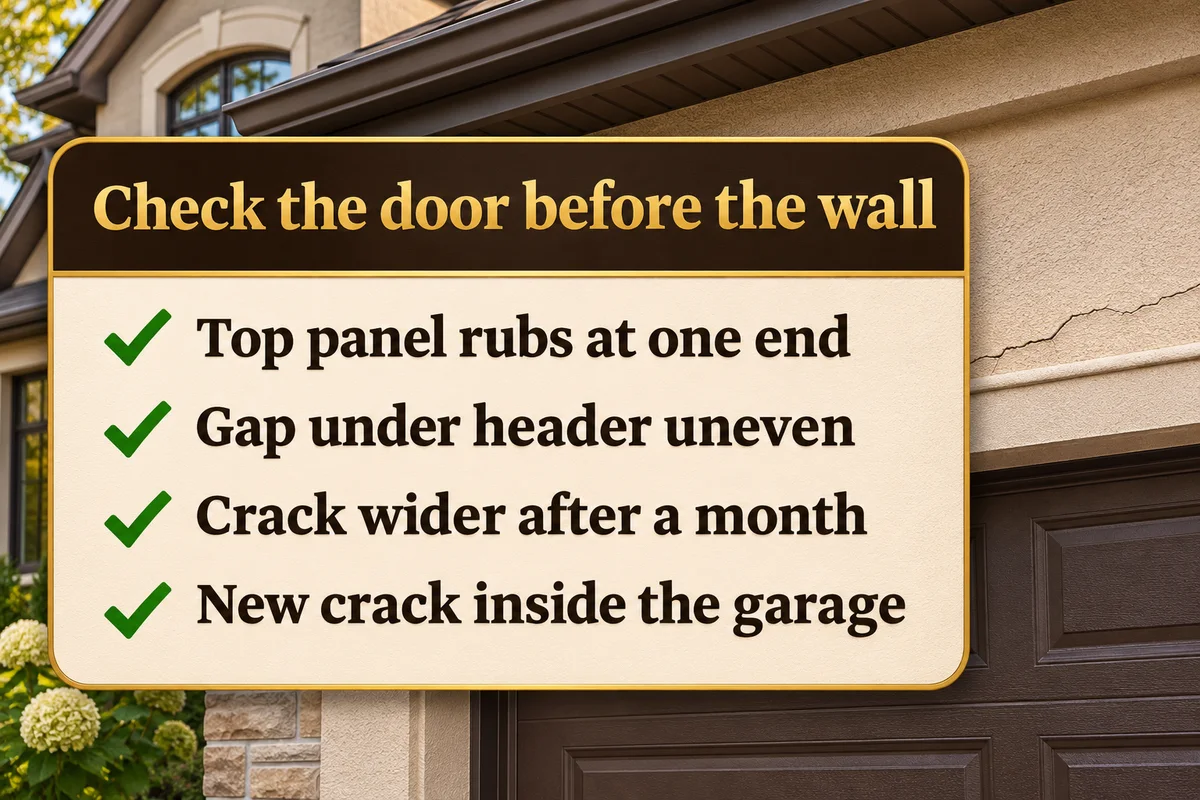
If two or more of those rows are true, the first call is a carpenter or a structural engineer, not a plasterer. I'll say that against my own trade: patching stucco over a header that is still moving is money spent twice.
Watch the crack for a month
One look can't tell you whether a crack is finished moving. A month of pencil marks can, and it costs nothing.
- Draw a short pencil line across the crack at each end, right where it stops, and write the date beside it.
- Take a photo of each end with a tape measure or a bank card held flat beside it, so the width is in the picture.
- Check after the next hard frost and again after a mild, wet week. The GTA gives you both in November.
- If the crack has run past your pencil line, or the card no longer covers it, it's still moving. If nothing changed in four weeks, it's most likely done.
The edge of a bank card is a handy gauge because everyone has one and it's a little under a millimetre thick. This is how I sort what I'm shown, not a rule from a code book:
Thinner than the card edgeA hairline in the finish. Repair it at the next good-weather visit; it is not urgent.
About the card edge, and stableRoute, mesh and re-texture it before water works in. Spring is fine if it hasn't moved in a month.
Wider, or still growingCheck the door and the inside first, then get someone to look at the header before the stucco is touched.
Two things every attached garage does to that wall
The garage is cold. On most of these houses it isn't heated, so in January the wall over the door sits much colder than the house wall a few feet away, and it moves more with each freeze and thaw. Any small crack there gets worked harder than one on the living room wall. If you also see dark streaks or efflorescence under the crack, water is getting in; my post on stucco control joints explains why a long wall like this one needs places to move on purpose.
The door opener hangs off the header. The bracket for the opener rail is usually screwed into the framing right above the door, and every time the door opens the motor pulls on it. If the bracket was fixed into the drywall or into a single thin board instead of the header itself, the pull goes into the wall. A crack that sits directly above the opener bracket, in the middle of the span, is worth a look from inside with a flashlight before anyone blames the beam.
Did someone widen the opening?
A lot of these houses started with two single doors and a pier between them, and later got one sixteen-foot door. That job takes the pier out and puts in a longer header, and it is a structural change, not a door swap. The City of Toronto's page on when you need a building permit lists enlarging or relocating existing windows or doors among the alterations that need one.
If you bought the house with a double door and see a long patch line in the stucco where the old pier was, or cracks running out from that line, ask the seller or the city whether that work was permitted. Other GTA municipalities have their own permit pages; check yours before anyone changes an opening.
What does it cost to fix stucco cracks over a garage door?
Most garage door cracks cost $120 to $400 each to route, mesh and re-texture on our price list. A loose or hollow area up to about 20 sq ft is $450 to $1,200. If a carpenter has to replace or brace the header, the strip of stucco over it comes off first and is rebuilt afterwards at $18 to $34 per square foot.
Those numbers come from the same lines as every repair on our stucco repair price list. The carpenter's or engineer's part isn't on our list, because it isn't our work, so get it priced separately before you compare totals.
| What you have over the door | The repair | Price on our list |
|---|
| A corner crack, door works fine | Crack routed, mesh bedded across it, base coat and texture matched | $120 to $400 per crack |
| Cracks plus a spot that sounds hollow when you knock | The loose coat removed to firm edges, lath renewed if it rusted, filled and textured to the wall | $450 to $1,200, up to about 20 sq ft |
| Header being fixed or replaced by a carpenter | Stucco over the header taken off first, rebuilt after the framing is done | $18 to $34 per sq ft |
| Patches that would show on the whole garage front | New base coat, mesh and finish across the elevation | $9 to $16 per sq ft |
Take a double door, with sizes I've picked to show the arithmetic. Two corner cracks at $120 to $400 each come to $240 to $800. One crack over the middle of the span adds $120 to $400. A 12 sq ft spot over the door that sounds hollow is a patch at $450 to $1,200. That's $810 to $2,400 if the door checks out fine.
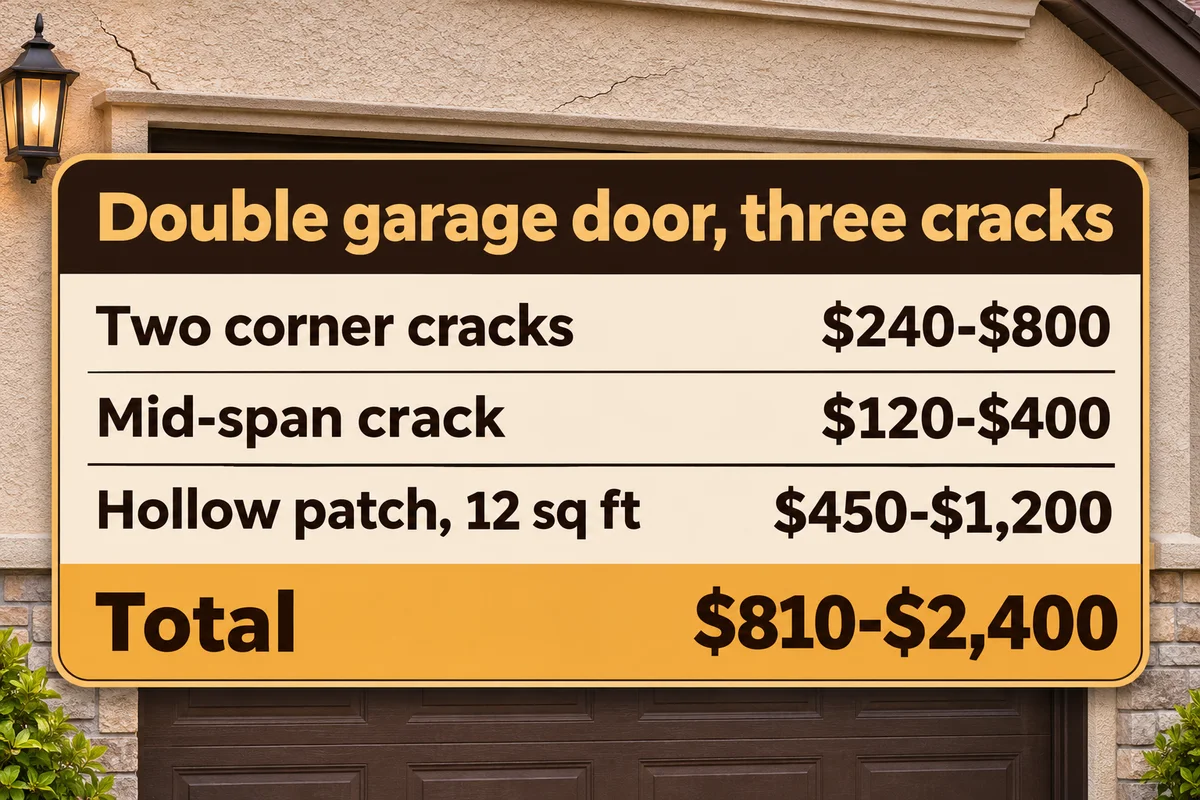
Now say the door rubs and the carpenter replaces the header. The stucco over a sixteen-foot opening, two feet high, is 32 sq ft taken off and rebuilt at $18 to $34, which is $576 to $1,088, plus the carpenter's price. And if the new work would stand out on a garage front everyone sees, refinishing 300 sq ft of it at $9 to $16 adds $2,700 to $4,800. My post on matching a stucco patch covers when you can skip that.
What I'd skip: the $99 patch-and-pray visit that smears a tube of caulk into the crack and paints over it. Caulk on a textured wall stays shiny and catches dirt, so you end up with a dark stripe over the door, and if the header is still moving the crack opens again right beside it.
Found it in November?
A fine crack over a garage door can sit through a GTA winter. Mark it, photograph it and watch it through December; you'll know more by spring than any of us can tell you today. A crack you can see daylight through, or a piece of stucco that has come loose over the door, should be covered before the freeze-thaw season starts pushing water into it.
Send me photos of the crack and of the closed door through the contact page, or text them to (905) 973-6470. I call back usually within a day, and the written quote is free and fixed. In Peel, start with the Mississauga stucco page; in Halton, the Oakville stucco page.