Somewhere between signing the quote and the first van pulling up, every homeowner asks me the same thing: how long is this going to take? The honest answer to how long a stucco job takes is two numbers, not one: the days my crew is standing on your property, and the days between the scaffold going up and the scaffold coming down. On a crack repair those match. On a full re-clad they are nowhere near each other, and the gap is the part nobody explains at the kitchen table.
How long does a stucco job take on a GTA house?
A crack repair is one day. A patch with a texture match runs three to five days. One elevation refinished takes about a week. A whole-house refinish is two to three weeks, and a full insulated re-clad is three to five weeks from setup to final walkthrough. Crew time is roughly half of that.
The calendar number is what you plan your summer around. Homeowners book a backyard party for the Saturday after “ten days of work,” then find out that day nine was a cure day and day ten got rained out. Nothing has gone wrong when that happens — the schedule simply meant something different to them than it did to the crew.
| Job | Crew days on site | Typical calendar time | Where the gap comes from |
|---|
| Single crack repair | 1 day | 1 day | Nothing to wait for |
| Patch and texture match | 1–2 days | 3–5 days | The patch has to cure before the finish is matched over it |
| One elevation refinished | 2–4 days | About a week | Base coat cure, plus a dry window for the finish |
| Whole-house refinish, sound walls | 5–10 days | 2–3 weeks | Cure days between coats, worked elevation by elevation |
| Full insulated re-clad | 10–15 days | 3–5 weeks | Tear-off, substrate repairs, foam, base coat, cure, finish |
Height is the biggest single mover inside those ranges. A bungalow in Milton that is mostly reachable off a low frame runs faster than a three-storey in Kleinburg where every stage waits on a scaffold move. Detailing is second: banding, reveals and deep window returns are all extra passes, and they stretch a custom home exterior past what its square footage suggests.
Commercial work runs on a different clock. On a plaza or a condo podium the constraint is access and tenants rather than material: night and weekend phasing, keeping an entrance open, working around a property manager. Those jobs run longer on the calendar and shorter per working day, which is why commercial stucco gets scheduled separately.
Why does the crew disappear for days in the middle of the job?
Because the wall is doing work even when nobody is standing in front of it. Every coat has to reach strength before the next one goes over it. Coming back too early, onto a base coat that is still green, is how you end up with a finish that lets go of the wall two winters later.
This is the biggest source of friction on a stucco job, and it is avoidable friction: from the driveway, a curing wall and an abandoned wall look identical. Here is what is actually happening, stage by stage, on a full insulated re-clad.
| Stage | What happens | What has to be true before the next stage |
|---|
| Setup and protection | Scaffold or lifts up, ground and windows protected, bin placed | Nothing — this is the one stage weather barely touches |
| Tear-off and substrate check | Old cladding comes off and the sheathing gets read wall by wall | Anything wet or rotten is replaced before it gets covered |
| Water management | Weather-resistive barrier, flashings, weep screed at the base | Every penetration detailed before insulation hides it |
| Insulation board | Foam adhered or fastened, joints rasped flat | The board is flat and dry — every wave shows in the finish |
| Base coat and mesh | Fibreglass mesh embedded, diagonal patches at opening corners | The base coat is cured hard and dry — the main pause in the job |
| Finish coat | Tinted acrylic finish, one continuous pass per elevation | Warm dry hours from start to finish on that elevation |
| Sealants and takedown | Joints sealed, scaffold down, site cleaned | A walkthrough with you before anybody leaves |
Look at where water management sits. Barrier, flashings and weep screed go on before a single sheet of foam, and once insulation is up none of it can be corrected without taking the wall back off. That is why I will hold a job for a day to get a head flashing right, and why that metal matters more than any bead of sealant.
Does a cement stucco job take longer than an insulated re-clad?
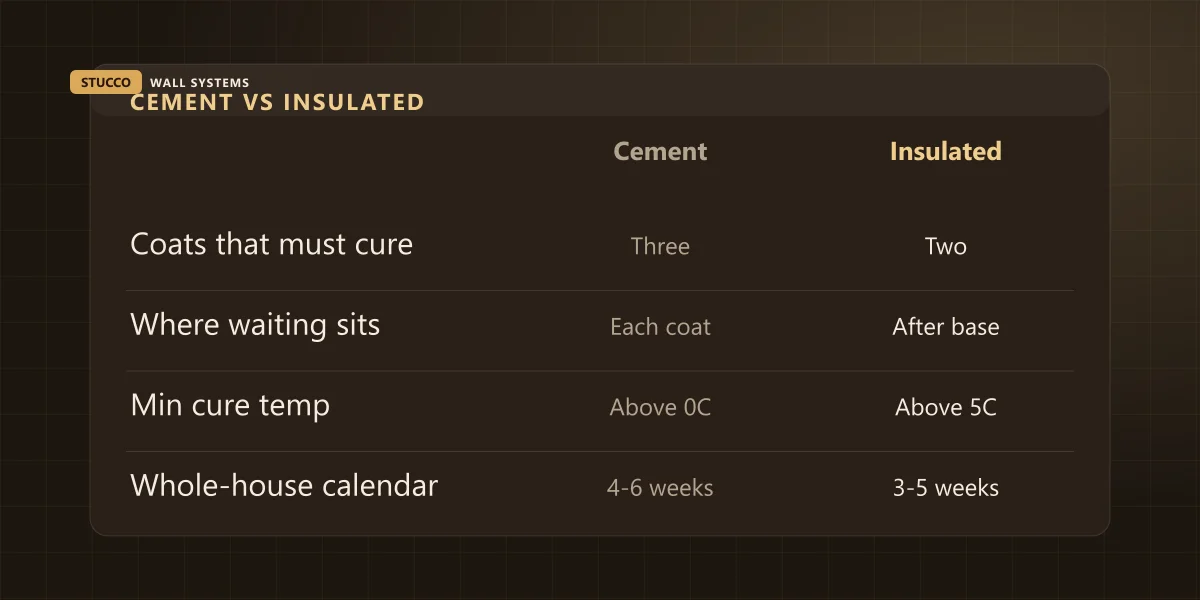
Usually yes, by about a week on a whole house. Traditional cement stucco is three separate coats and each one cures before the next goes onto it. An insulated system has one main pause, after the base coat. More coats means more waiting — not more labour, and not a better or worse wall.
| What differs | Traditional cement stucco | Insulated re-clad (EIFS) |
|---|
| Coats that have to cure | Three, in sequence | Two — base coat, then finish |
| Where the waiting sits | After every coat | Mostly after the base coat |
| Minimum cure temperature | Above 0°C, sustained | Above ~5°C, sustained for the finish |
| Typical whole-house calendar | 4–6 weeks | 3–5 weeks |
| What lengthens it most | A cool, damp stretch between coats | Bad sheathing found at tear-off |
That extra week is not a reason to choose one system over the other. Which one belongs on your house is a substrate and insulation question, and I go through it honestly in EIFS versus traditional stucco. It is a reason to know which one you bought before planning a date around it.
New construction is the one case where the timeline is somebody else’s problem as much as yours. New build stucco sits inside a general contractor’s schedule and gets squeezed from both ends, and cure windows do not move because an occupancy date was promised.
What actually stops the clock on a stucco job?
Five things, roughly in the order I meet them: rain on a finish day, overnight lows near freezing, bad sheathing found at tear-off, a colour that still has not been approved, and a driveway nobody can get into. Only one of those five is genuinely unpredictable. The other four get handled before we start.
| What stops it | What it actually costs | Can it be planned around? |
|---|
| Rain during a finish day | The whole elevation, not the hour it rained | Partly — we watch the forecast and re-sequence |
| Overnight lows near freezing | A finish day, sometimes a run of them | Yes, by booking inside the season |
| Wet or rotten sheathing at tear-off | Two to five days, plus a change to the price | No — nobody knows until the old wall is off |
| Colour or texture not signed off | Days, occasionally a full week | Yes — approve the sample panel before we start |
| Blocked driveway, locked gate, no water | Half a day, every single time | Yes, and it is the cheapest one on this list to fix |
The rain one surprises people. A finish coat goes onto one elevation in a single continuous pass, wet edge into wet edge. The crew stops at a corner, a control joint or a reveal, never in the middle of a clean field of wall. Stop halfway across and the two halves set at slightly different rates, and you get a band across the front of your house that will not rub out. So when the sky opens at eleven, we do not lose two hours. We lose that elevation for the day.
The overnight low governs the season, not the daytime high. A cement coat needs to hold above 0°C, sustained; an acrylic finish wants to stay above roughly 5°C. A warm afternoon in late October does nothing for a finish that spends the night at minus two. Frost dates are not the same right across this region either, and Environment and Climate Change Canada publishes station-by-station climate normals at climate.weather.gc.ca if you want your own numbers. The month-by-month booking picture is in the best time of year for stucco work in the GTA.
Sheathing is the honest wild card. Until the old cladding is off, nobody — me included — knows what is behind it. On a wall that has been quietly wet for years, replacing sheathing adds days and adds cost, and it is the one line on a quote that has to be able to move. If you already suspect something back there, the symptoms are in 6 signs water is behind your stucco.
What should I do before the crew arrives?
Clear about two metres around the whole house, get vehicles off the driveway for the duration, make sure we can reach an outdoor tap and an exterior outlet, and take down anything screwed to the wall. That is half a day of your time, and it removes the most common reason a working day gets lost.
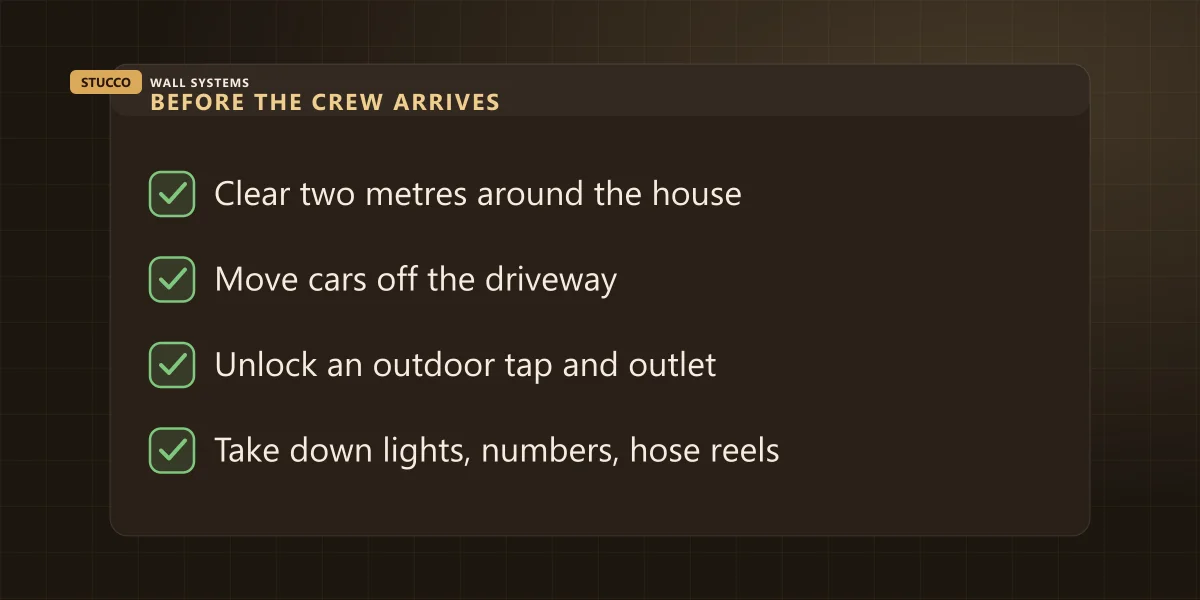
Two metres sounds like a lot until you stand next to a scaffold frame. Anything inside that band gets moved or protected: patio furniture, planters, the barbecue, the trampoline, garbage bins. Shrubs tight to the wall are worth a conversation before day one — we cover what stays, but a mature hydrangea against the foundation will have a hard week either way.
The driveway is the thing people underestimate. Materials land there, the mixer sits there, and on a re-clad the bin sits there for the duration. If you have two cars and a single drive, work out where the second one lives before we start — “just for today” street parking in most GTA municipalities turns into a ticket by the third day.
Anything screwed to the wall comes off before the finish goes on, and the light ones are cheaper if you do them yourself: house numbers, hose reels, address plaques, flag brackets, the satellite dish nobody has used in years. Anything wired stays with us. Then tell us what we cannot see — where the air conditioner lines enter, where the sprinkler heads sit, whether a window well is hidden under the gravel.
One more, and it costs you nothing: pick your colour and sign off a sample panel before day one. Approved on site before the scaffold goes up, that is a half-hour conversation in week one. Left to week three, it is a wall standing still while three people compare swatches in the sun.
Can we live in the house while the work is going on?
Almost always, yes. Exterior work does not touch anything inside the house — nothing gets disconnected, nobody needs to be home, and we do not need access indoors. What changes is noise through the working day, windows kept shut on whichever elevation is being coated, and a driveway you cannot use.
Noise is worth being honest about. Tear-off is the loud part, for a day or two. Grinding out cracks is loud in short bursts. Mixing is a steady hum rather than a hammer, and cure days are silent because nobody is here. If you work from home, the loud days and the quiet days alternate rather than blending into a fortnight of drilling.
Keep windows and doors shut on the elevation being worked. Not because of fumes — an acrylic finish is not a solvent product — but because dust and spray drift, and a fresh finish coat marks if someone pushes a window open into it. For parents and dog owners: the base of the scaffold is not a play area. We rope it and sign it, but a five-year-old is faster than a rope.
Why “we’ll be done in a week” is a red flag on a re-clad
Because cure time is not optional and cannot be compressed. If somebody quotes a whole-house re-clad in five days, either they are skipping stages or they are putting coats onto coats that are not ready for them. Both of those show up on the wall, and both of them show up after the cheque has cleared.
I have repaired plenty of walls where the timeline was the tell. A finish rushed onto a green base coat debonds — it comes away in sheets rather than crumbling, and sounds hollow when you tap it. A cement job that missed its cure window leaves a chalky surface that dusts off onto your hand. Neither shows the day the scaffold comes down: a rushed wall and a properly cured wall look the same to you for the first year or two. That is also roughly how long the $99 patch-and-pray crowd stays reachable by phone.
So compare the schedules along with the prices. A quote carrying a realistic number of days and a line about weather contingency was written by somebody who has done this before. A quote with no timeline at all — the car-window ones, which remain the only quotes I will roast here — tells you nothing about when your house gets finished. The layer-by-layer version is in why the cheapest stucco quote always costs the most.
The flip side is also true: a long timeline is not automatically a careful one. Ask what the pauses are for. Cure time between the base coat and the finish is a good answer. Vague is not, and neither is a crew that has started three houses at once and rotates between them — that is your job filling gaps in somebody else’s schedule.
The honest bottom line
Plan on the calendar number, not the crew-day number. Ask which system is going on your house, because that decides how many cure pauses are built into the schedule before anybody picks up a trowel. Clear the perimeter and the driveway before day one, approve your colour early, and treat the quiet days in the middle as the wall working.
One last date if painting is anywhere in your plan: fresh cement stucco needs a minimum of 28 days before any coating goes on it, longer in cool or wet weather — the rest of those rules are in painting stucco correctly. An integral-colour acrylic finish skips that clock entirely, because the colour is already in the material.
If you want a real schedule for your own house rather than a range, send me the address and a few photos or call (905) 973-6470. The assessment is free and the quote is written and fixed, with the stages and a realistic calendar on it — whether it is a repair or a full residential re-clad. We cover Oakville, Mississauga, Toronto and the rest of our service area, insured and WSIB covered, with 25+ years of walls in our project portfolio — including a Milton EIFS exterior renovation that ran this exact sequence — and 4.3 stars from 12 Google reviews.