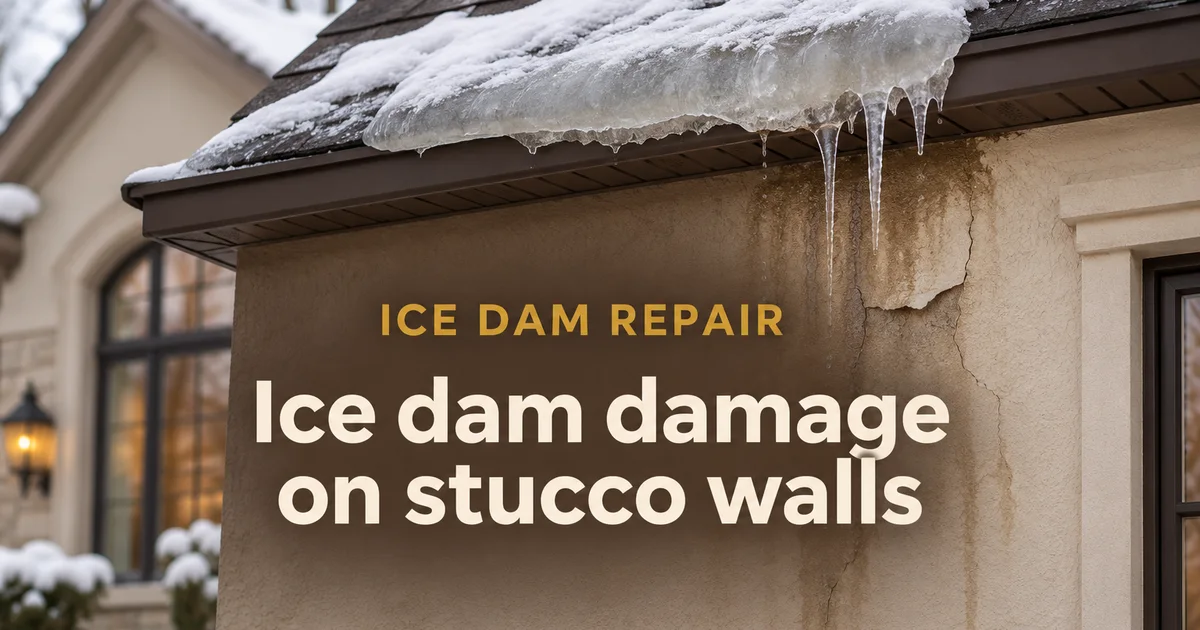
The ice dam calls come in March, not January. In January the owner sees a row of icicles as thick as a forearm and thinks the house looks like a Christmas card. In March the ice is gone and there's a dark band of wet stucco under the soffit, a brown streak at the corner, and a ceiling stain upstairs along the outside wall. That's ice dam damage on a stucco wall, and it almost always sits in the same place: the top two or three feet under the eaves.
I'm Musa Kastrati, and I've repaired stucco across Halton, Peel, Toronto and York region for 25+ years. The roof gets the blame for an ice dam, and the roof is where it starts. But the money usually goes on the wall, because that's where the water ends up and where it sits through every freeze and thaw until spring.
How does an ice dam get water into a stucco wall?
Heat from the house melts the snow on the upper roof. The water runs down to the cold overhang and freezes into a ridge. More meltwater ponds behind that ridge, backs up under the shingles at the edge, and drips into the soffit and the top of the wall below. Stucco there stays wet for weeks.
Follow the water from the roof down. These are the four stops it makes on a stucco house.
-
Under the shingles at the eave
Shingles shed water running downhill. They do nothing against water standing in a pond behind a ridge of ice. On a roof with no membrane under the bottom few feet of shingles, the pond finds the nail holes and the joints and drips through the roof deck at the overhang.
-
Into the soffit and behind the fascia
The overhang is a hollow box. Water that came through the deck lands on the back of the fascia board and on the soffit panels. A fascia that stays wet all winter softens, and a gutter full of ice weighs enough to pull its hangers out of soft wood. You'll often see drips or frost at the soffit vents.
-
Down the top of the wall sheathing
The stucco usually stops an inch or so under the soffit. Water running along the underside of the overhang finds that top edge and gets in behind it, onto the sheathing membrane and the wood sheathing. Behind a cement stucco wall it runs down until it meets something that stops it, often the head of the first window.
-
Into the stucco band itself
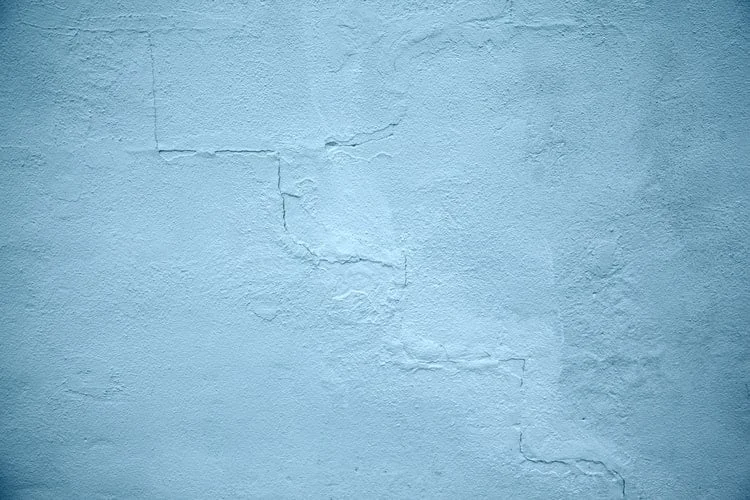
Cement stucco is a hard sponge. The top band soaks up water from behind and from the drips off the icicles in front, then freezes. Each freeze opens the pores a little more, and by spring the finish coat starts to crack and let go along a line parallel to the soffit.
On an EIFS wall the story is different. The foam board does not soak water up, so the water runs behind it, and the thin finish on the face loses its grip on wet foam. The wall goes soft when you press it, and the band under the eave can bulge out.
Icicles add their own damage on the way down. They drip onto window heads, foam bands and ledges, and the water that hits a flat ledge freezes there overnight. A ledge right under a long eave is the first place I look for cracks.
What shows on the wall, season by season
The confusing part of an ice dam is the delay. The water goes in during the freeze, and the stucco shows it weeks or months later. Each season leaves its own mark on the band under the eave.
January and February, ice on the roof
Icicles hanging over a stucco wall, ice sheets frozen onto the stucco face, frost or drips at the soffit vents.
Inside, a stain on the ceiling along the outside wall or a wet spot at the top of a window frame upstairs.
The first thaw
A dark band under the soffit that stays dark a day or two after the rest of the wall has dried. Brown streaks running down from the fascia or a corner.
Photograph it now. That band is the outline of where the water went in, and it fades in a week.
April and May
Hairline cracks running along the wall one to three feet below the soffit, white bloom on the stucco, paint blisters, flakes of finish on the ground. A knock with your knuckle sounds hollow in places.
On EIFS, soft spots or a slight bulge in the same band.
Summer
The wall looks dry and most people forget about it. The sheathing behind it may still be wet, and wood that stayed wet since February keeps rotting through the warm months.
A moisture reading tells you what your eyes cannot.
If you saw the dark band in March and the cracks in May, you have your answer. My guide to how a stucco wall gets tested for moisture explains how the wet area behind the band is mapped before anyone cuts.
Is it the ice dam or something else?
A stain under the eaves is not always an ice dam. An ice dam leaves a band along the length of the eave that shows after a cold, snowy spell. Overflowing eavestroughs, a missing kick-out flashing and condensation from inside leave marks in different places, at different times of year.
| Cause | Where the mark sits | When it shows |
|---|
| Ice dam | A band right under the soffit, along the eave, longest over heated rooms | At the thaw after weeks of snow on the roof |
| Eavestrough overflow | Streaks under a sagging run or a plugged downspout | After any heavy rain, spring or fall |
| Missing kick-out flashing | A fan-shaped stain where a lower roof ends against the wall | Every rain, worse with wind |
| Condensation from inside | Wet sheathing on cold walls, often near a bathroom | Late winter, with or without ice on the roof |
Two of these can happen on the same wall. The kick-out problem is covered in my post on where a roof meets a stucco wall, and the wall that gets wet from the inside is in the wet stucco wall the rain did not cause.
The order of the fix, and whose trade each step is
Fix the cause before the wall. If the roof edge still dams up next winter, a new stucco band gets the same water and you pay twice. The heat loss and the roof edge come first, then the gutters, soffit and fascia, then the stucco.
| Step | The part | Who usually does it | Done right, it looks like |
|---|
| 1 | Attic air leaks and insulation | An insulation contractor or energy advisor | Snow sits evenly on the roof instead of melting in patches |
| 2 | The roof edge | A roofer | A membrane under the shingles along the eave, so a pond cannot drip through |
| 3 | Eavestrough and downspouts | Our roofline crew | Troughs pitched to the outlets, downspouts clear and emptying away from the wall |
| 4 | Soffit and fascia | Our roofline crew | Sound fascia board, dry soffit, vents open |
| 5 | The stucco band | Our stucco crew | Wet stucco cut back to dry, sheathing checked, rebuilt and finished to match |
The first step is the one people skip. CMHC's About Your House sheet on attic venting, attic moisture and ice dams points to warm air leaking from the house into the attic as the source of the heat that melts the snow. Sealing those leaks is attic work, and it's worth doing before anyone touches the outside.
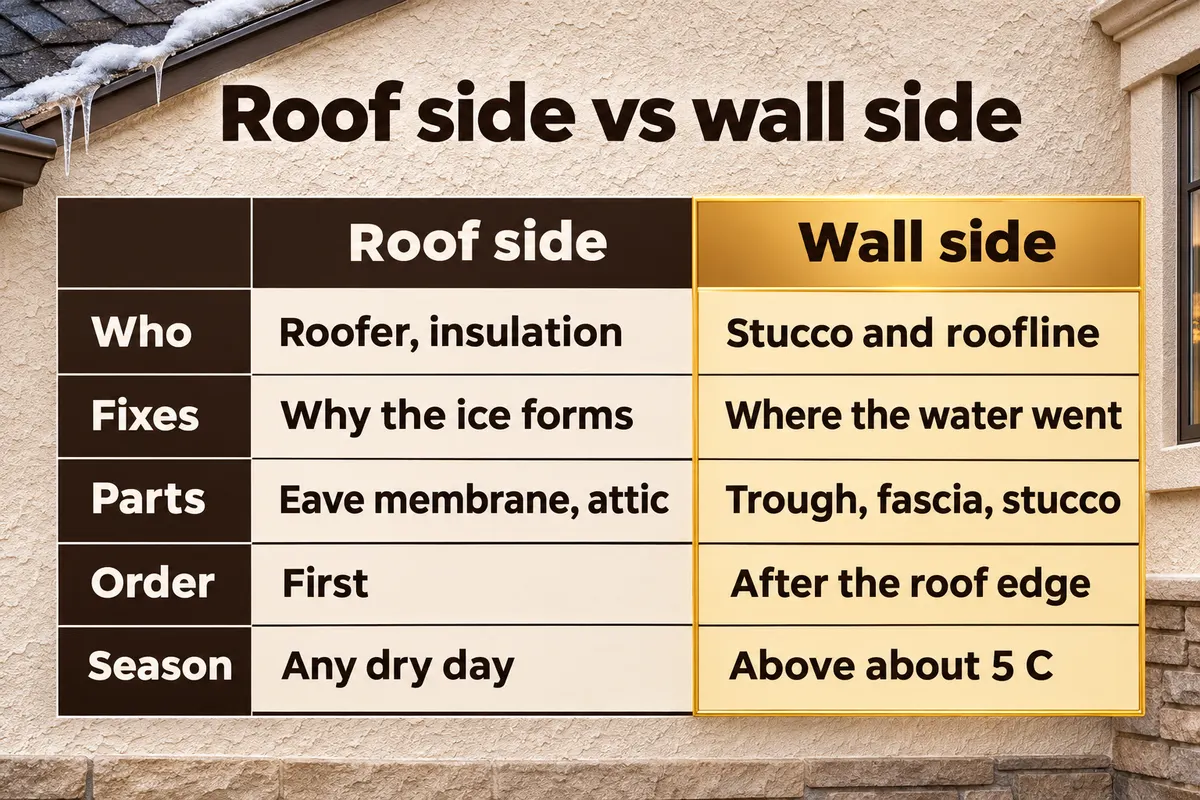
Steps three to five are ours, and they are best done as one job. The eavestrough comes off for the fascia, the fascia has to be sound before the stucco under it is closed up, and one crew on one scaffold costs less than three visits. The details of that work are on our soffit and eavestrough page.
What does ice dam damage on a stucco wall cost to repair?
On our soffit and eavestrough page, an eave wall soaked by ice dams runs $1,500 to $5,000 and up. Where a job falls in that range depends on how deep the water went: a stained band that only needs a refinish sits at the bottom, a rotten fascia and a rebuilt band in the middle, and wet sheathing at the top.
| The work | Price on our list | On an eave wall, it covers |
|---|
| Eavestrough | $12 to $20 per linear ft | New one-piece runs and outlets along the damaged eave |
| Soffit and fascia | $18 to $30 per linear ft | The rotten fascia board and the soffit behind it |
| Crack repair, routed and meshed | $120 to $400 per crack | A single crack where the band is still hard and dry |
| Section rebuild after water damage | $18 to $34 per sq ft | The wet band cut back, dried, rebuilt to the substrate |
| Elevation refinish | $9 to $16 per sq ft | A new finish so the repaired band and the old wall match |
The stucco rows come from our stucco repair price list. Rotten sheathing or a wet top plate is a separate line, and nobody can price it honestly until the stucco is off. A written quote should say so instead of hiding it in one round number.
Here is one eave wall worked through. The sizes are my example: the back of a two-storey house with a 30 ft eave, a wet band 2 ft deep along 20 ft of it, 12 ft of soft fascia, and the rest of the band refinished so the patch does not show.
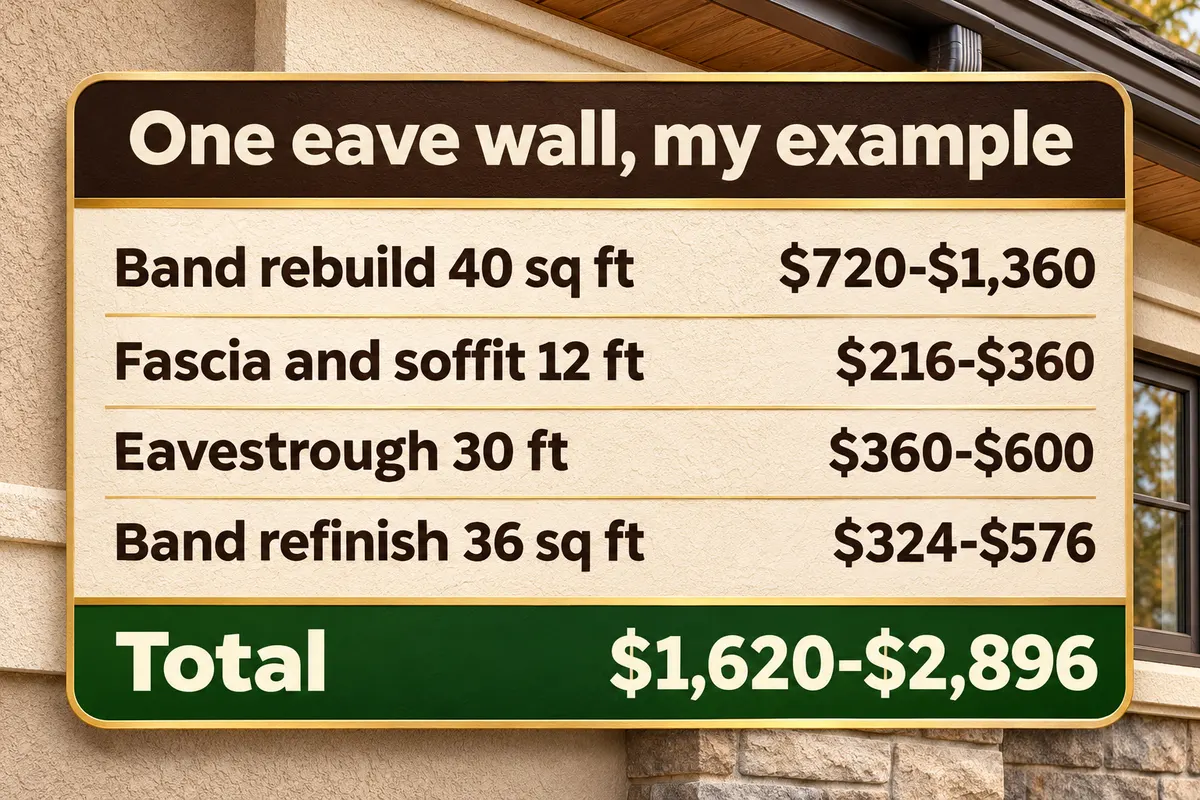
The wet band is 40 sq ft, rebuilt at $18 to $34, so $720 to $1,360. The soft fascia and the soffit behind it are 12 ft at $18 to $30, so $216 to $360. A new eavestrough along the full 30 ft at $12 to $20 is $360 to $600. Refinishing the other 36 sq ft of the band at $9 to $16 adds $324 to $576. The total is $1,620 to $2,896, before any sheathing the open wall shows.
Now compare a quote written from a car window: "patch stucco under roof, $500". It paints over a wet band in May, the band goes dark again next March, and you pay the full price anyway, one year later.
What not to do this winter
A few habits turn an ice dam on the roof into a much bigger repair on the wall. These are the ones I see most in the GTA.
- Chipping the ice off the eave with a hammer or a shovel. It tears shingles and the gutter, and the hangers rip out of a fascia that is already wet.
- Throwing salt pucks or de-icer on the roof. The brine runs down over the stucco and does to the top of the wall what road salt does to the bottom of it.
- Melting the ice with a hose. The water refreezes on the stucco below, on the ledges and in the cracks.
- Stuffing foam or caulk into the soffit vents or the gap at the top of the stucco to stop the drips. The water stays in the wall, and the attic loses the air it needs.
- Pressure washing the dark band in spring to make it look better. It drives more water into stucco that is already wet.
A roof rake from the ground, used gently on the bottom few feet of snow, is the safe way to take load off the eave. If water is already coming in, the wall can be covered until it's warm enough to rebuild: my post on holding stucco damage until spring shows what a good winter cover looks like. Stucco needs temperatures above about 5 C to cure, so in the GTA the rebuild happens between roughly April and November.
Getting your eave wall looked at
Send three photos through the contact page, or text them to (905) 973-6470: the whole wall under the eave, a close-up of the worst spot, and any stain inside. If you have a photo from the winter showing the icicles or the dark band, send that too; it saves a lot of guessing. I call back usually within a day, and the written quote is free and fixed. In Halton, start with the Oakville stucco page, and for what else water does behind a wall, see my guide to signs of water behind stucco.