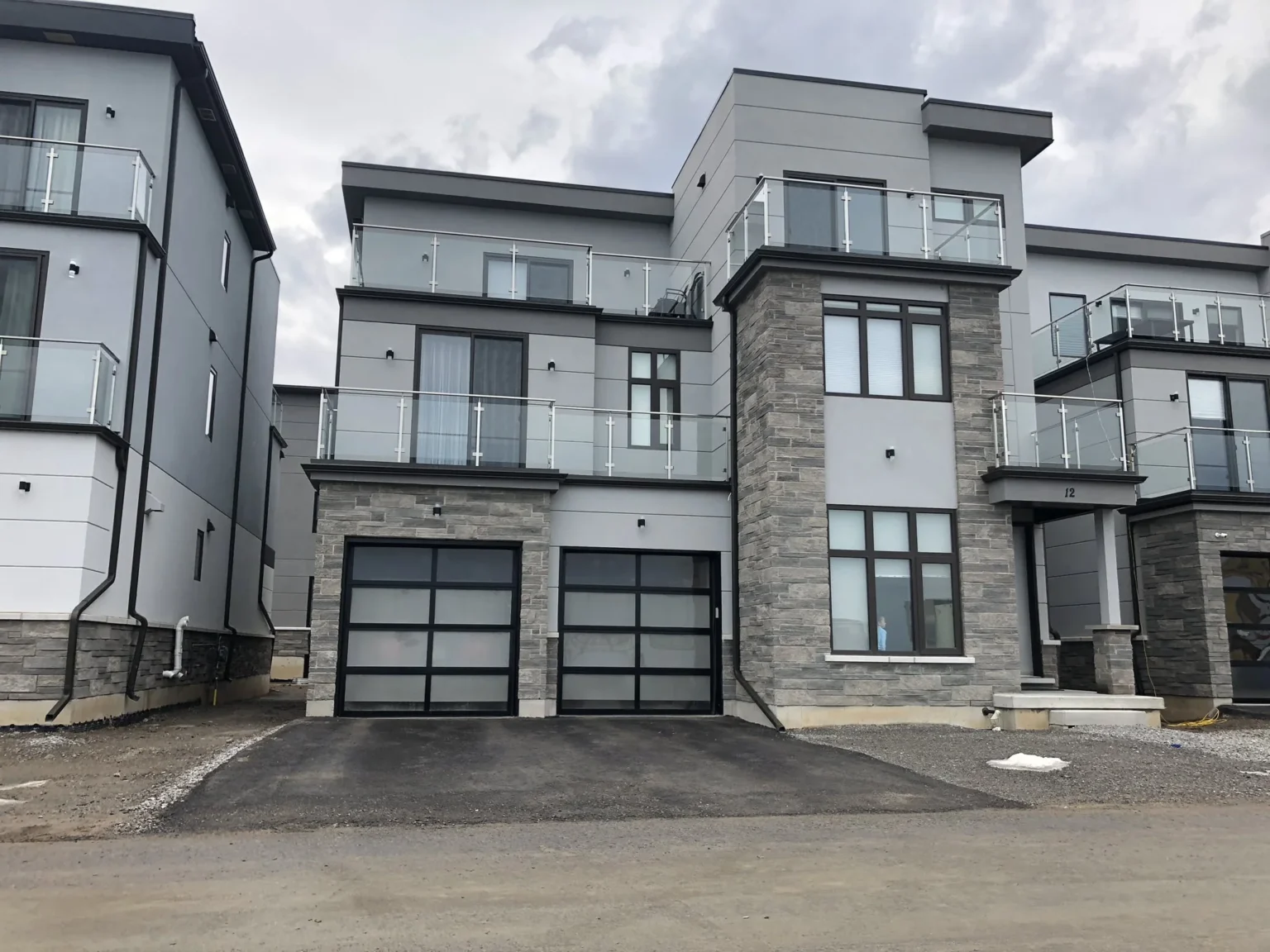
"There's a crack going right across the house, halfway up. Is the second floor coming off?" That's how the call usually starts. A horizontal crack in stucco at the floor line looks frightening because it is so straight and so long, sometimes the full width of a wall. On a stucco or EIFS house in the GTA it is a common crack, and one of the least dangerous for the structure.
I'm Musa Kastrati, and I've repaired stucco across Halton, Peel, Toronto and York region for 25+ years. The second floor is not coming off. But the crack still has to be read properly, because the same line can be finished moving or still on its way, and those two need different repairs at different prices.
Why does stucco crack at the floor line?
Because the floor frame behind that band of wall shrinks as it dries. The joists and plates at each floor lie flat, and wood shrinks far more across its grain than along it. So the upper storey drops a little onto the lower one, all in that one band. A rigid coat carried straight across it, with no joint, breaks along the line.
Think about how a GTA house is framed. The ground-floor walls go up, then a whole floor deck is laid across their tops, then the upstairs walls stand on that deck. In the band between the ground-floor window heads and the upstairs sills you have a stack of wood lying on its side: the top plates of the lower wall, the rim joist, the subfloor, the bottom plate of the upper wall. The studs above and below stand on end and barely change length. The flat pieces get thinner as they dry.
Cement stucco does not stretch at all. EIFS has a little more give in its finish, but not much. So the wall needs a planned line where it is allowed to move, and the floor line is the obvious place for one. When a house was finished with one continuous coat from the foundation to the soffit, the wall picks its own line, and it picks the floor band nearly every time.
Where to look on your own wall
Stand back across the street or at the end of the yard. You are looking for a line in the band marked below. On a bungalow with a finished upper half-storey it sits lower, just above the main-floor window heads.
The floor band: rim joist, plates and subfloor behind the coat
- Under the upstairs window sills. The top edge of the band. A crack right at the sill line can also be a sill problem, so check whether it runs past the windows.
- In the middle of the band. The classic shrinkage crack sits here and runs on past the windows, often from corner to corner.
- Over the ground-floor window and door heads. The bottom edge of the band. Short cracks that stop at a head belong to the opening, not to the floor.
A pair of binoculars helps more than a ladder. On the north wall, where the sun never dries the face, look after a rain: a crack holding water shows as a dark line for an hour or two after the rest of the wall has gone pale.
Four cracks that can look like it
Before anybody prices a repair, make sure the line really is the floor band. These four are the ones I see confused with it, and each one gets a different fix.
- A head-line crack at the openings
- Short pieces running from the top corners of windows and doors, level with the heads, stopping between openings. That's stress at the openings, covered in my guide to why stucco cracks at windows and doors.
- A stepped or tilted crack
- One that climbs or drops as it crosses the wall, or is wider at one end like a narrow V. That points at the foundation moving under one corner, and it needs a look at the foundation before the stucco.
- A lap line from the original job
- A faint straight seam where one day's coat met the next, often at scaffold height. It is in the finish only, it does not open over the years, and it is cosmetic.
- A grid of lines on EIFS
- Lines that run both ways in a regular pattern about the size of a foam board. That's the board joints showing through the base coat, a different problem from a single floor-band crack.
The floor-line crack is the one that stays level, runs past the openings, sits in the band between the storeys, and often appears on more than one side of the house at the same height. That last sign is the strongest one. Settlement does not draw the same level line on three walls.
Is a horizontal stucco crack at the floor line serious?
For the frame of the house, almost never. For water, it can be. A level crack has a lower lip, and rain running down the wall stops on it and soaks in instead of running past. In a GTA winter that water freezes inside the crack and pries it open a little more each cycle. Width tells you how urgent it is.
| What you see | What it usually means | When to act |
|---|
| A hairline you can see but cannot catch a fingernail in | The coat has cracked, but the line is tight | Mark it and recheck in spring; repair at your next stucco job |
| A crack a credit card slides into | Open enough for rain to get behind the coat | Seal it before winter, repair it in the next season |
| Wider than a card, or a dark or rust streak below it | Water has been getting in for a while; the lath or the sheathing may be wet | Have it opened and checked this season |
| Edges no longer flush: one side stands out from the other | The coat has let go on one side, or the wall is still moving | Call before anyone fills it |
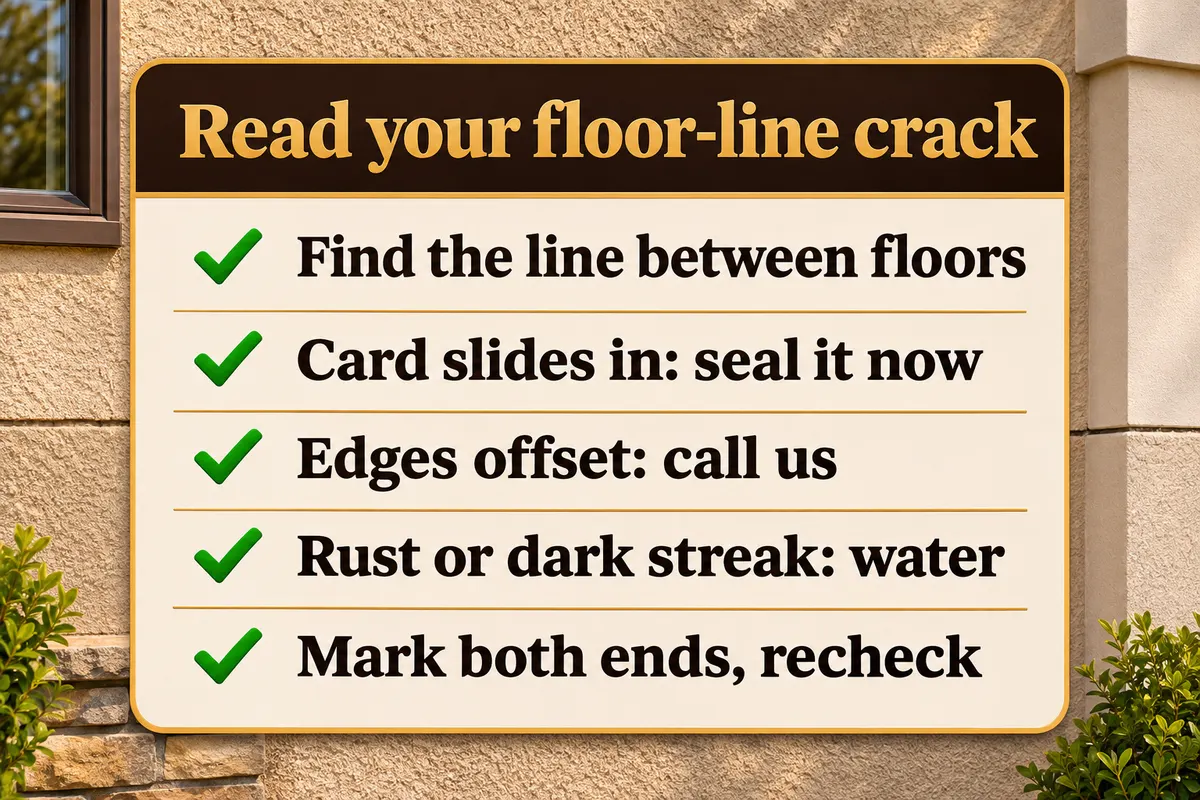
Mark both ends of the crack with a pencil and write the date beside each mark. Check them again after the first hard freeze and in April. A crack that has crept past its marks is still moving, and that answer decides the repair more than anything else on this page. If you want to know whether the wall behind a dark streak is actually wet, my post on how a stucco wall gets tested for moisture explains what the readings mean.
Fill the crack or cut in a joint?
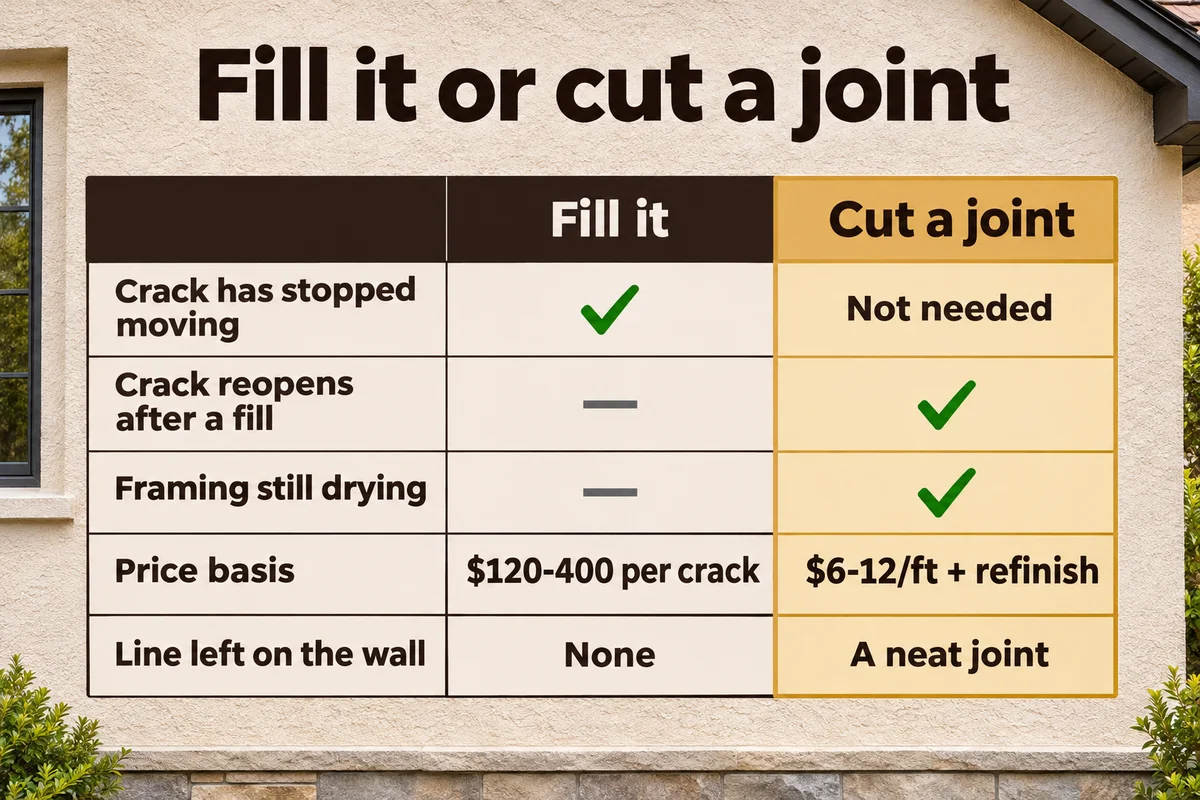
There are two honest repairs for this crack, and the one you need depends on whether the wood behind it has finished drying. Our stucco repair page names the second one for straight cracks along a floor level: cut in a proper control joint, re-mesh and refinish.
Route A: route, mesh and fill
The crack is opened into a clean groove, mesh is bedded across it in a base coat, and the finish is textured and tinted to match. On EIFS the same idea, with the base coat and mesh over the foam.
It's right on an older house where the pencil marks have not moved for a year. The wood finished drying long ago, the crack was a one-time event, and a meshed repair holds.
Route B: a joint along the floor line
A straight horizontal joint is cut along the band, the edges are reinforced, a backer goes in, and the joint is sealed with a flexible sealant. The finish either side is matched or the wall is refinished.
It's right on a house in its first years, or anywhere a filled crack has come back along the same line. The wall still needs somewhere to move, so you give it a straight line instead of a crooked one.
What does not work is the $99 patch-and-pray version: a bead of caulk smeared along the crack and a dab of touch-up paint. Caulk on a flat face bonds to the dusty edges for a season, then splits, and the line now shows twice, once as a crack and once as a grey stripe. The difference between a crack and a joint is explained in my article on what the straight lines on a stucco wall do.
A joint is a visible line. Done straight and level along the floor band it reads as a detail, the way a band or a reveal does, and it can be set to line up with the window sills above so it looks planned.
What does a floor-line crack repair cost?
On our list, a routed and meshed crack is $120 to $400 per crack. A joint cut along the floor line is priced from sealant at $6 to $12 per linear foot plus matching the finish either side. Where the patch would show on an older, faded wall, the elevation is refinished at $9 to $16 per sq ft.
| The work | Price on our list | Which repair uses it |
|---|
| Crack repair, routed and meshed | $120 to $400 per crack | Route A, on a crack that has stopped moving |
| Caulking and sealant, including control joints | $6 to $12 per linear ft | Route B, the sealed joint along the floor band |
| Patch and texture match | $450 to $1,200, up to about 20 sq ft | Route B, the finish either side of a short joint |
| Full elevation refinish | $9 to $16 per sq ft | Either route, when a repair would still show on a faded wall |
| Section rebuild after water damage | $18 to $34 per sq ft | Either route, only where the wall behind the crack is wet |
Three things move a floor-line job inside those ranges. Length is the first: a crack on one short side wall and a crack from corner to corner across the back of the house are different jobs. Height is the second, because the floor band is at second-storey height on most houses and needs a ladder setup or scaffold. The third is what we find when the crack is opened. Dry, sound lath and sheathing keep it a crack repair. Rust and soft wood make part of it a section rebuild, and nobody can honestly price that from the driveway. More on how crack prices are built is in my guide to stucco crack repair cost in the GTA.
Found it this week? Cement stucco needs temperatures above about 5 C to cure, so in late November the repair itself usually waits for spring. A crack that takes a card should still be sealed before the snow, so water does not sit on that lower lip all winter. My post on holding stucco damage until spring explains what a proper temporary seal looks like.
Getting your floor-line crack looked at
Send three photos through the contact page, or text them to (905) 973-6470: the whole wall from across the street, the crack close up with a coin or a card held against it, and any other wall where the same line shows. If you've marked the ends with dates, photograph those too. I call back usually within a day, and the written quote is free and fixed. In Halton, start with the stucco contractor page for Oakville.