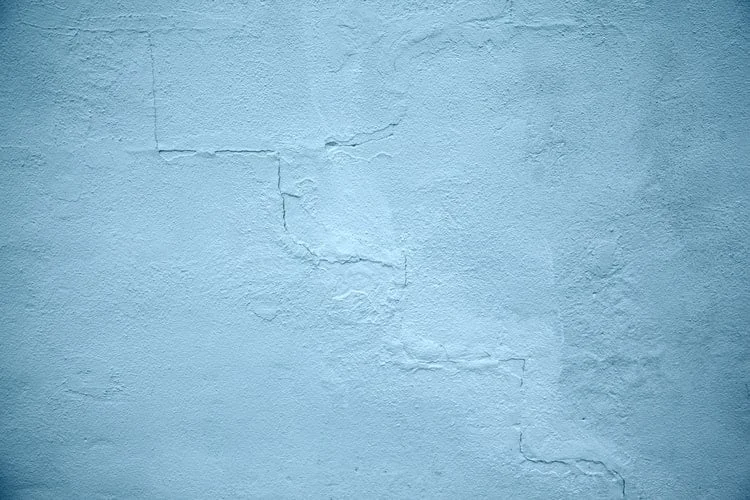
Walk around almost any stucco house in the GTA that is fifteen or twenty years old and the four walls will not match. One is greyish green, one has faded two shades lighter than the rest, one has most of the cracks, and the narrow wall facing the neighbour looks worst of all. That pattern is the house telling you something. Which side of a stucco house fails first depends on what the weather does to that side, and once you can read it, you know where to spend money and where a hose and a brush will do.
Which side of a stucco house fails first?
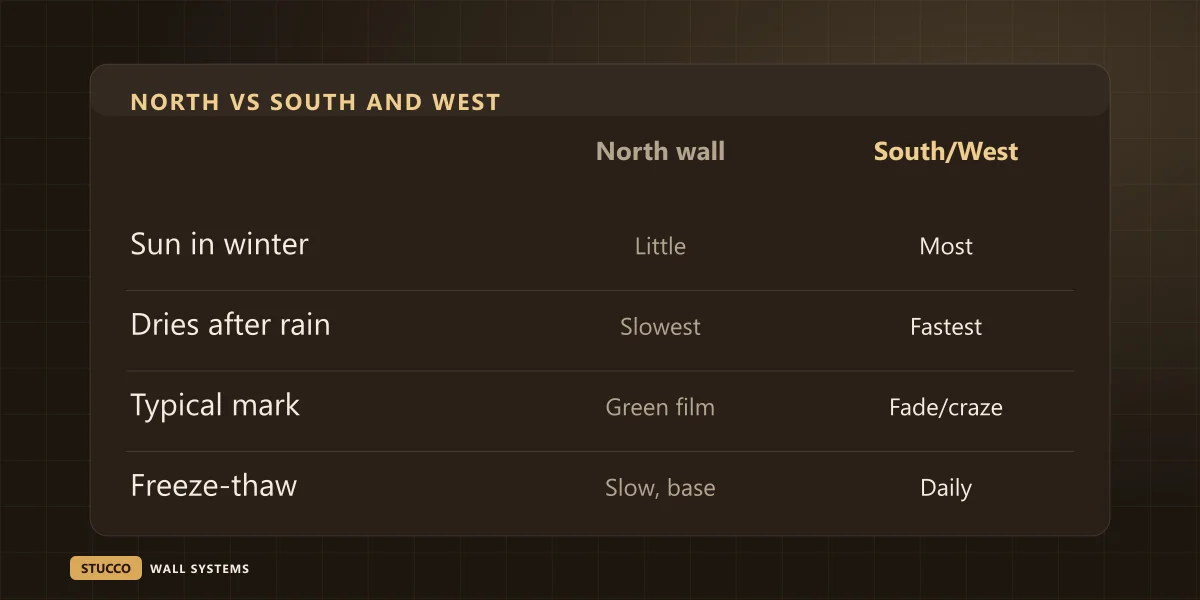
The wall that stays wet the longest fails first, and on most GTA houses that is the north wall or the narrow side yard that never sees sun. The south and west walls fail differently: they fade, craze and go through more freeze-thaw cycles, but they dry fast. The storm side leaks at its windows.
Stucco and EIFS do not mind getting wet. They mind staying wet, and they mind going from wet to frozen over and over again. Every side of your house gets its own mix of sun, wind, rain and shade, so every side wears out in its own way. These four cards are how I read a house when I walk it for a quote.
N
North wall: slow to dry
- What the weather does
- In winter it gets almost no direct sun. Dew, rain and melting snow sit on it for hours, sometimes days.
- What you see
- A grey-green film, dark streaks under the sills, a damp band along the bottom after the snow goes.
- What it means
- Growth on a sound wall is a cleaning job. Finish that is soft or flaking at the base is water, and that is a repair.
E
East wall: usually the quiet one
- What the weather does
- Morning sun dries the dew early, and the sun has moved round before the hottest part of the day.
- What you see
- Often the least marked wall on the house.
- What it means
- If the east wall is the bad one, the cause is local: a downspout, a sprinkler head, a deck, a roof valley dumping on it.
S
South wall: the most freeze-thaw
- What the weather does
- The low winter sun hits it square. On a February day the face can be above zero by noon and frozen again by supper.
- What you see
- Hairline crazing, paint that chalks or peels, colour fading faster than on the other walls.
- What it means
- Tight hairlines are a watch item. A crack that opens at a window corner, or that you can catch a fingernail in, is a repair.
W
West wall: heat and weather
- What the weather does
- It takes the afternoon sun at the hottest hour of a summer day. On an open lot it often catches the rain too, since most of our weather comes in from the west.
- What you see
- The most fading, blistered or peeling coatings, cracks at the upper corners, washed streaks under the sills.
- What it means
- Fade on its own is cosmetic. Cracks and stains around the windows on this side are where water gets in.
One thing rearranges all of this: the lake. On lakeshore streets in Port Credit, Bronte or along the Etobicoke waterfront, the wall facing the water takes wind and spray that a house ten blocks north never sees, whichever compass side that wall happens to be. Big trees and a tall house next door do the same thing on a smaller scale. A south wall under a mature maple behaves like a north wall.
The side nobody sees: the strip between your house and the next one
On a lot of detached houses in Erin Mills, Woodbridge or Richmond Hill, two houses stand four or five feet apart. That side wall gets no sun, almost no wind, and nobody looks at it from one year to the next. On many of the houses I quote it is the worst wall on the property, and the reasons repeat:
- The gas meter, the air conditioner and a downspout all live there, and the downspout often empties right against the wall.
- Gravel, patio stones or a raised walkway have been added over the years until the bottom edge of the stucco is buried.
- The neighbour's roof sheds into the same strip, so it gets two houses' worth of water.
- It sits in shade from both sides and dries even slower than an open north wall.
The bottom edge of the wall has to stay clear of the ground so water can drain out of it. I go through the measurements and a ten-minute check in the post on stucco clearance at grade, and the side yard is where that rule gets broken most often.
How do I find my own weather side?
Read it off the house, not off a compass. After a hard rain with wind, the wall that is darkest and stays wet the longest is your weather side. Clean streaks under the window sills, stained top corners and water marks on the inside sills point to the same wall. Trees, neighbours and the lake can make it any side.
| Clue on the house | What it tells you |
|---|
| Streaks washed clean below the sills, dirt everywhere else | Rain runs down this wall often and hard |
| Dark top corners right under the eaves | Wind is pushing rain up toward the soffit on this side |
| Water marks on the inside window sills of one side only | This is the storm side; check the joints around those windows outside |
| Green or grey film that comes back after a wash | A shaded wall that does not dry, not necessarily a rain side |
| One wall much lighter in colour than the others | The sun side, usually south or west |
| White crust along the base of one wall | Water is leaving the wall there; find out why before you scrub it off |
If you want to be sure, check the wind the next time a storm comes through. Environment Canada's past 24 hour conditions for Toronto Pearson list the wind direction and speed for every hour. Look up the storm, then go out and see which wall is wet. Two or three storms and you will know your house better than any rule of thumb can tell you.
A walk around the house, one wall at a time
Do this on a dry day in October or April, and go round in one direction so you do not skip a wall. Take your phone. A photo of each wall from the same spot every year shows you what changed far better than memory does.
Start on the north side
Look at the bottom two feet first. Press the stucco with your thumb along the base and under each window. Firm and gritty is fine. Soft, crumbly or hollow when you knock on it means water.
Then the east side
Usually the shortest stop. If something is wrong here, look up and around for the cause: a downspout, a sprinkler head, a deck, a roof valley that dumps on the wall.
Then the south side
Look at the cracks early or late in the day, when the light runs across the wall and shows them best. Sort them into hairlines in the finish and cracks that have opened, especially at window and door corners.
Then the west side
Check the window corners and the top of the wall under the soffit. Rub a hand over the finish: chalk on your palm means the coating is wearing out.
Finish in the side yard
Look at the ground line. If stone, soil or mulch is touching the bottom of the stucco, that is the first thing to fix, and it costs you a shovel and an afternoon.
Which wall should I fix first?
The one with water behind the finish, whatever side it is on. Soft, hollow or bulging stucco gets money before anything cosmetic. Open cracks around windows on the storm side come next, then the side-yard base. A faded west wall or a green north wall can wait for a wash or a refinish when the budget allows.
| What you found | Fix it first? | What it usually costs |
|---|
| Soft, hollow or bulging section on any wall | Yes, this comes first | $18-34 per sq ft to rebuild the damaged area back to the substrate |
| Open cracks at window corners on the storm side | Next | $120-400 per crack, routed and meshed |
| Stone, soil or mulch against the base in the side yard | Next, and you can do it yourself | Free to clear; a repair only if the base is already soft |
| Hairline crazing on the south or west wall | Watch it, recheck every spring | Nothing yet; $120-400 per crack if one opens up |
| Green film on a sound north wall | No repair needed | A gentle wash |
| One wall faded or chalky, no cracks | When the budget allows | Refinishing one elevation runs $9-16 per sq ft |
Most of the repairs I do land between $450 and $2,500, and a lot of that range is one wall, not the whole house. Doing the bad side now and the rest later is a reasonable plan, as long as you know a refinished wall will look fresher than its neighbours for a few years. Our stucco repair page lists what each kind of job costs and how long it keeps a crew on site.
The $99 patch-and-pray crowd will happily touch up the faded wall you can see from the street and leave the soft one in the side yard alone, because nobody walks back there to check. A crew that paints a green north wall without washing it first has just painted over a lawn. For that north wall, the washing is in how to clean stucco and the growth itself in the post on mould and mildew on stucco. For a faded west wall, read the rules for painting stucco before anyone rolls a coat on it, because the wrong coating on the sunniest wall of the house is the first one to peel.

Does the sunny side matter on the day the stucco goes on?
Yes. Fresh stucco wants to cure slowly and evenly. On a hot July afternoon the west wall can dry too fast and craze, so a careful crew works that side in the morning and keeps it damp. In late October the north wall cures slowest of all. The same house gets a different plan for each side.
That is a big part of why the time of year matters, which I cover in the best time of year for stucco work. If you are collecting quotes for a full re-stucco of your house, ask each crew how they handle the sunny walls in summer. One that has thought about it answers in a sentence. One that has not starts talking about the weather forecast.
If one wall of your house looks worse than the rest and you cannot tell whether it is a wash, a crack or water, send a few photos through the contact page or call (905) 973-6470. I usually call back within a day, and the quote is fixed, written and free.