Bulging stucco is a piece of the wall that has let go of whatever it was fastened or stuck to. That much is true of every bulge. What it let go of, and why, has five different answers on the houses I look at around the GTA, and they do not cost the same or wait the same. Nearly every page on the subject gives you one answer, water, and tells you to call somebody. Water is the commonest cause. You can often rule it in or out yourself in ten minutes, standing on the lawn. This guide sorts a bulge by where it sits and how it answers a knock and a push, says which ones cannot wait for spring, and puts our repair prices beside each.
What does a bulge in stucco mean?
It means a section of the coat is no longer held tight to the wall. Either what is behind it has swollen and pushed it out, or the fasteners, the grip between coats or the adhesive has given up and the weight is pulling it away. A bulge never goes flat again without a repair.
Flat stucco is held three ways at once. Metal lath is nailed or stapled to the framing. The first coat is pushed through that lath until it wraps the wire. Each later coat grips the roughened face of the one under it. On a foam wall the board is glued or pinned to the sheathing and a thin skin is trowelled onto the foam. A bulge is one of those holds failing, and the place it fails tells you which one.
Which kind of bulge is on my wall?
Sort it by three things: where on the wall it sits, what it sounds like under your knuckles, and whether it gives under your thumb. A soft bulge under a window is a different job from a hard, hollow one in the middle of a wall, and a different price.
Swollen sheathing behind the coat
Under a window corner, below a roof line, beside a downspout, along the bottom edge.
Water got behind the stucco, and the plywood or OSB took it up and swelled. The bulge is often soft or spongy under a thumb. There is usually a stain, a crack or a rust streak close by. This is the one the other pages mean.
Lath fasteners letting go
Mid-wall, often high on an elevation, often on an older house.
The coat is hard and in one piece, and the whole sheet has moved off the framing because nails or staples have rusted through or pulled out. It sounds hollow over a wide area. Push gently and it may shift like a loose panel.
A coat that never gripped the one under it
Anywhere. Common in an old patch, or on a wall finished late in the year.
The lath and first coat are still tight and an outer coat has lifted off them. The bulge is shallow and rings like a dinner plate when you knock. Its edge is often a crack that follows the outline.
Foam or skin lifting on an EIFS wall
Any height on an acrylic-on-foam wall, and low down where it gets bumped.
A foam board has come off the wall and leans out, or the thin acrylic skin has blistered off the foam. EIFS sounds hollow everywhere, so the knock tells you little. Sight along the wall for a hump with straight edges the size of a board.
A blister in the paint
On a painted wall, on the side that stays damp or the side that bakes.
The stucco is flat and hard, and a film of paint has ballooned off it, sometimes with water inside. Press it and it dimples like a bubble in wallpaper. Moisture is pushing out through a coating that cannot breathe.

The stains, soft spots and smells that travel with the first card have their own guide, six signs water is behind your stucco. If you cannot tell whether a hard bulge is wet behind, moisture testing answers that without opening the wall. The paint blister belongs with the rules in painting stucco.
What holds stucco on the wall?
Fasteners and grip. On a framed Ontario wall the lath is nailed or stapled to the framing at a spacing the Building Code sets, and the plaster hangs on that metal. Lose the fasteners to rust and the plaster is still in one piece, with nothing holding it to the house.
Section 9.28 of Ontario's Building Code, O. Reg. 332/12 gives the rule in one line:
"Fasteners for stucco lath or reinforcing shall be corrosion-resistant and of a material other than aluminum."
Ontario Building Code, Article 9.28.3.1
The same section wants each nail or staple to reach 25 mm into the framing, and not fewer than 20 fasteners in every square metre of wall. Put that beside the weight. Three-coat stucco at the thickness I build to weighs about ten pounds per square foot. A square metre is a little under eleven square feet, so roughly 108 pounds of plaster hangs on those 20 fasteners. That is about 5.4 pounds each.
A galvanized nail in dry wood carries that for decades. In wet wood it rusts, and then the arithmetic turns against the wall. When a few fasteners have rusted through, the load they carried moves to the ones beside them, which sit in the same wet wood. So a fastener bulge grows. The hollow area you can cover with a hand this fall is wider next fall.
The Code explains the third card too. The first coat has to be scored so the second has a key. The wall has to be kept above freezing, and the plaster at 10°C or warmer during the work and for 48 hours after. A coat that went on in a cold snap with no heat can look fine in November and come off in sheets after its first winter. That is why I am strict about when in the year stucco work gets done.
How urgent is bulging stucco?
That depends on which kind it is and what is underneath it. A soft bulge with water behind it, or any loose section above a door, a walkway or a driveway, should be looked at this week. A hard, dry, shallow one that is not growing can wait for a booked repair, as long as you measure it.
- This weekAny bulge above where people walk or park. A soft or spongy one. One with a fresh stain under it, or water coming out of a crack at its edge. Keep people and cars out from under it until someone has put a hand on it.
- Before freeze-upA bulge with an open crack around it, even if it is dry today. Water that gets into that pocket in November freezes in January and levers the coat further off. Get it cut out, or at least sealed and covered, while the days are still above freezing.
- This seasonA hard, hollow area with no crack and no stain. It is not letting water in yet. Book the repair in the normal queue and check it once a month.
- Watch and measureA paint blister, or a shallow hump that sounds solid. Pencil a line around the edge, write the date beside it, and take a photo with a tape in the frame. If the line is still the edge in spring, it is not moving.
The pencil line is worth the minute it takes. I cannot price "it looks bigger" from a photo. I can price a dated line that the bulge has crossed.
Can a bulge be pushed back or patched over?
No. The coat has stretched and cracked, and crumbs have fallen in behind it, so it will not sit flat again. A screw driven through it adds a hole and very little hold. New finish skimmed over a loose section hides it for a season and adds weight to the part that is already coming off.
The repair runs in the same order for all three cement kinds. The $99 patch-and-pray crew starts at step four.
- Sound the wall outward from the bulge and mark where hollow turns to solid. The cut goes in solid stucco, a hand's width past the mark.
- Cut the section out and look at what is behind it before anyone mixes anything. Wet or soft sheathing, rusted lath and torn paper are replaced back to dry, sound material.
- Find where the water came in and fix that. It is usually above the bulge: a window corner, a roof line with no kick-out, a split in the sealant.
- Put in new paper, lapped under the old at the top and over it at the bottom, tie new lath into the old, and build the coats back to the depth of the wall around the hole.
- End the new finish at a corner, a joint or a band where the wall allows it. A patch in the middle of a wall shows, for the reasons in stucco patch matching.
On an EIFS wall the loose board or skin comes off, the wall behind it is checked for water, and new foam, mesh and base coat are lapped onto the old. A paint blister is scraped off and the wall is left to dry. The coating is chosen after that, because the same paint will blister the same way.
What does it cost to fix bulging stucco in the GTA?
On our published prices, a single dry bulge of a few square feet usually lands in the $450–$1,200 band for a typical repair area. A section rebuild is $18–$34 per square foot. Once water has reached the sheathing or the framing, the job is $1,500–$5,000 or more.
| What is behind the bulge | What the repair involves | Our price band |
|---|
| Paint blister on sound stucco | Scrape, dry out, recoat with a breathable coating | Quoted on site as exterior painting |
| Outer coat lifted, base and lath tight | Cut back to bonded edges, new finish coat blended in | $450–$1,200 for a typical area |
| Lath loose, sheathing dry | Section cut out and rebuilt on new paper and lath | $18–$34 per sq ft |
| Sheathing or framing wet | Rebuild, carpentry, and the leak fixed at its source | $1,500–$5,000+ |
| Hollow across most of one elevation | That wall re-clad as new residential stucco | $8–$16 per sq ft installed |
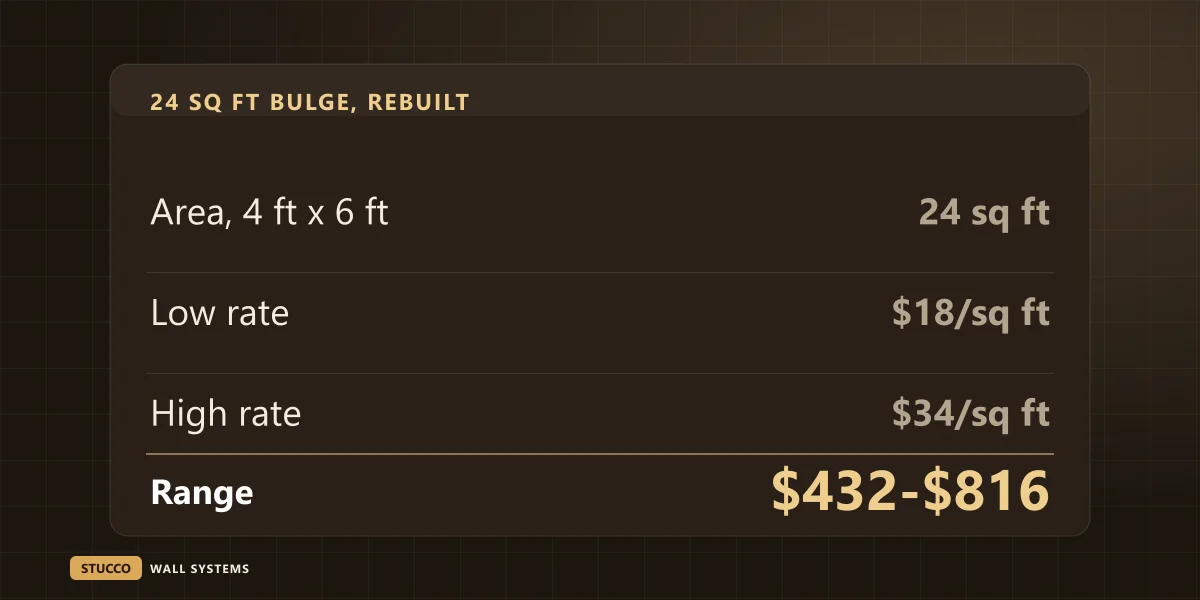
Take a bulge four feet wide and six feet tall with the lath loose behind it. I am using that size only to show the arithmetic. It is 24 square feet, and at $18–$34 that comes to $432–$816. In practice it sits at the low end of the $450–$1,200 band, because a crew, a mixer and a texture match cost a minimum however small the hole is.
What moves the price is what is behind the cut, and nobody can see that from the driveway. A quote for a bulge written from a car window is a guess with a signature on it. If more hollow areas turn up as the wall is sounded, the choice changes from a repair to a bigger job, and I work through that in stucco over existing stucco and in what a stucco removal uncovers.
What if the wall has always had a hump there?
Then it may not be a bulge. No framed wall is perfectly flat. A hump that sounds solid when you knock, has no crack around it and has not changed since you bought the house is usually a stud that bows outward or a thick spot in the base coat. It needs no repair.
Look at it when the sun is low and the light runs along the wall, because every wave throws a shadow then. Knock on it. If it is solid, pencil the edge anyway and look once a year. The thickness of the coat varies across any wall, and on a hand-trowelled wall from the 1940s some waviness is original.
If you have a bulge and want a straight answer, do the four checks, pencil the edge and send photos: one from across the yard that shows the whole wall, one close with a tape across the bulge, and one of whatever is directly above it. Tell me whether it is hard or soft and which way the wall faces. Our stucco repair crew works across the GTA, from Toronto to Mississauga. Sometimes the answer is that the wall needs nothing.