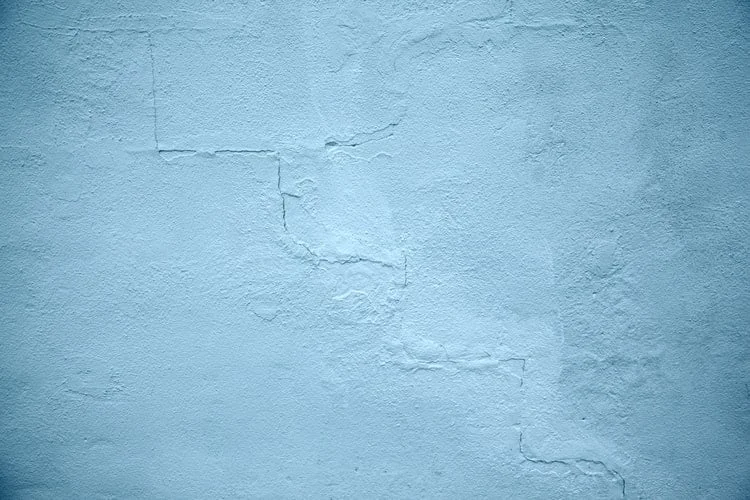
Should you seal stucco? On most of the houses I look at, no. A clear sealer is made for one kind of wall: cement stucco that has never been painted, has no open cracks and is dry on the day. That is a small share of the stucco in the GTA. Most cement stucco here has paint on it, most newer walls have an acrylic finish, and neither of those takes a clear sealer. I get the question every October, usually from someone holding a painter's quote with "seal stucco before winter" on one line and no product name beside it. I have been on the tools for 25+ years. Stucco walls fail where water gets in behind them, and a coating that goes over that spot only covers it up.
What is a clear stucco sealer?
It is a water repellent: a thin liquid, sprayed or rolled on, that soaks into the surface of cement stucco and dries clear. Rain stops soaking into the face of the wall, and the wall can still dry outward. It leaves no film and adds no colour. It does not fill a crack or glue a loose patch back on.
The word "sealer" means three different products on the quotes people send me. One is caulking around windows and doors. One is paint, often elastomeric paint, which is a coloured film. The third is the clear repellent, and that is the only one this post is about. Ask which of the three the line on your quote means before you compare prices.
So that I was not writing from memory, I opened one stucco manufacturer's page for its own repellent on October 13, 2026: Sika's product page for SikaWall-4905 Protect. I am not telling you to buy that one. It is a fair example of what these sheets ask for, and this is how it describes the job the liquid does:
"penetrates into the pore structure beneath the surface to form a water resistant layer"
Sika, SikaWall-4905 Protect product page
The same page says the treated wall can still breathe and dry out through its surface. That matters more than the repelling. A stucco wall has to let moisture out, and I explain why in the rules for painting stucco. Any clear product that cannot say this on its sheet stays off my walls.
Which stucco walls should be sealed, and which should not?
Only bare cement stucco in sound condition is a candidate, and even there it is optional. Painted stucco already has its coating, and the product is made for unpainted surfaces. An acrylic finish sheds water without help. A wall with cracks, stains or hollow spots needs repair, and new stucco needs its 28 days of cure first.
| The wall | Clear sealer? | What I would do |
|---|
| Cement stucco, never painted, no cracks | Optional | Run the hose test further down. If the wall goes dark fast and stays dark, a repellent is a reasonable buy |
| Painted cement stucco | No | The paint is the coating. When it turns chalky, repaint with a breathable acrylic |
| Acrylic finish or EIFS | No | The finish coat is acrylic already and the colour runs through it. Wash it gently and leave it |
| Any wall with cracks, stains, soft or hollow spots | Not yet | Book a stucco repair first. A sealer over a leak hides it for a season |
| Cement stucco or a patch under 28 days old | Not yet | Let it cure. A patch counts as new stucco |
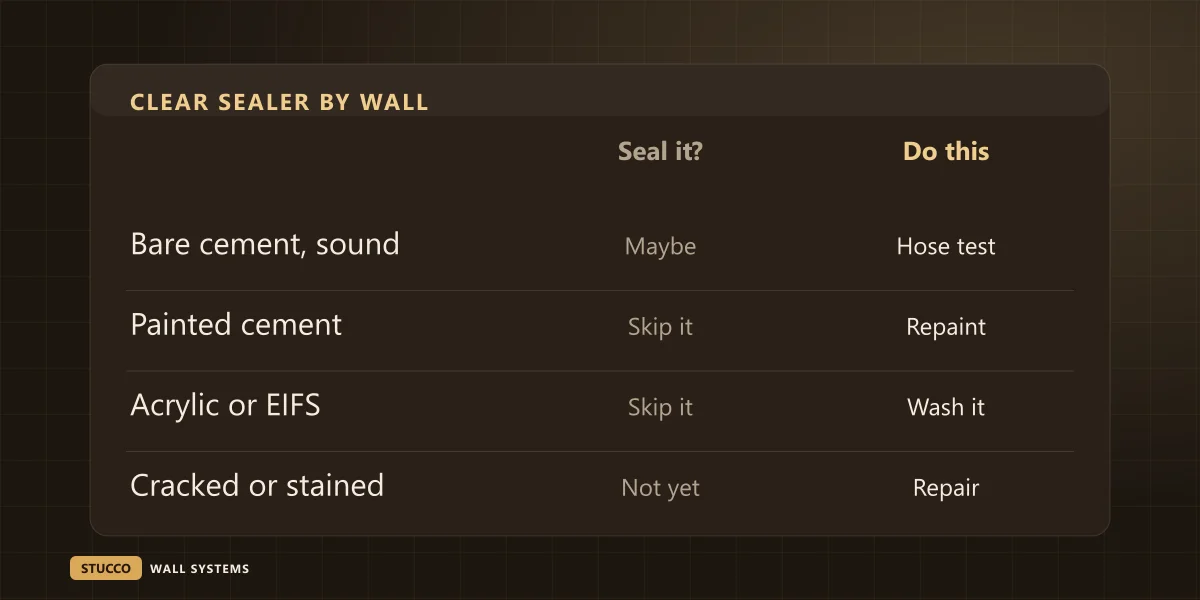
Count the walls in that table on your own street. In Bronte and Erin Mills most of the stucco I see is either painted cement from the eighties and nineties or acrylic from the last twenty years. The bare cement wall with the colour mixed into the finish coat does exist, mostly on older houses and on garden walls, and it is the only row where the product has anything to soak into. If you don't know what your finish is, a close photo is usually enough for me to tell.
What does the data sheet ask for before a sealer goes on?
Five things on the page I read: a surface that is sound, clean, dry and unpainted, at least 28 days of cure, no frost or ice in the wall, a set amount of product per square foot, and two hours between coats. Each line rules out a house I have been asked about.
Surfaces should be sound, clean, dry, unpainted, and free of any residue
Sound means the cracks and loose areas are repaired before anyone opens a pail. Unpainted takes out most cement stucco in the GTA. Clean means washed, and washing puts water into the wall, so the wash and the sealer happen on different days.
New concrete and masonry must be clean and cured a minimum of 28 days.
It is the same number I give for paint on new cement stucco. If I patched your wall last week, the sealer waits a month, and so does the painter.
Do not apply to substrates which are frozen or contain frost or ice.
On a November morning a north wall can still be white with frost when the crew arrives. A liquid that has to soak into the pores cannot do it when the pores hold ice.
Very porous surfaces: 75 to 125 sq. ft. per gallon
Rough, thirsty stucco drinks the most. The page lists 125 to 150 sq ft for moderately porous surfaces and 150 to 175 for dense ones. The gallons belong on your quote.
If two coats are required, allow a minimum of two hours of drying time before applying the second coat.
So a second coat is a second pass on the same day, and both passes should be written down.
Two things that page does not say. It gives no number of years the treatment lasts, and it does not say whether paint will bond to the wall afterwards. Put both questions to whoever is quoting and ask for the answer in writing from the product's maker. If you expect to paint the house in the next few years, I would skip the repellent and keep the money for the paint. I can't promise you paint will hold on a treated wall, and the sheet doesn't promise it either.
How do you test whether your stucco soaks up water?
Wet a patch with a garden hose on a gentle spray and watch it. Bare cement stucco that turns dark at once and is still dark long after the wall beside it has dried is taking in water. A wall where the water beads and runs off already has paint or acrylic on it, and the question is closed.
- Wait for a dry day after a couple of dry days. Pick a patch at chest height on the side of the house that takes the most rain.
- Spray it for about half a minute with the nozzle on shower. Leave the pressure washer in the garage, because it drives water into the wall.
- Watch the colour. Then wet a second patch under the roof overhang, where the wall is sheltered, so you have something to compare with.
- Come back in an hour and look at both.
If the whole patch went dark evenly and dried about as fast as the sheltered one, the wall is doing what cement stucco was built to do and I would leave it alone. If it is still blotchy and dark when the sheltered patch is dry, the face is holding water, and a repellent would cut that down. The same Sika page lists a reduced "wet look" after rain among the product's effects. If the dark shape follows a crack or sits under a window corner, the porosity of the wall has nothing to do with it. Water is running in at that spot, and the signs of water behind stucco are the next thing to read.
How much sealer does a house take?
On the sheet I read, one gallon covers 75 to 175 sq ft depending on how porous the wall is. A house with 1,600 sq ft of stucco takes 9 to 21 gallons for a single coat. If a quote for the whole house shows two or three gallons, the wall is getting a mist.
| Wall surface | Coverage on the sheet | Gallons for one coat on 1,600 sq ft |
|---|
| Very porous | 75 to 125 sq ft per gallon | 13 to 21 |
| Moderately porous | 125 to 150 sq ft per gallon | 11 to 13 |
| Dense | 150 to 175 sq ft per gallon | 9 to 11 |
The $99 patch-and-pray crews love a clear product, because nobody can see how much of it went on. Three lines on the quote fix that: the product name, the gallons and the number of coats. To check the gallons you need your wall area, and how stucco square footage is measured shows the arithmetic. I am not putting a price here because the site lists none for this work, and a number from me would be a guess. For scale, a repair on a wall that water has been getting into runs from a few hundred dollars to $5,000 and more. That is the bill a sealer is supposed to prevent, and on the wrong wall it only delays it.
What will a sealer not fix?
A leak. The water that damages a stucco wall rarely soaks through the face of it. It gets in at a crack, at a window corner, where a flashing is missing or where the wall sits too close to the ground. A clear liquid as thin as water closes none of those.
- A crack stays a crack. It gets repaired and matched first, and crack repair costs in the GTA are laid out by type.
- The joint around a window or a door is caulking and flashing work. Flashing explained for homeowners shows what should be there.
- White stains are salts that water carried out of the wall. Find the water before you coat anything, starting with white stains on stucco.
- A roof edge that pours onto the wall needs a kickout flashing, covered in where the roof meets a stucco wall.
- The bottom edge of the wall is where water that got in drains out. Nobody should caulk it shut while they are sealing the house.
The last one is the mistake that costs the most, because it turns a wall that could drain into one that holds water. The gap at the bottom is covered in stucco clearance at grade.
Is fall the right time to seal stucco in Ontario?
Early fall works if the wall is dry and any repair is a month old. By late October it gets tight. The sheet rules out frost or ice in the wall, a washed wall needs dry days before it can be treated, and a fresh patch needs 28 days. If the repair happens now, the sealer is a spring job.

Before winter the order of work matters more than the product. Cracks and failed caulking first, because freeze and thaw open up whatever water can reach. Eavestroughs and downspouts next. A clear repellent comes last, on the one kind of wall that takes it, and it loses nothing by waiting for April.
If you have a quote with a sealing line on it and you are not sure your wall is the right kind, send me the address and two close photos, one of the finish and one of the worst-looking spot. If it turns out the wall needs paint and not a sealer, that work is on our exterior painting page. We cover Oakville and the rest of the GTA, and new cement and acrylic finishes are part of our residential stucco work.