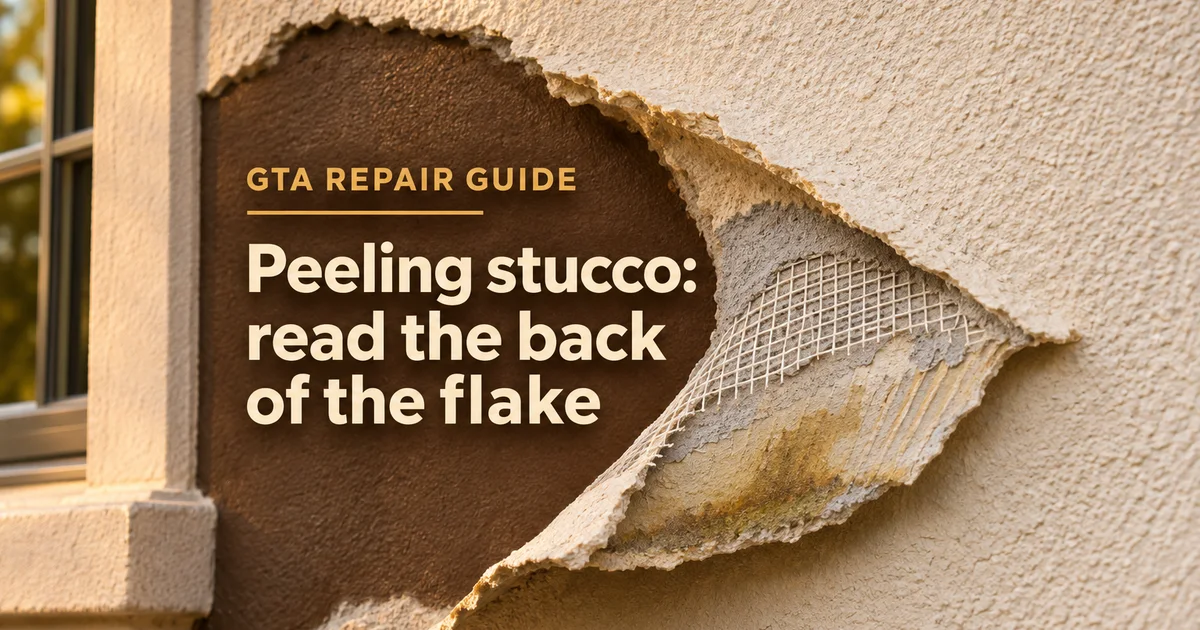
Peeling stucco is one word for at least four different failures, and they don't land on the same line of a quote. A skin of paint at the bottom of your wall may be a coating job. A gritty chunk with wire marks on its back is a repair that starts with opening the wall.
You can usually tell which one you've got before anybody visits. Go look on the ground under the bad spot, because the wall has probably dropped a sample for you. After 25+ years on GTA walls, the back of that piece is the first thing I look at, and it often tells me more than the front of the house does.
Why is my stucco peeling?
A wall is built in layers, and peeling means one layer has lost its grip on the one below it. Paint can leave the finish coat, the finish coat can leave the base, or the whole coat can leave the lath. Water is the most common reason, but a rushed paint job and a bad old patch do it too.
Cement stucco on an Ontario house is laid up in a first coat over wire lath, a second coat and a finish coat, and I measure those out in how thick stucco should be. A foam wall has a thinner build: a base coat with fibreglass mesh in it, then an acrylic finish. Paint, if there is any, sits on top. The place where the layers came apart tells you what failed.
Before anybody scrapes: how old is the house?
Scraping is the first thing most people do, and it's the wrong first step on an older painted wall. Health Canada says a home built before 1960 probably contains lead-based paint, and on one built between 1960 and 1990 the exterior may contain it.
So don't sand it and don't use a heat gun. Health Canada's lead paint page warns that both create toxic dust and fumes, and it wants children and pregnant women kept away from the work. A lab can test paint chips you mail in. Wear gloves when you pick up a fallen piece, and keep it in a sealed bag.
How do you tell peeling paint from peeling stucco?
Look at the back and the edge of a piece that has already fallen. Paint is about as thin as a fingernail, has a smooth or dusty back and flexes before it tears. Stucco is 3 mm or thicker, gritty like fine sandpaper, coloured right through, and it snaps when you bend it.
- Pick a dry day and find a piece on the ground below the bad spot. Don't pull one off the wall.
- Lay it face down on a sheet of dark paper and take a photo of its back.
- Look at its broken edge. Old houses can carry many coats of paint, so a thick piece can still be paint. Coloured layers stacked like a cake mean paint, and one colour right through means stucco.
- Bend it gently with your gloves on, then note whether it flexes or snaps.
- Stand back from the wall and photograph the bare spot it came from. What's left there is the other half of your answer.
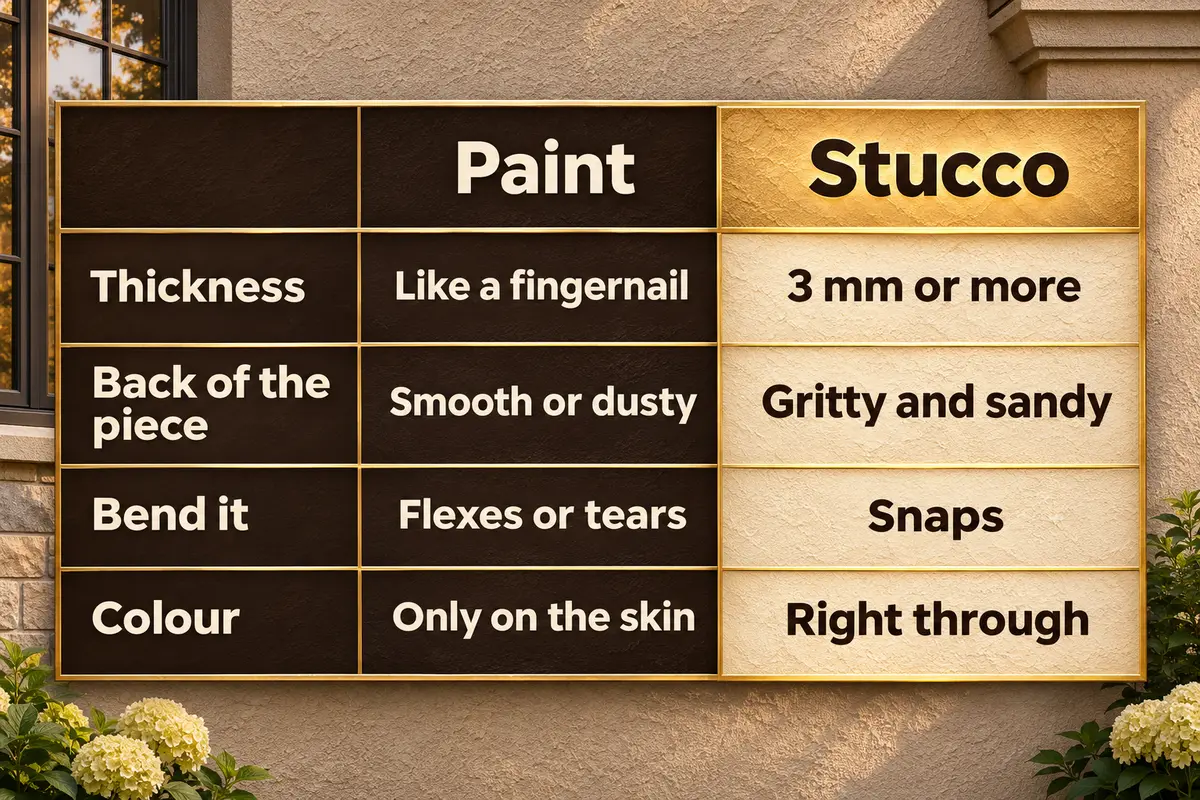
Match your two photos to one of these four. If you've got two kinds on one wall, go by the worse one.
Paint on its own
- Back of the flake
- Smooth, thin, sometimes printed with the bumps of the texture underneath.
- Left on the wall
- The stucco texture, still hard and whole, often in an older colour.
- What it points to
- Paint that never got a good grip, or damp pushing it off. I go through the usual causes in my rules for painting stucco, including the 28 days fresh cement needs first.
Paint with white powder behind it
- Back of the flake
- Dusted white, and the dust wipes off on your glove.
- Left on the wall
- A white crust or a soft, chalky surface that marks your finger.
- What it points to
- Water moving through the wall and leaving salts behind as it dries. Plastering contractor Ron Webber explains in the Journal of Light Construction how those salts weaken the stucco and spoil the grip of a top coat. My post on white stains on stucco helps you trace them.
The finish coat
- Back of the flake
- Gritty and coloured right through, with any paint only on the front.
- Left on the wall
- A flatter grey base coat. On a foam wall you may see the pattern of the mesh.
- What it points to
- A coat that lost its bond with the one under it, from a poor application, frost or water. It often follows the edge of an old patch.
Down to the lath or the foam
- Back of the flake
- Thick and heavy, sometimes with wire marks or rust on it.
- Left on the wall
- Building paper, wire lath, or white or grey foam.
- What it points to
- The wall is open, so don't wait on this one. Check the rest of that area with your knuckles, and read about bulging stucco if the area around it sounds hollow.
Where it starts on the wall tells you what's feeding it
Your flake names the layer. The location tells you what has to be fixed before any new coat goes on. Skip that step and you'll be reading another flake in two winters.
Can you paint over peeling stucco?
No. New paint only holds as well as whatever is under it, and what's under it has already let go. The loose material has to come off, the water source gets fixed, the wall dries and any repair cures. Only then does a coating go on, or it peels again.
That order is where the $99 patch-and-pray crew loses interest. A fresh coat over a damp wall looks terrific on the day the invoice gets paid. It also holds the water in, so the next flake to come off is bigger, and it brings the new paint along with it. On our exterior painting jobs, a painted wall gets a small test area first to show whether the old coating still has its bond, and the moisture gets checked before any colour goes on.
How much does it cost to fix peeling stucco?
Paint alone on sound stucco is priced after measuring. A small patch with a texture match runs $450 to $1,200 for up to about 20 sq ft, a full wall refinish $9 to $16 per sq ft, and a section rebuilt back to the sheathing $18 to $34 per sq ft.
These lines come from our stucco repair price list. Your written quote is fixed and free, so you'll have the real number once the wall has been seen.
| What your flake showed | Usual repair | Price line |
|---|
| Paint on its own | Loose paint off, wall checked for damp, new coating | Priced after we measure; repairs before colour usually run $450 to $2,500 |
| Paint with white powder | Water source fixed, salts cleaned off, wall dried, then a coating | Depends on the source; sealant renewal is $6 to $12 per linear ft |
| The finish coat | Patch and texture match, or a new base and finish across the wall | $450 to $1,200 for a patch; $9 to $16 per sq ft for a wall |
| Down to wire lath | Section opened to the sheathing, dried and rebuilt | $18 to $34 per sq ft |
| Down to foam | Foam wall repair | Priced after a look, see our EIFS repair page |
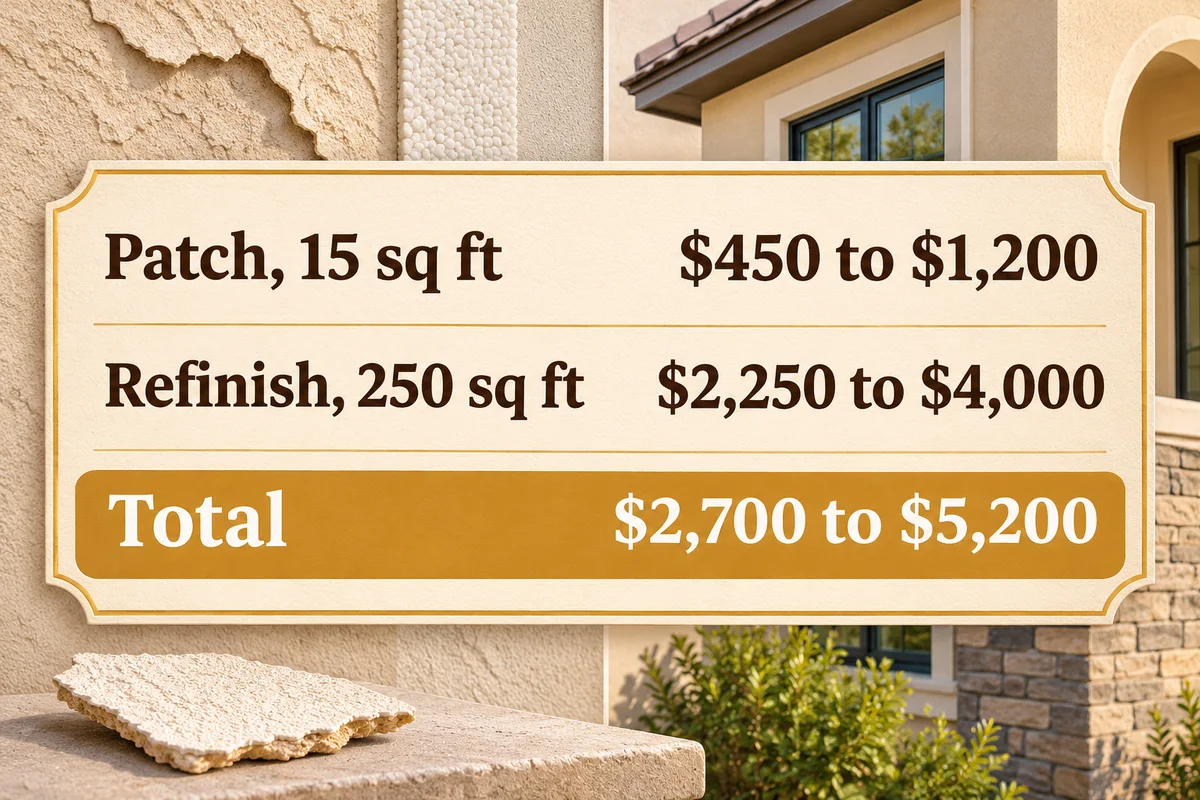
Now one wall, using sizes I picked as an example. Say the finish coat has come off over 15 sq ft of a 250 sq ft side wall. The patch is $450 to $1,200. If the old colour has faded and the patch would stand out, a refinish across the wall adds $2,250 to $4,000. So that wall lands somewhere from $2,700 to $5,200, and the patch line alone may do the job on a side nobody looks at. Ask for both numbers, since that choice is yours to make.
Found it in November? Most of this waits for spring
Coatings and cement need warmth to cure, and the GTA's repair weather is closing now. Paint peeling off a sound wall can sit through the winter without much harm. Rake up what has fallen, keep the snow pile off that wall and get your quote while the crew's spring calendar is still open.
Open lath or foam is the exception, because it needs a cover right away. My post on holding stucco damage until spring shows how to hang one so it sheds water.
Send me your two photos, the back of the flake and the bare spot on the wall, through the contact page or by text to (905) 973-6470. Tell me the year the house was built and which wall it's on. I call back usually within a day, anywhere across Halton, Peel, Toronto and York region.